
The anthology identifies the serious deterioration of our defenses (at increasing expense), America’s mal-adjusted strategies to deal with both conventional and unconventional warfare threats of the 21st century, DOD’s archaic personnel policies and fighting force structures, and Pentagon management (and overseers in Congress) that make almost everything worse.This is the kind of stuff that generally gets me excited, because more content in the conversation is always a good thing. However, as I scrolled down to read the section regarding the US Navy, I was very disappointed who CDI had selected to write the US Navy section: William S. Lind. Incredible, CDI hired a guy to talk about reforming the US Navy even though he is on record in his "On War" series saying the US Navy is irrelevant.
Each chapter also articulates principles and/or specific recommendations to help the new president and willing members of Congress find a way out of the mess.
At first I thought maybe I have been influenced a bit too much by the writings of William F. Owen regarding William S. Lind's contribution to 4GW, and I should give William S. Lind the benefit of the doubt. Therefore, attempting to review the summery without prejudice, we move to the summery of Chapter 6 titled: The Navy, by William S. Lind.
America’s geography dictates that it must remain a maritime power, but today’s U.S. Navy remains structured to fight the aircraft carrier navy of Imperial Japan. Reform can only proceed from a fundamental understanding that people are most important, ideas come second, and hardware, including ships, is only third.I am completely in-line with William S. Lind regarding the summery paragraph provided for his section of reforming the US Navy, and by extension I agree with his first, fifth, and seventh recommendation in theory without needing to see the supporting content, because they are aligned in theory with my own theories of maritime strategy. One point though, I am not ready to dismiss the Littoral Combat Ship as a failure, yet.
Recommendations:
- The main personnel deficiency of the Navy is an officer corps dominated by technicians. That reinforces the Navy’s Second Generation institutional culture. Reform requires adopting a Third Generation culture and putting the engineers back in the engine room.
- Fourth Generation War demands the Navy shift its focus from Mahanian battles for sea control to controlling coastal and inland waters in places where the state is disintegrating.
- Submarines are today’s capital ships, and the U.S. Navy must remain a dominant submarine force while exploring alternative submarine designs.
- Aircraft carriers remain useful “big boxes.” However, they should be decoupled from standardized air wings and thought of as general purpose carriers, transporting whatever is useful in a specific crisis or conflict.
- The Navy should acquire an aircraft similar to the Air Force’s A-10 so it can begin to effectively support troops on the ground.
- Cruisers, destroyers and frigates are obsolescent as warship types and should be retired; their functions assumed by small carriers or converted merchant ships.
- The Navy should build a new flotilla of small warships suited to green and brown waters and deployable as self-sustaining “packages” in Fourth Generation conflicts. (The Navy’s current “Littoral Combat Ship” is an apparently failed attempt at this design.)
However, the other conclusions raise red flags with me, and if I was guessing, I would suggest the fatal mistake in the third, fourth, and sixth recommendation is driven almost entirely from the fatal flaw as implied by the second recommendation. This is a statement that clues me to what Mr. Lind is probably thinking:
Fourth Generation War demands the Navy shift its focus from Mahanian battles for sea control to controlling coastal and inland waters in places where the state is disintegrating.
 William S. Lind is on record in "On War #238" making his position regarding A. T. Mahan and Julian Corbett clear, and his observations in that piece are very interesting. The fatal flaw of Mr. Linds argument however is that there must be a choice, Mahan or Corbett, and he carries these either/or arguments into his positions for maritime strategy including blue water or green/brown water. By taking either/or positions for 4th generation war in the maritime domain, Mr. Lind's strategic view of the maritime domain appears flawed. The way ahead isn't Corbett strategy instead of Mahanian strategy, the way ahead is the synergy of both towards a joint battle space capability from the sea that addresses the operational requirements of the battle space regardless of maritime geography.
The suggestion to eliminate the battle line and description of the submarine raises questions with me. It is difficult to tell from these recommendations how William S. Lind shapes the maritime domain, but it does highlight that we need a new dictionary for 21st century discussions of the maritime domain. When suggesting "Submarines are today’s capital ships" it is unclear if William S. Lind is reading the debates we have had here on the blog, that submarines can relieve surface ships of some of their obligation to total fleet requirements or whether the submarine is a ship of the line.
Probably neither, but it still highlights a necessity for a new dictionary, because Capital Ships are usually associated in the tactical role of Sea Control, and there is some serious irony with a 4GW expert advocating submarines for Sea Control in the 21st century maritime domain. To exercise sea control in a contested battle space of the maritime domain, a Navy must be able to clearly identify enemy targets to take action against. The problem with submarines doing the sea control tactical role is that submarines do not have the option to surface, inspect the cargo of a ship, identify the destination of the ship, and otherwise exercise the intelligence requirement to identify friend or foe in the battle space without giving up the submarines stealth advantage. The intelligence gap argues against the submarine as the primary sea control capability for any Navy, just as it argues against an aircraft carrier using only strike fighters. This role, and specifically when part of a blockade requirement, has historically been done by surface combatants. It has always been that way, and probably always will be.
To control the battle space with a submarine, it must deny the maritime domain from enemy forces through fear, historically established through a "total war" approach of restricting access by ALL ships. Under what political circumstances is this realistic?
The irony is that by suggesting the use of submarines as Capital Ships for sea control, William S. Lind, a 4GW advocate, has essentially advocated a "total war" approach to controlling the 4GW maritime domain battle space of the 21st century, and he may not even realize it! There are numerous analogies, including the comparison of the submarine exercising control through fear as being akin to the tactical application most often utilized by terrorists in the battle space of population centers. Another analogy would be to exercise control of a population center with the B-2 bomber using fear of carpet bombing to exercise control.
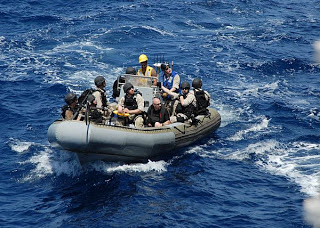
Sea control in the battle space of the 21st century has a requirement, and that requirement is the presence of manpower. This is a lesson directly applicable from the wars in Iraq and Afghanistan where manpower is a requirement for controlling the land. Submarines are in the same category of unmanned systems, they can either kill a target, or not. This is why I believe every smart 4GW conversation of the maritime domain should include a discussion of the boarding party, and emphasize the skills and capabilities required for it, just as we emphasize the skills of infantry in 4GW to clear population centers of enemy forces by searching houses and neighborhoods.
Submarines have become outstanding stealth platforms for delivering precision strike weapons from the sea, but is the precision destruction of known enemy conventional forces really the definition of sea control in the 4GW maritime domain? Guess we will have to wait and see what Mr. Lind has written, but the impression I get from the conclusions is that he has not put much intellectual rigor into his theories of the maritime domain. These recommendations suggest he just feels what the Navy is doing is wrong and has floated an alternative without the intellectual rigor necessary to be influential.
Based on these recommendations, I really look forward to this report, because I have that feeling in my gut I will disagree with a lot of it. If I do, I intend to come at it with 16" shells but in a way to use the report to generate 4GW discussions of the maritime domain. Unless I am missing something, there really isn't much content on the subject of 4GW theory of Seapower out there, meaning there is a noteworthy void.
Updated: I got sent a copy of Lind's chapter 6 this morning, and I stand by everything I wrote. Lind is smart, but the work is undeveloped. It is a 4GW centric recommendation but too many assumptions are made. He would have been good to sit down and really bash this out with some folks who think within a maritime domain context, but there is no evidence he did, because it repeats perceptions he has stated in the last and it reads like a letter of disrespect to the Navy as a whole. This paper is going to be great for starting conversations though, can't wait.
I also like that he talks about the mothership. I think he has been reading the blog, and could be frustrated with me that I'm not more supportive, but I must read Corbett AND Mahan different than he does.

No comments:
Post a Comment