
 One of my bugbears when writing about defense issues a decade ago was the state of aerial jamming capabilities fielded by the U.S. Military. This was around the time that the EF-111 Ravens were being retired, and (at the time) I was fond of telling colleagues that the surest proof there was a problem was that that Air Force had decided officially to rely on a Navy platform (the EA-6B) for its jamming capabilities until the EA18-G Growler was online. The EA-18G is now termed an escort jammer, as the first deliveries of that aircraft start to trickle into NAS Whidbey Island. While this is partially due to limitations on the reach of its systems imposed by both available onboard space and power, it also has to do with the limited amount of loiter time available to the aircraft.
 As the Navy and industry are proud of telling us, it is a smart choice because it has an approximately 90% commonality with the base F/A-18F Super Hornet. However, one problem with this is that it also shares the Hornet's notoriously short legs. While this isn't a problem if the mission you're undertaking involves escorting Hornets themselves, it has other implications. For example, it means that it is impractical to 'blind' air defense systems on a large scale using the Growler. It is impractical to undertake loiter-time missions more than a couple of hundred NM from the Growler's base. And while there are no strikes in the air escorted by the Growler, you will be short the capability to deny your adversary the use of electronic scanning to watch your movements and determine when their own airspace is 'clear.'
It is of course possible to mitigate these problems by ensuring that air defense systems have high priority in initial strikes of a large-scale operation. However, in situations where either an all-out air attack is not an option or where those strikes are found to be not fully effective (if the enemy has the sense to 'reserve' sensors for later rounds) then the problem resurfaces.
As it stands, the Navy (and Air Force) rely on the EA-6B to perform both escort and limited standoff jamming. As the aging Prowlers are retired, there will be a gap in US standoff jamming capabilities which the Prowlers will be unable to fill due to their legs. While the Navy may not have much of an issue with this, operating in a purely strike mode, the Air Force's need for and mission to acquire total airspace dominance means a standoff jamming capability is a requirement.
It seems that this problem has indeed piqued the AF's attention, as in 2006 they began funneling money to Boeing with the intent of evaluating the possibility of placing standoff jamming capabilities on the B-52H platform as an 'additional capability' rather than a full rebuild. Designated the CCJ or Core Component Jammer, this program is still in 'technology maturation' mode; however, the advantages of a larger platform with lots of available space and power (and crew) seems to be accepted.
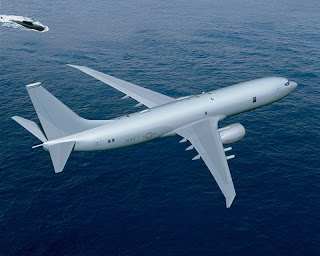
This is noteworthy mostly because it might (possibly) indicate a path to future standoff jamming for the Navy. The P-8 Poseidon is being designed and built with both high-power electronics and avionics/weapons hardpoints. Perhaps it will be possible to produce a system which will fit both Boeing products, or to adapt systems produced for the B-52H. Whether the Navy needs standoff jamming of its own is another question, one which seems to have been answered in the negative by the retiring of the Prowlers; but at the least, there should be a possibility of adding the capability to a patrol asset.

No comments:
Post a Comment