
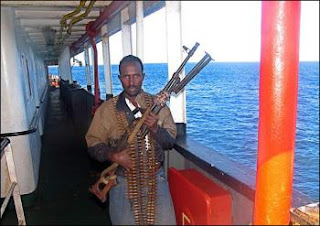
 This is an important discussion. If you read it at face value, it can easily piss you off. The US Navy sells the purpose of the Navy in the 21st century as keeping sea lines of communication open to commerce, but statements like this make it clear the Navy does not see piracy as a threat to that strategic objective.
The U.S. Navy said on Monday allied warships were doing all they could to thwart piracy in the strategic Gulf of Aden, but shipping companies should take their own measures to protect their vessels and crews.Taking a historical view it pains me to read this. One of the primary reasons he United States of America dumped The Articles of Confederation and wrote the Constitution of the United States was to gain the power of taxation, and the primary reason the founding fathers needed taxation was so the country could build a Navy for the specific purpose of fighting pirates.
The warning came as it emerged Somali pirates had hijacked another vessel off the Horn of Africa on Sunday, bringing the total seized so far this year to more than 30.
The U.S. Navy said the international naval force CTF-150 had stopped more then 12 attacks since May. CTF-150 comprises of warships from nations including Britain, France, Canada, Germany, Pakistan and the United States.
"The coalition does not have the resources to provide 24-hour protection for the vast number of merchant vessels in the region," said Combined Maritime Forces commander, U.S. vice admiral Bill Gortney.
I also find it very frustrating that last Thursday the Admirals stood in front of the American people in Durham and discussed in detail the role of naval power to protect the global system to insure the free flow of trade, and here we have a clear example of trade disruption on the seas and the US Navy basically tells ship owners they can't solve the problem.
However, it really isn't such a simple issue, and the discussion requires more intellectual rigor. On one hand, I think the Navy telling civilian maritime traffic to protect itself, which could imply arming up, doesn't really sound like a good idea. On the other hand, stopping piracy in the Gulf of Aden is not easily done, and is a low priority on the list of priorities for naval forces within the 5th Fleet AOR.
The Navy does not do a good job emphasizing the national security specific roles required of the service in forward theaters today. An example is the defense of the Iraqi oil terminals, a critical but rarely discussed role of the US Navy in the 5th Fleet. The American people don't understand what the large surface combatants do when forward deployed to the 5th Fleet. It is easy for people to see the value of an aircraft carrier providing air support including intelligence gathering and combat support in both theaters of war, but the day to day of naval forces are not well understood by most Americans.
That might be a difficult topic for the Navy to discuss with the American public, but it is a topic the Navy may need to make in the future to get more ships. When piracy, a problem that directly effects free trade, is seen as a low priority for the US Navy, it does not make much sense for the US Navy to hold conversations with business leaders and talk about the importance of protecting the global trade system at sea. The discussion is generic anyway, and without specifics the Navy message comes of as inconsistent when matching statements like this one from Admiral Gortney and the one given in Durham last week
The question to be asked is why the US Navy is not committed to stopping piracy in the 21st century? That question is a political question, not a strategic question of the Navy, or a tactical question regarding resources. It represents one of those political issues no one ever running for national political office gets asked about. The Navy correctly points out there is no threat to global system from Somalian piracy, piracy represents a minor disruption that barely shows up on the big picture. Ultimately, without the international political and legal framework to deal with pirates, the US Navy is sticking to national security priorities until mandated by political leaders to give the problem more attention.
While this particular statement comes from a US Navy Admiral, it could have just as easily come from any nation in the world, except France.

No comments:
Post a Comment