
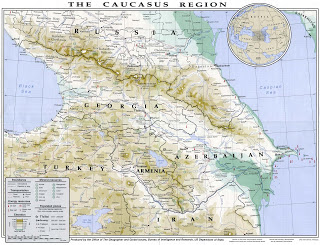
 The world has sent a signal to Russia, your strategic objectives are acceptable. There does not appear to be any view from any particular nation suggesting opposition other than rhetoric in regards to the Russian occupation of South Ossetia and Abkhazia. The only questions yet to to find answers are in regards to what other objectives Russia may have, and if they intend to follow through in achieving all of those objectives?
As of this writing Russia is engaged in the systematic destruction of the town of Gori, although no reason has been offered why. We have already witnessed the destruction of Tskhinvali. Blame both sides, Georgia for the initial action, and Russia has made choices with artillery that simply can't be dismissed easily. Both sides carry the burden of indiscriminate killing in this campaign. To date this has been a war fought mostly with artillery, and Russia has more guns.
I don't want to give the impression I'm picking sides here, because objectively, I find it impossible to do so. I will give some idea of what I'm saying. This is a typical report emerging in the Russian media. This one is in English, expect a lot of stories like this.
“When cleaning out debris in a house, fragments of cassette bombs were found. It is an illegal weapon which should never be used against civilians. And the Georgians’ use of multiple launch rocket systems is also inhuman. It proves the genocide of the Ossetian people, which is going on for centuries, is continuing. It is beyond understanding how Saakashvili could have shot peacekeepers. Evacuation is full of dangers. You have a 30 per cent chance of surviving,” said Yury Beteev from Osininform information agency.For context, prior to the announcement that Georgia would withdraw from Tskhinvali, Russia shelled the city all night in what one independent journalists described as "a fireworks display that ran all night long." At sunrise the next day, Georgia began retreating and Reuters has been running pictures of dead Georgian soldiers in the streets of Tskhinvali ever since.
Note the peacekeeper comment in the statement above. While it got buried in the reporting after the war started, that comment from all indications is correct. Georgian special forces killed or captured dozens of peacekeepers for the purposes of moving the artillery and rocket launchers into place to attack the city at the start of the campaign. What is a democracy that kills peacekeepers for the purpose of starting a war worth? These are the serious questions we must weigh in observing this conflict.
The RussiaToday article continues.
“Our reconnaissance planes detect Georgian troops and forces of the second echelon. They are reserves that’ll be deployed against Tskhinvali and in other directions, and they are our targets. We strike them and in such cases Georgians distort facts - they name villages, cities, communities located in the proximity, saying the Russian air force targets them. With full responsibility I can state that Russia has not targeted a single village,” said Col. Gen. Anatoly Nogovitsyn, Defence Ministry spokesman.This almost suggests Russia intends to destroy the rest of the Georgian Army as an objective. By now we have all heard the UN testimony regarding what sounds like a potential leadership removal objective. We opened this piece highlighting that Russia is shelling the city of Gori as of this writing, and has been for many hours. News reports out of Georgia and Russia are reporting citizens are in a mass exodus of the city. There is a very large forest fire that is burning wildly out of control, and will wipe out many outlining areas around Gori.
With Russia in complete command of the campaign, the questions we ask differ from those of Stratfor. Stratfor is suggesting the conflict is shifting from military to political. With forces still flowing towards Georgia, we tend to think Russia has a slightly different option. Up until this point all objectives for Russia have been strategic, essentially you can describe the entire strategic intent of Russia as to secure the southern flank of Russia. The question not answered is whether objectives are also economic. In other words, rather than a shift from military objectives to political objectives for Russia as Stratfor is suggesting, we are now curious whether Russia transitions from strategic objectives towards economic objectives.
As observers looking at the strategic implications, it seems to us Russia's strategic objectives of consolidating the provinces are within the context of acceptable outcomes from the worlds point of view, but if this campaign shifts towards economic objectives specific to the oil pipelines and oil and gas regions of Georgia, one would think that is when we begin discussing red lines.

No comments:
Post a Comment