
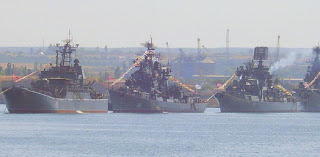
It is found that anything that can go wrong at sea generally does go wrong sooner or later, so it is not to be wondered that owners prefer the safe to the scientific. It is also found that it is almost as bad to have too many parts as too few; that arrangements which are for exceptional and occasional use are rarely available when wanted, and have the disadvantage of requiring additional care. Their very presence, too, seems in effect to indispose the engineer to attend to essentials. Sufficient stress can hardly be laid on the advantages of simplicity. The human factor cannot be safely neglected in planning machinery. If attention is to be obtained, the engine must be such that the engineer will be disposed to attend to it."There are a number of lessons from the limited information we have heard regarding the Russian Black Sea Fleet involvement in Georgia, and we don't believe it is too early to begin talking about them.
In the November 13, 2024 session, published 1878, Alfred Holt, "Review of the Progress of Steam Shipping during the last Quarter of a Century," pp. 2-11, here p. 8, Minutes of Proceedings of the Institution of Civil Engineers, Vol. LI, Session 1877-78--Part I. London: Published by the Institution, 1878. (source)
I have already read in multiple places how shocked, SHOCKED I tell you!... people are that the tiny Georgian Navy could possibly not only conduct a successful attack, but perhaps even damage the Russian cruiser Moskva in a Black Sea battle a few weeks ago. We have no hard evidence, only the reports that we have linked from the blog, but if we are simply speaking to the possibility the answer is of coarse "yes it could happen." Those with doubt fail to conceal their utmost faith in technology, a terrible failing if there ever was one in the littorals. Most of all though, they simply fail to recognize the most important element of littoral warfare: tactics. You see, the quote above is best known as one of the earliest precursors to the modern version of Murphy's law. As it turns out, Murphy was a nautical man, and understood littoral warfare.
Those who seek comfort in technology to override all possibilities fail to realize that tactics is the ultimate equalizer. Technology is not a substitute for tactics. Considering the probability of a nighttime amphibious landing, with multiple small vessels traveling in the littoral, and the potential of private civilian craft also operating at night; a maritime force can and apparently did exploit the conditions for an attack. With limited visibility, the Russians were forced to rely on technology to identify friend from foe in the fog of war, a process that is never easy. This is not limited to the Russians, and is an important reminder that while technology can improve the situational awareness of naval forces, tactics and doctrine determine success or failure in littoral warfare regardless of the size of your opponent. Victory at sea is earned by those who take victory from their opponent.
But the battle was not the most important lesson from the recent conflict in the Black Sea. The most important lesson is that Russia was able to take objectives because their naval forces were expeditionary. While control of the sea is a worthy task, we are yet to see a major power, regional or superpower, struggle to take command of the sea from an opponent who contested it. The utilization of naval power for Russia was decisive, in fact Russia has achieved extraordinary goals not because Russia was able to attack by land south into South Ossetia, but because they were able to move large numbers of troops by sea to seize strategic objectives. Lets be honest, Poti is an enormous strategic holding by Russia, it isn't surprising they aren't giving it up now that they have achieved control.
For all the talk about how the United States hasn't conducted an amphibious landing against a hostile enemy, we note it has been even longer since a US submarine has sunk an enemy vessel in anger... yet no one is suggesting we get rid of submarines. Amphibious assault is a core military requirement of naval forces as old as sea power itself, and as Georgia reminds us, in the expeditionary era it is the ability to leverage expeditionary forces that will give nations the advantage over their adversaries.
The lesson at sea of the recent Russian-Georgian conflict is that our strategists have been right all along, it is about turning towards the littorals to extend influence beyond the shores, and we must perfect the skills, hone our tactics, and resource properly to empower our people to be prepared and successful in the littorals where Murphy's law tends to show its ugly face.

No comments:
Post a Comment