
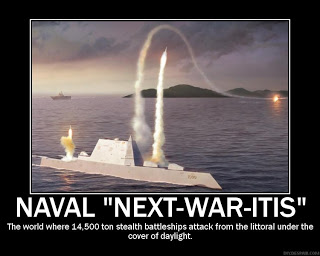
 The Navy is looking to build a ship designed during the cold war, built after the cold war, and intended to fight in a strategic environment last seen during the cold war. So what is the solution? Tell Congress there is a cold war. Since the end of the cold war, the Navy has been searching for the threat to justify more big cruisers and destroyers. It appears they have found three (PDF), as testified by Vice Admiral Barry McCullough.
Rapidly evolving traditional and asymmetric threats continue to pose increasing challenges to Combatant Commanders. State actors and non-state actors who, in the past, have only posed limited threats in the littoral are expanding their reach beyond their own shores with improved capabilities in blue water submarine operations, advanced anti-ship cruise missiles and ballistic missiles. A number of countries who historically have only possessed regional military capabilities are investing in their Navy to extend their reach and influence as they compete in global markets. Our Navy will need to out pace other Navies in the blue water ocean environment as they extend their reach. This will require us to continue to improve our blue water anti-submarine and anti-ballistic missile capabilities in order to counter improving anti-access strategies.The Navy should be applauded for recognizing the emerging threat of ballistic missiles on the horizon and announcing that it intends to take the threat seriously. Rear Admiral Thomas Marfiak, who wrote an article in Proceedings called Where Are the Ballistic-Missile-Defense Cruisers?, a very relevant article that Proceedings has made publicly accessible, outlined the emerging threat in a compelling way and gave good advice to the Navy on how to adjust and pace itself to meet the emerging threat.
During last Thursday's testimony when discussing the threat environment, Vice Admiral Barry McCullough answered a question by Rep. M. James Saxton (R-NJ).
Rep. M. James Saxton (R-NJ):The Navy is making the argument that the combination of Ballistic Missile Defense AND anti-ship missile defense AND blue water submarine threats is why the DDG-51 is now the optimal ship for the Navy to build instead of the DDG-1000. We look at the emerging threat environment the Navy is seeing in order discussed.
Could you just specifically -- as specifically as you can say how the threat has changed and how you believe the decision that you made will best meet that threat?
Vice Admiral Barry McCullough:
There are three specific areas. One is with the increased proliferation of ballistic missiles that provide antiaccess challenges to our forces today globally, not only the high-end threat posed by potential adversaries in the Pacific, but lesser-included capabilities in the Arabian Gulf region, in Northeast Asia, and the ability that that -- or the proliferation into that threat globally. So the ballistic missile threat is the first piece.
The second piece is when you see high-tech threat capability that's usually resident in a nation state come off the beach in a conflict against a non-state actor and strike a war ship and do significant damages to it. It's where is that capability going to go next, with what potential non-state actor. And that happened in the Eastern Med in 2006.
And I will tell you there are nations that are developing quiet diesel submarine technology and putting it into blue water to challenge where we operate. And we need improved capability against the open ocean deep water quiet diesel submarine threat.
And that's where we see the capability that has come rapidly left from where it was projected. I don't think anybody ever envisioned Hezbollah being able to launch a C-802, and they did that quite well.
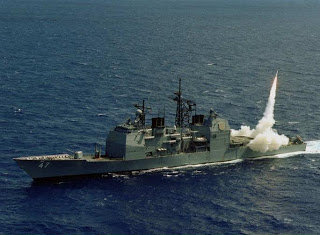 The US Navy today operates 22 Ticonderoga class cruisers, and the Navy has already purchased 62 Arleigh Burke class destroyers , 53 of which have been commissioned and the next 9 to be commissioned over the next 2-3 years. All 84 have the AEGIS system and are capable of supporting the requirement for Ballistic Missile Defense.
The Navy's existing plan of record for AEGIS ballistic missile defense is to convert 18 ships, 3 cruisers and 15 destroyers to fully capable AEGIS ballistic missile defense capable ships by October of 2010. There is currently no plan to upgrade the remaining 66 AEGIS ballistic missile defense capable ships with AEGIS ballistic missile defense, and instead of addressing the emerging ballistic missile threat on the horizon with the existing 66 AEGIS ships that could be upgraded quickly, 9 of which haven't even been commissioned yet, the Navy has decided to make the shipbuilding argument to build 8-9 new AEGIS capable ships at a price of 1.8 - 2.2 billion dollars a piece as the way to meet that emerging challenge.
It is worth noting that in testimony on Thursday, it was suggested by Vice Admiral Barry McCullough and stated outright by Ronald O'Rourke that the 8-9 Burke destroyers would be exact copies of the DDG-112, meaning they would not be built with AEGIS ballistic missile capabilities. Given the emerging strategic environment, not to mention the demands of field commanders today for ballistic missile defense requirements, the Navy is telling Congress to build 8-9 more DDGs without ballistic missile defense to meet a ballistic missile defense requirement, and the Navy did not even discuss the option of expanding the existing and ongoing cruiser modernization schedule, or the upcoming destroyer modernization schedule. We are going to assume this is coming in POM10, but we can also assume those costs are not in the current budget looking forward.
According to Vice Admiral Barry McCullough, the expanded threat matrix for ballistic missile defense includes Iran and North Korea. This is not difficult to sell given public opinions, North Korea has launched ballistic missiles and has a proven (uhm, sortof) nuclear capability, while Iran has also demonstrated its ballistic missile capability, including its desire to expand it. Iran is on the path towards the development of a nuclear capability in blatant ways that are in clear defiance of the IAEA, to the point the world has slapped a number of sanctions to date through the UN on Iran.
But by most professional analysis, the ballistic missile capability of Iran and North Korea are minor current threats, and questionable future threats to the maritime domain. These are terror capabilities as conventional weapons, and are only effective as weapons against the Navy if armed with nuclear warheads. While the UN process cannot prohibit the development of nuclear weapon technology, as demonstrated by North Korea, it can certainly make it fiscally impossible to expand and improve a comprehensive ballistic missile technology program. North Korea is a financial mess, and Iran is on the fast track to financial ruin. Forecasting expansion, growth, and improved technology gains for such expensive weapon systems when the financial situation of these states is already dire is counter intuitive. That isn't to undermine the necessity of Naval power to be able to address the ballistic missile threat in the future, rather we highlight the lack of urgency necessary in shipbuilding regarding the Iran and North Korea threat. 8-9 more Burkes does not significantly, if at all, improve the capabilities of the US Navy against today's ballistic missile threats from North Korea or Iran. New warships built today are intended to meet the threat environment of 2020-2050, not 2008-2020.
The anti-ship cruise missile threat is more interesting, but not based on how the Navy explained it in testimony. It is very revealing the Navy has used the irregular warfare environment in testimony to support building an Arleigh Burke class destroyers to meet the anti-ship missile threat. Until today, the Littoral Combat Ship was the only ship the Navy has attempted an intellectual argument publicly regarding the irregular threat matrix at sea. How can the example of Hezbollah be intellectually compelling as a rationale for more Arleigh Burke destroyers without completely invalidating every ship that doesn't have AEGIS, including the LCS?
 The lesson of 2006 is not that the cruise missile threat is so severe we need to concentrate on building AEGIS ships, the lesson is a reminder for Naval forces not to fight in a war zone with your defensive weapon systems off line. That is the same lesson the US Navy should have learned in the Tanker War of the 1980s with the USS Stark, and if they didn't learn that lesson, and believe more DDG-51 class destroyers is the solution, then something is seriously wrong. We think the Navy learned the right lessons from 2006, and while Vice Admiral Barry McCullough is making a valid point about the danger of anti-ship missiles, he is making an irrelevant argument in favor of more Burke class destroyers with his argument.
We also find the submarine argument interesting, because this is a shipbuilding issue. If the lack of a blue water submarine threat was the rationale against building $2.2 billion dollar Virginia class submarines for the last decade, and why the Navy has allowed the submarine force to drop to historical lows, why is the Navy now taking the position that the presence of a blue water submarine threat is the rationale for a $2.2 billion dollar surface combatants? You know, submarines don't have to defend themselves against anti-ship missiles or ballistic missiles, they inherently operate outside the threat environment of those weapon systems. They are also much more effective hunting submarines than Arleigh Burke class destroyers.
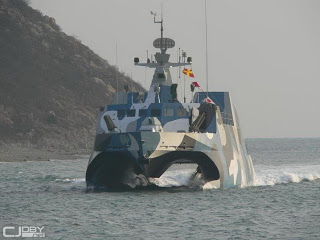
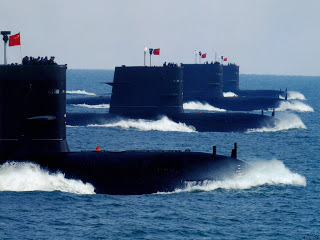
The Navy's emerging strategic threat environment is "coincidently" exactly what we have been observing in regards to China's improving capabilities. Back in February, we observed the mass production of the Type 022, the massive buildup of conventional and nuclear submarines, the continued growth of mine warfare vessels, and the rapidly expanding arsenal of ballistic missiles pointed at Taiwan. In examining China's strategy, we observed it to be something akin to a Streetfighter strategy that saturates the battle space with cheap streetfighters above and below the sea supported by mines and ballistic missiles. It isn't really a blue water capability, although it can be in the Pacific.
The anti-ship missile threat today, when accounting for who might represent a potential adversary, highlights the United States is facing much fewer large surface warships with anti-ship missiles than during the cold war. The US Navy is also much more capable today against that threat than it was during the cold war. The only change to the threat environment regarding anti-ship missiles is the massive production of Type 022s from China. Is that the driver for the threat environment change?
The same is true of the submarine threat. It is noteworthy Vice Admiral Barry McCullough discusses quiet diesel submarine technology, not AIP submarines. Is this a nod to China's Kilo and Song class submarines, both of which are diesel? The nuclear submarine threat is extremely low compared to the cold war, one can count China's entire nuclear submarine fleet on two hands. Russia's submarine and surface fleets are still shrinking, but Russia has begun the process of rebuilding its fleet and could be a factor in this strategic shift. After all, nothing says cold war like putting Russia up on the PowerPoint.
Essentially, the strategic shift in the maritime environment is nothing more than the Navy embracing China as its peer competitor and waving a hammer and sickle in the direction of Russia. With peer competition, the Navy can then focus all shipbuilding resources dedicated to this new purpose, which of coarse means buy more battleships. Looking for the next big one, creating it if necessary, is what Naval Next-War-Itis looks like.
The proposed plan is to buy 8-9 more battleships so the Navy can fight a war in a battle space saturated by China's surface and subsurface streetfighters. We don't know if the DDG-51s would be effective against swarms of fast attack missile boats and large numbers of diesel submarines, but clearly given the available options, the Navy sees that as the best course forward.
 The decisions make a lot of sense, as long as you believe the US is going to fight a war against China in the future. In effect the Navy is accepting risk in irregular warfare to build its future military capabilities to fight the big one against China..., or Russia, either is fine as far as the Navy is concerned.
That would be a strong strategic argument, if it wasn't completely counter to the new direction expressed in the National Defense Strategy of the United States (PDF) released last week. I guess this explains why Gates hasn't endorsed the Navy's plan, and why Roughead didn't endorse the National Security Strategy. From our point of view, we question if it is a good thing that the Navy has decided to do its own thing, after all, why would anyone be concerned about the Navy making a conscious decision to sprint at flank speed down the road recently blazed by the Air Force? Oh, that.
We commend the Navy for embracing the strategic challenges of ballistic missile defense that is clearly emerging in the future, and give credit to Admiral Roughead for having the vision to announce the Navy intends to address this challenge sooner rather than later. We are also very pleased the Navy went to Capitol Hill and tried to make a strategic argument, it has certainly been enlightening. The Navy will always find more success with strategic arguments, at least when those arguments make sense. Did this strategic argument make sense? Not to us, on this blog strategic thought is in line with grand strategy, and moving the Navy in a direction not just counter, but opposite, the National Defense Strategy of the United States is not grand strategy, and is counter to what is expressed in the 3rd paragraph on the second page of the introduction in the Navy's own Maritime Strategy (PDF) which states the Navy will be guided by the National Defense Strategy of the United States.
With that said, the Navy may find success with its strategic argument, there are plenty of China hawks in Congress.

No comments:
Post a Comment