
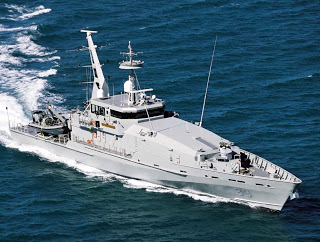
 Brickmuppet is talking about the Coast Guard, shipbuilding, and all kinds of interesting stuff, and in doing so puts up a couple of links that has me thinking Navy. There has been unmistakable increase in the utilization of small boat operations worldwide. While the US Coast Guard does a good job of handling the issue off the US coast, the ungoverned spaces of the worlds sea lanes don't have Coast Guard assets capable of slowing down these new small speed boat tactics.
For example, everyone is familiar with the small speed boat operations in the Gulf by the Iranian Revolutionary Guards, and by now people should be aware this capability has been expanded to Hezbollah following the 2006 war against Israel. These same speed boat vessels are used by both Nigerian and Somalian pirates.
There is a line of thinking that fast boat operations are best countered by fast boat operations, and while we are not yet subscribers to this line of thinking, we are beginning to feel the tug of the arguments. We have seen the problem like this, most threats at sea available to criminals and terrorists are very inexpensive, but major war requirements have always been very expensive. One challenge for the Navy is to find inexpensive solutions for the highly lethal but inexpensive threats so money is available to counter expensive challenges with expensive systems.
So here is the question, if they could be sustained, and with a 3000nm range that shouldn't be too hard, would something like the Armidale Class (PDF) be appropriate for fighting terrorists and pirates in forward theaters? The logistics here are not simple, so simply building the ships is only step one, a support infrastructure is required and these small vessels have a total officer/sailor crew of 29.
We are starting to wonder if the US Navy should think about buying 30 of them in one big buy, and here is why: They only cost $14 million US, they appear well designed for sustained maritime security operations in low threat environments, and this is one way to counter low cost high threat environments with a low cost. highly capable system. We acknowledge $14 million is a starting place for costs, because the US will likely upgrade the weapons and mission payload requirements a bit, but the total cost per unit would probably cap at around $20 million, still very affordable for 30. We are thinking of a program here of around $600 million, which we observe could pay for itself in insurance premiums alone in one year in at least two different regions today.

No comments:
Post a Comment