
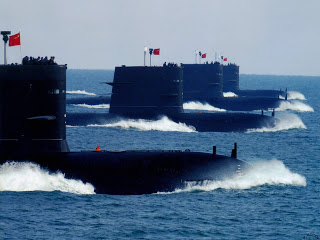
 How dangerous is China? Ask the Russians, who are organizing their lawyers to go after the one place China seems to take seriously, their wallet. There has been some very interesting discussions taking place over in Russia, and it turns out, while they didn't really care that the Type 39 Song Class submarine was built based on the old Romeo design, they aren't very happy to learn the Yuan class is basically a copy of the Kilo class Russia sold to China. Strategypage is the only English source with the story so far, but I expect we will see more on this topic over the next few months.
Russia is getting more and more upset at what it sees as Chinese making unauthorized use of Russian military technology. The latest irritation is the new Chinese diesel electric sub design, the Type 39A, or Yuan class... Russia was selling new Kilos for about $200 million each, which is about half the price other Western nations sell similar boats for. The Kilos weigh 2,300 tons (surface displacement), have six torpedo tubes and a crew of 57.Strategypage has the gist of the discussion, but what really has the Russians bothered is that there appears to be a lot of internal similarities between the Kilo and Yuan, and a bit of copycat has occurred. The problem for Russia is, China can produce the Yuan cheaper, and new versions of the Yuan class are clearly more modern. China is installing Stirling AIP systems on the Yuan's giving them more power, and they require less crew to operate than the Kilo class. Shipbuilding inflation has finally hit Russia, and the cost of producing the Kilo's has gone up. Hugo Chavez is learning this the hard way, he will be paying a hell of a lot more for his Kilo submaines than China did, but Russia is the only country exporting submarines who will sell to him... so far.
You see, China is growing militarily and economically, and it is our responsibility to fear China because they are evil communist bastards who don't play by the rules, at least that is how China is presented most of the time. An example of this viewpoint was printed today in the Wall Street Journal, where Mark Helprin lays out eight and a half paragraphs of argument telling you and me we need to be afraid of China, with the conclusion being we need to increase our defense spending enormously right now to address this immediate and certain threat.
As we content ourselves with the fallacy that never again shall we have to fight large, technological opponents, China is transforming its forces into a full-spectrum military capable of major operations and remote power projection. Eventually the twain shall meet. By the same token, our sharp nuclear reductions and China's acquisitions of ballistic-missile submarines and multiple-warhead mobile missiles will eventually come level. The China that has threatened to turn Los Angeles to cinder is arguably more cavalier about nuclear weapons than are we, and may find parity a stimulus to brinkmanship.Mark Helprin's argument contends that as parity with China is achieved, an inevitable result in his opinion, is that at that point the United States will no longer be able to compete against China and nuclear weapons become the only options. By seeking the nuclear conclusion, we are thereby warned that China, after rising to economic and military parity with the United States, will then engage in nuclear war with the United States, which of coarse casually discards all of those economic gains. His vision of deterrence to this almost certain yet unlikely scenario is a military larger than one ever produced in history, and in this vision of deterrence no challenger will ever contend for command of the sea, air, or space against the United States. The theory promoted by Mr. Helprin is that should the United States ever face a peer competitor, the doom of the United States is all but certain.
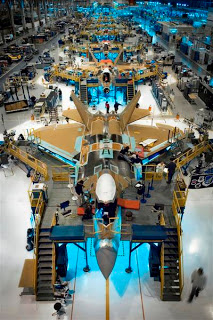 This vision however ignores the truisms of military strategy, that in fact the natural order of peacetime is the eventual uncommand of the sea, air, and space the United States dominates today. While it is commonplace to hear the difficulties of war, we often ignore the difficulties of peace. Accepting peace and prosperity globally comes with an obligation to also accept the competition that creates Uncommand of the Sea, the air, and space (or the perception of contested Command of the sea, the air, and space by nations) as the natural state of progress.
We outright reject that if in the face of some extraordinary hostile condition or through some extraordinary mischance the United States finds ourselves without sufficient military strength to maintain command of the sea, air and space to a peer competitor or stronger competitor, that our nation would therefore be too weak to prevent the enemy gaining such command themselves. It requires a negation of the whole theory of war to reach such a conclusion, a conclusion of which at least requires more supporting facts than is given.
China is certainly a challenge, specifically an economic challenge, but with all challenges comes opportunities. We find it ridiculous that at this point in time, when China is clearly not advancing an offensive strategy and may still be decades away from such a strategy, that the United States should stop and invest massive amounts of military budgets to build the best of today's technology to fight a war that may not even occur at some far off future point in time. Never mind the technology disparity when equipment like clones of Russian cold war era Kilo class submarines make up the modern Chinese arsenal, a technology that may very well be close to obsolete with the next generation of ASW research already well underway.
Spending massive amounts of money today to buy the best equipment available today to fight China on some unknown date in the future in a still undefined era of future technology is not a strategy, and that mentality is exactly what Defense Secretary Robert Gates called ‘next-war-itis’ today.
Meeting the war-fighting needs of the troops now and taking care of them properly when they get home must be the priority, Gates said in a speech to journalists at a seminar here sponsored by the Heritage Foundation, a conservative think tank.
“I have noticed too much of a tendency towards what might be called Next-War-itis — the propensity of much of the defense establishment to be in favor of what might be needed in a future conflict,” Gates said.
But in a world of limited resources, he said, the Pentagon must concentrate on building a military that can defeat the current enemies: smaller, terrorist groups and militias waging irregular warfare.
If it means putting off more expensive weapons for the future or adding to the stress on the Army — that is a risk worth taking, he said.
“The risk of overextending the Army is real,” said Gates. “But I believe the risk is far greater — to that institution as well as to our country — if we were to fail in Iraq. That is the war we are in. That is the war we must win.”
We believe most people will look at Gate's comments and think it has to do with style, COIN vs conventional war, and focus on the technology procurement aspect of what Gates is saying. We do observe that discussion although do not see it as the important point Gates is making. The theme of focusing on the war your in today and not the war in some distant future isn't new for Gates, he makes the case a number of ways and does it often. When broken down in simple terms, Gates is making the argument the DoD needs to sacrifice the future of the military for the war of today. Gates is a well respected strategic thinker on both sides of politics in America, why then does he often make urgent arguments for immediate focus on the events of today, what could be described as a short term focus? Why is there such a disconnect between the position of Mr. Helprin and Secretary Gates?
We observe Mr. Helprin represents the position of a lot of people, and in this contrast with Secretary Gates, we believe he actually represents the position of the majority of Americans. You see, the reason Mr. Helprin looks ahead to China is the same reason many Conservatives do, and believe it or not, it is the same reason many Progressives and Liberals think we need to get out of Iraq as fast as possible.

No comments:
Post a Comment