
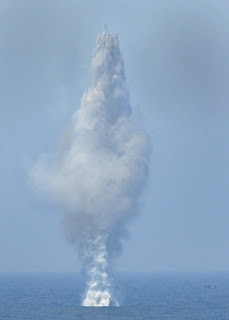
“The clever combatant imposes his will on the enemy, but does not allow the enemy’s will to be imposed on him.”
-- Sun Tzu
The US Navy has 216 admirals, which left me wondering, how many would realize that the above quote from Sun Tzu heads Chapter four of JP -15. My guess is a better question would be how many of those admirals have read Chapter 4 of JP-15. For those who are curious, Joint Publication 15 is titled Barriers, Obstacles, and Mine Warfare for Joint Operations, and chapter four deals with sea mines.
Milan Vego lets fly harsh criticism in this months issue of Armed Forces Journal with a comprehensive review of Mine Warfare in the Navy today. Termed Mine Blindness, his brutally honest evaluation of mine warfare within the Navy asks a number of important questions regarding the future of mine warfare. We had a pretty spirited debate on what to quote, which is an indication of just how good this article is, but this paragraph strikes us as the important point not to be missed.
Navy Warfare Publication (NWP) 3-15, “Naval Mine Warfare,” is the Navy’s principal document providing guidelines for the employment of mines and MCM. It is a well-written document, but obviously focused on the tactical level of war. Critics point out that despite significant technological advances in mine warfare since World War II, the doctrine has changed relatively little. NWP 3-15 does not explain the effect of great diversity in the physical environment on the employment of MCM forces. A more serious problem is that NWP 3-15 is not based on a framework provided by the Navy’s operational doctrine — because the latter does not yet exist. The first edition of Naval Doctrine Publication 1 (NDP-1) was supposed to provide Navy-wide doctrine for fighting at the operational level of war but ended up being almost exclusively focused on the tactical level of war. Since 2000, efforts have been made to rewrite NDP-1 to reflect the operational level of war at sea. Reportedly, the new NDP-1 should be issued in the not-so-distant future. However, it is doubtful that it will include discussion of the role and importance of mine warfare. Another major problem is that the Navy’s long-overdue doctrine should look several years into the future and determine technical requirements for both dedicated MCM forces and OMCMs.
We believe Milan is hitting an important point throughout his conclusion, the bottom line on Mine Warfare within the Navy isn't capability, it is culture.
The Navy urgently needs to transform its culture and genuinely integrate all aspects of mine warfare into its doctrine and training. Mine warfare should become one of the core war-fighting functions. Perhaps one of the most difficult yet critical elements is the existence and development of a theory of mine warfare; without this, no sound mine warfare doctrine can be developed. All U.S naval officers should be fully knowledgeable about the role of mine warfare in the past, today and in the future in the conduct of warfare at sea. Without a comprehensive theory of MIW, it is difficult to see how sound doctrine can be written. The Navy needs to incorporate MIW as an integral part of its operational doctrine. Then NWP 3-15 has to be rewritten so that it is clearly based on the larger operational framework. Technology should not be allowed to dictate tactical or, even worse, operational doctrine on the employment of U.S. mines and MCM. The key to success is having a single authority responsible for writing MCM doctrine, training and collecting lessons learned.
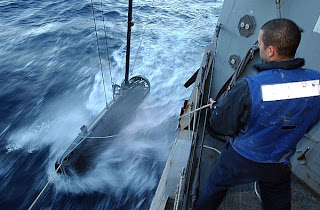 Milan is looking for a comprehensive strategy on Mine Warfare, and we think that is the way ahead. We are not happy about the early retirement of the Osprey class. We acknowledge these were not the most capable mine warfare craft, but they can be specialized in a critical capability we observe to be missing from the Navy's MIW capability. Homeland Defense.
Dr. Scott Truver, principal author of the U.S. Navy’s 1992 Mine Warfare Plan, has an article in the Winter 08 Naval War College Review (24MB PDF) called Mines and Underwater IEDs In US Ports and Waterways. This is a brilliant article, and highlights the real cost of why Mine Warfare cannot afford to be the bastard child the Navy treats it.
Mines can directly attack the nation’s waterborne trade.More than 90 percent of American exports and imports by volume transits U.S. ports, and the efficient and safe movement of our foreign, coastal, and inland-waters trades is critical for America’s globalized, just-in-time, and just-enough economy. The economic consequences of just a few mines in our ports could be catastrophic, as the two-week West Coast labor slowdown in the fall of 2002 implies—a $1.95 billion impact per day. According to a University of California at Berkeley analysis, the direct and indirect economic impacts of a twenty-day longshoremen’s work action would cost the U.S. economy more than $50 billion (in 2002 dollars). Even if no ships were sunk or damaged and no channels were blocked, explosions in a few key ports on East,Gulf, and West coasts and in the Saint Lawrence Seaway— clearly not an impossible feat, as September 11th tragically proved—would have a chilling effect on commercial shipping in terms of increased insurance costs and vessel lay days. The economic tremors would reverberate throughout the
nation and to trading partners overseas.
I live in New York, moved to the state in 2000, and it is an ironic reality that my professional career took off on September 11, 2001, that some how on the worst day in the lives of many New Yorkers, including many we know, my professional life changed for the better. The study of the aftermath of 9/11 is something I have spent a considerable amount of time doing, and observing from other researchers. One of the least discussed aspects of 9/11 is the financial cost to the United States.
In 2005 I had an opportunity to review much of the raw data collected by the Governors Office that was being contributed to a National report on the aftermath of 9/11. The data accumulated was combined with a lot of data that was contributed from national agencies as indirect costs were calculated. The final tally 5 years after 9/11 was lowballed at $1 trillion dollars direct and indirect economic GDP centric cost to the United States just by the two airplanes that hit in New York, never mind the other two airplanes. You will never, ever hear that discussed in the media, because if people realized how devastating the terrorist attacks were to our economy, people would realize the less than $1 trillion spent over 6+ years of war is hardly too high a cost. Legitimate criticism of the war, go for it, but the cost comparison of war to the cost of losing a single day in the US is a strawman argument in defiance of the facts.
However, that in turn makes it fair game to add the cost of war to the $1 trillion GDP indirect cost, which highlights a further realistic cost of failure in defending the homeland.
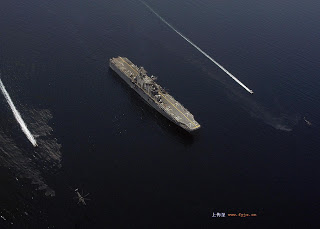 Dr. Truver is warning of a serious issue. If China was to lay mines in a few choice waterways off Washington, Oregon, and California the day they decided to take on Taiwan, it would be a month before the most critical aspects of the Navy's Pacific Fleet could respond. It wouldn't have to be China though, it could be any number of nations or non state actors for any number of purposes. As Dr. Truver points out, the utilization of only a few mines could have the same effect as a major military mining effort.
What mine countermeasures does the Navy have to support Bangor, Everett, or Bremerton? Does the Navy have enough mine detection and clearance capabilities to quickly remove smart mines prior to the deployment of two billion dollar submarines or an eight billion dollar aircraft carrier?
Nevermind the challenge of clearing mines with the Littoral Combat Ship off a coast with hundreds of Anti-ship missiles pointed at it, what does the Littoral Combat Ship contribute to the port of Long Beach? How many Littoral Combat Ships are required for a Long Beach size MCM effort? It is an important question, because if the Navy has to commit its entire Pacific flotilla to homeland defense, the flotilla will not be available in forward combat theaters to support scouting efforts for the battle line.
This is a critical point not to be missed. The same flotilla that will clear mines for the homeland is the same flotilla expected to perform scouting for the battle line against what will soon amount ot hundreds of small attack platforms intertwined with tens of thousands of vessels at sea at any given time in that region of the Pacific. At the operational level of war that Milan is discussing, scouting will be critical to success, and even if the Navy can support both missions, where will littoral submarine defense come from? This modular consolidation strategy of mine warfare, scouting, small boat attack, and anti-submarine operations in the littoral needs a critical review, because thanks to consolidation, the numbers don't add up.
We observed the current Mine Warfare plan appears to be include the possibility of moving mine countermeasures to the battle line. The development of deployable unmanned platforms and the consolidation of airborne mine countermeasures brings MCM capabilities to bear from the primary forces, as opposed to only dedicated forces of the LCS. Specifically, and we will not provide details, we observe the move to transfer a great deal of mine detection to the submarine service. However we note Milan asks excellent questions on that topic too, can the existing battle line cruiser/destroyer force handle another mission profile? We agree with his assessment, those are not the platforms for that role.
We recall comments by Rear Adm. John Christenson, vice commander of the Naval Mine and Anti-Submarine Warfare Command, who made the following comments.
“We want mine warfare to be part of every naval officer’s expertise and experience level,” he said at an industry conference.
The command plans to train Navy leaders in the specialty and will require every expeditionary and carrier strike group to demonstrate proficiency in mine warfare in the near future.
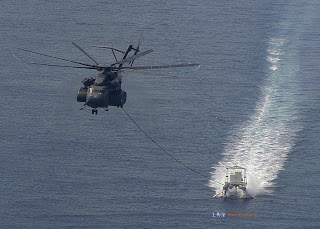 In that article, we noted the primary issue facing the Navy in mine countermeasures is the consolidation of mine warfare to the Littoral Combat Ship, and the requirement to keep the LCS with the Strike Group in order to bring MCM to the Strike Group. Look, while people might believe the LCS is about ASW, it isn't going to be anytime soon. The LCS primary responsibilities will be mine warfare and small boat attacks, because those are the modules that dominate the program purchase plan. And please, don't even get me going on the silly RAND LCS MIW report, any wargame where the LCS zooms off in front of a strike group in a Chinese War scenario to clear mines for carrier forces is unrealistic at best, raising legitimate questions regarding the quality of the PLAN player. Cheap shot? Maybe, but read the report before comment.
As we recently highlighted, the GAO issued a report last year that covered the Navy Mine Warfare procurement programs, and had several good things to say. In fact, the report was very positive on a lot of the new MIW technologies, which we believe is noteworthy. The report was reported in the media however as critical of the Littoral Combat Ship, because in fact the report had almost nothing good to say about the Littoral Combat Ship for the role of Mine Warfare. According to the GAO, the LCS is the biggest problem with the Navy's Mine Warfare plan. I don't think most of us needed the GAO to tell us a 40 knot corvette the size of a frigate is not a great idea for mine warfare, but hey some opinions matter more than others.
If the LCS isn't the right platform, the Navy wants to increase awareness among Strike Groups for Mine warfare, and the Navy is building a mine countermeasures capability that scales to the battle line, is this a case of damned if you do or damned if you don't? The question is, should the Navy pull MIW back from the flotilla to the battle line (we include submarines as part of the battle line)? What is the strategic rational for such a move? If not the LCS, then what?
These are difficult questions. Given the "all ahead flank" attitude regarding the LCS and the incredibly strange RW plan, I doubt there is a strategic answer to these questions available.
One final thought. You want to talk about irony, that Sun Tzu quote is an albatross in this discussion. Observe, I borrowed those last two pictures from a discussion on Chinese internet about US Navy mine warfare capabilities, or more specifically the lack of respect for it.

No comments:
Post a Comment