
 I'm starting to think the Navy consolidated Mine Warfare with the Submarine service so they both would be easier to control as they are downsized. I'm not sure there is another way to interpret these statements by Adm. Roughead.
"If you look globally at submarine growth and submarine sophistication, we are not the only ones thinking along those lines because submarines are proliferating significantly around the world," Roughead said.
Roughead said the current fleet of nearly 70 submarines serves a range of missions--- from high-end warfare to involvement in the war on terror.
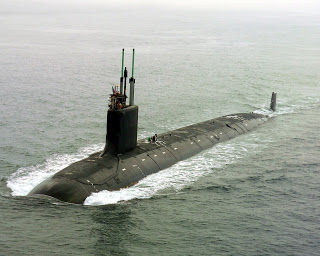
Roughead said he'd like to bring out about 30 new fast-attack submarines. Half of them would be built in Connecticut.
So 30 more new fast-attack submarines will be sufficient? Lets do the math here.
There have been 10 Virginia class submarines funded to date. Thirty more would be 40 total for the class. You can then add the three Seawolf class submarines, and because there is no planned replacement for the Ohio SSGNs, those can not be counted.
That means the future submarine force will be around 43 submarines under this 'strategy', five below the stated (reduced) requirement of 48, and this is seen as the way ahead at a time when Adm Roughead obviously observes there is a global growth in the proliferation and sophistication of submarines around the world.
I almost said I don't think that plan for submarines has any relationship whatsoever to the Maritime Strategy, however upon further review, there are no specific threats or challengers identified in the Maritime Strategy. I guess you can claim every purchase is ideal for the challenges at sea facing our nation, because whether its a Virginia class submarine or a yellow submarine, it's all fighting the same unspoken, unidentified threat that is so top secret the Navy cannot even identify it to the citizens of the United States. With such secrecy, the uninformed, uninterested taxpayer might question whether such a threat exists. Under those conditions, it sure seems easier for Congress NOT to spend money on the Navy, or more applicable, spend money for the Navy as THEY see fit because there is nothing enabling the taxpayer to say to Congress their actions are counter to strategy.
The words "inconsistent" and "incomplete" appears to be applicable to the strategy the Navy is executing. Can anyone in the Navy identify an actual "strategy" for fleet constitution, why a specific number of submarines is required, or is the current fleet constitution strategy simply a shipbuilding plan determined by what is affordable in a fiscal year? Is the current plan the way ahead because is is seen to be what keeps the industry stable from the perspective of the Navy?
We believe the future fleet should be constituted based on a "strategy of the means" to best address the desired 6 ends and support the 6 ways as outlined in the maritime strategy. Absent evidence of a publicly identified, open source "Strategy of the Means" regarding fleet constitution, we don't believe there is a strategy in the US Navy for fleet constitution.

No comments:
Post a Comment