
Q Congressman Murtha told our front page last week that he would put money in the budget for a 10th LPD-17. He said the service is no longer hesitant about that. Is that case? Will you support that?
A ADM. ROUGHEAD: You know, my -- I support the shipbuilding program that I have put forth for the '09 budget. There is not an LPD-17 in that budget submission. So I -- you know, I support the budget that we put forward.
His answer is understandable, but the '09 Navy budget has a snowballs chance in hell, and we see that as a good thing. The question comes from discussions that are picking up momentum on capital hill regarding amphibious transport. While Murtha may be cited in the question by the reporter, we observed that on Tuesday Gene Taylor was discussing amphibious ships as well, including the LPD-17, when addressing the Defense Forum sponsored by Aviation Week. Government Executive reports:
But in a speech to a forum sponsored by Aviation Week, Taylor said the LPD-17, or San Antonio-class of amphibious ships, should be added to that requirement. "I want to see LPD, and anything else that makes sense, be nuclear powered," he said. He later told reporters that the larger helicopter-transporting amphibious assault ships also should be nuclear powered.
In our opinion, the first 10 LPD-17s should not be nuclear powered, but we observe if a future decision is made to build more, nuclear power would be a good move. With the recent discussion to use amphibious ships for “Maritime Security Groups” that do not include Marines on amphibious ship deployments, we agree that nuclear power would contribute value for humanitarian operations. Our concept actually includes many of these ideas, a nuclear powered mothership for what we have termed the Littoral Strike Group. The mothership would be very similar to an amphibious ship, except instead of deploying Marines for amphibious assault, it would deploy large numbers of manned and unmanned systems for littoral warfare and regional sustained presence.
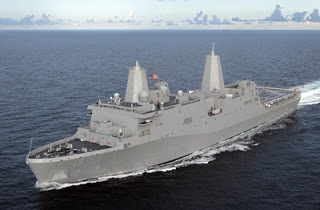 We recognize that we are one of the lone voices in the wilderness calling for the 10th LPD-17, noting in fact we made the call the second week we started blogging. We would actually like to see many more than just 10, we believe the platform is exactly right for the 21st century bringing all of the metrics that enhance the warfighter both on land and at sea. We disagree with those who suggest the amphibious ship is a bad investment, and in modern war against a contested coast we do not see MSC ships as a viable alternative for amphibious assault, because given the dangers, those civilians can simply choose not to participate.
Consider for a moment the world we live in. At the same time the United States is reducing its forward basing structure, the US is also facing resistance to military access due to political issues, AFRICOM's struggles highlight this problem well. Access is not assured in the future, which places importance for US military forces to retain forcible entry. The trends tell a different story.
If you combine the Army, Army National Guard, and Marines the US Military has around 32 divisions today. Of those forces, the US military has 4 airborne brigades and 2 MEBs for forcible entry operations, or roughly 2 divisions of 32 for forcible entry. That means for the hardest part of war, forcible entry, the US military can only deploy 6% of its entire force. Further, airborne brigades are light, only the Marines have heavy weaponry. We note these measurements contrast with what was required for WWII. When the nation operated 90 total divisions, 13 were Marines and 5 airborne. In other words, during WWII nearly 19% of the total US military force had forcible entry capability, and of that the heavy to light ratio was over 2:1. (Source)
We also note amphibious vessels are good investments. The Navy announced this week it will retire the USS Tarawa (LHA 1), USS Juneau (LPD 10), and USS Nashville (LPD 13) next year. The USS Juneau (LPD 10) and USS Nashville (LPD 13) will each have served nearly 40 years when they are retired. The LHAs have served 30 years, but good ideas are already being floated on how to leverage their capabilities for new roles.
Finally, the desire for amphibious ships remains strong. We note in the FY 09 budget, the Marines list the 10th LPD-17 as their top unfunded priority. We really like Adm Roughead, but his job is to get ships built to support the Navy and Marines, not to decide which ships get built. In regards to the 10th LPD-17, it may not be included in the shipbuilding budget his job requires him to support, but we believe it will do more for the Navy in support of the Maritime Strategy than any other platform than the Virginia class submarine in 'his' shipbuilding budget.

No comments:
Post a Comment