
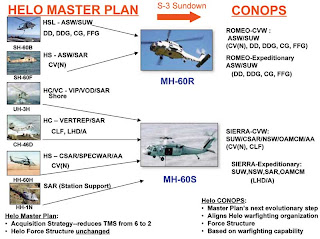
 The Navy has had to make several sacrifices over the last several years to deal with fiscal reality. Many of these decisions do not have the luxury of being made based on warfighter requirement, rather the bean counter requirement. The accountant requirement has shifted the Navy to focus on finding ways to improve business efficiencies to enhance warfighting effectiveness. One area of operations in the Navy hit the hardest is the helicopter community.
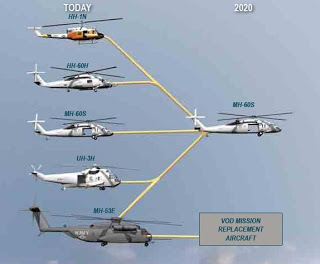
Current plans either have retired or intend to retire legacy platforms including various Sea Hawk models (SH-60B, SH-60F, and HH-60H), Sea Kings (UH-3H), Sea Knights (CH-46D), and Hueys (HH-1N), all of which will be replaced by the new MH-60S (Sierra) and MH-60R (Romeo). Mission roles of legacy RW included antisubmarine and antisurface warfare, search and rescue, combat search and rescue, special warfare support, VIP/vertical onboard delivery, and vertical replenishment.
According to the Naval Helicopter Concept of Operations, the MH-60R will provide surface and subsurface warfare support with its Airborne Low Frequency Sonar (ALFS), Electronic Support Measures (ESM), Advanced Forward-Looking InfraRed (FLIR), precision air-to-ground missiles, machine guns, and lightweight torpedoes. The MH-60S will parner with the MH-60S for surface warfare missions, carrying the same FLIR and air-to-ground weaponry and machine guns. Additionally, it will be the primary Combat Search And Rescue (CSAR) and Naval Special Warfare (NSW) platform supporting Joint Theater operations. The MH-60S will additionally perform the Organic Airborne Mine CounterMeasures (OAMCM) mission using any one of five advanced sensor/weapons packages to provide detection, localization, and neutralization of anti-access threats (mines).
The current RW concept of operations outlines an acquisition program for 254 MH-60R and 263 MH-60S medium-light helicopters to meet mission needs. This procurement plan is already under way, with 11 MH-60R and 103 MH-60S helicopters in the Fleet and test community in mid-2007.
From the bean counter perspective, this RW concept of operations meets all objectives well. The single airframe model is optimal for maintenance plans, reducing support requirements and meeting objectives for efficiency. From a warfighter perspective, the plan has hit a roadblock, and people are taking notice. The Navy had originally planned to retire the CH-53E by 2005, but has opted not to despite the costs. There is currently no replacement available, and the CH-53E remains the only aircraft able to meet the medium and heavy lift demands of the fleet.
In the September 2007 edition of Proceedings, Captain George V. Galdorisi, USN (Ret.) and Scott C. Truver draw attention to the problems facing the Navy RW community.
If current requirements are extrapolated to cover just the Navy’s two-year Program Objective Memorandum (POM) and six-year Future Years Defense Program (FYDP)--let alone the Navy’s 30-year shipbuilding and aviation plan—it is not clear that the current Navy Helicopter Master Plan and Naval Helicopter CONOPS can meet expected needs. Helicopters provide critical capabilities in support of Navy Carrier Strike Groups (CSGs) and Expeditionary Strike Groups (ESGs), but no CSG or ESG deploying today leaves with its full complement of Navy helos--nor will they in the future--because demand for these multimission assets already exceeds the supply.For example, when the Navy made the decision in the mid-1990s to retire the S-3 Viking aircraft, it also decided to have helicopters assume the Viking antisurface warfare (SUW) mission. At approximately the same time, the service decided to have Navy helicopters provide an organic airborne mine countermeasures (AMCM) capability to carrier and expeditionary strike groups. These decisions and dynamics shaped the Naval Helicopter CONOPS, a concept that was ultimately approved by the CNO on 24 January 2002; however, the concept did not address future heavy lift or dedicated AMCM requirements. In addition to the type-model-series “neck-down” extrapolated from the helicopter master plan, the helicopter CONOPS also examined the concept of operations to provide MH-60Rs and MH-60Ss to carrier and expeditionary strike groups and detailed the numbers of each aircraft to be assigned to each battle formation.
While Navy helicopter requirements documents speak of delivering “capabilities” to carrier and expeditionary strike groups and not of “filling rails”—i.e., providing the maximum number of MH-60R or MH-60S airframes that can be carried on CSG and ESG ships—current H-60 helicopter usage rates demonstrate that the actual demand for these aircraft by carrier and expeditionary warfare commanders far exceeds what operational requirements documents predicted.
On October 3rd, the House Armed Services Committee had a private briefing with the Navy on the subject. According to defensenews, Congress was not very happy after the briefing.
The congressmen spoke two days after the subcommittee received a briefing on the helo plan from Rear Adm. Allen Myers, director of the Navy’s Air Warfare Division. The briefing was closed to the public, although testimony will appear shortly in the Congressional Record, Bartlett said.
Bartlett has been seeking a meaningful response from the Navy on the medium and heavy-lift question since March, when he asked the Navy six specific questions about the medium-lift capabilities.
“I got a nonanswer,” he said.
A congressional staffer said the committee members were “very unsatisfied” with the Navy’s response.
“It took four and a half months for the Navy to provide an answer — a five-sentence answer to six multilevel questions,” the staffer said. The response “did not even mention medium lift.”
Subsequent meetings between the Navy and Congress on Capitol Hill also failed to satisfy the committee, the staffer said, leading to the Oct. 3 briefing.
Bartlett said after the briefing he still had a number of outstanding questions to be answered, but praised Myers’ effort. The admiral, he said, “did a pretty good job defending the undefensible.”
Congress appears focused on the LCS.
But a growing number of observers are concerned that elimination of heavy- and medium-lift helicopters, such as the MH-53E, leaves the Navy short in its ability to handle several key missions.
“One of those areas is mine warfare,” Bartlett said. “Another is battlefield medical support.”
In search-and-rescue, Bartlett pointed out, the MH-60 “can only do 170 miles out, 170 miles back, far too little dwell time if the search area is any distance from the base.
“In terms of medical evacuations, it is nowhere near large enough to carry a compact emergency room — a real problem with that golden hour that is so key to keeping our people alive,” Bartlett added.
Sestak added a new concern to the mix: that the new MH-60s can’t carry mission modules to Littoral Combat Ships (LCS) at sea if no port is available to change out the modules.
...
“There are too many missions which could be compromised,” Bartlett said. “We’re really limiting the LCS. This is a clear violation of our hope for the future that we can do it from the sea.”
The defensenews article also goes on to mention Sea Basing.
Sestak and Bartlett also expressed concerns that the MH-60s won’t be able to maximize advantages from the Sea Base concept, a plan to base and operate large joint forces at sea.
A key to the concept is “connectors” — helicopters and smaller craft that would swiftly transport troops and equipment between ships and shore. Sestak pointed out that the smaller MH-60s will need to take many more trips, and therefore more time, than larger helicopters to transport the same amount of materiel.
“Speed is really a part of this,” Sestak said. “There’s not a lot of speed when you have to do many helicopter lifts.”
Finally, a recognition of the major issue.
Our concerns are that our present helicopter plan was really drafted in the 1990s, when budgets were really constrained,” Bartlett said Oct. 5 in an interview with Defense News. “Since then, several things have happened. We’ve had 9/11, the war in Iraq, and have a very much more robust budget now.”
Rep. Joe Sestak, D-Pa., agreed.
“We should not be looking in the rearview mirror,” said Sestak, a retired admiral. “We should be looking ahead.”
There is a lot here.
First, I want to see Joe step up, he no doubt understands the vertical lift problem facing the Navy, and this is one of the rare times where a specific warfighting gap exists today in the current war for the Navy. A fast track may or may not be appropriate for addressing the gap in lift, but what is appropriate for fast track is for Congress to call on the Navy to take a serious, objective look at the capability gaps, now, and get back with analysis. Clearly the most affordable way ahead is to look at existing platforms like Lockheed Martin’s US101 or Sikorsky’s S-92, or perhaps even the NH90.
But moving beyond the specific choice of platforms, what bothers me is the wide disconnect between the Navy vision and the Congress vision in context of the larger discussion, and how metrics applied by each side are so different.
There is little, if any, research or reporting in the public domain on the LCS that I am aware of where RW would be employed for module swap on the LCS. Clearly this is smart, but the Navy has only mentioned module swap in the context of forward basing or even sea basing, but never via RW.
 Additionally, the discussion of RW in context of Sea Basing has been almost entirely limited to that of the Marine Corp. RAND recently released an excellent report on Sea Basing called Warfighting and Logistic Support of Joint Forces from the Joint Sea Base. It is without question the best study to date on the current Navy plan for Sea Basing with the MPF(F) squadron, and goes into excellent detail of analysis regarding the logistical capabilities. While I will go into a lot of detail later this week on this report, in summery one of the major gaps identified is the RW heavy lift capability.
The MH-60 S/R program is good in my opinion, it meets a number of requirements effectively, with its major shortfall being the lack of total platforms to meet demand at the present time. Congress can fix that, but it requires money they may choose not to spend on the problem. In the meantime, the gaps in medium and heavy lift however are beginning to strain the system, and there are currently no programs of record to address either problem. At the same time, the RAND analysis identifies the need for more heavy lift RW to fully support the requirements of the Joint Sea Base.
The Proceedings article and RAND report are timely, and I look forward to the release of the testimony by the HASC. There appears to be a disconnect between the "capabilities" metric applied by the Navy and lift metric applied by Congress. The way I see it, Congress appears to be right on this issue, but it leaves the question why the Navy hasn't stressed the lift metric?
The square peg, round hole analogy applies, and we know that answer. We already have the medium lift replacement, finally, and it is actually deployed now... Too bad it doesn't actually have the medium lift capability to be a true replacement.

No comments:
Post a Comment