
 The House Armed Services Seapower and Expeditionary Forces Subcommittee met on Tuesday to discuss the topic of surface combatant construction. As usual, there were submitted statements by all sides, with questions and answers. While the submitted information is interesting, the questions and answers were revealing.
The first panel consisted of Dr. Eric Labs and Dr. J. Michael Gilmore of the Congressional Budget Office, Mr. Ronald O’Rourke of the Congressional Research Service, and Mr. Paul Francis the Director of Acquisition and Sourcing Management for the Government Accountability Office. There were a number of interesting points raised in the discussion.
The CBO statement actually details many of the points raised by the CBO in both the opening statements and Q&A; session. All figures are in FY08 dollars. The highlights include:
The CBO has now revised their estimated cost of the 313-ship fleet plan to be an annual average of 22.7 billion dollars a year, roughly 30% higher than the Navy estimate.
The CBO estimates the costs for both the DDG-1000 and CG(X) programs to be woefully underestimated, before adjustments to the programs like nuclear power are even discussed.
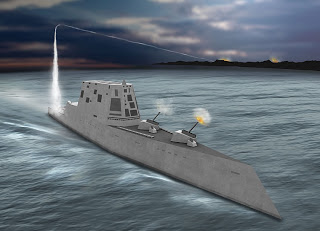
The CBO now expects the first two DDG-1000s to cost 4.8 billion each, with the other 5 costing an average of 3.5 billion each. That is 27.1 billion dollars for 7 ships. By comparison a new DDG-51 would cost 1.6 billion, meaning for the cost of the DDG-1000, the Navy could buy t 17 more DDG-51 Flight IIAs. The CBO goes on to make the following two points:
The Navy’s estimate for the two lead ships of the DDG-1000 class is equivalent to about $230 million (in 2008 dollars) per thousand tons of lightship displacement (the weight of the ship without its fuel, payload, or crew). That figure is smaller than the cost of the lead DDG-51 class destroyer or the lead Ticonderoga class cruiser (in FY08 dollars). CBO’s estimate for the first two DDG-1000s—which equals $380 million per housand tons—is based on the cost of the lead DDG-51, adjusted for differences in the size of the two types of ships.
At the same time, the Navy’s 2008 budget submission to the Congress estimates the cost of building the seventh DDG-1000 in 2013 at about $2.1 billion (in 2013 dollars). Deflated to 2008 dollars (using the inflation index for shipbuilding that the Navy provided to CBO), that estimate equals about $1.6 billion—or the same as for an additional DDG-51, which would have the benefit of substantial efficiencies and lessons learned from the 62 models built previously. The lightship displacement of the DDG-1000 is about 5,000 tons greater than that of the DDG-51s under construction today. In effect, the Navy’s estimates imply that those 5,000 extra tons, as well as the 10 new technologies to be incorporated into the DDG-1000 class, will be free.
The CBO now estimates the lead CG(X) to cost 4.9 billion, with the remaining 18 CG(X) to cost an annual average of 4.0 billion. That comes out to 76.9 billion for 19 ships, without adding costs or requirements like nuclear power which averages around 600 million per ships (an extra 11.4 billion for all 19 ships).
 The CBO now expects CVN-78 to cost 11 billion dollars, roughly 10% higher than reported last year.
Excluding mission modules, the CBO now estimates the 55 Littoral Combat Ships (LCS) to cost an average of 450 million per hull.
The CBO now estimates the first 2 LCS cost to be around 630 million each, and does an excellent job of putting this into perspective.
Experience had suggested that cost growth was likely to occur in the LCS program. In particular, historical cost-weight relationships—using the lead ship of the Oliver Hazard Perry class of frigates (FFG-7) as an analogy—indicated that the Navy’s original cost target for the LCS was optimistic. The first FFG-7, including its combat systems, cost a total of about $650 million (in 2008 dollars) to build, or about $235 million per thousand tons. Applying that per-ton estimate to the LCS program suggests that the lead ships would cost about $575 million apiece, including the cost of one mission module (to make them comparable to the FFG-7). In this case, looking at cost-weight relationships produced an estimate less than the apparent cost of the first two LCSs but substantially greater than the Navy’s original estimate.
I find that very interesting, while I'm critical of the LCS, it is noteworthy that the lead LCS is about the same cost as the lead Perry class, something I was unaware of. Is a single LCS hull worth a Perry hull? It certainly isn't as capable, particularly since the Perry is armed better and the LCS is missing its mission modules. Is this really what the Navy wanted with the LCS, a 1-1 cost replacement for the Perry, except modular not weapons based? The CBO also makes an interesting point on Amphibious ships:
On a per-ton basis, the lead LPD-17 was the most expensive amphibious ship ever built, at more than $130 million per thousand tons (see Figure 4). Using the historical cost-weight relationship of either the LSD-41 or LHD-1 amphibious ship as an analogy would have substantially understated the actual costs of the LPD-17. Subsequent ships in the LPD-17 class cost between $1.4 billion and a little less than $1.7 billion, or an average of about $90 million per thousand tons. To meet the $1.5 billion cost target in the current shipbuilding plan, the Navy would have to build all future amphibious ships for about $70 million per thousand tons. However, the Navy estimates that the lead LHA-6 will cost about $90 million per thousand tons.
The CRS and GAO echo the numbers used by the CBO, and in the Q&A; a number of points are made. Eric Labs hammers the Navy on its estimation of ship costs. He should, if the Navy has estimated the cost of the lead DDG-1000 to be less than the current AEGIS fleet, the Navy figures are clearly wrong. Eric Labs made a point worth consideration, in his 10 years in estimating costs in Navy shipbuilding, he has not once overestimated a ships cost.
Several factors of shipbuilding costs are discussed, whether pointing out how the system is designed to cheat the numbers for program acceptance from Congress to the cut in management personal in the Navy to handle the oversight of shipbuilding. The Ship Characteristics Improvement Board is a start, but a number of former offices that used to control shipbuilding have been shut down, and re-establishing boards to review programs already in trouble isn't going to solve todays problems.
The CRS and GAO reports go into details of ways Congress can change the status quo in the industry. The various points would take awhile to sum up, so either the reports or listening to the audio of the hearing can provide additional insight there.
Two specific programs were mentioned specifically in Q&A to watch out for, as a delay in either is sure to raise the cost of the DDG-1000 and CVN-78, the Dual Band Radar and the Total Ship Computing Environment. According to the panel, the slips to date in both programs have left no margin for error for the current DDG-1000 and CVN-78 schedule.
Panel 2 which was the Navy testimony I'll cover tomorrow. It was an interesting discussion as well, but left me wanting to do some research before discussing.

No comments:
Post a Comment