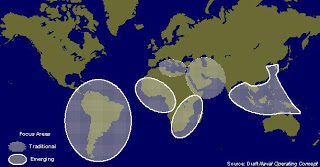
 While the United States is fighting the war today in the Middle East, the US Navy is looking to win the war of tomorrow without firing a shot. The battleground for that war will exist in various hot spots around the globe, some as near as South America and some as far as the South Pacific. Foremost among the future economic interests of the United States is the Gulf of Guinea. Like the Middle East, it is difficult to look around and find open, honest governments worthy of Ivory Tower partnerships, which in my opinion, makes it a critical region the US needs to get more engaged with sooner rather than later. While some complain the US interest in the region is centered around oil, as someone who thinks the US could be doing a better job taking care of its economic interests, I'd respond "it better be about oil" or our economy is going to go down the toilet.
Amid concerns that weak government controls in some West African states has made the region fertile for drug cartels, people smugglers and Islamist groups, the U.S. navy command in Europe has focused its activities southward.
"The clear majority of shipping coming into the United States is coming off the coast of West Africa into the Gulf of Mexico," Vice-Admiral John Stufflebeem, commander of the U.S. Sixth Fleet based in the Mediterranean, said on Saturday.
"So we are interested in this (region) from a security perspective from our own homeland, and ... in commerce and quite frankly, oil is one part of it," he told Reuters.
The Gulf of Guinea, which includes oil producers like Angola, Equatorial Guinea and Nigeria, is central to U.S. efforts to reduce dependency on Middle Eastern exports.
It currently supplies around 15 percent of U.S. oil consumption, and that is forecast to rise to 25 percent by 2015, although resource-hungry China is also looking to corner oil supply from the region, notably in Angola.
With the upcoming Global Fleet Stations deployment of the USS Fort McHenry (LSD 43), the US has already begun setting the stage in the region to insure a long term commitment. With Nigeria in political chaos, Sao Tome and Principe is an ideal location for a future naval base in the region to promote security. The new $18 million Automatic Identification System (AIS) radar system in Sao Tome and Principe was the first step, and the Navy Seabee's arrived this week to repair the countries Coast Guard facilities.
The equipment delivered by Endeavor will be used to renovate the boat ramp at the city of Sao Tome’s coast guard base. Currently, the base’s only boat ramp is unable to launch patrol boats due to erosion and shallow slope into the water. During their three-month project, the Seabees will widen and steepen the slope of the ramp.
While in Sao Tome, the Seabees will also build a guard house for the base.
Both of these building projects are aimed at strengthening Sao Tome and Principe’s ability to contribute to maritime safety and security in the region. Increasing regional maritime security in the Gulf of Guinea is one of the U.S. Navy’s top priorities in their growing engagement with Africa.
The US Navy and allies are quietly in action behind the scenes in the Gulf of Guinea region setting the stage for the upcoming Global Fleet Station deployment, but there are still several questions that will need answers to determine the entire concepts effectiveness. Will the US be able to achieve the political cooperation to help with the Niger River security problems? Will the US have enough assets, including the right assets, to take on the piracy in the region, or will we see another pirate encounter involving a LSD? Is the State Dept ready to go? If the answer to any of these questions is 'no' then the plan is flawed. You only get one chance to make the right first impression, and the first impression on this mission can have serious ramifications for the US and the region over the next decade.
The potential for kinetic operations is high in the region, and the ability of the Global Fleet Station to respond to these events is going to be critical. The media is going to ignore all the good will and progress, but is going to be all over the kinetic stuff this time. It is entirely possible the HSV Swift Global Fleet Station deployment has all kinds of kinetic activities happening behind the scenes, but the reality is, nobody actually cares about the drug trade in South America, but oil is on everyones radar, so the quiet stuff is more likely to make headlines.
I am encouraged by the soft power information leaking out. Working with NGOs is important, and creating the right environment for private investment, combined with sustained US Navy presence are good starting points for providing the type of Phase 0 operations Global Fleet Stations is designed for. The United States needs to be focused on leveraging economic power in the region to counterweight the historical forces that contribute to the regional chaos. The GWOT is termed the Long War, well if that is true, the Navy needs to term Global Fleet Stations as a vehicle for the Long Peace. A long term commitment to security, economic growth, and education has the potential to transform the region, but management, creating political cooperation, and fostering relations needs to be both precise and productive. Thinking small will result in small gains, thinking big means setting big goals, leading to the potential of big strategic gains in the region.
While AIS becomes a standard Maritime Domain Awareness tool, the tool won't be effective unless sustained presence is established. Nations like Nigeria are soon to hold a higher importance than Saudi Arabia as a US energy supplier, so establishing credible security early in the region is critical to making the type of economic and political change necessary to insure long term improvements in the region. If the Gulf of Guinea does become the strategically important region predicted, this Global Fleet Station deployment could carry significant long term ramifications for the US Navy's role in peacetime.

No comments:
Post a Comment