Thursday, October 15, 2024

The Art of Battalion Command in Counterinsurgency: Part Three - The Local Approach

The Marine Corps University Counterinsurgency Leadership In Afghanistan, Iraq and Beyond: The Art of Battalion Command in Counterinsurgency transcript (PDF) is so good, I have decided to post the entire thing in four installments. I believe there are important insights in these discussions not only for Afghanistan, but in the context of US Navy discussions as well. The participants were:

Bing West, Correspondent, The Atlantic
Col. Dale Alford, Institute for Defense Analyses, USMC
Col. William M. Jurney, US Joint Forces Command, USMC
Col. David Furness, Marine Corps Liaison Office, US House of Representatives

Held on Wednesday, September 23, 2024 at 10:30 at the National Press Club, Washington DC, part three is the presentation by Col. William M. Jurney.
Good morning. Dr. Moyar, again asked us to address a few points from the battalion perspective regarding lessons and experiences from Ramadi, ’06, ’07 timeframe.
I would start by saying that the employment concept of military forces is first and foremost based on getting at the enemy so that’s the perspective that I’m going to come from.

With an offensive mindset and not defensive you look for and go after that which allows you to take and maintain the initiative against that which opposes you. There is no cookie-cutter solution or template for this. And I think all too often, that’s what we see folks seeking, that there’s got to be one set template approach. And I would submit to you that that’s just not going to be the case.

However, in counterinsurgency, you can’t expect the key terrain to be the population. We’ve heard some folks talk about that today. So the question comes up as to whether you should be population focused or enemy focused. And I submit to you that the answer is yes. You cannot look at one without understanding the full implications to the other.

The key thing that I said just now was “understanding,” which is much different from assuming or misplacing your own Western bias onto the actions or reactions of particular events in a given AO. Wide variances can exist from one local area to the next, therefore you must account for and understand these specific nuances for each local area or community.

From that point, you can already see that an effective tactical concept of employment, by necessity is going to come predominantly from a bottom-up point of view.

Nevertheless, back to the question of population focus or enemy focus - in my framing of the two, I would submit that the population is viewed more as a means to get at the enemy versus a standalone end state. It’s not that CMO or civic actions should not be aligned to meet the needs of the people. It’s just that they have to be more closely aligned and prioritized by that which gives you the greatest tactical advantage to get to the enemy first.

Oftentimes, I’ve seen civil military actions that are not connected to either the needs of the people or anything else that ties to improving a unit’s ability to hurt the enemy.

Now, that’s not meant to be a disparaging comment about our civil affairs efforts but rather at the decisions of commanders because it is a commander’s decision no different than ordering an attack, which brings me to my next point which is that you cannot understand something that you do not live with, sleep with, and operate with every day and night.

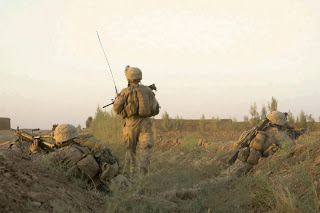
Effective COIN operations in and around populated centers require a permanent, persistent, credible security force. It cannot be part time. You will not gain the level of understanding of the situation, nor the trust of the people if you’re not there 24/7.

The best security force is homegrown. It’s local. Some might think that I’m simply advocating the last experience in Ramadi with the Awakening. Actually, no. The Awakening was a growing movement that was making a difference outside the city of Ramadi in late ’06. And although it helped in providing new recruits for outside the city of Ramadi - which was a good thing - this movement and its recruits were from surrounding rural areas and they would not operate within the city proper. And therefore, not the ideal local type that you want, who knows the streets and knows the people.

Yes, at some point we hoped that a national identification of governmental forces transcends a struggling country psyche, but near-term COIN is not going to happen. Make no mistake.

The best security and sense of security for locals are a local, and that local security force will also know the area and its people in such a way that no level of cultural understanding will ever bring.

A local security force is the enemy’s worse nightmare come to town. If the enemy loses its ability to hide in plain sight, he then loses his freedom of movement and action. He also loses the ability to replenish its own ranks with new recruits. So you’re hurting the enemy and you’re meeting the essential needs within your AO for employment, money, prestige, honor, and even a sense of adventure for some by joining a legitimate government security force which also allows, culturally speaking, a desired venue to prove yourself a man and a warrior.

Some will argue that a 24/7 combined action battalion concept for partnering and entire battalion and its leadership with newly forming security forces in the populated areas is simply too risky. I would not disagree more. I submit there’s not only greater risk to the force but also an even greater risk to successful accomplishment of the mission if you choose to operate from some isolate disconnect FOB while conducting independent or intermittent partnered U.S. ops that lack permanent presence and a connection to the people.

Lastly, I suggest that our tactical concepts of employment must pursue multiple lines of effort concurrently if you’re going to take the initiative.

Kinetic and non-kinetic, regular, irregular, conventional, non-conventional - you pick the moniker of the day. There are many. However, focusing on the enemy by only pursuing U.S. targeted raids, all under the framework of “clear, hold and build” are not enough to truly be on the offensive and take the initiative. They’re essential and they’re viable ops. But I would not suggest that such a narrow approach would be pursued.

I have seen time and again the limited activity of general purpose forces waiting on the big one, waiting on the big one to emerge for that game changing targeted raid, the kill or capture an all important individual. This single line of effort is simply not going to work in gaining you the initiative, nor will it work for a unit that simply follow a lockstep sequential approach along the clear, hold, build construct.

I suggest that building or holding one might in fact clear the enemy without a firefight. If so, then why would you limit yourself to only those tools that traditionally associate with conventional ops against a fixed enemy force especially when you can’t even find the enemy?

Therefore, you should cast your net wide along all viable lines of effort if they can help you get at the enemy. Actions that you take should either directly or indirectly lead to improving our ability to impose our will on the enemy.

Discussions of civil military ops, key leader engagement, training employment of local security forces, restricting lines of movement, population control measures, census taking, improving governance and essential services, all are techniques and methods to be applied and/or combined as a leader sees fit based on a continuous process that sees a tactical advantage at taking up such actions.

If not, then I submit that you’re likely putting men and women at risk for nothing. Moreover, you could actually be making your own situation worse by inadvertently disenfranchising the most critical element of getting at the enemy: the population.

And with that, I’ll turn it over to the Dale who I know has been on the ground in Afghanistan. Thank you. (Applause.)

The Art of Battalion Command in Counterinsurgency: Part Four - Culture and Terrain

The Marine Corps University Counterinsurgency Leadership In Afghanistan, Iraq and Beyond: The Art of Battalion Command in Counterinsurgency transcript (PDF) is so good, I have decided to post the entire thing in four installments. I believe there are important insights in these discussions not only for Afghanistan, but in the context of US Navy discussions as well. The participants were:

Bing West, Correspondent, The Atlantic
Col. Dale Alford, Institute for Defense Analyses, USMC
Col. William M. Jurney, US Joint Forces Command, USMC
Col. David Furness, Marine Corps Liaison Office, US House of Representatives

Held on Wednesday, September 23, 2024 at 10:30 at the National Press Club, Washington DC, part four is the presentation by Col. Dale Alford.
I’d like to start by saying us three on the stage here, first of all, we’ve known each other as brothers literally for 20 years. Our families, our friends, we’ve spent many, many hours over the last 20 years drinking beer together and on occasion sipping a glass of whiskey talking about this stuff. And what I just heard over the last 30 minutes, I could say again over and over and expanse on each of those points because we literally know what each other think. And that’s a unique thing about the Marine Corps that you need to understand.

What I will talk about - I was asked by Mark to talk about the lessons from Al-Qa’im and how they transfer to Afghanistan. I had an opportunity to command a battalion in Afghanistan ’04, came home for seven months, went back to Iraq with the same battalion, literally the same battalion, same five company commanders for the most part, the three - the XOs all just - that was an unique piece the 36 were able to do. And then this past year I spent nine months in Afghanistan working for a great soldier named Gen. McKiernan.

What I will say is what Bill said. It is population centric versus enemy centric? Yes. Again, it’s both. And you call look at al-Qaim and you can say we did Iron Fist, a battalion size operation - got to do everything that everyone believed that you would want to do as a battalion commander: shot rockets, dropped bombs, threw hand grenades, the whole bit - and then a regimental size operation, Steel Curtain, in order to take back the area of Al-Qa’im.

That was a means to an ends though. As we moved and did that, we literally dropped off platoons that built position and at the end of a 10-week period, we have 14 positions. And we immediately moved the Iraqi army in with us. I learned many of those things at the first tour in Afghanistan - mistakes made - and was able to use that the next year in Iraq.

And how does that transition to Afghanistan? Right now, what I see in Afghanistan, and I had the opportunity to travel around the entire country, visit many, many units including our NATO partners, that we’re completely an enemy-centric force.

We need to re-position a significant portion of our FOBs and COPs among the population because right now they’re not. The problem is they were built for CT missions in ’02 and ’03 and in ’04 in wrong locations for a population-centric COIN effort.

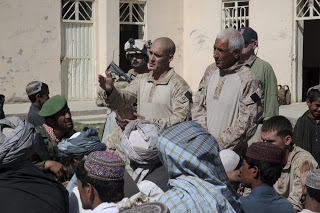
And the second thing is we talk about it a lot, we write about it a lot but we are not focused on the Afghan army and the Afghan police and the Afghan border police. We don’t live with them as partnered units. We consider partnering to link up and do operations. If you’re not sleeping with them, eating with them, and crapping in the same bucket, you’re not partnered and we’re not partnered in Afghanistan.

Real quick. COIN population centric is not about being nice to them like - (inaudible) - said. “Hearts and minds” gets confused sometimes. It’s about separating the population from the insurgents, protecting them, influencing them, and controlling the population, especially in the initial stages. And we talked about already about the enemy. It’s fluid; it hides in plain sight. The enemy does it.

And what do we mean by hearts and minds? I think, Dr. Mansoor, you brought up “trust and confidence.” I totally agree. The heart or the trust is that we’re in their best self-interests. We’re in their best self-interest. The people have to be believe that and in their mind or their confidence in us they have to believe that we are going to win, and when I say we, it’s the Afghan army and police with our support and their government. They have to believe that we’re going to win and we’re going to protect them. In their heart they have to believe we’re in their best self-interest and in their mind they believe that we are going to win. We’re failing to do that.

I’ll talk a little bit about if you’re going to do population-centric COIN and you’re going to live with the Afghan army and police, how do you do that? And the very first step is you really need to understand who you’re dealing with. I’m going to talk a little bit about understanding the Afghan people from my 17, 18 months experience in the country.

First off, this is a quote I found and I totally agree with it. They’ve learned to survive 30 years of war by hedging their bets. They’ve learned to play both sides. And they are still doing it. Why? Because they’re getting slapped on one cheek by their government and the other cheek by the Taliban. They don’t have a good choice and we’re not providing them a good choice because we’re not population centric, we’re not amongst the people, and we’re not with their army and police force. That’s the first step. I was pleased to see Gen. McChrystal’s paper that came out Monday that he’s writing about it. Now we’ve got to execute it.

The next thing is these people can read you better than any people I’ve ever been around including my uncles that live in north Georgia which are very similar to. (Laughter.) They live off the land. They’ve learned over their lifetime in order to survive how to read people. You’ve got to understand that when you deal with then on a daily basis. If you’re not sincere, they will see through you in a heartbeat and you will not be successful with them.

And the next point is about their problems. Their problem is they don’t have honor. They don’t have justice in their government. They believe that their government is corrupt. Whether it is or not, they believe it. And they don’t believe that they have physical security and a significant portion of the population doesn’t have food security four or five months out of the year; those three things, we - if we’re among the people and with their army - we can focus on those.

This is an important list. First bullet: The Afghans have based all their thoughts and decisions on history. When an Afghan looks at life, he looks backwards. He thinks about his history, he makes decisions off of his oral history that he knows of his society.

When we, the Western world, look at life, we look forward. We think about how we’re going to have a bigger house, we’re going to have a better retirement, I’m going to get a better car, I’m going to send my kid to college and get a better education, which in my case, it’s not very difficult to do.

When you deal with an Afghan, he makes decisions. You’ve got to know that. He looks at life 360 degrees from the way you look at life. It’s difficult for us to wrap our minds around and understand that. We must try better.

It’s an agricultural-based society which is extremely important and it was - and much of their agriculture was destroyed in past history and we must focus our effort and our development to bring that back. First thing is we’ve got to be there amongst them.

And then the rural versus the city - 80 percent of the population is a rural force, rural people. They don’t want electricity in many of the homes. We think they do. Why did Iraqis want electricity as soon as we - because they had electricity. The Afghan - many of the Afghans never had electricity. They want electricity to move water in their clinics and to schools but in their basic homes, they’re not begging for it, but we’re trying to give it to them in many cases. We need to understand them better before we try to help them.

And the last one, how do you get them to pick our side? This whole thing is about getting them to pick our side. Right now, they’re playing defense. They’re on defense because they’re not picking our side because they don’t believe in their heart that we’re in their best self-interest, and in their mind they don’t know if we’re going to win.

The Afghan culture, it’s like the Iraqi culture on steroids. It really is. It’s a weird mix between Pashtunwali and Islam, which in many cases are opposed to each other. And the parts where the insurgency really is, the East and the South - because this is a Pashtun insurgence, make no error about it - Pashtunwali is extremely strong even though something similar to Pashtunwali is throughout the rest of the country. And it is a great code. It is a very similar code that my uncles in north Georgia live by.

Understanding the people and their culture, and you need to do that because that’s all they have. That village elder that you deal with on a daily basis, if you’re doing this business right, his honor and his culture and his history is all he has in life and he will kill you for it.

We’ll go through the Afghan army real quick. One thing I’ll say about it is you’ve got to leverage a culture. The leadership we’ve talked about already, the logistic of their force is weak and we had to work on that. You’ve got to accept chaos when you deal with the Afghan Army because it’s going to be there. And you’ve got to show that you’re committed and risk your life right beside them. If you don’t do that, they will not fight with you.

The army - I’ll talk about all three of them - the army is an extremely credible force especially at the company and below. The battalion and above, they’re struggling. Battalion and above is struggling because they’re trying to build the airplane while they fly it. And if we’re them all the time, which we’re not now, as a partnered force, we can make that a lot better. Advisors and mentors are not enough. We have to evolve for that. We had to start with a partnered force and evolve to mentors and advisors and then work our way out of a job. We got it backwards, I believe.

The Afghan police - there’s got to be a local-based police, as Col. Jurney talked about. It must be from the local area and the people have to know who they are. That’s where the intelligence comes from and I believe that we, as a general purpose force, have to live with the police force.
I can do some math for you really quick. How do you do that because there’s a lot of places. Let’s just say there are 360 districts. There’s 388 but we’ll say 360. I think an infantry battalion can do about 12 positions, 12 districts, and we’ve got some examples of this down south with the Marines in Delaram. You divide that and it comes out to be 30 battalions. Thirty battalions is 10 brigades. We’ve got to do some real math and tell some real truth about what it’s going to take if we’re going to do population-centric COIN because the police are the most important thing we’re doing and right now we’re not focused on it.

Those clusters in those districts, you’d be amazing at what happens when the Marines live with them or the soldiers. The governor, the district governor moves and he puts his house right by the police station. The district police chief moves right by the police station and stays there 24/7. The judge moves there. He can move the DSTs, the district support team out of PRTs into those areas. It becomes a cluster in those districts and that’s where it matters in Afghanistan, down at the district level. We’re failing to do that.

And last, the last piece is the Afghan border police, the forgotten soldiers. They are a paramilitary fighting force. If you want to get into a firefight in Afghanistan you go partner up with the Afghan border police. You’ll get all the fighting you want. We’re not doing it. And we must change the way we’re doing it and we must do some real math on what it’s going to take if we want to make a viable, stable Afghan country that no longer harbors terrorists. If that’s so, then there are some hard lessons, some hard decisions that have to be made about what’s going to take.

Thank you. (Applause.)

The Great Green Fleet

I would have had difficult time keeping a straight face during this announcement, which would have got me thrown out of town had I attended the Naval Energy Forum. It is actually a very clever slogan and an idea well worth promoting and following through, but it does sound a bit corny the first time you say it out loud.
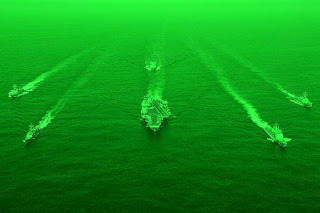
Navy Department leaders issued a set of ambitious new plans to boost the Navy and Marine Corps’ energy efficiency Wednesday, including the goal of fielding a completely sustainable carrier strike group dubbed “the Great Green Fleet.”

Navy Secretary Ray Mabus cited the example of President Theodore Roosevelt’s Great White Fleet, which announced the arrival of American sea power by circling the globe in 1907, and said a new focus on energy would augur just as big a turning point for the service.
Is there an Admiral bold enough to paint all the ships Green too, perhaps a camouflage kit similar to the General Dynamics LCS art? Maybe we can borrow the blue camouflage designs from the Chinese Type 022, but instead of white we use green? Could be fun in Photoshop anyway...

The basic idea is to use nuclear power and hybrid drives, like technologies previously discussed, for all the ships, aircraft, and submarines in the carrier strike group. I think it is a clever idea. According to the idea, the SECNAV wants the Navy to demonstrate that it can sail this green carrier strike group by 2012 and deploy it by 2016 as evidence the Navy can exert influence at sea without the need for foreign oil. Obviously this is all very possible.

The article by Phil Ewing lists other SECNAV energy plans for the Navy:
  • Mandate that energy usage, efficiency, life-cycle costs and other such factors be part of the Navy’s decision when acquiring new equipment or systems, as well as vendors’ efficiency or energy policies.
  • Cut petroleum use by half in the Navy’s fleet of commercial vehicles by 2015, by phasing in new hybrid trucks to replace older ones.
  • Get half the power at Navy shore installations from alternative energy sources — including wind or solar — by 2020, and where possible, supply energy back to the grid, as the Navy does today at Naval Air Weapons Station China Lake, Calif. Marine Corps Commandant Gen. James Conway said Wednesday he wants Marine Corps bases in the U.S. to eventually buy no external power, and sell back excess power when possible.
  • Reach the point that half the energy used throughout the Navy Department, including in ships, aircraft, vehicles and shore stations, comes from alternative fuel or alternative sources by 2020. Today that percentage is about 17 percent.
Here is a fact about Navy history that uniformed folks rarely mention when honoring their uniformed brothers throughout US Navy history. For every A. T. Mahan, there was a Theodore Roosevelt on the civilian side. Even Stephen Decatur had his Benjamin Stoddert and Paul Hamilton. It hasn't been since John Lehman that the Navy had a Secretary of the Navy who came out and gave a bold, forward looking vision that was relevant to the geopolitics of ones era. If Secretary Mabus truly makes bold initiatives in energy during this era, he will be remembered, because I think we are about to enter the decade of energy.

Look, a few things between just you and me. My spies tell me RAND is soon to release a report on Alternative Energy that is going to flat out say Algae energy is "impossible" and is going to recommend the federal government quits "wasting" its money on the technology. I read RAND reports and enjoy many of them for their analytical processes and development theories, but as a dumbass Arkansas redneck known to make a reckless rant or two, I really can't wait to see this report. Here is the dirty little secret... if that RAND report isn't released very, very soon, it will be obsolete and may never actually see the light of day, and it will save RAND from looking supremely foolish and out of touch. The analogy that will be used should this report see the light is that this report is like holding a hearing in Congress in late November 1903 saying that human controlled flight by man is impossible.

I recently solicited emails to every algae energy expert I could find mentioned in a LA Times, NY Times, and Wall Street Journal articles on algae energy asking what it will look like for a major oil replacement energy source technology to "break out" into the mainstream information space. I sent eight emails and had five responses, and all five of them asked the same thing: "Who are you working for?"

That is an interesting sign that tells how the politics of Green Energy are dominating, and the money of this sector is competitive. Seeing that I couldn't find one expert to go on the record for my little corner of the internet, I consulted my international businessmen friends instead, and asked what we are looking for. The answers are my top five tips for watching Green Tech break out, and I expect it to happen very soon.
  1. Don't watch the oil companies, watch the transportation companies. If an airline, transportation company, or shipping company signs a deal with a green energy company, the green technology is probably viable and preparing for commercial production. Everyone wants to be the next Southwest Airlines locking in cheap fuel for the next several decades like they did with oil long ago.
  2. The first big green energy contract will likely be an American company setting up shop overseas. All this talk of "Green Jobs" in the US is the stuff of politicians and academics; real investors will take advantage of cheap land and cheap labor. It will not be good politics when a US "Green Energy" company builds a billion dollar facility in the 3rd world, but it will be good business.
  3. The companies that break out with the first few huge commercial contracts will get raked over the coals by "experts" and "consultants" in the green energy field, including in mainstream media and with Washington elite, casting skepticism on both the contract and the technology. For many experts and consultants, their opinions are only worth anything as long as Green Energy remains a field of theory instead of practice.
  4. The DoE, indeed the entire federal government including the DoD, will likely be the very last to learn which company makes the big breakthrough in Green Energy technology that can take over for oil. The governments funding model is configured for people with concepts, not products. The Navy's contract with Solazyme is a perfect example how government is completely caught up looking at pretty trees instead of the forest when it comes to green technology. Solazyme has very cool technology for making SVO, but it can't scale because they literally cook sugar to create SVO. Show me what the kitchen looks like that Solazyme uses to cook enough SVO to replace gasoline used in cars. Hmm...
  5. The future oil replacement is Algae, not ethanol, and the algae technology that breaks out into commercial contracts will not be reliant on traditional methods of photosynthesis and therefore will not conform to the conventional wisdom of "expert" analysis. The major technology breakthrough will be when a company can find the right combination of an open pond capable photobioreactor for use on synergistic colonies of algae (several Algae companies already have algae strains to meet this requirement) and has perfected an extraction technology that scales to commercial levels. Everything else has been invented.
The SECNAV is being very smart with his recommendations and for pushing a vision of energy, in fact I would call the timing fantastic. Attend any energy forum or read any "expert" paper and they tell you we are still very far away from algae energy. We really aren't as far away as is suggested in the press, it is a lot closer than people think and on scales people are not prepared to believe. We will see 200,000+ bpd SVO facilities by 2015 that are capable of producing biodiesel at prices about equal to $30-$40 a barrel of crude. That is only 5 years from now.

You see, the conversation over Green Technology is soon no longer going to be about "what if," the questions will become "what now." After all, it will be American companies setting up these algae energy facilities in foreign countries, shifting the global energy center of gravity away from the Middle East and into places of cheap labor like South America, Africa, and southeast Asia.

With the ability to build mature 200,000+ bpd SVO facilities in 3-4 years, the transformation is going to happen a lot quicker than people think. I'm not even going to bother making the bonus points on how this positively influences food and water resources, which will make the algae technologies even more desirable to investors, including governments having problems with inland fishery problems.

The real conversation is whether you have even considered how this is going to change your near-term wargame? You better give it more than a thought or two, the decade of energy change will be 2010-2019. Want to hold me to a prediction? Hold me to this one... we will see the first billion+ dollar Algae Energy contracts to produce large quantities of SVO by 2Q 2010, if not sooner.

Wednesday, October 14, 2024

CSIS Global Health Essay Contest

Here's an excellent opportunity for some of the great writers who regularly comment here to put their brains to work in the service of their fellow man.

The Center for Strategic and International Studies is sponsoring an essay contest, with $1000 going to the essay that best answers the question:

"What is the most important thing the U.S. can do to improve global health over the next 15 years?"

My money's on Robert Farley, if he decides to enter!

Bryan McGrath

Navy Energy Security

I really enjoyed the Rhumb Lines from yesterday, good enough to quote in my opinion.
The Naval Energy Program is focused on enhancing operational capability. Energy security means having an adequate, reliable and sustainable energy supply - sufficient to meet the demands of the mission. Energy conservation and efficiency enhance our combat capability to fly and sail farther, and longer. Investing in alternative sources and protecting our supply provide resilience against a fragile grid ashore, insulates from volatile energy prices, and ensures we can accomplish our mission at sea.

Energy Security
  • Energy security is focused on transforming vulnerabilities associated with energy supply and demand into a strategic and operational advantage. Energy security involves tactical and shore missions that have different energy challenges and opportunities, and therefore require unique solutions.
  • By implementing energy efficiency measures and considering energy when making decisions, from the individual to program-level, the Department of the Navy is reducing energy consumption and serving as a global role model for environmental stewardship.
Tactical Energy Security
  • Tactical energy security addresses risks to the warfighter. These include significant costs associated with volatile petroleum prices, unstable petroleum suppliers and extensive supply lines on land and at sea. Lengthy supply lines are vulnerable to attacks that can result in loss of life and mission.
  • The Navy increases tactical energy security by improving overall fuel conservation efforts, enhancing energy efficiency of tactical platforms and increasing use and availability of non-petroleum fuels.
Shore Installation Energy Security
  • Increasing shore energy security provides protection from vulnerabilities related to the commercial electrical grid, which is susceptible to natural disaster, physical or cyber attack and malfunction.
  • The Department of the Navy increases shore energy security by lessening our shore energy consumption through sustainable building design and renovation. We will further strengthen our energy security by enhancing protection of critical infrastructure and increased use of renewable alternatives.
This part is very good.
  • The Department of the Navy’s emerging energy strategy is centered on energy security, energy efficiency and environmental stewardship while remaining the pre-eminent maritime power.
  • Energy security is critical to mission success. Energy security safeguards our energy infrastructure and shields the Navy and Marine Corps from a volatile energy supply.
  • Energy efficiency increases mission effectiveness. Efficiency improvements minimize operational risks, saving time, money and lives.
  • Environmental stewardship protects mission capabilities. Investment in environmentally responsible technologies afloat and ashore reduces green house gas emissions and lessens dependence on fossil fuels.
The key point:
  • DoD is the largest government and individual petroleum user in the U.S., consuming about 330,000 barrels per day. The Department of the Navy is the 2nd largest fuel user in the DoD, consuming about 100,000 barrels per day. The Air Force uses about 200,000, and the Army uses about 30,000.
The Naval Energy Forum kicks off today outside Washington DC today. I had intended to go, but it didn't work out. You can check it live video stream here, and I think they will have archive video up later as well.

I will have a lot more on this subject, probably next week.