Saw this in Defense News, and it got me thinking. What caused WWI? If I sat down and tried to write an acceptable answer to that question, it would probably take two or three paragraphs. That's unacceptable. See if you can construct a one-sentence answer of twenty words or less that answers the question.
Bryan McGrath

Saturday, July 18, 2024

CBO Report Comment
Galrahn's post below on Eric Labs' new CBO report adds Labs' work to my growing "to read" list. I did scan G's post and the exec summary, so I figure I have enough to think out loud a bit.
I'm sure Eric Labs goes into the money on these alternatives as skillfully and honestly as anyone in DC can. In my opinion, Labs has a better ability to cost shipbuilding programs than anyone in the Navy or industry. So I won't talk about money.
I will talk a little about the "requirement". Because if you tee this discussion up along the lines it appears Labs is taking it, you bang up against a striking logic brick wall, to wit:
The NSC for the Navy question has been laid before the Navy in great detail. Northrop Grumman's best marketing folks have briefed everyone of importance in the Navy about the extensibility of NSC. The problem for NSC has always been its "threat" to LCS. The Navy has a great deal riding on LCS, so when the discussion of NSC would come up, senior officers would always cite NSC's inability to "meet the requirement" (of LCS). Having never actually laid eyes on the LCS requirement, I could never judge the veracity of this view. But knowing what I know about the stated requirement for LCS, one could surmise that NSC's draft was too deep and it was too slow, among other things.
The problem with the Navy's view here isn't that NSC can't meet the LCS requirement--I'm willing to believe that. The real problem is that LCS doesn't meet the requirements for low-end presence that the Maritime Strategy surely suggests. It is too expensive to build in numbers, and it has insufficient range/endurance. The Navy made much ado about operations on the low-end, capacity building, HA/DR, maritime security, etc--but they do not have a platform or platforms that adequately address these aspirations. THIS is where the NSC has relevance to the Navy.
Some in the Navy talk about the light armament of the NSC as a detriment to independent operations--tell that to the folks who will command them for the Coast Guard. Let's face it; if we found ourselves at war with another maritime power, the fact that the ship is white isn't going to matter much.
This is probably far too many words about a report I haven't read yet--but I'm excited to be a part of the ID team, and I thought I'd get some thoughts out on day 1.
I'm sure Eric Labs goes into the money on these alternatives as skillfully and honestly as anyone in DC can. In my opinion, Labs has a better ability to cost shipbuilding programs than anyone in the Navy or industry. So I won't talk about money.
I will talk a little about the "requirement". Because if you tee this discussion up along the lines it appears Labs is taking it, you bang up against a striking logic brick wall, to wit:
The NSC for the Navy question has been laid before the Navy in great detail. Northrop Grumman's best marketing folks have briefed everyone of importance in the Navy about the extensibility of NSC. The problem for NSC has always been its "threat" to LCS. The Navy has a great deal riding on LCS, so when the discussion of NSC would come up, senior officers would always cite NSC's inability to "meet the requirement" (of LCS). Having never actually laid eyes on the LCS requirement, I could never judge the veracity of this view. But knowing what I know about the stated requirement for LCS, one could surmise that NSC's draft was too deep and it was too slow, among other things.
The problem with the Navy's view here isn't that NSC can't meet the LCS requirement--I'm willing to believe that. The real problem is that LCS doesn't meet the requirements for low-end presence that the Maritime Strategy surely suggests. It is too expensive to build in numbers, and it has insufficient range/endurance. The Navy made much ado about operations on the low-end, capacity building, HA/DR, maritime security, etc--but they do not have a platform or platforms that adequately address these aspirations. THIS is where the NSC has relevance to the Navy.
Some in the Navy talk about the light armament of the NSC as a detriment to independent operations--tell that to the folks who will command them for the Coast Guard. Let's face it; if we found ourselves at war with another maritime power, the fact that the ship is white isn't going to matter much.
This is probably far too many words about a report I haven't read yet--but I'm excited to be a part of the ID team, and I thought I'd get some thoughts out on day 1.
Another Great Gates Speech
 I think Gates speech at a Meeting of the Economic Club of Chicago might be one of his best yet. Read the transcript. A few bits worth thinking about.
So where do we go from here? Authorization for more F-22s is in both versions of the defense bill working its way through the Congress. The president has indicated that he has real red lines in this budget, including the F-22.I think this part is on the money.
Some might ask, why threaten a veto and risk a confrontation over a couple of billion dollars and for a dozen or so more -- a dozen or so more planes?
The grim reality is that with regard to the defense budget, we have entered a zero-sum game. Every defense dollar devoted to -- diverted to fund excess or unneeded capacity, whether for more F-22s or anything else, is a dollar that will be unavailable to take care of our people, to win the wars we are in, to deter potential adversaries, and to improve capabilities in areas where America is underinvested and potentially vulnerable. That is a risk I cannot accept and one that I will not take.
And with regard to something like the F-22, regardless of whether the number of aircraft at issue is 12 or 200, if we can't bring ourselves to make this tough but straightforward decision -- reflecting the judgment of two very different presidents, two secretaries of defense, two chairmen of the Joint Chiefs of Staff, and the current Air Force secretary and chief of staff -- where do we draw the line? And if not now, when?
If we can't get this right, what on earth can we get right? It is time to draw the line on doing defense business as usual. The president has drawn that line, and that line is with regard to a veto. And it is real.
A final thought. I arrived in Washington 43 years ago this summer. Of all people, I am well aware of the realities of Washington and know that change -- that things do not change overnight. After all, the influence of politics and parochial interests in defense matters is as old as the republic itself. Henry Knox, the first secretary of war, was charged with building the first American fleet. To get the support of Congress, Knox eventually ended up with six frigates being built in six different shipyards in six different states. (Laughter.)Gates has become the guy who stands at the front of the 4th of July parade and carries the flag. People don't necessary believe in Gates, but a lot of people see the flag and follow it.
But the stakes today are very high -- with the nation at war, and a security landscape steadily growing more dangerous and unpredictable. I am deeply concerned about the long-term challenges facing our defense establishment, and just as concerned that the political state of play in Washington does not reflect the reality that major reforms are needed, or that tough choices and real discipline are necessary.
We stand at a crossroads. We simply cannot risk continuing down -- going down the same path, where our spending and program priorities are increasingly divorced from the very real threats of today and the growing ones of tomorrow. These threats demand that all of our nation's leaders rise above the politics and parochialism that have too often plagued considerations of our national -- the national defense, from industry to interest groups, from the Pentagon to Foggy Bottom, from one end of Pennsylvania Avenue to the other.
The time has come to draw a line and take a stand against the business-as-usual approach to national defense. We must all fulfill our obligation to the American people to ensure that our country remains safe and strong. Just as our men and women in uniform are doing their duty to this end, we in Washington must do ours.
Gates has made several tough decisions lately, the F-22 in particular is a very tough call and I think it will cost the US more money than less in the long run, but whatever. What I really appreciate about what Gates is doing though is that he is trying to move the DoD from its rooted position, and the F-22 is the best example of a deeply rooted program. If that program moves, anything can be moved, and everyone knows it.
The fight isn't really about the F-22 anymore. The fight is about who controls the strategic priorities of the defense budget. It is a political fight that has nothing to do with the ideology of Democrats and Republicans, unless that ideology is about power and money. All Gates wants to do is move the DoD, and it doesn't matter to where it moves, only that it gets off the road it is on. Any direction will do, because once the move takes place, then the thinking begins.
I am a big fan of the F-22, and I think we should build around 400, but I support Gates move to cut it because this debate is no longer about the F-22. Anyone in favor of reforming the DoD supports Gates move to cut the F-22, and anyone who likes the business as usual entrenched interests value system of defense budgeting favors the F-22. That is what the F-22 has come to mean, a symbol for change or status quo.
CBO Studies Small Combatants
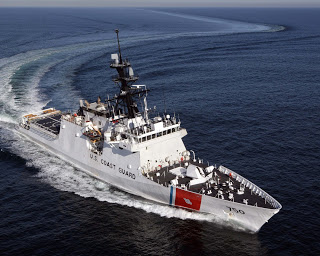 Eric Labs has a new report (PDF) on modernizing Small Combatants for the Coast Guard and Navy released this week. A lot of this is very interesting. This is from the executive summary.
Summary and IntroductionThe report turns out to be a very easy and interesting read with a lot of content worth discussing.
As articulated in their respective long-term shipbuilding plans, the Navy and the Coast Guard intend to spend more than $47 billion combined over the next 20 years to purchase a total of 83 small combatants. Of that number, the Navy plans to purchase 53 littoral combat ships (LCSs), in addition to the two that were purchased in 2005 and 2006. The LCSs will be built using two different hull designs—one, a semiplaning monohull; the other, an aluminum trimaran—although the exact mix of hulls has not yet been determined. The ships will carry one of three sets of equipment, or mission packages, depending on which mission they are expected to perform (antiship, antisubmarine, or countermine warfare).
The Coast Guard plans to buy five new high-endurance cutters, commonly referred to as national security cutters (NSCs), and 25 new medium-endurance cutters, often called offshore patrol cutters (OPCs). Three other NSCs ordered prior to 2009 have been built or are currently under construction. Although the Coast Guard plans to begin buying the offshore patrol cutter in 2015, it is not yet certain what the OPC will look like or if it will be confined to one class of ship. Together, the NSCs and OPCs, which are designed to operate 50 nautical miles beyond the U.S. coastline, are part of the resources and force structure that make up the Coast Guard’s “Deepwater
assets.”
As the designation “small combatant” implies, the Navy’s LCSs and the Coast Guard’s NSCs and OPCs are designed to be significantly shorter in length, lighter in weight, and shallower in draft than most Navy surface warships (carriers, amphibious ships, cruisers, and destroyers). For instance, the Navy’s LCSs have a full-load displacement—the weight of the ship plus its crew, weapons, fuel, and cargo—of about 3,300 tons. The national security cutter displaces about 4,300 tons of seawater, and the most recent notional design of the offshore patrol cutter would have the ship displace 3,700 tons. By contrast, the most modern Arleigh Burke class destroyers, the backbone of the Navy’s surface combatant force, displace about 9,500 tons; amphibious ships displace from 16,000 to 45,000 tons; and aircraft carriers displace about 100,000 tons.
Despite a superficial similarity in size, the small combatants being developed by the Navy and the Coast Guard have different characteristics and capabilities, which are designed to fulfill different missions. In general, the Coast Guard ships are meant to operate independently at sea for long periods of time and at some distance from the shore (that is, to have a large, unrefueled range of operation) and not to engage in major combat operations. The Navy’s LCSs, by contrast, are designed to have less range than Coast Guard cutters but to operate at much greater speeds and serve during wartime as part of a naval battle network in close-in littoral waters in other parts of the world. Those differences in mission requirements have led the two services to reject a common ship platform for their small combatant needs and to adhere to their previously articulated procurement plans.
In the early stages of implementing those plans, however, the Navy and the Coast Guard have encountered various challenges. Cost overruns and construction problems have plagued both versions of the Navy’s littoral combat ship—designated LCS-1 (the semiplaning monohull) and LCS-2 (the aluminum trimaran)—as well as the Coast Guard’s national security cutter. Because of the difficulties associated with constructing the NSC, development of the Coast Guard’s notional offshore patrol cutter has been delayed by five years. All three ship programs have experienced substantial cost growth above the original estimates the services provided to the Congress as well as delays in construction of more than a year for each ship.
As a result of those delays and cost overruns, some members of Congress and independent analysts have questioned whether the Navy and the Coast Guard need to purchase four different types of small combatants and whether—in spite of the services’ well-documented reservations about using similar hull designs—the same type of hull could be employed for certain missions. To explore that possibility, the Congressional Budget Office (CBO) examined three alternatives to the Navy’s and the Coast Guard’s current plans for acquiring littoral combat ships and deepwater cutters.According to CBO’s estimates, all three alternatives and the services’ plans would have similar costs, regardless of whether they are calculated in terms of acquisition costs or total life-cycle costs (see Table 1). CBO’s analysis also indicates that the three alternative plans would not necessarily be more cost-effective or provide more capability than the services’ existing plans. Specifically, even if the options addressed individual problems that the Navy and Coast Guard might confront with their small combatants, it would be at the cost of creating new challenges.
- Option 1 explores the feasibility of having the Coast Guard buy a variant of the Navy’s LCS—specifically, the semiplaning monohull—to use as its offshore patrol cutter.
- Option 2 examines the effects of reducing the number of LCSs the Navy would buy and substituting instead a naval version of the Coast Guard’s national security cutter. (The rationale for this option is that, according to some analysts, the NSC’s longer mission range and higher endurance might make it better suited than the LCS to act as a “patrol frigate,” which would allow the Navy to carry out certain activities—maritime security, engagement, and humanitarian operations— outlined in the sea services’ new maritime strategy.)
- Option 3 examines the advantages and disadvantages of having the Coast Guard buy more national security cutters rather than incur the costs of designing and building a new ship to perform the missions of an offshore patrol cutter.
New Blog Author - Bryan McGrath
I am very excited that the first of my two new blog authors is ready to get started.
Bryan McGrath retired from the Navy in 2008 after 21 years of service, including command of USS BULKELEY (DDG 84). His final tour in the Navy was as project lead and primary author of the nation’s Maritime Strategy, “A Cooperative Strategy for 21st Century Seapower." Bryan earned a BA in History from the University of Virginia and an MA in Political Science from The Catholic University of America, and was a 2006-7 MIT Seminar XXI Fellow.
He is currently the Director of Consulting, Studies and Analysis at Delex Systems, Inc. , headquartered in Vienna, VA. Bryan also runs his own blog for political commentary at Conservative Wahoo. In some of his early blogging, you may remember Bryan jumped online over at Steeljaw Scribes place after the publishing of the maritime strategy and put up a defense as Strategy1 for a few days.
Well sir, you have retired, and I have never met a retired sailor without an opinion. Look forward to reading all about it.
Bryan McGrath retired from the Navy in 2008 after 21 years of service, including command of USS BULKELEY (DDG 84). His final tour in the Navy was as project lead and primary author of the nation’s Maritime Strategy, “A Cooperative Strategy for 21st Century Seapower." Bryan earned a BA in History from the University of Virginia and an MA in Political Science from The Catholic University of America, and was a 2006-7 MIT Seminar XXI Fellow.
He is currently the Director of Consulting, Studies and Analysis at Delex Systems, Inc. , headquartered in Vienna, VA. Bryan also runs his own blog for political commentary at Conservative Wahoo. In some of his early blogging, you may remember Bryan jumped online over at Steeljaw Scribes place after the publishing of the maritime strategy and put up a defense as Strategy1 for a few days.
Well sir, you have retired, and I have never met a retired sailor without an opinion. Look forward to reading all about it.
Subscribe to:
Posts (Atom)