Friday, August 22, 2024

Debka Makes Us Dumber Again

Debka is good at disinformation, but they are getting dumber and dumber by the day. This is classic Debka.
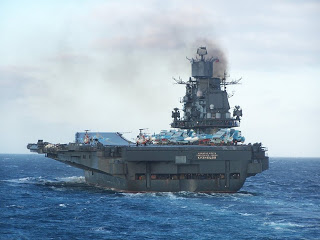
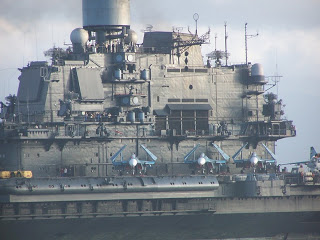
DEBKAfile’s military sources disclose that a powerful Russian naval contingent, led by the aircraft carrier Admiral Kuznetsov , left Murmansk on the Barents Sea Aug. 18 to dock at the Syrian Mediterranean port of Tartus Saturday, Aug. 23. It includes the Russian Navy’s biggest missile cruiser Moskva and at least four nuclear missile submarines.
That would be amazing! According to Debka, the Admiral Kuznetsov and the rest of its powerful Russian navy contingent is heading to Syria, traveling the 4,903 nautical miles at sea from Murmansk to Tartus in 6 days! Wow! Too bad they failed math, because according to Debka the Russian naval group is going to average 34 knots for every nautical mile. Jeez, and people believe this stuff?

When I read something like this, I've always wondered if Debka is one of those secret message websites where specific readers have a secret decoder ring that enables them to obtain super secret messages hiding in plain sight, because this is just so stupid in its implication it is hard to believe they could be that dumb.

Anytime Debka talks about Navy stuff, go the other way. The Admiral Kuznetsov has been reported to be planning a deployment to Syria, but there is no evidence it has deployed. The source for that information was Russian news, and today the Northern fleet news is all about maintaining ships in the Med, but no word about a deployment yet.

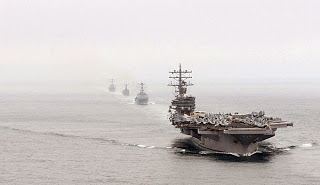
Beware of Debka, they only write disinformation. For example, this is pure fantasy, That was a rumor started by Timothy Alexander (see google cache here, as original was deleted). In case you are curious, the USS Theodore Roosevelt (CVN 71) is in Norfolk.

Fabius Maximus has been tracking that last rumor, and has every angle of the disinformation covered.

Russia - Georgia Analysis We Can Support

Mark Safranski, also known as Zenpundit, has an article out on Pajamas Media regarding the Russian - Georgian conflict called Lets Not Rush Into Cold War II. Mark nails every point perfectly, scores on every possession, and generally educates at a level even the politicos should be able to understand.
From administration to administration, we zigzag with the needs of the moment in our dealings with Russia without a clear vision of what America’s vital interests in the former Soviet states actually are.

Georgia is a textbook case. While America has a legitimate concern in encouraging former Soviet states to develop into market democracies, there is no intrinsic economic or strategic American vital interest in Georgia per se and even less in South Ossetia. Georgia is our ally for only two reasons: Tblisi was enthusiastic to send troops to help in Iraq in return for military aid and it occupies a strategic location for oil and gas pipelines that will meet future European energy needs. In other words, Georgia’s role is of a primary strategic interest to the EU, not the United States. Which is why European and British companies have such a large shareholder stake in the BTC pipeline and why European FDI in Georgia exceeds ours. Yet it will be American troops in Georgia handing out bottled water and MREs, not the Bundeswehr or the French Foreign Legion. Something does not compute here.

Exactly, our policy with Russia is a step by step tactical approach absent a comprehensive strategic approach. Slam and Dunk. So what do the politicos do? The commenter's claim the Zenpundit is a liberal infiltrator. However, had the Zenmaster posted the same piece on DailyKos I'm betting he would have been nailed with the neocon label. In my book, what is missing is a clearly stated foreign policy from either side of the isle of politics, so any clearly stated strategic discussion of foreign policy commentary from an economic first perspective that doesn't follow a traditional ideological mindset will be rejected by both sides until we collectively find our national strategic vision articulated by a President.

While Mark got my blood pumping, the adrenaline gave me a natural buzz when I followed up Mark's piece with Thomas Barnett's 3000 word passion statement. When I use the F bomb, it means I'm having an emotional moment and care about a topic, and that is generally how I see it when the bombs drop on other blogs. Quoting any part of the 3000 words to summarize the whole is futile, so go read it and come back.

Russia and the US are not equals, but can be in their approach to the gap. I would also include other major powers in this equation. I love that piece by Tom, because in a great many words, he is essentially invoking our Yin Yang theory for strategically approaching our national interests.

When any major power exercises power in the gap, it ultimately represents an opposing (competitive) and, at the same time, complementary (completing) application of power towards the ends of shrinking the gap. Tom found the Yin Yang.

In this case, Georgia, which has a relationship with the United States is being consumed by Russia, and ultimately will be regardless of what the United States does. This represents a loss of influence for the United States and Europe, a gain of influence for the Russians. BUT this also represents a long term complimentary action to the strategic goals of everyone in the core. Why? Because successful military intervention by a core nation into the gap shrinks the gap.

Apply the same theory to Iraq. The US military intervention there represented a loss of influence by Russia and Europe, and a gain of influence by the United States. The result is an action that is complimentary to the strategic goals of other core nations (think China and energy here), and the effects of this intervention are broad. Consider what we see in the UAE, Bahrain, and Kuwait and we have movement towards more shrinking of the gap. There is no reason to believe that Russian intervention in Georgia couldn't have a similar effect on regional nations, including Ukraine.

The major powers in competition with the United States can be described as 7 primary regional powers (US makes 8, and is unique because it is the only true global power). In no particular order.

1) Europe
2) China
3) Western Pacific Nations (South Korea, Japan, Taiwan, and Australia)
4) Russia
5) India
6) Brazil and South Africa
7) Canada and Mexico

Those seven power bases represent the "core" of where the focus of American strategic interest lies in globalization. If the State Department backed by the president can manage the competing relationships the US has with these 7 powers, the DoD can then manage the threats that emerge in the gap. If we do not maintain a good relationship between the United States and those 7 powers, the United States cannot guarantee the global system that currently governs economics. Those 7 major power regions represent the map for the State Department.

Everything else represents the map for the DoD. Part of the role of State and the DoD is to remember, when any of the above 7 engage militarily in the gap, while it is factual to say it is in our competing interest, it is also factual to say it is in our completing interest.

One point here I'll expand on later... we have been talking about operational capabilities and strategic environment a lot on the blog since this post. We firmly believe the DoD must maintain acquisition focus against the operational capabilities developed by nations in the core, but align those capabilities in a way that gives them creditable capability in the gap. Why? Because the market for military technology in the gap is the core, which means we must expect to see core capabilities in the gap.

Anyway... Mark and Tom are both on the money here. The driving force behind both our political and strategic national interest is economic. The other seven major powers we describe above represent the stakeholders in that economic system, and the system is key. While the US faces major economic challenges in the near term due to debt issues, long term stability of the economic system is also the solution to that problem as the gap becomes the emerging consumer market.

And while i shouldn't have to say it, the competition between the powers of the core is obviously about one thing: Resources, including energy. This is why bio-diesel, and other alternative energy sources not named ethanol should be a national security priority, which takes enormous priority over a climate issue. Georgia isn't the first gap nation to see military intervention by the core, it is essentially the same strategic choice the US made in Iraq except from a Russian interest point of view. It also represents the beginning of what will be a century of interventions throughout Africa by core nations, after all, that is ground zero for the future competition in the 21st century.

If Mark is the liberal, and Tom is the neocon, I must be the globalization nazi. So be it, in my realist world, world peace requires tough men with guns defending a global economic system where all regional powers are stakeholders, and in my academic world, economic prosperity requires measured cooperation as part of the competition of major powers.

Thursday, August 21, 2024

7th Fleet Focus: Malabar 2008 News

Sindh Today brings news with details of the participants for the upcoming Malabar 2008 exercise. For those not familiar, Malabar is the annual naval exercise conducted in the Indian Ocean with the US Navy and the Indian Navy. Last year Australia and Singapore both participated, but this year no additional nations have been announced as participants.

Of note, the announcement that INS Viraat (R22) will not be participating, as it currently undergoes refit. Some of the activities are described as:

‘We will engage in anti-submarine operations, submarine to submarine operations, flying operations, cross deck embarcations,’ the officer said.

‘During the exercise, alternating control and command will also take place, under which the Indian fleet commander will take over the command of the US fleet and vice versa.’

The participants as announced are as follows:
US Navy

USS Ronald Reagan (CVN 76)
USS Chancellorsville (CG 62)
USS Gridley (DDG 101)
USS Decatur (DDG 73)
USS Thach (FFG 43)
USS Springfield (SSN 761)

Indian Navy

INS Talwar (F40)
INS Godavari (F20)
INS Brahmaputra (F31)
INS Betwa (F37)
INS Aditya (A59)
INS Shishumar (S44)
The exercise is scheduled to take place between October 15 - 24.

Jianggezhuang Nuclear Submarine Base

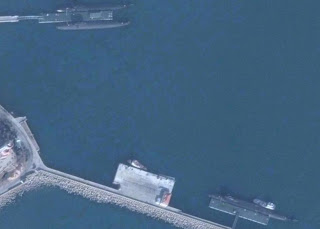
Google Earth has a new image of the Jianggezhuang Nuclear Submarine Base available for those who are interested in such things. Hans Kristensen notes on the FAS Security Blog notes the image was taken on December 5, 2024 by the Quickbird Satellite. As the picture to the right highlights, you can see several PLAN nuclear submarines, in fact we see a total of 6 in port in the photography.

What is noteworthy is the submarine on the bottom. That is the only Type 092 Xia class SSBN, which had previously been seen in dry dock. We also note there are five SSNs in port, which are likely the five older Type 091 Han class SSNs, although it is hard to tell.

While it is understandable why the PLAN would upgrade the Xia, after all, they don't have very many nuclear submarines, we've been speculating what upgrades were potentially given. With the recent discussion of ASAT and SDI, not to mention after reading this post on Conventional Weapons on Trident Subs, I am reminded of an article Bill Gertz published in January that China was "building a submarine-launched direct-ascent missile system." Could it be the Xia was modified to support this initiative?

That reminded me of something else I read, "An Assessment of China's Anti-Satellite and Space Warfare Programs", an 80 page report that was put together following the Chinese January 11th ASAT test. It is a long read, but is the most up to date collection of research in the open source of the Chinese ASAT test, including hard to find materials on a Chinese ASAT strategy. In particular, quoting Professor Liu Huanyu of Dalian Naval Academy wrote an article called Sea-Based Anti-Satellite Platform where he says:
….Nuclear submarines are not only well concealed but can sail for a long period of time. By deploying just a few anti-satellite nuclear submarines in the ocean, one can seriously threaten the entire military space system of the enemy. In addition to anti-satellite operations, these nuclear submarines can also be used for launching low orbit tactical micro-satellites to serve as powerful real time battlefield intelligence support. The main weakness of a submarine is that it is difficult to install detection systems on a submarine. Submarines have a weak capability for autonomous searching and therefore need the support of the national space monitoring system.
That was written in 2004, and that report is loaded with details regarding ASAT discussions that invovled submarines. One wonders what the Xia Type 092 upgrade may have included.

Wednesday, August 20, 2024

Fleet Movements in the Med - Updated

As we transition from Georgia to Poland to a lot of threatening political rhetoric from Russia as it expresses its displeasure with how events have unfolded, news reports from Russia tend to indicate the Russian aircraft carrier Admiral Kuznetsov is preparing to deploy to the Mediterranean Sea, specifically the Syrian port of Tartus.
The “Admiral Kuznetsov”, part of the Northern Fleet and Russia’s only aircraft carrier, will head a Navy mission to the area. The mission will also include the missile cruiser “Moskva” and several submarines, Newsru.com reports.

President Assad in meetings in Moscow this week expressed support to Russia’s intervention in South Ossetia and Georgia.
Syrian President al-Assad is visiting Moscow and is reportedly negotiating arms and mutual defense initiatives, including a Russian Naval base in the port city of Tartus. This would give Russia a Navy base in the Mediterranean Sea. This should not be a surprise, although the timing and speed that Russia is moving is notable. When Putin first assumed power, one of his first stated goals was to return Russia to prominence in the Mediterranean Sea, indeed what many may not remember is that the Kursk incident occurred during preparations for a major Naval deployment to the Mediterranean Sea. To put it mildly, things did not go according to plan.

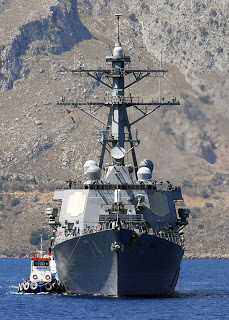
On Wednesday, news reports highlighted that the USS McFaul (DDG 74) and USCGC Dallas (WHBC 716) departed Crete loaded with humanitarian supplies. Piecing together news reports, it appears these two ships will be followed by the USS Mount Whitney (LCC 20) later this month.

Interesting note, there are several rumors the Polish frigate ORP General K. Pulaski (272) (formally USS Clark (FFG-11)) and a Canadian frigate will accompany the USS Mount Whitney (LCC 20). The rumor about a Canadian frigate is interesting, with the HMCS Ville de Quebec (FFH 332) escorting food shipments off Somalia for the World Food Program, it raises the question whether the Canadian Navy will send either the HMCS Iroquois (DDH 280) or HMCS Calgary (FFH 335) once HDMS Absalon (L16) joins Task Force 150 at the end of the month.

There are some reports in Turkey, and specifically McClatchy in the US, who have raised the issue of the 1936 Montreux Convention which governs access by Turkey of warships in the Black Sea. We have done a bit of research, and McClatchy sources appear misinformed. The USS McFaul (DDG 74) and USCGC Dallas, and even the USS Dallas (SSN 700) had already received permission by Turkey to access the Black Sea for an exercise that has been long planned. The exercise actually included Russia, but was called off when the conflict in Georgia began. Other ships of SNMG1 were given permission as well, which may be why the rumors of the Polish and Canadian frigate are running in the media. The USS Mount Whitney (LCC 20) did not ask for permission then, which may be why there is some discussion whether the USS Mount Whitney (LCC 20) has been given permission yet.

However, one thing is clear, the issue of the 1936 Montreux Convention is largely overblown at this point, and in reality, isn't helping Turkey right now. The intent of the 1936 Montreux Convention was to keep big warships out of the Black Sea, but it was set at a time when displacement was a major determination of how powerful a ship is. Clearly it means very little today, the USS McFaul (DDG 74), if not the USS Dallas (SSN 700), represent the most powerful pair of naval vessels of war in all of eastern Europe. The 1936 Montreux Convention does little to prevent their access, and instead creates a political issue to allow the barely armed USS Mount Whitney (LCC 20), or the unarmed USNS Comfort (T-AH 20).

While now is probably not the right time for Turkey to reevaluate the 1936 Montreux Convention, clearly it is something Turkey may want to take a look at in the future. Ironically, the last time a nation violated the 1936 Montreux Convention was in 1991 when the Russian aircraft carrier Admiral Kuznetsov transited the straits. If the Admiral Kuznetsov does deploy to the Mediterranean Sea, it will be interesting to see if Russia does it again.

Update: Fucking McClatchy, these people are working hard to be Debka quality... which is pretty bad IMO.

They change their article with the facts. The USS Dallas returned today. Check the google cache, McClatchy has rewritten their articles today, but was reporting USS Dallas had approval by Turkey to move into the Black Sea yesterday.

Cached version:
http://64.233.169.104/search?q=cache:rWBGtxSVWMgJ:www.mcclatchydc.com/251/v-print/story/49307.html+%22Months+earlier,+Turkey+approved+the+US+military+sending%22&hl=en&ct=clnk&cd=1&gl=us

New version:
http://www.mcclatchydc.com/world/v-print/story/49307.html

These are the same people pushing the news about the Montreux Convention being a big deal, which appears to be another load of McClatchy crap with NATO now moving a bunch of warships in the Black Sea.