Showing posts with label Natural Disasters. Show all posts

Sunday, June 1, 2024

Observing the Incredible, Sobering Images of the Earthquake in China

Nearly 69,000 people have been confirmed dead and 18,000 others missing in the earthquake measuring 8.0 on the Richter scale that hit China's Sichuan Province on May 12. In looking for the appropriate analogy, we believe this earthquake will significantly impact Chinese domestic policy on the same scale (if not more) that 9/11 significantly impacted American foreign policy.

Photo Caption: This Friday May 16, 2008, photo, distributed by the official Chinese news agency Xinhua, shows a dead student's hand holding a pen tightly in the debris site of Dongqi Middle School in Hanwang Town of quake-hit Mianzhu City, southwest China's Sichuan province. (AP Photo/Xinhua, Liu Zhongjun)

Very few of these pictures are overtly gruesome, and yet the impact is such I warn ahead of time.

Link1
Link2
Link3
Link4
Link5
Link6

We have heard a lot about the C-130 shipments to Myanmar, but I haven't seen much on the C-17 fully loaded flights of humanitarian aid to China. With aid flowing into China from all over, if anyone knows of any "informative" links of any particular countries contribution to the Chinese earthquake, leave a link in the comments please.

The school issue specifically is still significant, 3 weeks later.
The rubble-strewn streets of Wufu are lined with wreaths, and white flowers made of folded paper hang from bushes. Among the symbols of grief are signs openly directing roiling anger at the government.

Almost three weeks after an earthquake shattered central China, anger is seething that corrupt officials may have allowed shoddy building construction that resulted in the deaths of thousands of children when schools collapsed in the disaster.

The anger — unusual in tightly-controlled China for its open challenge to the government — has not been cooled by repeated assurances that the issue will be thoroughly investigated and offenders severely punished.
In many areas, schools collapsed killing hundreds even when most other buildings nearby did not. At first, the government concealed the problem by not covering it in the press, but no longer, the Chinese media is now actively covering the issue across China. That in and of itself represents significant change from previous policy.

Monday, May 26, 2024

Monsoon Season Arrives In Myanmar

While the international community is busy trying to get the junta to live up to the promises that aid workers can enter country and help with the estimated 2.5 million people in need of assistance following the Cyclone early this month, the situation on the ground continues to deteriorate. While aid is getting in through relief flights and a few ships, the response is often described as slow and inadequate. Most aid agencies report problems caused by the government, and the estimated dead and missing is at 133,000+. Government problems continue to dominate the headlines.
Development Program's director for crisis prevention, said Monday that despite the government's statements that most of the short-term relief has been completed, "no one" at the U.N. or on her team "feels that we are anywhere near the end of the humanitarian relief period."

Ms. Cravero, who was in Yangon, Myanmar's main city, for a donor conference Sunday, said only 50% of the affected people have been provided with significant aid and that foreign governments at the meeting stressed they would only offer more support when they see more access and transparency in aid distribution.
There is cautious optimism following the UN brokered diplomatic deal that would allow aid workers, which will supposedly allow workers into country by the end of this week. While the UN is putting the happy face on these developments, we don't expect it to happen quickly. While the government does nothing, conditions on the ground will get much worse this week as the monsoon season we discussed immediately following the Cyclone tragedy arrives in Myanmar.
The monsoon has struck and it is raining all day, every day and will continue like this until October; with high winds and heavy rainfall. They will not see the sun for the next five to six months.

These people have no shelter at all; they have no dry clothes. The young, the weak and the old are particularly vulnerable. People are so demoralised that they have lost interest in taking on any activity, unusual for such industrious people.

Imagine if you had spent the last two weeks soaking wet and up to your knees in water, nothing to eat or drink, with your family dying all around you, your livelihood gone, your home blown away, weakened with dysentery and influenza.
While there have been a number of western media editorials calling for confrontation and intervention, the aid agencies are calling for a different approach. Many aid agencies find the local Burmese institutions to be quite capable, and more important, trusted by the local population unlike external support which has been made unpopular through decades of propaganda. This is a view from a western aid worker perspective inside Myanmar that is outside the usual western press reporting.
Contrary to press reports, a good deal of aid is getting through. The big US cargo planes are still being prevented from landing, but the organisations we are working with all have their own channels. Commercial air freight into the country is working normally and a good deal of aid supply is coming through this way.

Most necessities are available here - there is a ready supply of freight from China, India and Thailand - and yet cyclone survivors are being given bottles of mineral water flown in from the UK when local companies are offering excellent products.

Supplies can be sourced here easily and far more cheaply than flying them in. This is mainland south-east Asia - Burma is surrounded by mass-producing, low-cost, tiger economies. This is not “darkest Africa”.

Village people here are mistrustful of foreign medicines and would prefer Burmese traditional medicines. And they find the high-energy biscuits being doled out by the aid agencies unpalatable and demoralising. Traditional staples such as rice and fish paste are both readily available just outside the disaster zone - indeed, last week, at the Thilawa docks, the government was loading ships with rice for export to Bangladesh. There is no shortage of rice.

There is no need to fly food in, just money, which is lighter, to buy simple essentials.

While the military regime may be incompetent to deal with the crisis, we should not under-estimate the resourcefulness of other Burmese institutions. Local firms, associations, clubs and schools have been collecting funds and goods to send to the needy. Their biggest problem is they can not deliver beyond the distance of a day trip, about 90 miles.

With so many political issues going on, the NGOs have had to learn how things work - you need a Burmese front organisation and the NGO takes the back seat. This is now working - and timely, as a continued local-only response would be impossible to sustain in the long term.
The article goes on to note that the western criticism is hurting the effort. We are not impressed by this argument, we do not see the wisdom in the international community standing quiet while the lives of millions of people hang in the balance, and find the logic of such a stance to be empty given the response by the junta to all conditions, positive or negative.

When two and a half million people face five months of rain with no shelter, and the international community is prohibited from helping these people, it is somewhat telling that the NGOs see the best option being to stand by and allow for small gains. Very understandable though, no government or institution has been willing to take any substantial action towards offering a better alternative.

As the monsoon season rains on the people in Myanmar over the next week, the real danger becomes the expected increase in mosquitoes. With a lack of shelter, an abundance of rotting animal and human corpses, conditions for a perfect storm for disease appears a certainty without rapid action... something that has been absent the entire effort.

While there may be food right now, we note that the rice crop did not get laid down prior to the monsoon seasons arrival, meaning the nation is facing a 40% drop is in the rice crop from the beginning. The UN is right to look at this as a long term problem, because meeting the short term problems of finding shelter for millions of people is only the beginning, the lack of a rice crop in the region this year and the destruction of most regional fishing industries leaves the local communities with long term needs as well.

Wednesday, May 14, 2024

The Slow Burn in Burma

The UN finally read their own homework, and has raised estimates across the board regarding the unfolding tragedy in Myanmar. We pulled statistics sourced to the United Nations from 2005 earlier this week when when we attempted to highlight the region hit by the storm appears to have impacted around 4 million people. We based that assessment on storm track, satellite imagery, and data population data sourced to the UN and the CIA.

It appears our calculations were off, not as many have been flooded out as we assumed, but it also appears the media is catching up to the level of catastrophe.
The United Nations said on Wednesday up to 2.5 million people might have been affected by the Myanmar cyclone and proposed a high-level donors conference as the Myanmar junta again limited foreign aid.

U.N. humanitarian affairs chief John Holmes told reporters between 1.6 and 2.5 million people were "severely affected" by Cyclone Nargis and urgently needed aid, up from a previous estimate of at least 1.5 million.

Myanmar state television raised its official toll to 38,491 dead, 1,403 injured and 27,838 missing.

The International Federation of the Red Cross estimated on the basis of reports from 22 organizations working in Myanmar that between 68,833 and 127,990 people had died.
As we count down to the monsoon season, it is only going to get worse and worse, and before monsoon season arrives the weather will not cooperate. It rained all day today, and will again tomorrow... and thats the good news.
Amid signs that a second cyclone may be headed toward the Irrawaddy Delta, the directors of several relief organizations in Myanmar said Wednesday that some of the international aid coming into the country for the victims of Cyclone Nargis was being stolen, diverted or warehoused by the military.

The aid directors declined to be quoted directly on their concerns for fear of angering the ruling junta and jeopardizing their operations, although Marcel Wagner, country director of the Adventist Development and Relief Agency, confirmed that aid was being diverted by the army.

He also said it was going to be a growing problem, though he declined to give any further details because of the sensitivity of the situation.
Everyday this week there has been a new editorial written by a western writer to invade Myanmar. This isn't helpful, it only contributes to the xenophobia of the junta who sees large ships from the US and France off their southern shore. While the intentions are humanitarian, all the junta sees is invasion by western powers.

In the meantime, the storms continue to come, the aid trickles in while the shenanigans with the aid continues. The cries get louder, the body count continues to increase, the news will only go from bad to worse, and the calls for action will only get louder. Expect the next week to be a steady drumbeat of bad news as emotion takes hold while the situation goes from bad to worse.

Cobra Gold ends on May 22nd, next Thursday, nothing is going to happen before then. In the meantime, we observe an international naval force slowly increasing at sea off Myanmar. Among the few ships to make port in Myanmar, India's INS Rana (D52) delivered humanitarian supplies earlier this week. The captain was quoted saying the region is in "total devastation." It will be interesting to see where the situation sits when Cobra Gold completes, because there will be some 15.000 US and French Marines in that theater potentially supported by a rather large international naval armada. The estimated number of deaths to the violence in Dufar is 375,000 total due to violence to date. We note the Red Cross believes 1/3 that many may already be dead in Myanmar, and things are about to get much worse.

Monday, May 12, 2024

7th Fleet Focus: Ghost of Macarthur Lands in Myanmar

An important development occurred this morning with the arrival of an Air Force C-130 transport fully loaded with humanitarian assistance from USAID, the flight included a VIP passenger. Admiral Timothy Keating, Chief of US Pacific Command, traveled with the humanitarian aid to speak personally to the leadership in Myanmar. We immediately observe this unofficial visit is perhaps a turning point in the diplomatic effort to increase humanitarian support for the Burmese people suffering from the Cyclone which devastated the region on May 2nd and 3rd. Admiral Keating would be the highest ranking US military officer to visit Myanmar in many decades.

"It was a cordial meeting and we exchanged ideas on how we might assist in the relief effort. They showed us maps of where they had the greatest need," she told a press conference.

"Water, food, mosquito nets, shelter materials and blankets were all highlighted as extremely important."

Fore said Keating briefed the Myanmar officials, including the deputy ministers from the foreign affairs and social welfare ministries, on the US capability to help in the aftermath of the cyclone.

He told them the United States was "ready to assist in these efforts", she said.
We have previously covered the elevated importance of regional military commanders in diplomatic efforts since the end of the cold wars, particularly in reaching out to the 3rd world nations best described as unfriendly to the United States. This is an enormous development, one that sends clear messages to the junta regarding the seriousness the United States takes the crisis developing in Myanmar. The chain of command begins at the President, but from there it would go to Secretary Gates then Admiral Keating. To put this event into perspective, this would be like General Petraeus going to Tehran to offer US humanitarian assistance once he is CENTCOM commander following a humanitarian crisis in Iran.

The US is preparing regionally to respond, and there are a couple of developments worth keeping an eye on. First, after this first flight the US will make two more flights on Tuesday. Henrietta Fore, an administrator with the US Agency for International Development (USAID), suggests the United States intends to take it one day at a time. It is worth noting that one day at a time is very interesting, because in two days events begin to transition quickly, and the US is slowly preparing itself for all contingencies.

More than 11,000 troops are in Thailand for the annual Cobra Gold exercises along with four naval ships led by the USS Essex, which is like a mini aircraft carrier with helicopters on board and the capability to launch amphibious landings in hard-to-reach places.

More ships — including two aircraft carrier battle groups — could reach the area quickly but are for the time being hovering back in international waters. Their inclusion would vastly improve the logistics of any relief effort.

Officials have said that no aid will be flown in without the Myanmar government's permission, however.
The last sentence is key. It is unknown what Admiral Keating said to the junta, and while Admiral Keating is an excellent diplomat in his own right, he also has a reputation for being blunt and honest often offending the Chinese with that brutal honesty. While no one, including us, expects the United States will take any kind of military action regardless of how events unfold, we keep in mind that predicting how events unfold is dangerous to predicting what could happen. While all indications are the crisis response could be turning favorably toward the advantage of peaceful aid delivery, we are also observing the military options unfolding.

On Wednesday the Essex ESG will arrive off Myanmar, but there is no indication they will be allowed to offer assistance. By this weekend, the world will have a better sense regarding the level of crisis fallout in Myanmar, but that also marks the arrival of very bad weather. If a massive humanitarian crisis continues to get worse, and the news reporting right now continues to highlight that as very much possible, it will be very interesting to see how public perception develops. Depending upon how fast the death toll rises, it may be that in 2 weeks, when the Peleliu arrives off the coast of Myanmar with the Hospital Ship Mercy, public opinion could be very different than it is now regarding the crisis, and a military response may be something the entire international community calls for. With Cobra Gold completed by then, we observe the US Navy could have 2 Carrier Strike Groups and 2 Expeditionary Strike Groups, with at least 13,000 Marines ready to take action in Myanmar.

We still suggest the military option is incredibly unlikely, but we very much like what has unfolded here, and suggest it is the first major diplomatic effort likely to produce results. We observe it is very possible the US Military Diplomat, in the form of Admiral Keating going to Myanmar, backed by the command authority of incredible US military power, may be able to achieve what all the diplomats in the international bodies have been unable to do up until this point... get results with diplomacy.

We have often described the proactive humanitarian stance of the Navy's maritime strategy to be likened to taking the offensive in peacetime. We observe Keating's visit is very much akin to leading a battle from the front lines in that regard. We observe great potential here to deescalate a potential crisis, but it takes leadership to go establish the rule sets, which in this case may have included some kind of suggestion regarding the strategic options unfolding over the next two weeks should the junta ignore their humanitarian responsibilities.

Reminds us of how Admiral Fallon dealt with China when he led PACOM. Perhaps the ghost of Macarthur still haunts in Southeast Asia.

Sunday, May 11, 2024

7th Fleet Focus: Monsoon Season Looming As Myanmar Dithers

We are observing one of the single most evil applications of political power in my lifetime, and the number of deaths likely to occur without assistance to the Burmese people could approach over a million by the end of the month, potentially more. As we observed last week, the monsoon season begins near the end of the month, although weather forecasts for next week may signal an early monsoon season. With those regions already flooded by the cyclone, the monsoon season will likely wash out the areas where there are survivors, and will create devastating effects to the millions who lost their homes to the cyclone.

It is also now clear that next years rice crop will not be laid down in time. This is a critical aspect of the discussion of the Myanmar tragedy that we have not observed analyzed in the media reporting or public statements, but it may explain the behavior of the junta in Myanmar. While the rice not being laid down will not create an immediate food shortage, it will create a massive food shortage next year, as 40% of the rice grown in Myanmar is grown in the devastated areas. While no one is saying it out loud, the strategy we observe unfolding appears to be to allow as many people as possible die, thus fewer people to feed next year when shortages will occur.

For perspective how large a tragedy is unfolding, Time Magazine has injected an article very much worth comment, and it does a good job putting the tragedy into perspective. The article is called: Is It Time to Invade Burma?
The disaster in Burma presents the world with perhaps its most serious humanitarian crisis since the 2004 Asian tsunami. By most reliable estimates, close to 100,000 people are dead. Delays in delivering relief to the victims, the inaccessibility of the stricken areas and the poor state of Burma's infrastructure and health systems mean that number is sure to rise. With as many as 1 million people still at risk, it is conceivable that the death toll will, within days, approach that of the entire number of civilians killed in the genocide in Darfur.
We believe there are many more dead than is being reported, for several reasons. First, aid has only reached half a million people. The UN numbers the population of the heavy disaster region to be around 2 million people, with around 3 million people under flooded areas. In other words, as many as 2 million are in regions that have been wiped out by the Cyclone, but 3 million more are threatened due to living in a flooded region as the weather turns to more rain. It takes about 5 days by truck to drive to the southern affected regions from the capital, and there is no evidence of daily convoys. Another problem, on Saturday military forces involved in the humanitarian relief efforts were pulled off that duty so the government could run its sham election.

Other media reporting highlights the growing humanitarian problems in the country, and the problematic response.
Myanmar cleared two further UN aid flights to land on Saturday and allowed three UN trucks carrying enough tents and materials to shelter 10,000 people to cross from Mae Sot, Thailand.

But the trucks will take at least two days to reach Yangon, formerly the capital, Rangoon. And that is still days by road away from the worst hit Irrawaddy Delta area.

India, which Myanmar considers a friend, also brought in a transport plane full of supplies, the fourth, plus two shiploads of aid that the generals have allowed it to deliver. Thailand sent one planeload of relief supplies.

The United Nations appealed for $187 million in aid, even though it is still not confident the food, water and tents flown in will make it to those most in need because of the junta's reluctance to admit international relief workers.

India and Thailand both have been satisfied with unloading their supplies at the airport and leaving them for the junta to distribute. The UN is balking at that kind of an arrangement and threatened Friday to suspend relief fights when a shipment of its energy biscuits was impounded by the military.

It quickly backed down, but it is still trying to negotiate an agreement that will ensure the world community's aid goes to those who need it most.

Two diplomatic envoys to the junta sent by the Thai Prime Minister were told the government was "too busy" to receive them. This has raised international concerns, as Thailand is considered a close friend of Myanmar. UN Secretary-General Ban Ki-moon has been pleading for Myanmar to allow aid agencies to help, but all attempts by the UN Secretary-General to contact the Burmese leaders directly have been unsuccessful.

So far, there has been fewer than 12 total flights and only 2 ship loads of humanitarian supply to Myanmar, all of which was left to the government to distribute itself. The UN reporting is mixed, they claim 500,000 people have received some aid, but it is unclear if those people were in the flooded regions or the cyclone devastated regions. The UN is also claiming several villages have been out of food for several days, and only source of water are areas where dead bodies are scattered in. UNICEF health specialists estimate "20 per cent of children in the worst affected areas already have diarrhea and cases of malaria have also been reported."

We expect the UN to scream really loud and watch people die being unable to build a consensus to help the dieing people. By the end of the week, 100,000 will be everyones estimate, and given how long it takes to travel to many southern regions, particularly as the weather gets worse and increases flooding in the country, by the time we get "official" estimates 250,000 could be dead.

We don't expect the international community to take action without the approval of the junta. While military forces are moving into the region, the details tells the story. The Essex ESG is moving towards the coast of Myanmar, while the French are also sending FS Mistral loaded with humanitarian supplies. It is worth noting that the Essex ESG left a large number of Marines in Thailand, so they aren't ready for combat, while the Mistral is not carrying the usual military forces it would utilize in a combat theater. In other words, the platforms don't have the necessary payloads to conduct the type of offensive military operations Time Magazine is suggesting. To put the readiness levels of amphibious ships and Marines into perspective, there are 11 amphibious ships at sea today on deployment, and only 3, the Tarawa ESG returning home to San Diego after 6 months in the Middle East, actually have their regular load of Marines aboard. All that forward presence, and no real force options. Sure would be nice if we had a strategic sea basing capability to enable joint capabilities.


Thursday, May 8, 2024

More Suffering In Myanmar

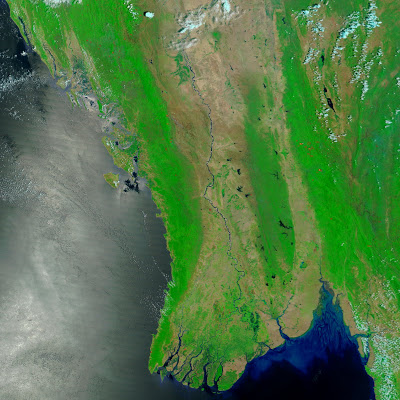
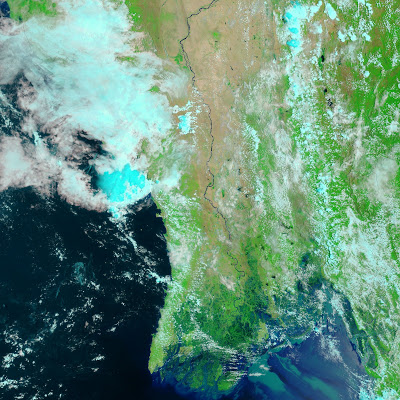
The satellite pictures of Myanmar following the cyclone tell the story, the farmland in the south has been washed out. Here we are, days later, and still some parts have not even been contacted yet. The news this morning was the estimates for the dead were reaching 6 digits, and that Burmese junta had decided to allow US humanitarian flights.
Thanks to the negotiations in Thailand, the Burmese junta has authorized the US air force to carry out flights into Burma to bring humanitarian aid to the population which was hit by the Nargis cyclone last Saturday: this was announced by General Boonsrang Niumpradit, the head of the military forces in Thailand, at the end of a joint military effort which the Bangkok forces are carrying out with those of the US and called 'Cobra Gold.
But at the last minute they changed their mind.
A PLANNED US aid flight to Burma is not going ahead, the US ambassador to Thailand said today, saying it was not clear if there had been a miscommunication or whether the junta withdrew permission.
There are about 5 people who can make a decision in Myanmar, and to date their decision has been to allow only limited assistance. It is tragic how much sea power is at sea regionally right now not able to support the humanitarian effort. Between the US forces at Cobra Gold, and the French and Indian naval forces at Varuna 08, some of the most desirable naval forces for humanitarian operations are at sea in the Indian Ocean and yet, blocked.

We predicted this would end badly, and all signs are still pointing that direction. When the biggest nation in the region, China, sends cash and that's about it while the second biggest country in the region India, sends a frigate and a PC, thats a tough situation. China and India are trying to do more, and India is having some success, but they are dealing with a government doing everything it can, including letting citizens die, to insure this incident doesn't threaten their power. Every bit of potential outside influence is being managed carefully.

Looks to me like the Burmese junta will only accept token assistance, and many people will die as a result.

Tuesday, May 6, 2024

Just Blame Global Warming and Let Them Die

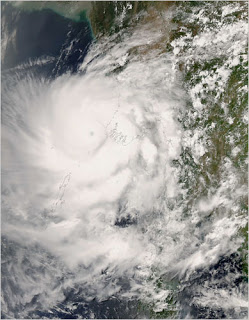
From where I'm sitting, that will probably be how the junta leaders treat Cyclone Nargis. It has turned out to be an incredible disaster, and it has all the signs of getting worse. The International Herald Tribune has a summary of ongoing events.
Foreign aid workers in Burma have concluded that as many as 50,000 people died in Saturday’s cyclone, and two to three million are homeless, in a disaster on a scale comparable with the 2004 Indian Ocean tsunami.

The official death count after Cyclone Nargis stood at just under half that by 1300 GMT today, at around 22,500 people dead plus a further 41,000 missing.

But due to the incompleteness of the information from the stricken delta of the Irrawaddy river, UN and charity workers in the city of Rangoon privately believe that the number will eventually be double that.

"We are looking at 50,000 dead and millions homeless," Andrew Kirkwood, country director of the British charity Save The Children, told The Times.
As the hours pass, the death toll is expected to jump considerably. These two satellite images from spaceref.com tell the story, the first from April 15, 2024 and the second from May 5, 2008. These images are provided from the Moderate Resolution Imaging Spectroradiometer (MODIS) on NASA's Terra satellite. They use a combination of visible and infrared light to make floodwaters obvious. According to spaceref.com, water is blue or nearly black, vegetation is bright green, bare ground is tan, and clouds are white or light blue. Click for better resolution.

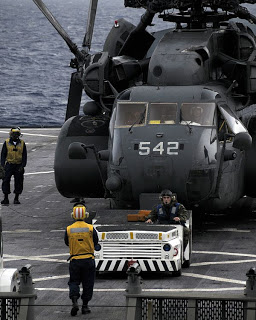
The US Navy is standing by, but the closest ships are the Essex ESG scheduled to start the Cobra Gold 2008 exercise on Thursday with Thailand. The ships are 4-5 days away and have yet to receive orders to leave. The USNS Mercy (T-AH 19) which departed San Diego last week is 3 weeks away. Both the Kitty Hawk and Nimitz are at sea, but both are also near Japan. With the military rejection of US assistance, it is being left up to regional nations to prevent a colossal tragedy. India has sent two ships. China is throwing money at the problem, and more money is pouring in from around the world to aid agencies, some of which are yet to get permission to help. The military has a history of believing aid agencies are spies, and isn't very cooperative.

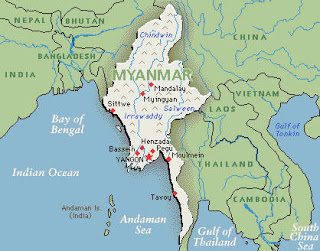
You have to work hard and read dozens of different stories to get the scope of the impending disaster. Myanmar has 53 million people, and about 25 million live in the 5 disaster states, most of which are flooded out. The primary occupation in the disaster region is farming, it is rice country and accounts for 40% of the food grown in in Myanmar. Typically rice is cultivated during the monsoon season, which starts later this month. Given the disaster it will be an enormous challenge to get next years crop down in time. As long as the rice from last years crop wasn't stored in the devastated areas, there shouldn't be any immediate food shortages for now, but the future looks grim.

Reading through news reports it stands out how much frustration there is in the aid community. The secretive nature of the military and junta leaders have become an enormous roadblock to getting international aid into the country. With the farmland in the southern delta taking most of the damage, the survivors need to get back to work within the next week in order to get even some crop down in time for next year. That is looking very unlikely.

With rising food costs around the world, this could not have come at a worse time for the Burmese people, or the rest of the world. If food shortages occur in Myanmar, the food will have to come from somewhere else, and with rising food costs globally this will just exacerbate existing global shortages.