Showing posts with label Motherships. Show all posts

Wednesday, July 30, 2024

Observing the Absence of the Navy's Expeditionary Ship

While big blue Navy sails the seas in peacetime, the Navy Expeditionary Combat Command has gone to war. Shipbuilding may get all the headlines, but the Navy needs only to point to its Medical Corps, NECC forces, and IA program to remind Congress the US Navy is not sitting idle on the sidelines. We have been observing the NECC over the last few weeks, specifically reading as much as we can regarding the participation of the NECC in both RIMPAC 2008 and Operation Brimstone, and it is easy to get excited.

We really like the way this story puts all the pieces we are observing together.
For the first time in a joint task force exercise (JTFX), the Navy Expeditionary Combat Command employed the adaptive force package (AFP) concept as part of "Operation Brimstone" July 21-28.

Capt. Anthony Krueger, commander of Navy Expeditionary Combat Task Group (NECTG) 955.6, said the concept of tailoring the right force to the right job proved itself during the exercise and helped prepare NECC forces to confront actual missions if required.

"If we have to do this for real, we now have a better idea of what it's going to take to make it work in a real-world operation," said Krueger, who also serves commodore of Riverine Group 1.

The NECTG 955.6 staff had task group coordination abilities and responsibilities during Operation Brimstone equal to USS Theodore Roosevelt (CVN 71) Strike Group or USS Iwo Jima (LHD 7) Expeditionary Group. NECTG directed about 750 Sailors of the expeditionary forces participating among the 15,000 service members from four nations in JTFEX.
Lets start bottom up, because we always start with leadership. Bringing the NECTG at an equal level with the strike group command staffs demonstrates a lot of wisdom in our opinion, because we see the value. We also really like the synergy of bringing three very different types of force packages together for exercises, and we think when one considers the 26th MEU as another force package within this capability set, one can start to see why we believe in the future the MEU, not the MEB, will be a supremely capable unit of action for war or peace from the sea. We recognize the limitations and ramifications of forwarding that position, and will discuss that topic in much more detail in the near future.

The Navy Expeditionary Combat Command adaptive force package (AFP) concept is something we look forward to learning more about, because without knowing about the specific concept at all it is an operational concept we have discussed the potential of on the blog. When we talk about motherships, we talk about them in the context of logistical enablers for manned and unmanned systems to execute naval expeditionary capabilities for war and peace, and in looking at the Littoral Combat Ship as a mothership for unmanned vehicles, it is easy to see that concept. What is less understood when we talk about the manned system is how the Mothership as a logistical support vessel for manned capabilities operates. Consider for a moment the forces in the NECC taking part in RIMPAC 2008.
More than 500 Sailors from Explosive Ordnance Disposal Group 1 (EODGRU 1), Maritime Expeditionary Security Squadron 9, Explosive Ordnance Disposal Mobile Unit 11, Mobile Diving and Salvage Unit 1, Explosive Ordnance Disposal Operational Support Unit 7 and Navy Cargo Handling Battalion 12 are participating in the biennial exercise. Naval Mobile Construction Battalion 133 is also participating from the island of Guam...

During RIMPAC, these units will exercise their combat capabilities such as maritime security, explosive ordnance disposal, diving and salvage, expeditionary construction and logistics and maritime civil affairs.
As an adaptive force package (AFP) the capabilities listed in the last paragraph represents a number of applications where manpower can make a significant impact to the maritime domain in peacetime, but these forces also bring considerable enabling capabilities during wartime, specifically to the ESG. This is why we discuss the mothership as the 4th ship of the ESG. With the mothership, the Navy takes to war the tools necessary for the Marines to do their work, but we observe the same skill set used a different way brings with it considerable peacetime utility.

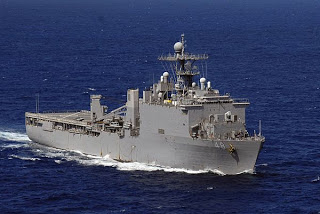
Consider for a moment the equipment requirements for NECC forces listed. Which platform can carry that equipment forward and self deploy it from the sea? From our point of view, that is where to start designing a mothership. Because we believe the mothership is a warship, specifically because it carries the unmanned scouting capabilities necessary for wartime information dominance, we believe the LPD-17 makes for an excellent choice to carry the bulk of the equipment being utilized by those NECC forces, and still have room for several unmanned mission modules. The manning requirements and capabilities also stack up well. It isn't the only platform that could do the job, rather we observe as an armed warship with low visibility the utility, size, and metrics of the LPD-17 fits the requirement set.

When we look at the maritime environment of the next two decades, we see the US Navy active in the littoral areas of the South Atlantic, South Pacific, Caribbean Sea, and Indian Ocean. With that in mind, for the execution of either war or peacetime strategy, would the Navy deploy a battleship or a mothership fully loaded with a NECC adaptive force package (AFP) to use Command of the Sea in those regions? The Navy has already answered that question, this blog is essentially the discussion of the solo deployments of Amphibious ships for Navy purposes, a trend that will continue next week when the USS Kearsarge (LHD 3) deploys without Marines

We think the mothership would forward the nations strategic interests much further than another large surface combatant would, and the deployment of existing amphibious ships for Navy specific, not Marine specific purposes over the last few years reinforces our argument.

One final thought. The NECC is the tremendous success story of the Navy over the last 2+ years. The Navy would be very wise never to forget the amazing job done by Rear Adm. Donald K. Bullard, he deserves tremendous credit for getting the NECC operational. When one considers how very little monetary resources the NECC gets compared to other aspects of the Navy, that 47% of the NECC is made up of reservists, and that the NECC has already gone to war in its short existence, Rear Adm. Donald K. Bullard, who retired back in January, can not be bestowed too many accolades praising the job he did with the NECC in our opinion.

Saturday, July 12, 2024

Anti-Surface Warfare Makes a Comeback

Navy Times is reporting on the debut of the Littoral Combat Ship anti-surface mission module debut today. Regardless of your opinion specific to the Littoral Combat Ship, and we give plenty of opinion on the subject here, the completion and delivery of the module is a good thing for the Navy.
With its gun; non-line-of-sight missile system, or NLOS; Fire Scout unmanned aerial vehicle; armed MH-60R helicopter; and the attendant networks and sub-systems — all of which officially debuted here Friday — the LCS now has its surface warfare mission package. It’s the second of two mission packages delivered for the 3,000-ton customizable warships; the mine warfare package was unveiled in September and the antisubmarine package is scheduled to be unveiled in San Diego later this summer.
We understand the good Navy folks who design these programs get annoyed, but your brochure doesn't fly here. With a LCS in this configuration, the Navy is now in position to deploy an unrated 3,000 ton designed to kill speedboats coming in at a cost of more than half a billion dollars.

Jason Gross, a PEO spokesman for littoral and mine warfare, has some comments towards the end of the Navy Times article. We see the popular "Navy Truck" description used, a good description in our opinion because that description describes a mothership. Some of the other comments are worth discussion.
The ability to mix and match equipment gives the ship “focused mission capability,” as program workers call it...

“If you think these [guns] are little, take a look at that bullet,” he said, motioning toward a menu of ammunition.

“I wouldn’t want to be in front of it.”
Modularity is the most important technology of the Littoral Combat Ship, and the first comment is to that point, but the gun is not unique to the Littoral Combat Ship, indeed we've read in many places the gun will be mounted on Unmanned Surface Vehicles.

The limitation of the Littoral Combat Ship isn't the concept, indeed the concept is important to the future Navy. The limitation is its size, motherships need to be big, not small. The Navy has turned the entire low end of its forward deployable force structure into an unrated mothership, plowing into the future with a fleet of battleships and a flotilla of unrated motherships. This is absent all historical lessons of maritime strategy, as it has been proven throughout all maritime history that fleets cannot meet requirements expected of it with a fleet of only battleships.

It is good to see the LCS and associated modules finally built and fielded though, the only way the over 50 crowd of theorists are going to ever understand the limitations of the Littoral Combat Ship, indeed recognize the metrics for technology and manpower for war and peace in the 21st century maritime environment, is to the LCS to sea and see the data for themselves.
The Littoral Combat Ship has the potential to be the best minesweeper the US Navy has ever built, and with modularity it will at times be capable of more than that, but as a peacetime platform and in any battle scenario involving more than "AK-47 guy" in a speedboat, the Littoral Combat Ship is going to be a big and expensive disappointment.

Tuesday, July 8, 2024

Littoral Dominance Requires a Broader System of Systems Battle Force Approach

Building upon yesterdays discussion on corvettes we want to add something a bit different to the discussion. The lines have become blurred between what a modern battleship, cruiser, destroyer, frigate, and corvette is, so we thought we would try to break down what we see as a frigate and what we see as a corvette in the modern era, and discuss another corvette option.

Using our modern rating system for warships, we see a modern frigate as a fifth-rate warship armed with 20-47 battle force VLS cells, and/or 20-47 battle force missiles. That means by our rating system, both LCS MMC versions would constitute a frigate. As we have previously discussed, the Lockheed Martin version of the multi-mission combatant offers 16 strike length VLS cells while the General Dynamics version of the multi-mission combatant offers 16 tactical length VLS cells. Both also feature at least 4 Harpoons, qualifying them both as fifth level frigates in our modern rating system.

Using the same rating system, we see a modern corvette as a sizth-rate warship designed specifically for the protection of shipping role, armed with either VLS cells or legacy missile systems, and armed with local air defense SAMs and anti-submarine and anti-ship cruise missiles for convoy defense; or a seventh-rate warship optimized for a single role, usually either anti-submarine or anti-surface warfare, or for general-purpose naval missions. The distinguishing feature of these ships is that they carry only terminal missile defenses—either in the form of rapid fire guns or short-range terminal defense SAMs.

The Perry class of today and the existing Littoral Combat Ship design both qualify as seventh-rate corvettes. Only the US Navy would operate ships between 3000-4000 tons with a weapons payload equal to or below a modern corvette.

However, just because the US Navy doesn't understand what a frigate or a corvette is, confusing the concept with a mothership in fact, and is demonstrating strategic absence in regards to the cruiser role, it doesn't mean the rest of the world is. In particular we go back to a July 13, 2024 article in Janes called TKMS unveils new reconfigurable patrol ship by Alex Pape, in which the Meko Class evolved into a modular platform. What is different? On a platform level, the payload is very different:
Planned mission modules incorporating existing naval systems into the modular architecture include the BAE Systems Bofors 57 mm gun, Saab Bofors Dynamics RBS 15 anti-ship missiles, as well as the latest generation of unmanned underwater vehicles (UUVs) from Atlas Elektronik and Saab Underwater Systems.
If you can find it, there is also an excellent sales brochure called Modular Security Ships for Littoral Supremacy, which is sometimes available by this link (PDF), that details both of the MEKO Fusion concepts.
  • The MEKO® Combat Ship for the Littorals: 108m, 2750 t, >40 kts, steel hull, composite superstructure, up to 21 MEKO® Mission Modules.
  • The 84m MEKO® FUSION: 84 m, 1500 t, >40 kts, composite hull & superstructure, up to 15 MEKO® Mission Modules.
We don't highlight the MEKO Fusion because we think it is a better ship than the Littoral Combat Ship, this isn't about one ship vs one ship, rather we note the biggest difference here is that ThyssenKrupp Marine Systems (TKMS) is taking a total battle force network approach to littoral dominance with modularity. A ship compatible in a modular network doesn't necessarily have to be as big of a frigate to be effective, or small as a corvette even, rather it is about meeting requirements and metrics beyond a single purpose ship capability, even if the ship is modular.

Network-Centric Warfare in Navy terms was intended to get people thinking about ship designs as system of systems approaches to solving complex maritime problems, and modularity was one result. One of the questions we would pose is why modularity became the only result when the US Navy was thinking about a system of systems approach to the littorals?

When we think about the littorals, we don't believe one shoe in many colors can fit all, rather we believe we need to be looking at different sizes and styles of ships to fit all. The US Navy uses strike groups for naval aviation and expeditionary warfare, but chose to take a single system approach to what has been described as the most difficult challenge facing maritime forces today: the littoral. If the challenge really is as big as the US Navy claims, why did the Navy throw an unrated mothership at the problem?

We keep thinking a truly modular, interchangeable approach to the littorals will include a large ship, preferably an amphibious ship, as the command node within a modular system of systems network. The mothership will be able to both support the modules itself, but also distribute modules to other platforms of all sizes. Modules don't have to be a complete set of systems, rather the set of systems is part of the distributed modular network. The idea of using amphibious ships in a modular naval network approach to the littorals isn't a unique thought, we note the existing LCS modules will be tested on Amphibious ships rather than Littoral Combat Ships, due to delays of the LCS platforms under construction.

Maybe the LCS should be another platform in the littoral battle force network, but we expect the LCS is ultimately both too big and too expensive to truly distribute and dominate the littoral battle network that is required for the littoral challenges of war and peace, and the LCS is certainly not well armed enough to dominate enemy naval forces in any but the least threatening environments. Information dominance is critical to success, but it doesn't do the Navy any good if the Navy has complete information dominance but lacks physical presence due to lack of manned vessels necessary to follow up and engage for both war time and operations other than war.

The real advantage we note in regards to the MEKO approach over the US approach to modularity isn't the design characteristics of the corvette platforms themselves, nor the broad approach to the modular options per platform (even though it shows more creativity), rather the advantage of the MEKO approach to modular, system of systems networks is the concept of introducing more than one platform to contribute to the littoral challenge, and we really appreciate the total system of systems approach towards the strategic ends of littoral dominance.

After all, it is worth noting that when TKMS designed their modular corvette force, they just happened to design a mothership capable of supporting the modular battle force at the same time.

Tuesday, June 24, 2024

Thinking Industrial Instead of Strategic

Inside the Navy has a report by Rebekah Gordon called Winter: Shipbuilding Must Balance Desire With Budget Constraints, where Navy Secretary Donald Winter is at the Naval War College quoted commenting on the state of shipbuilding and looking to the future. It starts out with some interesting comments:
Much of the solution also lies, he said, in a diverse fleet portfolio, and thoughtfully matching ship requirements and capabilities with the maritime security requirements of a region.

“We do not need high-end capability ships to counter piracy off the coast of Somalia or the Gulf of Guinea, and it is reasonable to accept some degree of risk in assigning lower-capability ships to many regions of the world,” Winter said.

“We do need warships to respond to crises and some threats, but we do not need a carrier strike group in all cases.

“While we talk about a global fleet and the need for a full spectrum of capabilities, we do not need the full spectrum of capabilities all over the world. In reality, we need to tailor capabilities to the region, potential missions and the security environment,” Winter added.
We believe this is in line with how Admiral Roughead discusses the future fleet. Roughead, who has yet to make any changes to the shipbuilding plan in his first year as CNO, can be found using the word "balance" in every single discussion on the topic. We think that is important, because there is no balance in today's Navy where every surface combatant in a battleship, with one exception.

We now have front and center the only saving grace of the little crappy ship. The Navy Secretary went from discussing strategic considerations regarding shipbuilding... to grabbing something because it is affordable.
“LCS, for example, even at current cost projections, is still significantly less expensive than any other ship we have and is an affordable response to our presence requirements,” Winter said. “At current cost levels, we can build several of these highly capable warships for the cost of a major combatant.”
OK, so the line "affordable response to our presence requirements" and LCS in the same sentence is a laugher, but even if we let that slide, observe that Winter isn't identifying the solution rather he is illustrating the problem. The LCS is the only ship the US Navy is even considering right now under 9000 tons, so its affordable, thus great! Intellectually compelling? We don't think so...

Remember when everyone was excited about the Littoral Combat Ship because of its unmanned platforms that were going to change the way the Navy fought during wartime? That time has come and gone. We need unmanned systems to fight war, because the scouting capabilities unmanned systems bring to the force insure information power over the enemy. Too bad we are putting that advantage on the least survivable ship in the strike group, but hey lets ignore the strategic discussion and stick to the industrial narrative!

We need small combatants to manage peace, in fact it is noteworthy that Winter is essentially suggesting this is a shortcoming of the US Navy. If there is such a thing, we tend to agree. Why then are we building small combatants and loading them up with the tools to fight war?

Motherships need to be large, they are for fighting war. The small combatant has an important role to play managing the peace. SC-21 had it right, the Navy needs a combatant and a mothership to manage the 21st century maritime domain. SC-21 got it backwards, we need large motherships (not the LCS) and small combatants (not the DDG-1000) to effectively execute the strategy, and the Navy is nuts if they think anyone is buying the theory you can shove your unmanned systems into a small combatant to consolidate, and call that a peacemaker.

When the Navy Secretary is touting the LCS as a great thing because of its cost, we have officially stopped thinking strategic in fleet development. At the Naval War College no less... embarrassing.

Observing The Band Aid Boat

Maybe we can get some additional details from Captain Robert T. Wiley, because from our point of view the band aid boat would be a very interesting topic for discussion. As we understand it, these band aid boats represent a lesson learned regarding the hospital ship deployments.

We point this out why? Because as we have discussed, motherships supporting manned platforms are an important part of the strategic peacemaking function at sea, and the MSC is proving this in situations exactly like this today. We see manned deployable systems as an important metric that needs to be considered as the Navy looks to the future regarding how it will resource towards the soft power naval deployment.

NHA TRANG, Vietnam (June 20, 2024) A band aid boat from the Military Sealift Command hospital ship USNS Mercy (T-AH 19) transports a group of Vietnamese military distinguished visitors for a tour aboard the ship. The hospital ship is the first foreign military vessel to visit Nha Trang since 1975. The Pacific Partnership deployment to Vietnam continues to improve bilateral relations between the United States and Vietnam, demonstrating our continued commitment to work together to address mutual issues and concerns. U.S. Navy photo by Mass Communication Specialist 2nd Class Mark Logico (Released)

Click image for hi-res.

Thursday, June 12, 2024

LSD Modernization News

Inside the Navy is reporting the LSDs will soon be modernized.
All 12 ships in both the Whidbey Island (LSD-41) and Harpers Ferry (LSD-49) classes will undergo a major gutting of their obsolete steam boiler and electrical systems, as well as other upgrades and capability additions to meet mission requirements through 2038, according to Naval Sea Systems Command (NAVSEA). One ship will undergo modernization this year beginning in July, two ships will follow each year in fiscal year 2009 through FY-13, and the last ship will be finished in the first quarter of FY-14.
Some of the improvements are described in the article.
The ships will also get an overhaul to their electrical systems, with a new generator and digital-control system.

New capabilities for the ship will include DEXTER, a technology from Military Sealift Command that provides sophisticated and predictive monitoring of the diesel engine, and Marine Corps Expeditionary Fighting Vehicle integration. Requirements for the latter are still being determined, Walker said.

The more-than-$660 million program will alternate ship overhauls between Norfolk, VA, and San Diego, CA.
A couple of things caught our attention in the article. First on the modernization itself, this is much needed. The lack of bandwidth on the LSDs is a big problem and a complaint we have heard more than a few times. The condition of the LSDs has been described as poor, and the use of these platforms has increased under the Bush administration from the heavy use during the Clinton administration. Many experts believe these platforms will require more than one major overhaul to actually serve until 2038 as described.

We love the LSD-41s, and believe they would make a great platform for large motherships. In noting the Marine Corp requirements, we believe the best way to meet the 11 / 11 / 11 requirement of the Marines is to build 9 more LPD-17s instead of 5 more DDG-1000s, which would ultimately create a force of 8 LHDs, 3 LHA(R)s, 18 LPD-17s, and 4 LSD-41s for the Marines, and shift all 8 LSD-41s for mothership operations.

This could be done in a straight swap based on CBO funding estimates, 1 in FY09, 2 in FY10, 2 in FY11, 2 in FY12, and 2 in FY13 using the money currently allocated to the DDG-1000. According to the Navy budget, this could not be done in a straight trade in terms of spending, but we think the Navy cost estimate for the DDG-1000 is broken.

In retaining their amphibious operational capability, the 8 LSD-41s become reserve forces for any future Marine amphibious requirement, enabling a potential amphibious force of 41 amphibious ships instead of 33. Daily operation would have the LSD-41 utilized for Navy roles including Global Fleet Stations, Afloat Forward Operating Bases, and motherships, or said another way, the same way the Navy uses the LSD-41s today.

Wednesday, June 11, 2024

International "Littoral Strike Group" To Fight Piracy

We are picky about sources, particularly sources that take perspective of countries other than the United States. When it comes to India, Russia, China, Japan, Great Britain, Canada, and Australia in particular, we get very picky. The politics make it tough, the absence of politics in analysis is a bonus, but in the end we see these countries as the most important countries to the United States National Defense and Foreign Policy in the 21st century.

Over the past several months we have continuously been impressed by Ilya Kramnik, a Russian analyst for RIA Novosti who also contributes analysis of Russian military subjects with UPI.

Eagle1 linked his latest contribution this morning, a very interesting Russian take on how to control piracy problems plaguing commerce. Ilya Kramnik sets up the discussion with a historical look at global piracy and the conditions off east Africa, then gives a few suggestions for how Naval forces can effectively stomp out the problem with an international coalition, of which he suggests Russia would participate in.
The most realistic way of combating piracy is cooperation between militarily strong countries in protecting navigation in problem areas. A united squadron of ships set up on the basis of a broad coalition (NATO countries, Russia, and the Gulf states) could effectively counter piracy off Somalia, or in any other trouble spot.

Legal measures are also important. The UN Security Council's mandate for the invasion of Somalia's territorial waters, use of arms against the pirates, and allocation of the required forces and equipment (reconnaissance aviation, deck helicopters, radars, and Marines and Special Forces trained in boarding and releasing hostages) will eventually make piracy too dangerous an occupation.

It would be enough to set up a squadron of five to six warships and one light helicopter carrier as a flagship. Warships from different navies could rotate patrol duty with shifts lasting for several months. In the most dangerous areas, merchant vessels could be escorted by ships, helicopters, or armed motor-boats.

Importantly, patrols will be effective only if struggle against piracy overrides the inviolability of territorial waters. Otherwise, the pirates will always be able to escape punishment.
We approach this article from the strategic view, and work from there. Piracy represents a peacetime system disruption to sea lines of communication, instances of "uncommand of the sea" through violence or threat of violence, but as a peacetime system disruption this contested state at sea requires a peacetime strategic approach to eliminate. As we have stated before, successful maritime strategy during peacetime leverages military power to establish "command of the sea" when system disruptions create conditions of "contested uncommand of the sea."

In this case, the strategic approach from the Russian view advocates the use of two distinct peacetime processes. First, international law (UN Security Council Action) is leveraged to establish ROE so that the military can address all the symptoms while working towards solving the problem. One the process is established through the pol-mil diplomatic process, we note the desired peacetime military solution advocated for is Strategic Sea Basing.

Note the desired forces being advocated for: Reconnaissance aviation, deck helicopters, radars, Marines and Special Forces trained in boarding and releasing hostages, armed motor-boats, five to six warships, and a flagship to support aviation capabilities. This force structure sounds a lot like an international version of what we have previously called the Littoral Strike Group centered around a mothership. The tactics advocated for include regional maritime domain awareness, maritime presence, and the establishment of convoy's. Ilya Kramnik is describing exactly what this blog has been advocating for in regards to how to think about developing peacetime naval force structures for dealing with peacetime system disruptions: Motherships and small combatants.

Our definition of a mothership is a logistical supply and repair, command and control, and reconnaissance enabler for naval forces to forward deploy smaller platforms in forward theaters to address irregular warfare environments. The desired purpose of a mothership is to establish a mobile forward operating base in contested seas that coordinates regional maritime domain awareness through unmanned systems, and persistent maritime presence for manned platforms. The mothership represents the networked command core at sea supporting maritime manned networks for peacetime presence and engagement, and unmanned networks for maritime information dominance.

If we use the example of a Whidbey Island class Dock Landing Ship, the mothership would utilize a powerful radar system and electronic suite for tracking regional maritime traffic, conceptionally something like JLENs optimized for tracking maritime traffic instead of cruise missiles, and rooted to the mothership which acts as the network core. Additionally the mothership would support 4 small surface combatants (what we call SSC-135s) with the size and well deck docking capabilities of the ~135 ft LCU-1600s, allowing for 4 to be carried on the LSD-41s instead of LCUs.

Additionally, a mothership would support unmanned surface and subsurface mission modules, specifically the repair facilities to keep these platforms operational and stowage space for operational swaps in forward theaters. Unmanned platforms can be independently deployed from the mothership using the cargo crane if necessary. The mothership becomes the HVU of what we call a Littoral Strike Group, essentially the 21st century replacement for the cold war, blue water SSG, with the HVUs being the mothership, amphibious ships, and/or MSC ships that make up the tailored forward operating base at sea. Escorted by 1 DDG-51 and 4 surface combatants, this force would meet the desired metrics Ilya Kramnik is advocating for.

Additional Notes: If the 4 other surface combatants were Littoral Combat Ships, we note a LSD-41 mothership in this situation becomes a LCS tender on top of other roles, able to swap out mission modules that can be carried forward in the cargo hold. The crane on the Harpers Ferry class is rated for 30 tons, so I assume the same crane is used on the Whidbey Island class. I am unsure how mission modules are swapped out on the Littoral Combat Ships though, skin to skin may not have been a design factor and using a dock may be a requirement. One could assume this could be done, but assuming capabilities with the Littoral Combat Ship to date has been an exercise in disappointment.

In thinking about motherships, we have simulated the concept operationally in two ways. The first is the method described above, as the HVU for what we call a Littoral Strike Group, the information dominance command and control network core enabler for operations in contested maritime environments. Another conceptual view we have taken is that of a 4th platform for existing ESGs, carrying 'that other stuff' ESGs can't carry forward. We usually think of "that other stuff" as air traffic controllers, Seabee's, and other enabling components the Navy provides during Marine operations, a naval role in expeditionary warfare that we believe the Navy needs to dedicate more attention to in complimenting Marine operations in the joint battlespace.

Wednesday, May 28, 2024

Fleet Constitution Evolution For 2009 QDR

Inside the Navy has an article today called Navy Looking at Potential Requirement for "Green Water" Vessel (subscription only) that discusses the Navy looking into a new ship class. This is the first time we have observed a two-star Admiral discussing a new ship class since the release of the 313-ship fleet.
“We’re contemplating a green water craft of some kind,” Rear Adm. Bruce Clingan said in a May 19 interview at the Pentagon. “That’s one of the things that we will explore” in the next Quadrennial Defense Review (QDR).
The concept is to field a ship for low-intensity conflicts, irregular warfare, increasing maritime security, and dealing with issues such as human trafficking while connecting with partners who have small navies for cooperative training. Specifically regions like the Gulf of Guinea in West Africa and Latin America are cited as locations where such a ship could have immediate impact to the maritime domain.
“We begin to speak to the green water requirement with [the] Littoral Combat Ship, but it’s a pretty big ship,” Clingan noted. The two LCS hulls under construction, one by Lockheed Martin and the other by General Dynamics, are over 300 feet long.

“There’s a rule of thumb, not scientific, that says a ship can coordinate well with another ship twice its size and half its size,” the admiral said. “And there’s an awful lot of our potential partners with ships from 45 feet to 150 feet. Do we need to look at a ship that’s somewhere around 100 feet, that’s cost-effective, that will help us build these meaningful partnerships working in conjunction with the Global Fleet Stations? Those are the types of things we have to consider as we move forward.”

As they plan for the future, Navy decision-makers are looking at the fleet and evaluating the utility of fielding an additional, smaller boat for use in places such as the Gulf of Guinea.

“To effectively build partnerships -- you know, an awful lot of our partners find it hard to work with a cruiser-size combatant capability -- one of the things in this 313-ship ‘floor’ that we’ll be looking at through the QDR process will be: Does the mix merit refinement? Do we have the right set of capabilities in these multimission ships?” Clingan explained. “This is an ongoing effort.”

What a Navy green water craft would look like remains unclear, the admiral said.
The article then turns towards a technical report released late last year from students at the Navy Postgraduate School called A Systems Engineering Approach For Global Fleet Station Alternatives in the Gulf of Guinea. Is the Navy looking for a high-low mix for peacemaking? For those who haven't read the report, the GFS ship design calls for a ship between 5,000-10,000 tons with a draft of 15 feet or less, a top speed around 15 knots, a minimum 5,000 nautical mile range, and a crew of no more than 50 with additional berthing availability.

One aspect of the NPS report we found interesting is that it recommends and cites metrics why the LPD-17 class is the best existing platform for conducting this role if a new ship was not to be developed. Metrics for measurement included size, cargo-carrying capability, aviation and small boat capability, speed, communications, and command and control, which we find very interesting because with the exception of high speed, we have used the same measurements to describe the requirements for a large mothership.

Naturally we believe the developments being discussed are a move in the right direction, but it requires some critical thought prior to moving forward. While Global Fleet Stations is an important mission, and nobody on the internet has given more attention to Global Fleet Stations than we have, we observe there must be proper consideration for balance and alternatives built for the Global Fleet Station design must justify the costs of peacemaking. An inexpensive armed 100 ft Corvette makes a ton of sense, but a 10,000 ton ship intended solely for peacemaking is a rather large investment that simply cannot be justified for the Navy unless it brings needed capabilities to the warfighter.

Is it possible the Navy is reading and listening? While the NPS design is very interesting, in fact we like it a lot, we observe that major investments towards soft power must also scale towards a hard power profile to justify costs. For us, that means amphibious ships are the best investment for Global Fleet Station mission profiles, even if they aren't perfect for the role. We note that if the Navy can sustain the existing AEGIS fleet until 2020-2025 time frame, the shipbuilding budget is well positioned to invest in peacemaking over the next decade while also building redundancy and options for the joint warfighter in planning for a future challenger.

Should the cancellation of the DDG-1000 occur, the Navy could choose to take an interesting step towards aligning resources for the Maritime Strategy by moving up the replacement date for the LSD(X) to now and building LPD-17s to fill that role. By doing so, the existing LSDs can then be utilized for the emerging requirements of motherships for unmanned combat systems and peacemaker roles including MDA and GFS. By using the existing 12 LSDs as motherships, this allows the Navy to go with an often discussed Flower/Fletcher model for small surface combatants, essentially a new 100 ft fast corvette and reuse the existing LCS hull for a fast frigate. While this may sound like a cost nightmare, it really isn't if you think about it. The Navy would essentially be trading the existing budgets for the remaining 5 DDG-1000s, 51 LCS, and the planned 12 LSD(X) for what amounts to 12 LPD-17s and a mix of frigates/corvettes.

The Navy would also have 8 of the existing LSDs as motherships until 2030, when the planned Littoral Combat Ships would start needing replacement anyway. This approach would ultimately save the Navy money in shipbuilding while allowing the Navy to use the 12 existing LSDs to further develop important 21st century strategic concepts, including Motherships, GFS, and MDA on a Sea Based platforms. By focusing all shipbuilding resources towards the small surface combatant, amphibious force, logistics force, and submarine force the Navy becomes well positioned to focus its shipbuilding budget to replace the existing large surface combatant force and SSBN force when that time arrives.

Thursday, May 15, 2024

Thinking LSD(X) and Motherships

We've been reading CRS Report RL34476 by Ronald O'Rourke on the LPD-17 program, and within pops out some interesting details regarding the current 2 MEB AE threshold for the Marines that has been agreed to by the Navy. Here we are in an Expeditionary Maritime Era, where projecting forces to shore becomes a critical strategic aspect of the era, and the Marines have to negotiate with the Navy and downsize just to meet a reduced requirement a full MEB smaller than what was recommended by the 1997 QDR. Keep in mind, the 11/11/11 figure listed is a designed goal, not actually in the Navy's current shipbuilding plan.
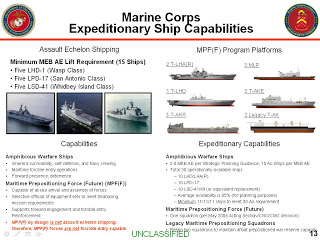
The Marine Corps states the 2.0 MEB AE amphibious lift goal translates into a requirement for a force of 33 amphibious ships, including
  • 11 LHAs/LHDs,
  • 11 LSD-41/49 class ships, and
  • 11 LPD-17s.
In explaining how the requirement for 2.0 MEB AEs translates into this 33-ship requirement, the Marine Corps states the following:

Given the lift capabilities of the Navy’s current amphibious ships, each MEB AE would require 19 operational amphibious ships to lift: 6 LHAs/LHDs, 7 LSD-41/49s, and 6 LPD-17s.

To arrive at a more fiscally constrained goal, the Marine Corps reduced the above 19-ship total to 17 operational ships: 5 LHAs/LHDs, 7 LSD-41/49s, and 5 LPD-17s. This 17-ship force requires about 11% of the MEB AE’s vehicles to be shifted to the AFOE, which creates a degree of operational risk. This 17-ship force was presented to Navy officials in mid-2007.

To arrive at a still-more fiscally constrained goal, Navy and Marine Corps officials in mid-2007 agreed to reduce the 17-ship total to 15 operational ships — 5 of each kind. This 15-ship force requires about 20% of the MEB AE’s vehicles and about 12% of its cargo to be shifted to the AFOE, which creates an additional degree of operational risk.
It would be nice to start thinking LSD(X) sooner rather than later, the purpose being to improve the MEB capability of the Marine Corps sooner rather than later. We think this approach would be good for a few reasons. First, Marine Corps equipment has become larger during the current wars as they armor up. It really makes one wonder how the MRAP fits into the MEU float loading plan without major sacrifices. The LSD(X) can help relieve the pressures this problem creates.

Second, building the LSD(X) sooner allows for the Navy to take the existing LSD force and use their mid-life upgrade to turn them into large motherships. A LSD(X) / Corvette approach between now and 2025 allows the Navy to completely replace the small surface combatant fleet, the submarine fleet, and the bulk of the expeditionary fleet just in time to free up funds for building the major surface combatant replacements.

In other words, fleet strategy would then reflect building for the current warfare requirements while planning for the future warfare requirements.

LCS Modules Move On Without the LCS

INSIDE THE NAVY had an article on Monday by Rebekah Gordon that dealt with the Littoral Combat Ship mission modules. Specifically, because the LCS is delayed, the Navy is looking for alternative platforms for testing the modules in development.

Basically the report highlights the Fire Scout will be tested on a Perry class frigate, and the MIW module will be tested on the USS Bainbridge (DDG 96) in December. So what about the ASW module?
Surrogate ships will be used later this year for initial at-sea testing of the ASW mission package, according to Baribeau. In October, end-to-end testing will be conducted using a torpedo retriever boat at the Atlantic Undersea Test and Evaluation Center instrumented range off of Andros Island in the Bahamas.

An ASW distributed forces exercise is scheduled for December in deep water off of Southern California, and LCS project managers have requested a Navy amphibious ship to act as the surrogate vessel.
Testing the ASW module on an amphibious ship sounds stupid right? Wrong. As the range of unmanned platforms increases, the limiting factor of unmanned systems is how many can be forward deployed, not which platform they get forward deployed on.

We'd like to think this is evidence the Industry and Navy are coming together on the concept of the mothership. Wishful thinking on our part maybe, but it is the future.

The article ran in the May 14, 2024 issue of Navy Clips.

Monday, May 5, 2024

Strategic Sea Basing Enables Fleet Constitution Evolution

As bad as we thought Proceedings was last year, this year the publication has made a comeback with a vengeance. I get a considerable amount of email from active duty officers O-6 and below who love to rant against Proceedings. My recommendation, don't cancel your subscription, and if you already did, think seriously about subscribing again. Either Robert Timberg has grown in his role as editor, which is likely, or the Board has given some advice to refocus content to insure relevance in wartime, which is also possible. For whatever reason, April 08 had some of the best articles I have read in years, and so far I think May 08 is great. If you get locked out of any links from this blog to Proceedings, that means its time for you to subscribe.

As a creature of habit, I always dive into the comments section first to read responses to previous articles, and this one advocates something we have been discussing privately. About a month ago I wrote an article regarding our vision of Sea Basing as a strategic concept.

Our position reflects a belief that strategic speed for strike groups is more important than tactical speed on platforms, and strategic speed is achieved through forward deployed, well resourced, sustained presence. We believe Sea Basing is best developed bottom-up, not top down. We believe that with a bottom-up approach, the Navy and Marines will evolve capabilities that scale from small wars to major power war, and effectively address the unknown variables contained in each that will only be identified through operations. The capabilities desired for the Marines have been well defined within the context of Sea Basing as two MEB assault. We like this as a goal to work towards, but not as a standard to build first. What we have not observed to date with the emergence of the Marine Corps Sea Basing vision is joint integration.

We believe the Navy should resource to integrate joint supporting elements as Sea Basing evolves bottom-up toward major war scenarios involving the Marine Corps. Examples would include NECC roles including riverine and construction, forward air controllers and related equipment, EOD teams and equipment, SOCOM forces and equipment, and integrated agency follow-on support.

In developing a strategic approach for Sea Basing, the bottom-up approach for Sea Basing establishes the bottom as the logistical supply and repair, command and control, and reconnaissance enabler for naval forces to forward deploy smaller vessels in forward theaters to address irregular warfare environments. We base this assessment on historical analysis ranging from operation Game Warden in the 60s, but also Earnest Will in the 80s, modern afloat staging bases off east Africa today, but even going back to the naval activity in the early 1800s off Tripoli examples can be found.

As a strategic concept for the Navy Sea Basing becomes the Command and Control, but also logistical enabler for small vessels and unmanned platforms in forward theaters. We envision the starting place for this concept to be the large mothership, what amounts to an independent Forward Operating Base at Sea. While we envision motherships to carry unmanned and manned platforms, it has been suggested a well designed large mothership should also be designed to support and sustain patrol ships for independent operations. It is on the patrol ships topic Proceedings has an interesting comment in the May 08 issue.
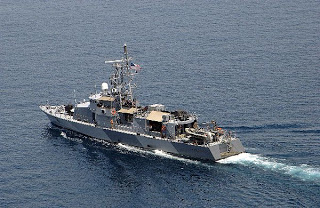
I read Rear Admiral Holland's article as I was finishing a deployment as CO of the USS Siroco (PC-6). The more I read about the Littoral Combat Ship, and the problems associated with the program, the more I am convinced what we need is more Cyclone-class coastal patrol ships (PCs). The PCs are the ultimate littoral combat ship, with a shallow draft of nine feet, plenty of speed (approximately 35 knots), and the right manning (28 Sailors). In addition, PCs are highly maneuverable, fast, and they pack a punch with a 25-mm MK38, 25-mm MK96, twin .50-caliber mounts, 240B mounts, and MK19 grenade launchers. Navy leadership should take a closer look at this program, conduct minor improvements to the engineering plant and weapon systems, and build 15 or 20 more ships. PCs can perform most littoral missions such as oil platform protection, maritime security operations, close combat support of riverine units, and shallow-water visit, board, search, and seizure (VBSS).

Also, these ships, the smallest commissioned vessels the U.S. Navy currently operates, are great for interaction with smaller navies in the Arabian Gulf, Africa, and Latin America. The Cyclone class needs a few improvements such as a better communications system, a replacement for the MK38 mod 0, and a small portable missile system for surface engagement that would give it more reach or a small multiple rocket launching system that could be used against small boat formations. If the Navy really wants to get creative, a medium-endurance PC can be developed. It would be approximately 200 feet long, have a 12- to 14-foot draft, incorporate the same hull design of the current PCs, and have a combat craft recovery system or stern ramp. These heavier PCs should be equipped with the Rafael Typhoon Gun System, allowing them to accomplish point air defense and have a better surface warfare capability.

The bottom line is that the PCs are the original littoral combat ships and they are a proven design. They provide early command opportunities to junior surface warfare officers, and invaluable shiphandling, weapons, and multi-discipline training to the entire crew. They are tough, minimally manned, and cost a lot less than LCS. Let's build more of them!
There is a recent article in Newsweek by Christopher Dickey called Bluff and Bloodshed, The Persian Gulf is more dangerous than ever. Will the U.S. and Iran go to war at sea? While it is another story on how the Navy could escalate a full scale war with Iran over an accidental shooting, despite the fact the intent of the Navy's maritime strategy is to deescalate tensions, we found another aspect of the article excellent. We are huge fans of Herald Lee Wise's book Inside the Danger Zone: The U.S. Military in the Persian Gulf, 1987-1988. In our opinion, it is the best story of the Tanker Wars between the US and Iran from the 80s time period, and combined with The Night Stalkers by Michael J. Durant and Steven Hartov, one can get a real sense of the operations in that region during the Tanker Wars conflict period. Herald Lee Wise contributes some interesting insights to Christopher Dickey's article.
Low-tech weapons are effective in naval conflict.
"Modern technology remains weak at detecting undersea mines," says Wise. But mines are not the only problem. In the 1980s, as now, the Iranians used "swarming" tactics against larger merchant and naval vessels, sending relatively small boats at high speeds buzzing around and near the U.S. ships. The same thing happened in January this year, and possibly—the boats were never identified—just last week around a merchant ship on contract to the U.S. Navy.

Fight fire with fire.
In 1988 the most effective way to combat the Iranians turned out to be with weapons similar in scale to their own. Special Operations Forces using stealth helicopters from bases built on huge oil barges in the northern gulf effectively shut down Iranian mine-laying activity there.

By contrast, the billion-dollar guided missile cruiser USS Vincennes, gunning for Iranians near the Strait of Hormuz, fought a battle against a swarm of Iranian gunboats in July 1988 that was inconclusive.

What was memorable about that day was that in the heat of the moment the Vincennes mistook a civilian airliner overhead for an Iranian warplane and shot it down, killing all 290 people aboard.
We conduct many naval simulations, and in our simulations have tried to figure out what about the Littoral Combat Ship 3000 ton mothership concept would be superior to much larger motherships supported by PCs. Perhaps our simulations are flawed, but we note Millennium Challenge 2002 and the entire Streetfighter development argues multiple small forces enabled by C4ISR offer a number of tactical and strategic advantages over adversaries, but more importantly scales very well in addressing both small wars and major power war. We believe there is a role for patrol ships in the US Navy today, although we acknowledge for them to contribute, they will require Sea Based logistical and C2 solutions to be effective.

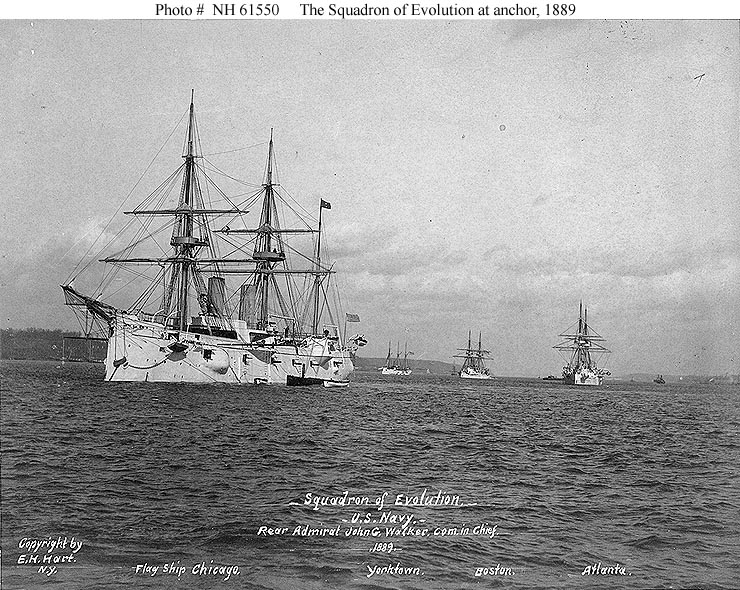
As the first picture in this article highlights, the Navy finds itself in a similar time period to that of the squadron of evolution. It has been a decade since the strategical and tactical ideas of our time were originally identified, and the Navy has only one more decade before the entire shipbuilding budget must be dedicated to replacing the most expensive part of the surface fleet as it ages out. We believe the Navy has all of the metrics and concepts for the surface fleet right, and unlike many we also believe the Navy has the strategy right. However, we believe the application of those metrics and concepts to strategy is flawed. There are a number of alternatives, and we don't claim to know which is better, but any alternative that chooses small combatants over big combatants, and large motherships over mini motherships is smarter than more battleships and an unrated flotilla. It is time for the Navy to align resources to strategy and patrol ships represent one way to align means with ends and ways for small wars at sea as outlined in strategy.

For Sea Basing that means realistic development and evolution. Today's ESG cannot even carry all the equipment for a modern MEU, and tomorrows ESG won't be able to either. Shouldn't both the Marines and the Navy establish what is required just to conduct an assault with one MEU against a hostile coast before both jump straight to 2 MEBs? How many small craft equipment sorties will be required to clear a beach from mines? How many UUVs are required to clear the sea of mines for a LCU to travel from the Sea Base to the shore? How quickly will air traffic controllers be able to deploy 200 miles in land with all equipment to support the new long range of MV-22s and Joint Strike Fighters? Sea Basing is going to be complicated, it includes much more than just the man and material of the Marines, because there is a rather long tail for the Navy extending well into land. With the 2 MEB Sea Basing concept consuming every resource for the Marines, what Joint capabilities are truly available in this strategy? In the 1980s against Iran, the Sea Basing platforms supported small Army helicopters, yet this transformation MPF(F) concept skipped that capability.

Sea Basing is going to be at least as complicated as Naval Aviation was to develop, yet instead of building the Langley, the Navy and Marines are developing a Nimitz. In our observations of proposed Sea Basing plans, the Navy and Marines have skipped over all of the various small war possibilities just to achieve the least likely, most difficult major war requirements. Shouldn't the services build up to this point rather than skip to it? Suggesting the highest end requirements scale down is dishonest because the Sea Base concept lacks the obvious capabilities of Sea Basing demonstrated historically in both Vietnam and against Iran. Unless we are parking LSDs/LPDs in the middle of small wars hot spots at sea and calling that a Joint Sea Base, the bottom-up joint services approach seems the wise way to invest in such an important strategic capability.

Why do I keep pounding this issue to death? Corbett warned about the dangers of a battleship Navy. While supporting all the big deck carriers and an AEGIS battleship fleet, it is hard not miss how the fleet continues to decline in numbers. Balance is key. For a nation like the US, which sends its Navy half way across the world to defend our interests, the processes that will be needed to support sustained forward presence is where change begins. The Navy will not recognize the value of small vessels until they recognize how to support and sustain them, and that is where the strategic concepts of Sea Basing comes into play. Once the Navy realizes that Sea Basing enables options otherwise not possible at sea, and the Marines see the advantages of a joint approach for going in to land, we believe that will be when the platform designs that define both the naval aviation fleet, surface fleet, and expeditionary fleet today will begin to evolve.

Wednesday, April 16, 2024

The Expeditionary Approach To Africa

As we continue to observe naval developments around Africa, we are very encouraged that regardless of how slow AFRICOM moves, the Navy has the right approach. We observe the latest from Navy NewsStand:

The dock landing ship USS Ashland (LSD 48) pulled into Antsiranana, a small port city on the northern tip of Madagascar, Tuesday, April 15.

Antsiranana is Ashland's third stop on her current deployment with U.S. 6th Fleet's Southeast Africa Task Force, promoting maritime safety and security in the region. The ship recently visited the Indian Ocean islands of Mauritius and Reunion.

Notably, this is only the second time a U.S. Navy ship has visited Madagascar since 1972. USS Normandy (CG 60) also called on the country last year during its assignment to the Southeast Africa Task Force.

Presence. The US Navy is there. I don't know where the 6th fleet was before last year, but starting last summer we began observing an increased tempo of engagement with Africa in a meaningful way. Meaningful naval engagement with Africa in the 21st century began in 2005 with the USS Emory S. Land (AS 39) mission to the Gulf of Guinea, but that deployment was the only US naval vessel to actually visit Africa in 2005. The tempo increase didn't begin until last year. There is a pattern developing in the way the Navy is approaching the global maritime environment in the non-integrating gaps, and the expeditionary ships are leading the way.

Most of the top Admirals in today's Navy were Captains and Cmdrs of some of the most important actions in the 80s and 90s. In those two decades, whether you are talking about Kosovo, the Gulf War, and virtually all of the other actions involving the US Navy, the carriers and surface combatants were centric to those actions. It is no accident therefore that naval leadership of today is dominated by former carrier commanders and commanding officers of surface combatants, they were the ones at the tip of the spear. However, we observe the 21st century is different.

We have a theory that the bulk of the Admirals of tomorrow are the CO's and XO's of expeditionary warfare ships and submarines of today. The expeditionary ships and submarines of today represent the sharp end of the spear in executing the maritime strategy. We see it everywhere, whether you look at the submarines in the Pacific or firing cruise missiles at terrorist targets, or the expeditionary forces that are expanding their roles as they engage nations in the non-integrated gaps from Southeast Asia to Africa to South America.

It is why whenever we talk about an expeditionary ship, whether it is the USS Whidbey Island (LSD 41) or the USS Oak Hill (LSD 51), we try to remember to talk about the Commanding Officers. When I took a look at the USS Ashland (LSD 48) webpage after reading this story, I was disappointed when I did not see biographies for the CO, XO, and CMC. While our theory is far from the minds of these Commanding Officers, it occurs to us that the biographies are important. If the Navy of tomorrow represents the men executing the most important naval activities of today, then Cmdr. Jeff Ward of the USS Ashland (LSD 48) could be an Admiral of tomorrow. Hiding his biography isn't doing him any favors.

The story concludes with this comment.

This is the second deployment of CTF-363's Southeast Africa Task Force. In 2007, CTF-363-assigned assets USS Forrest Sherman (DDG 98) and USS Normandy (CG 60) visited eight Southeast African nations. For many of these countries, it was the first time a U.S. Navy ship had visited in more than 40 years.

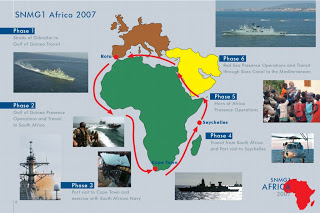
The USS Forrest Sherman (DDG 98) deployed with the Enterprise CSG last July, but spent the majority of the deployment visiting regional nations from the Black Sea to Africa. A similar mission is being conducted today by the USS San Jacinto (CG 56), which deployed with the Truman CSG. The USS Normandy (CG 60) was part of the Standing NATO Maritime Group ONE (SNMG 1) circumnavigation of Africa last year.

We like that the Navy is using expeditionary ships in the role of exercising with regional nations, in particular we imagine that without the MEU equipment, the USS Ashland (LSD 48) probably has that huge well deck filled with the right equipment to exercise efficiently with regional partners. In regards to that last sentence, the key word is imagine. I'm assuming a lot, because I'm assuming the Navy is testing mothership operations with a ship well designed for that role. I'd like to think it is loaded up with a bunch of small boats, unmanned vehicles, specialized training units, coast guard personal, and equipment to support Seabee's. If not, another missed opportunity.

Why do we constantly talk about motherships? Observe recent operations off Africa, including the recent French activity, and it is self evident. The USS Whidbey Island (LSD 41) was an offshore mobile forward operating sea base for 6 months, and piracy off Somalia is down in that region from last year. The USS Oak Hill (LSD 51) has replaced the USS Whidbey Island (LSD 41) in that role. The USS Ashland (LSD 48) is currently making the rounds in southeast Africa, I expect they will do good things on this deployment to a region who rarely sees the US Navy. The USS Fort McHenry (LSD 43) recently completed the African Partnership Station that is best described as DOEE with the MSC, a HSV, and a LPD. I still need to write up our conclusions on that mission.

Note none of those expeditionary ships mentioned in this post have Marines onboard. The Marines should be screaming for more expeditionary ships, because despite all the calls to get back to sea from the Marine community, when the Marines get out of Iraq they are going to find the Navy is using their ships for their own purposes. The Navy has good reason though, the mothership concept works, it is one of the strategical and tactical ideas of our time, its a shame the concept is being wasted on the small LCS design, although we have faith the Navy will 'eventually' realize this. Thomas Barnett used to talk about the future Navy being more ferry than warship (he still may). At the time who believed him? It is very difficult to take an objective look at how the Navy is approaching Africa today with these big expeditionary ships carrying alternative payloads and not acknowledge the Navy is basically validating through current operations he was exactly right.

We could produce an article the same length about the expeditionary ship deployments to South America and Southeast Asia conducting the same type of mission profiles, and those articles would include the Hospital ship deployments and large deck amphibious ships. With the upcoming Mercy and Boxer deployments, we eventually will. The expeditionary ship requirements for the Navy are plainly obvious, they are best reflected by the operational tempo of the expeditionary fleet, which is higher per class than any other ship class the Navy operates (besides submarines, see a pattern?). Who is ready to admit the needs don't match the plan inside the Navy? If your looking for a sign the Navy is adjusting to its own strategy with its resource priorities, keep an eye on the 10th LPD discussion for FY09, it is where the transition will begin.

Tuesday, April 8, 2024

Matching the Metrics With the Mission

Sometimes I wonder if the ideas promoted on this blog for peacetime strategic approaches are in line with Navy thinking. Sure we are influenced heavily by those in or retired by the Navy for our ideas, but not so much above 0-6. However, every once in awhile an article comes along that gives us some hope, and this time it comes from Proceedings. Springboard, check your 6, I'm not the only person talking up motherships anymore.

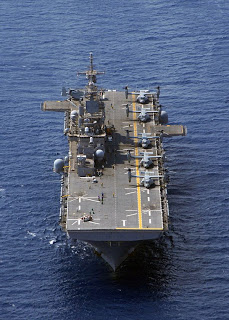
The LHD-1 was designed for amphibious assault, meaning it can embark and support the expeditionary strike group commander or commander amphibious task force, tactical air control assets, VSTOL aircraft, helicopters, landing craft (LCAC or LCU), and a Marine expeditionary unit (MEU)—size landing force of personnel and associated equipment.

But when the MEU and associated gear are not embarked, or when the LHD is in a "ready surge" status with no MEU assigned, the ship's many capabilities could and should be used to support a growing number of non-traditional missions. Recently we have seen examples of the need for these in events such as Hurricane Katrina and tsunamis.

Combatant commanders and task group commanders desire an afloat forward staging base, but what should it carry and be able to accomplish? Some recent LHA/LHD surge deployments in response to emergency situations (Hurricane Katrina and Indian Ocean Tsunami Humanitarian Assistance—Disaster Relief, for example) and the 2007 LHD-1 surge deployment to deliver MV-22 aircraft to Iraq have occurred with minimum embarked assets and did not optimize the capabilities of the ship, perhaps due to a lack of pre-determined force packages.

Bingo. Sounds to us like someone is talking about motherships, although they are proposing the use of the second largest warships in the fleet when they are idle for the mothership purpose. The article goes on to highlight the capabilities of the LHD-1 class, and the authors do a very nice job. The authors don't come out and say it, but they are talking about the same specific metrics we often discuss here as part of motherships, and if you read the article you will find the same mission profiles and descriptions used to describe the intended peacetime roles of the LCS. One exception though, mothership packages are manned AND unmanned, in other words, they are LCS+, and we think it is forward thinking should the Navy examine how best undertake an understanding force packages and requirements for motherships using the existing LHDs, or any L-class ship. Actually, they already do a lot of this, but more is good. Effective motherships in the 21st century will be big, and we believe that upon testing, the Navy will find they don't have to be that big or aviation centric.

The article goes on to list 6 potential mission profiles for the mothership.

  • Humanitarian Assistance/Disaster Relief (HA/DR)
  • Maritime Security Operations (MSO)/Counter-Piracy/ Surveillance
  • Strike Support/Counter-Terrorism
  • Afloat Staging Base
  • Maritime Operations Center Forward Command
  • OPLAT Defense/Patrol Craft/Mine Countermeasures Support

Sound like the LCS yet? It should, the LCS is the mothership program of record. The LCS represents the strategic and tactical concepts of our time, no question, and that concept is called the mothership. The capabilities requirements established by SC-21 for surface combatants and motherships was right on metrics, but in our opinion wrong on execution. Rather than a big surface combatant and a bunch of small motherships, we still believe it should be big motherships and a bunch of small surface combatants. 7 DDG-1000s makes no sense at all, and neither do a bunch of small unrated motherships. 7 motherships, or as we would suggest, 9 (1 for each ESG), makes a ton of sense, particularly when supported by a bunch of fifth-rate combatants to execute the currently missing cruiser role.

We observe that a purpose built large mothership would execute these specific peacemaker mission sets for the Navy, but would also transition to warfighting by additionally providing unmanned vehicles for ASW and ASuW in the littoral, and increase scouting capabilities at the Strike Group level. Most importantly, motherships will bring with them the facilities to keep unmanned systems operational (something the mothership program of record can't do).

We note the authors are promoting the use of the LHD-1 class to be for peacetime operations what is supposedly being offered by the LCS. Those who think the LCS is a surface combatant would disagree, but can those critics cite a single surface combatant the LCS will defeat in an actual shooting war? Can those critics answer why the LCS is said to offer these same peacemaking mission sets? If you are looking for evidence, read the comments section of Proceedings last month, you'll find Lockheed Martin making our case. If the LCS can really do it, we won't need amphibious ships to conduct these roles in the future. Who really believes that?

We are very pleased to see this article published in Proceedings. It is a shame the idea and discussion of the concept wasn't expanded to 3000 words, but this is a great start. This is an important discussion on roles and missions, executing strategy, how and why, and we are very pleased to see someone else trying to promote that discussion in Proceedings.


The authors of the Proceedings article served in the wardroom of the USS Kearsarge (LHD-3): Captain Sensi, commanding officer; Captain Pagano, executive officer; Commander Guzman, command and control, computers, communications and combat systems and information (C5I); Commander Hills, prospective C5I; Commander Conner, aviation intermediate maintenance department (AIMD); Commander Henderson, supply officer; Commander Sherck, senior medical officer; Commander Connor, air boss; and Commander Vogt, operations officer.

Wednesday, March 19, 2024

New Fleet Tech Requires Thoughtful Integration

We go out of our way here to describe tools of naval war in the context of the mission profiles they are best suited to conduct. This is particularly true of emerging technologies, specifically unmanned systems. We try to emphasize as often as possible that unmanned systems, primarily used for scouting roles today, will evolve, but as they evolve they will only evolve for warfighter roles within the US Navy. We believe understanding this is critical to strategy, because we do not believe the Navy operates under this theory.

This is why we are trying to warn the Navy that the LCS, a mini-mothership for unmanned vehicles, will ultimately be a very poor peacemaker platform for the US Navy, ultimately denying the Navy exactly what the surface combatant force needs for a peacetime maritime strategy. We have long believed there is a lesson in Iraq for the Navy that is going largely ignored, despite individual augmentee's who remind us the lesson plain as day. Peacemaking requires manpower. Without sailors the Navy cannot be a peacetime force, cannot engage on the personal level for all of the various peacemaker roles that simply cannot be done without human beings.

That does not mean unmanned systems do not have a critical role in the future, in fact we believe investment and development of unmanned systems by the Navy to date has been very well done. There are roles today that unmanned systems can help with, warfighter roles on the front lines today where lack of availability alone prevents them from making a major contribution. This is a great example.

Closer to Doha, Rear Admiral Robert Cooling, Assistant Chief of Naval Staff, UK Royal Navy (RN), spoke about the need to protect critical infrastructure such as Iraq’s two major oil distribution platforms. That task is currently being undertaken by a coalition warship, most recently the RN's Type 22 frigate HMS Campbeltown.

It is the kind of task that UMV manufacturers believe they can assist in, using UUVs or USVs as close protection and reconnaissance assets that could be deployed to protect areas leaving a warship to pursue activities, but close enough to provide assistance if something were to happen.

If UUVs, in particular, are to break out of the small ocean survey and mine counter measure niches that they have carved for themselves it will be in areas such as inshore maritime security and infrastructure protection that speakers believe opportunities will arise.

This is a physical security role, the primary warfighter requirement of the US Navy today for the war in Iraq. The article also notes Singapore's use of unmanned vehicles. What is interesting about that is that the only unmanned vehicle my chief has ever seen was deployed from a LST in the Singapore Navy. There is something to be said for an unmanned boat with a 30mm gun designed for precision accuracy to rain death on target. These can and perhaps will be game changers in a firefight against small boat swarms.

You know how many are intended to operate from a LCS in the future? One, maybe...two, and only from the ASuW module version of the LCS. Terrible strategy.

Again, this is why we believe the Large Mothership will be in the 21st century what the Aircraft Carrier was in the 20th century, and in fact motherships will become the High Value Units on the battle line of the future in many cases instead of the large deck aircraft carrier as the center of a strike group. It is not a replacement for the aircraft carrier, motherships bring a completely different function to the total battle force, but they represent those warfighter requirements of the fleet that are required, but not easily handled otherwise.

I almost never talk about the results of our wargames, but I'm starting to wonder if we should more often. James Dunnigan has given open source gamers more than almost any previous military historian and gamer in history for the development of simulations and wargames for the purposes of independent evaluation of systems, CONOPs, and in fact usability of technology, and all that prevents regular folks from utilizing his tools is effort and study. Leveraging both our personal and professional gaming experience, we have spent the last several years studying the lessons available in his publishings and available in the open source, and combined with our industry experience both in gaming and simulation, including the crews experience in developing war games at places like the NWC, we believe our simulations are as credible as any.

We recently ran 3 excellent simulations all of which leveraged the LCS, and did so for three different geographic locations facing three very different enemies. In all three examples we find the same pattern emerges, a pattern that the Navy simply must be ignoring, because it is impossible to miss how obvious it is in simulation.

In wartime simulations, as the Littoral Combat Ship suffers battle attrition, even as the high value units survive attacks, the scouting capacity and capability of the total battle force continuously diminishes because the primary scouting assets, unmanned vehicles, are in fact primarily concentrated to the flotilla and not the battle line.

This would seem to be a glaring tactical weakness from a total force perspective. It is counter to WWII when scout planes were resources of the battle line (larger, survivable warships) and even going back to the age of sail, it was the supporting nature of the battle line that enabled the flotilla to do its scouting work. The concentration of scouting systems (unmanned systems) to the flotilla appears to put the most enabling network components for scouting on the ships most likely to suffer attrition.

The Navy appears to desire a fleet of only battleships, basically the highest rated warships of our era, and rather than a supporting fleet of cruisers (frigates) and a flotilla, the US Navy has decided the entire flotilla will instead be a mini-mothership and cruisers (frigates) are no longer needed. We find it stunning the Navy is ignoring the tactical disadvantages to this approach. We have attempted to reach out to a number of people we respect who might shed light on this decision process, none have responded to defend the Navy in this regard.

This is a revolutionary change in maritime strategy, at least from a historical perspective up to and as recently as the Falklands War. HMS Sheffield (D 80), HMS Ardent (F 184), and a number of other escorts remind us that in war, the primary role of escorts remains to protect high value units, and as tragic as it is that the British took tremendous damage during that conflict, those escorts conducted their role successfully.

What evidence exists that technology has advanced so far as to suggest Navies no longer require frigates (cruiser role vessels as per the age of sail)? Is it smart strategy to build the flotilla to be a mini-mothership? Our observation is that new technologies are arriving on the scene rapidly, both for warfighter and peacemaker roles. The Navy is attempting to field these technologies rapidly, as they should, but they should also recognize and study where and how these technologies get incorporated into the fleet, because strictly from a historical, tactical, technical, and strategic perspective I cannot find a single retired Admiral, a single active duty Captain, a single Naval Professor, a single naval historian, a single naval author, or a single naval technologist who will debate in defense of the Navy.

Not a single one. Does that person exist? Is so, who and where? If not, why continue down this road, why are we wasting time and money?

Monday, March 10, 2024

The Navy is Developing Mothership Operations

I love this article. We are seeing the early development of a new concept that has the potential to change the way the Navy conducts its peacemaker security roles at sea. This is a sign of the evolution of peacemaker operations under the NCW model.

Amphibious transport dock USS Cleveland (LPD 7) completed first-time Interaction Patrols (IPATS) by integrating the use of a landing craft utility (LCU) with air assets during a recent series of exercises in the Persian Gulf.

IPATS are an element of Maritime Security Operations (MSO) which help generate support and awareness amongst commercial vessels sailing in the region of the coalition's efforts to ensure a safe and secure maritime environment. Coalition forces also conduct MSO under international maritime conventions so that commercial shipping and fishing can occur safely in the region.

Cleveland, operating as an afloat forward-staging base, demonstrated the ability to direct multiple IPATs using its visit, board, search and seizure (VBSS) teams on maritime security missions while effectively maintaining command and control of aircraft. Utilizing an embarked landing craft utility (LCU) from Amphibious Assault Craft Unit 1 (ACU 1), Cleveland's VBSS teams deployed from the smaller, more maneuverable landing craft.

Notice what we have here. A Motherhip (USS Cleveland LPD 7) deploying medium sized, independent platforms able to independently support VBSS operations, in this case using LCUs. The reason for the LCU is cited as a platform that extends range beyond that of the RHIBs, in other words, endurance. We note this is two of a three step process we have previously described for peacemaking at sea.

The afloat forward-staging base is not a new concept, rather a concept that has been exploited by the Navy in theater many times. We believe the afloat forward-staging base can be used in a number of ways beyond the ways described in the past, and this story is one such example.

The next step is to find a platform that can self deploy from motherships that can support the VBSS operations of a RHIB, thus extending the network and extra 'hop'. While that is a process down the road, we commend the Navy for leveraging these existing platforms in this way.

The concept is brilliant in its simplicity, by leveraging aviation for maritime domain awareness, and by leveraging the endurance of the LCU, the mothership is able to coordinate security over a wider area as part of a peacemaking network.

"Our efforts to improve our maritime patrol procedures aims to minimize maritime crime and harassment in the region," said Capt. Billy Hart, Cleveland's commanding officer. "Ultimately, these efforts will bolster security and stability in the region. We experimented with this new concept, along with Destroyer Squadron 26, proving the concept and then putting the pieces into motion. It boosts efficiency and may become the standard for maritime security patrols."

We hope so, the establishment of peacemaking doctrines to support the new Maritime Strategy is an important step. All ahead steady. Test and verify. Evolution not transformation. We can't commend this activity enough, because we see it as an evolutionary step in the establishment of true Maritime Domain Awareness and acknowledgment of the peacemaking possibilities of the mothership in the 21st century.

In the future we believe the mothership will become the MDA centric surface platform, centralizing the C4ISR role within the peacemaking model. The mothership will manage deployable aviation platforms, mostly unmanned but also manned, to support not only the scouting responsibilities, but also the security support responsibilities. We also believe the establishmwnt of doctrine under this model will lead to the Navy developing naval specific platforms (as opposed to amphibious platforms) for the mid-sized endurance platform. That mid-sized deployable platform, if armed and designed with both speed and endurance in mind, will expand the network even further enabling the Navy to independently manage security operations in areas of very long coastlines and heavy shipping traffic without requiring an entire strike group or a destroyer squadron.

Wednesday, March 5, 2024

Obseving the Marine Maritime Debate on Capital Hill

Navy Times has an interesting article that overviews some of the Marine Corps discussions taking place on Capital Hill. We have mixed feelings on some of the press coverage, because in many ways it creates a perception that there is a conflict of interests in statements and desires.

Marine Corps leaders say they’re concerned about the Navy’s capability to support amphibious assault forces and is asking Congress to provide money for at least one new ship.

“Our nation needs this ship, and we need your help in procuring it,” Lt. Gen. James Amos, head of Marine Corps Combat Development Command, told a House Armed Services subcommittee Feb. 26.

Amos was referring to an additional LPD 17 San Antonio-class amphibious transport dock; the class is replacing a series of aging amphibious ships.

The Navy is on track to buy nine LPD 17s, and getting a 10th hull is the Corps’ top unfunded priority for the fiscal 2009 budget cycle.

The article goes on to highlight several points. First the Marine Corps want 33 amphibious assault ships; 11 “big deck ship” amphibious assault ships, 11 dock landing ships, and 11 LPD 17s.

Second, the Marine Corps desire 2 MEBs for amphibious assault, and the article highlights an important point, a single MEB requires 17 amphibious ships for assault, meaning the Navy needs to maintain a total amphibious force of 34 ships, if the amphibious support mix retains the current three types of ships.

Finally, despite recent Navy comments, Congress Rep. Roscoe Bartlett, R-Md observes something we have been unsure about. Apparently we are not reading the FY09 budget incorrectly.

Navy budget documents for the fiscal 2009 proposal show the production line for San Antonios will shut down after nine ships. Restarting production would raise the cost of future amphibs.

Rep. Roscoe Bartlett, R-Md., said the Navy’s decision to shut down that line seems like a bad one.

“With all the talk about controlling costs of shipbuilding, I was dismayed that the Navy would request and take specific steps that should only have the effect of increasing the eventual cost of the 10th LPD,” Bartlett said.


Thats the way we read it too, although we note the Navy has made several comments otherwise. While the press is giving some of the story, the testimony of General Conway in front of the Senate on Feb 28th makes clear in our opinion what the Marines are looking for at sea.

Based on strategic guidance, in the last several years we have accepted risk in our Nation’s forcible entry capacity and reduced amphibious lift from 3.0 Marine Expeditionary Brigade (MEB) assault echelons to 2.0 MEB assault echelons. In the budgetary arena, the value of amphibious ships is too often assessed exclusively in terms of forcible entry—discounting their demonstrated usefulness across the range of operations and the clear imperative for Marines embarked aboard amphibious ships to meet Phase 0 demands. The ability to transition between those two strategic goalposts, and to respond to every mission-tasking in between, will rely on a strong Navy-Marine Corps Team and the amphibious ships that cement our bond. The Navy and Marine Corps have worked diligently to determine the minimum number of amphibious ships necessary to satisfy the Nation’s needs—and look forward to working with the Committee to support the Chief of Naval Operation’s shipbuilding plans.

The Marine Corps’ contribution to the Nation’s forcible entry requirement is a single, simultaneously-employed two Marine Expeditionary Brigade (MEB) assault capability—as part of a seabased Marine Expeditionary Force. Although not a part of the Marine Expeditionary Force Assault Echelon, a third reinforcing MEB is required and will be provided via Maritime Prepositioning Force (Future) capabilities. Each MEB assault echelon requires seventeen amphibious warfare ships—resulting in an overall ship requirement for thirty-four amphibious warfare ships. However, given current fiscal constraints, the Navy and Marine Corps have agreed to assume greater operational risk by limiting the assault echelon of each MEB by using only fifteen ships per MEB—in other words, a Battle Force that provides thirty operationally available amphibious warfare ships. In that thirty-ship Battle Force, ten aviation-capable big deck ships (LHA / LHD / LHA(R)) and ten LPD 17 class ships are required to accommodate the MEB’s aviation combat element.

In order to meet a thirty-ship availability rate —based on a Chief of Naval Operation sapproved maintenance factor of 10%—a minimum of eleven ships of each of the current types of amphibious ships are required—for a total of thirty-three ships. The Navy has concurred with this requirement for thirty-three amphibious warfare ships, which provide the “backbone” of our maritime capability—giving us the ability to meet the demands of harsh environments across the spectrum of conflict.

Emphasis ours. There is a lot of good information here. Notice how this is breaking down.

For the 2015 MEB Assault Echelon (AE) the Marines require 17 ships (five LHD, five LPD-17, five LSD-41, two LSD-49), which as is confirmed in testimony means for the MEB ACE the Marines require 4 LHA/LHDs, 1 LHA(R), and 5 LPD-17s. Current plans leaves the Marines short 1 LHD, which is intended for the Sea Base. The primary equipment aspects include 18 LCACs, 30 JSFs. 48 MV-22s, 20 CH-53Ks, 18 AH-1s, 9 UH-1s, 2 MH-60s, and 8 UAVs. A full MEB ACE is basically 246 CH-46 equivalents. For the Sea Base, the 30 JSFs get put on CVNs, which could directly effect Navy specific aviation requirements.

The Marine Corps should never have accepted the reduced 2.0 capability, which was reduced to 2.5 during the cold war due to budget, because during the cold war it was actually 3.0. We continue to remind that the reduced 2.0 capability is counter to the studies leading into the 21st century, which noted the 3.0 MEB capability would become MORE important to meet irregular challenges in a world changing through globalization. The Marines are advocating for 33 ships to support a reduced 2.0 MEB assault capability, which actually requires 34 operational ships to fully assault with 2.0 MEBs, and all 34 would need to be 100% operational. This tends to imply what the Marines actually need is 36 ships. The Navy has no intention, and is under no obligation to support that.

To compound the problem, the Marine Corps are trying to squeeze this capability into the new Sea Base MPF(F). No wonder they have slowed down, no wonder they are looking for a new amphibious ship mix, and no wonder the Marines inch up the number of LPD-17s they need every year, from last years number of 10 to this years number of 11. All of this is absent the discussion of the JHSV, which has an entirely different but important role for expeditionary warfare.

Absent from the discussion is the Amphibious Lift Enhancement Program (ALEP), which has never been tested but has five LKAs and four LSTs, providing a total of 201,000 square feet of vehicle lift capacity. Also absent from the discussion are the two Aviation Maintenance Logistics Ships (T-AVB), both of which will be retired by 2020. Each T-AVB carries a Marine Aviation Logistics Squadron (MALS) to a crisis area, without which would put a huge strain on strategic airlift to support.

Does anyone believe at this point the LPD 17 class replaces four classes of older ships—LKA 113, LST 1179, LSD 36, LPD 4? Does anyone believe the Navy and Marines should really give up the LHA(R) for the Sea Base? Anyone remember the warnings in the Defense Science Board Study on Seabasing? This is why ONR had it absolutely right, what is needed to solve the sea basing aviation issue is something very large, something like the Maersk S-Class Conversion Concept. 2 on each coast would be the biggest boost to capabilities for virtually every Sea Basing mission ever convinced, and would allow both the Navy and Marine Corps to rightsize the amphibious fleet to support not only the amphibious assault requirements for major war, but the mothership requirements for peacetime.

Amphibious ships continue to be the most flexible platform in the Navy today, Congress should ask Sec. Winter to develop alternatives for amphibious ship strategies either with or without the Sea Base for supporting a 3.0 MEB capability afloat, with a 2 MEB Prepositioning requirement, and at least a 2.0 MEB forcible entry capability.

While the Navy might claim that is exactly what is currently in motion with the Sea Base, clearly the data continues to tell a different story.