
Monday, July 28, 2024

Saturday, July 26, 2024
Future of Surface Warfare Lethality
The Hudson Center for American Seapower had a discussion panel yesterday at the Capitol Visitor Center (with lunch!) on the Future of Surface Warfare Lethality.
Here's the video.
Here's the video.
Thursday, July 24, 2024
Monday, July 21, 2024
Seapower and the Interwebz
The Internet as we know it has only been around for a generation. Pretty much everyone in the industrialized world takes the Web for granted by now, as it has become a ubiquitous component of business, government, and our social lives. Yet, most of us probably don't give much thought to the 77 undersea fiber optic cables spanning nearly a million kilometers that carry 99% of the world's communications and data. Fortunately, one website has done the service of providing not only an amazing visualization of this vital, yet vulnerable infrastructure, but tied its importance to naval history and military operations. Even the Air Force's UAV operations rely on undersea cables to reduce the latency inherent in satellite networks. Built Visible's Messages in the Deep page serves as a reminder that our daily lives remain inextricably linked to the oceans. (for even more details, see Submarine Cable Map). This overlooked aspect of seapower facilitates global commerce today much as surface shipping has done for centuries.
Saturday, July 19, 2024
China participating in RIMPAC and J-20 updates
This year, China has been invited to RIMPAC for participation. China is sending No. 171 (Haikou), No. 575 (Yueyang), No. 886 (Qingdaohu) and No. 886 (Peace Ark) to the exercise.
I'm sure some others would disagree but I think such participation is great for not only relationship between the 2 countries and lowering naval tension. Aviation week posted a good article of its visit on No. 171 Haikou. It's certainly no surprise to me that the reporters were allowed to take pictures and interview the captain and crew member, since China has had this kind of "open house" on its new ships in different port calls around the world. The article promised an "exclusive and rather frank sit down with Senior Capt. Zhao Xiaogang" coming up, so I'm interested in seeing how that goes.
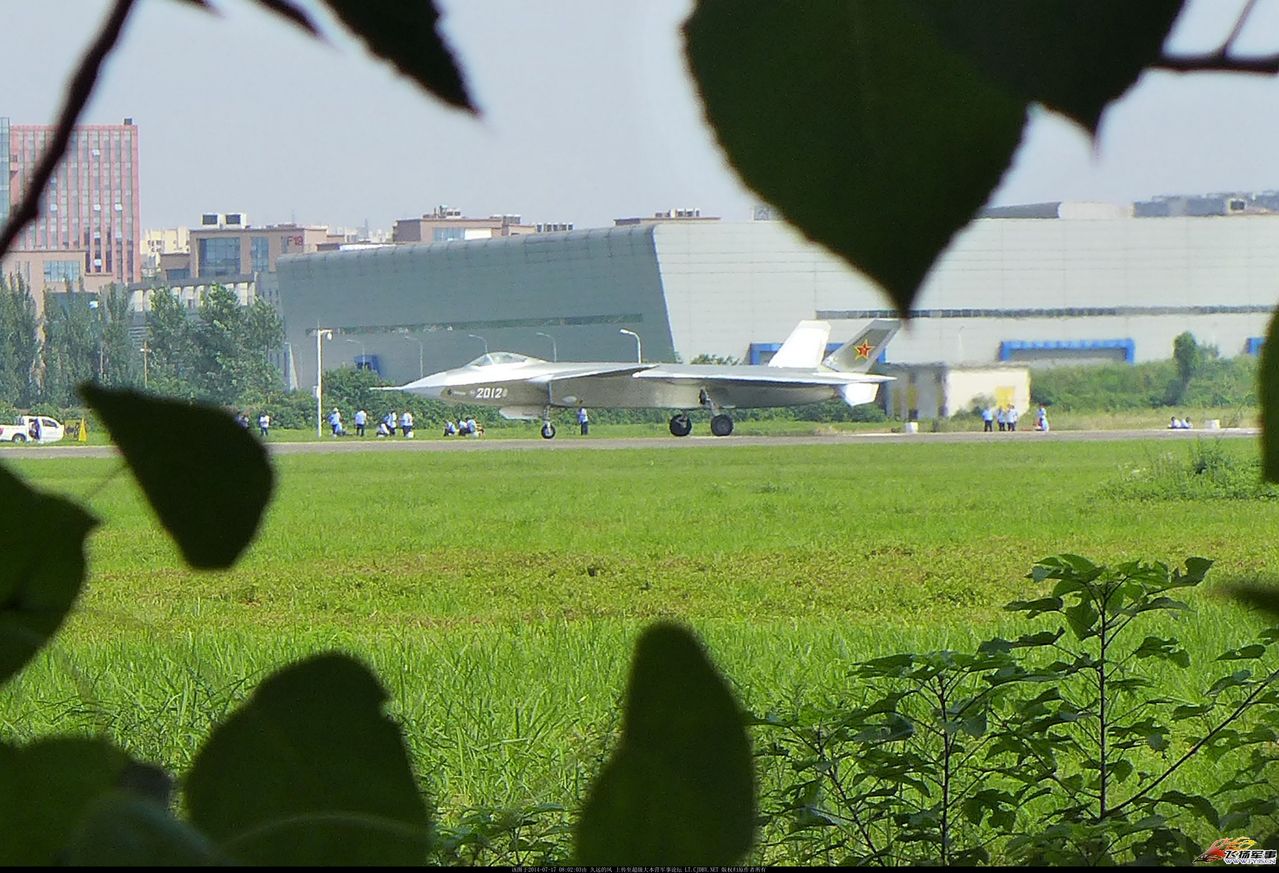
We are also seeing what appears to be a new prototype of J-20 coming out this past week for low-speed taxi test. From what we've seen so far, there is no much changes on this new prototype (No. 2012) compared to the last prototype (No. 2011). There might be some changes in the tail area and around the engine going forward, but I think CAC has mostly settled on the design of this aircraft. We can see it below:
Would be interesting to see how this proceed vs PAK-FA going forward.
I'm sure some others would disagree but I think such participation is great for not only relationship between the 2 countries and lowering naval tension. Aviation week posted a good article of its visit on No. 171 Haikou. It's certainly no surprise to me that the reporters were allowed to take pictures and interview the captain and crew member, since China has had this kind of "open house" on its new ships in different port calls around the world. The article promised an "exclusive and rather frank sit down with Senior Capt. Zhao Xiaogang" coming up, so I'm interested in seeing how that goes.
We are also seeing what appears to be a new prototype of J-20 coming out this past week for low-speed taxi test. From what we've seen so far, there is no much changes on this new prototype (No. 2012) compared to the last prototype (No. 2011). There might be some changes in the tail area and around the engine going forward, but I think CAC has mostly settled on the design of this aircraft. We can see it below:
Would be interesting to see how this proceed vs PAK-FA going forward.
Wednesday, July 16, 2024
HASC Seapower and Projection Forces Sub-committee: UCLASS Hearing
Bob Martinage, Shawn Brimley, Ron O'Rourke, and I were invited to testify today before the HASC Seapower and Projection Forces Subcommittee on the subject of UCLASS.
The video can be found here. Be advised, there's a huge chunk of dead screen in the middle because the hearing adjourned for votes.
I have included my statement for the record below; the middle third may look familiar to some, as it comes from a post I did here a few years ago called "A Seapower Manifesto". Shawn Brimley's superb statement for the record can be found here. If I can get links to Messers. Martinage and O'Rourke's written statements I will come back and update. (Here is Martinage written statement).
Ron O'Rourke did is usual methodical job of laying out for the members some important analytical questions without giving any indication of his opinion--this is his job and he is a master at it. Brimley, Martinage, and I were in lock-step agreement that a UCLASS requirement that overly privileges ISR at the cost of contested strike is not only wasteful and duplicative, but strategically unwise.
The video can be found here. Be advised, there's a huge chunk of dead screen in the middle because the hearing adjourned for votes.
I have included my statement for the record below; the middle third may look familiar to some, as it comes from a post I did here a few years ago called "A Seapower Manifesto". Shawn Brimley's superb statement for the record can be found here. If I can get links to Messers. Martinage and O'Rourke's written statements I will come back and update. (Here is Martinage written statement).
Ron O'Rourke did is usual methodical job of laying out for the members some important analytical questions without giving any indication of his opinion--this is his job and he is a master at it. Brimley, Martinage, and I were in lock-step agreement that a UCLASS requirement that overly privileges ISR at the cost of contested strike is not only wasteful and duplicative, but strategically unwise.
Testimony
before the House Armed Services Committee
Subcommittee
on Seapower and Projection Forces
Prepared
Statement of Bryan McGrath
Managing
Director, The FerryBridge Group LLC and Assistant Director, Hudson Institute
Center for American Seapower
July 16,
2014
All testimony herein
represents the personal views of Bryan McGrath
Thank you Chairman Forbes and Ranking Member McIntyre and
all the members of the Seapower and Projection Forces subcommittee for the
opportunity to testify and to submit this written statement for the record.
I am a defense consultant by trade, specializing in naval
strategy. Additionally, I recently
joined with Seth Cropsey of the Hudson Institute to found a think tank devoted
to Seapower, known as the Hudson Center for American Seapower. All of my adult life has been spent either in
the Navy or working on matters of naval operations and strategy.
On active duty, I commanded a destroyer, and I was the team
leader and primary author of the 2007 USN/USMC/USCG maritime strategy known as
“A Cooperative Strategy for 21st Century Seapower. Since leaving active duty in 2008, I have
written and spoken widely about preponderant American Seapower as the element
of our military power most that most effectively and efficiently promotes and
sustains America’s prosperity, security, and role as a world leader.
I am concerned that there is insufficient understanding
among the American people and its leaders of the relationship between
preponderant Seapower and our national greatness. I am concerned that there is insufficient
attention being paid by the American people and many of its leaders to the
dramatic and potentially irreversible impact of recent budget cuts on American
Seapower. I am concerned that the Obama
Administration has not backed up the strategic aspirations embodied in its
“rebalance” to the Pacific with rational resource planning and tough strategic
choices. Mostly, I am concerned about
rising Chinese power and the threat it poses to the global order from which we
in the United States benefit greatly (and truth be told, for which we pay
disproportionately).
Others on this panel will eloquently describe the nature of
the Chinese threat. There has been no
shortage of discussion in the various defense journals of “Anti-Access/Area
Denial Threats” and the clear desire of the People’s Liberation Army (PLA) to
execute a counter-intervention strategy that seeks to deny the United States
the ability to project significant military power. Chinese modernization trends clearly stress
the desire to create conditions under which our access and influence in the
region are diminished. While some focus on the means of this strategy, I would
emphasize the ends, which are to undermine our alliance system in the Asia
Pacific region. The United States MUST
contest this strategy. It must not cede
significant portions of the earth’s surface because other powers develop
weapons that increase risk to our forces.
We must lean forward by capitalizing on one of our most important
competitive advantages, by which I mean our research and development base and
our ability to change strategic conversations with the power of our ideas and
the output of our industrial base.
Which brings us to the subject of today’s hearing, the
Navy’s Unmanned Carrier Launched Surveillance and Strike System, hereafter
referred to as UCLASS. Much has been
made in the press about the Navy’s plans for this system and, because the exact
requirements remain justifiably classified, we cannot know with certainty the
direction the acquisition will take.
But there have been troubling reports that lead me to
believe that the specifications for the system vastly over-privilege
surveillance at the cost of capable strike in contested electromagnetic and
surface-to-air missile environments. I
believe some members of this Sub-committee agree with me. This is not a small point. As a matter of fact, it is a very significant
one. It is potentially the beginning of
“the beginning of the end” of America’s preponderance at sea.
The centerpiece of America’s forward deployed power
projection capability is the aircraft carrier strike group, or CSG. The CSG should be thought of as a sea-based combat
system for the command and control of battle-space (specifically, the seas and
skies in which it operates) and the projection of power ashore. This largely self-sufficient unit of American
military power has contributed to the proper functioning of the global system
of trade and finance for over sixty years by ensuring that no nation has the
capability threaten the freedom of the sea commons. At the heart of this capability is the nuclear
powered aircraft carrier, an instrument of remarkable flexibility and
adaptability that has deterred conflict and assured allies and friends for
decades, even as critics routinely (re)raise notions of its obsolescence. It is the ultimate expression of our interest
in the region and our ability to influence friends.
The secret to the aircraft carrier’s centrality in American
defense planning has been the simple fact that, to a large extent, the platform
is agnostic to the weapons it wields. No
other element of America’s arsenal has so thoroughly adapted with the times, as
aerospace technologies provided for ever increasing capability. Over the years, the “main battery” of the
aircraft carrier—known as the “Carrier Air Wing” (henceforth, CVW)—has continuously
evolved to ensure the U.S. Navy operates with a comfortable margin of
superiority over all potential adversaries.
History has not reached its end and, for the U.S. Navy to
continue to exercise preponderant Seapower in the 21st Century, the
CVW must continue to evolve to reflect the state of technology and the
viability of the threat. The importance
of CVW evolution is precisely why Secretary of the Navy Ray Mabus’ early
prioritization of unmanned surveillance and strike capability on a U.S. carrier
was such a clear and powerful statement of purpose, notable from an
Administration that has thus far not shown a grasp of the importance of
American Seapower.
Simply put, if America does not devote itself to fielding
unmanned, autonomous strike platforms capable of operating in contested environments,
we may in fact reach the point where six decades of predictions finally come
true—that the aircraft carrier will have reached its point of obsolescence,
taking with it billions of dollars of taxpayer investment and prudent
operational planning, simply because we did not have the courage and foresight to
field the capability required to sustain our Navy’s ability to operate where it
matters, when it matters. Put another
way, if we do not insist that the Navy put the UCLASS acquisition on a path to
creating a future air wing of manned and unmanned platforms capable of
operating as a system to counter adversary strategies in contested environments,
we are likely to see the dominance of the American Navy wane and, with it, the
network of alliances and friendships that has underpinned American security and
global prosperity for decades.
Why Seapower? American Seapower is the
most flexible of the various instruments of military power, and the one
uniquely able to accommodate our desire for a peaceful and prosperous world.
Even more, it is an essential element of an effective grand strategy, along
with a strong economy and useful alliances. As policy-makers begin to
think seriously about an appropriate grand strategy for the Post War on Terror
world, American Seapower should occupy a central position. Several
obvious US national security imperatives are made possible by preponderant
American Seapower.
Seapower Enables the Homeland Defense “Away Game”.
Naval forces operate for extended periods far from US shores without the
permission of any sovereign government; this translates into the extension of
America’s homeland “defensive perimeter”. The ability to gather
information, perform surveillance of seaborne and airborne threats, interdict suspected
WMD carriers and disrupt terrorist networks without a large shoreward
“footprint” is critical in a world of denied access and decreasing acceptance
of American troops stationed abroad. Dealing with these threats as far
from our shores as possible gains decision space and time for political and engagement
opportunities.
Seapower Bolsters Critical Security Balances. Preponderant
American Seapower underwrites East Asian security by demonstrating to Allies
and friends American resolve to maintain regional stability.
Additionally, the overwhelming advantage enjoyed by US naval forces in sea
control and striking power is, in and of itself, an inducement to maintaining
security. Absent such preponderance, a nascent Asian naval arms race has
the potential to intensify, with predictably deleterious effects for the United
States and our Allies. In the Arabian Gulf and Indian Ocean, sustained
preponderant US naval combat power serves to assure allies of the nation’s
resolve to maintain stability in the face of an unpredictable regime in
Iran.
Seapower Provides an Effective Conventional
Deterrent. The visible presence of American Seapower operating
freely in the maritime commons provides an effective conventional deterrent to
those who would seek to threaten regional security and stability. First,
the capabilities and capacities of preponderant naval power are arrayed in a
manner that causes an adversary to question the effectiveness of a pre-emptive
attack (deterrence by denial). Such capabilities include sea-based
ballistic missile defense (BMD) and the striking power of carrier-based
airpower armed with precision guided munitions. Second, the likelihood of
a prompt and painful counter-attack from the sea raises the costs associated
with military adventurism (punishment). In either case, recent
scholarship in the study of conventional deterrence indicates that overall US
conventional superiority is less likely to provide an effective deterrence than
is the local regional balance of power.
This suggests that in order
to deter effectively, the US must be “present”—and no form of military power
can be as consistently present in as many critical places at once as
Seapower.
Seapower Enables Diplomacy, Development and Defense.
American Seapower is the global guarantor of freedom of commerce on the world’s
oceans, thereby promoting American economic stability and growth. This
role has been played before in history by the Portuguese, the Dutch and the
British, but never before has it been played by a nation without imperial or
colonial aspirations. American guarantees to the global commons do not
come with a colonial “tax” on other nations. The overwhelming majority of
world trade (by weight and by value) travels across the world’s oceans, to the
benefit of all trading nations. Additionally, America’s diplomatic power
is increasingly enabled by its Seapower, a symbiotic relationship reminiscent
of US foreign policy conduct throughout much of its pre-World War II
history. American Seapower provides its statesmen and diplomats with new
options for flexibly engaging Allies, partners, friends and others. This
close relationship between America’s naval forces and its diplomatic arm will
be essential to promoting good governance in ungoverned spaces and building partnership
capacity in nations facing critical security threats.
Seapower Provides for Modulated Military Response. The
world is an increasingly disordered and untidy place, with regional instability
a constant feature of the strategic landscape. Should deterrence fail (as
it sometimes does), already present, combat ready naval forces are prepared to
conduct prompt and sustained operations. These operations range from
shows of force, raids and demonstrations, strikes and special operations, all the
way to the forcible entry of land power from the sea. This menu of
choices is a primary feature of American Seapower, and it provides the
President with unmatched flexibility to respond, escalate, and de-escalate
without having to deploy additional forces from the United States. Should
the nation find it necessary to transition to a punishing land war, American
Seapower provides the means for assuring the entry of follow-on forces, as well
as providing considerable combat power in support of ongoing land operations.
Seapower Provides America’s Survivable Nuclear Deterrent.
The Navy’s fleet of 14 ballistic missile submarines (SSBN) -- each equipped
with Multiple Independent Re-entry Vehicle (MIRV) armed Trident Submarine
Launched Ballistic Missiles (SLBMs)—is our most survivable method of providing
strategic nuclear deterrence. With Russia increasing its reliance on
nuclear weapons and China upgrading its own nuclear stockpile—in addition to
the nuclear mischief of North Korea and Iran—the US must continue to upgrade
its SSBN force even as it considers new and novel ways to employ them.
Seapower Shows the Best Face of America. The
purpose of American military power is to protect the United States by fighting
and winning wars, and American Seapower is no exception. That said, the
staggering cost of military power demands a premium be placed on those forces
with peacetime missions that also advance the
national security of the United States. No nation on earth is as quick to
provide humanitarian assistance in the wake of natural and humanitarian disasters
as the US, and no element of American power is as critical to prompt and
sustained recovery efforts as American Seapower. Whether it is the direct
provision of food, water and shelter; emergency medical care; or security in a
chaotic environment, it is American Seapower that answers the nation’s call
when its considerable sympathy moves it to act.
Why is UCLASS
Critical to Sustaining American Seapower?
When the Berlin Wall fell, the United States was left as the
sole superpower, able to project power from the sea wherever it needed without
serious fear either of opposition or reprisal.
America’s Navy was ascendant, and its ability to control the seas (the
necessary precondition to project power from the sea) was unquestioned. As a result, the CVW evolved from its
Cold-War era instantiation which included longer range strike assets and sea
control aircraft (both of which were necessary to contest a near peer in the
Soviet Navy) to one which featured much shorter range strike aircraft capable
of higher sortie rates, leveraging the precision guided weapons
revolution. Sea control aircraft—which
prosecuted enemy surface ships and submarines—were largely removed from the air
wing, with the strike/fighter squadrons assuming greater sea control
responsibilities.
This arrangement was sufficient so long as no one contested
America’s ability to control the seas. That
salutary condition began to wane in the 21st century, as China
worked to assemble a family of capabilities designed to ensure that American
forces would not be capable of operating close enough to its shores (or more to
the point, to Taiwan’s shores) for it to be able to generate the massive amount
of power projection necessary to achieve major military objectives. Keep the Americans outside the combat range
of their power projection platforms, and America loses its competitive
advantage. Chief among the strategies
for accomplishing this goal was the development of a series of
“anti-access/area denial” measures designed specifically to target the aircraft
carrier, which the PLA rightly identified as the lynchpin of American forward
combat power.
It must be remembered that the U.S. Navy made a conscious
decision to alter the makeup of its carrier air wings after the dissolution of
the Soviet Union, trading range for sortie generation, a luxury afforded it by
a lack of any real threat. Again, the nuclear-powered
aircraft carrier itself did not fundamentally change; the weapons system it
projected did. China has created a
series of weapons (missiles -- both ballistic and cruise -- long range bombers
and submarines) designed to increase the threat to the carriers which (by their
logic) would cause us to operate them well-outside the effective combat range
of their air wings. If our air wings do
not evolve to once again “buy back combat range,” then the Chinese strategy
will have succeeded.
In addition to a whole host of countermeasures designed to
attack China’s ability to find, fix, target the aircraft carrier in the first
place, the Navy must evolve its air wings to conduct strike operations at
longer ranges in non-permissive environments.
When UCLASS was first announced, it was assumed by many that it would be
the first step in fielding an unmanned capability that would operate side by
side with manned aircraft on the carrier decks to accomplish this goal. As the Joint Strike Fighter begins to
populate carrier decks, providing fifth generation capabilities and increased
strike range, UCLASS would evolve to eventually replace the F/A-18 E/F Super Hornet
fleet with an unmanned, autonomous platform capable of operations in a
contested environment, including complex electromagnetic and air defense
threats. This long- range vision of
manned and unmanned strike vehicles extending the useful operational range of
the aircraft carrier dramatically above its current striking distance reinforced
the centrality of the aircraft carrier in America’s forward deployed power
projection scheme.
This ability to generate combat power at greater distances
directly counters China’s A2AD regime, and serves as a defining capability to
what has come to be called “Air Sea Battle”.
Much has been made of Air Sea Battle in the open press, and much of that
has been overheated and wrongheaded.
What has received insufficient attention in the Air Sea Battle debate is
the deterrent value gained by ensuring the PLA knows that its A2AD regime can
be effectively countered. A carrier air
wing capable of striking targets from outside the likely operational range of
China’s A2AD complex provides a powerful incentive to Chinese leaders NOT to
incite conflict that they know would bring a swift and powerful reprisal. Additionally, a U.S. capability to
effectively counter China’s A2AD complex provides assurance to our Allies and friends
in the region that we will not be ejected from the Western Pacific, removing
the temptation for them to pursue separate accommodations with the Chinese.
Ensuring that UCLASS requirements account for appropriate
levels of stealth, autonomy, range and lethality that enable it to operate in contested
environments will ensure that the carrier air wing continues to evolve in a
manner that leverages the mobility and flexibility of the nuclear powered
aircraft carrier. This is critical to
sustaining American Seapower, which I believe is critical to sustaining our
security, prosperity, and global leadership.
What is Wrong with a
UCLASS that Privileges Surveillance and Precludes Strike?
The primary problem with a UCLASS that overly privileges
surveillance at the cost of strike operations in a contested environment is
that, in a time of tight budgets, we can ill afford to build and field yet
another ISR system that cannot penetrate and attack. The Navy is already purchasing 68 MQ-4C
Triton UAV’s and in excess of 100 P-8 manned MPRA aircraft; therefore, a
carrier based, non-stealthy UAV that stresses mission duration over stealth and
strike is largely duplicative to these two more capable systems. That a non-stealthy ISR heavy UCLASS might
have some limited capability for strike in a permissive environment will not
justify even the first dollar that would be spent on it.
The opportunity costs associated with pursuing a
surveillance-heavy UCLASS are immense, not the least of which could be the
potential for realizing the six-decade old predictions of the end of the
aircraft carrier. It is not my intention
to advocate for a stealthy, strike UCLASS in order to “save the aircraft
carrier”. It is my intention to advocate
for a stealthy, strike UCLASS because I fear that if we do not move in this
direction, the PLA anti-intervention strategy will largely succeed, and the preponderant
Navy that we enjoy today will become a thing of the past. Unless and until something comes along that
enables the United States to deter and assure from the sea with the success of
the aircraft carrier and its embarked air wing, we must continue to evolve the
air wing to ensure that the utility and flexibility of the carrier will
continue to be manifest.
Why Would the Navy
Proceed with a Surveillance-heavy UCLASS?
The simple answer is resources. Clearly, a non-stealthy, surveillance
privileged platform with limited or zero autonomy and without the ability for
in-flight refueling would represent considerably less acquisition risk than a stealthy, autonomous, in flight refuelable
platform. Were cost the only (or even
the main) consideration, such a path would be worth considering.
But acquisition cost is not the only—or even the
main—consideration; or at least it should not be. The main consideration of this program should
be to ensure a future path to manned and unmanned carrier air wings capable of
operations within an enemy’s desired “keep out” zone, thereby contributing to
the continuation of preponderant American Seapower. Allocating considerable
resources to a UCLASS that does not advance THIS goal may be less expensive in
the short run, but it is MORE wasteful than pursuing the (admittedly) more
challenging and expensive goal of stealthy, autonomous, strike in a contested
environment
Critics of my view strike me as being in a hurry to get an
admittedly limited system fielded as soon as possible, with the goal of making
enhancements as the program progresses.
This is often a path that I advocate, but in this instance, the
significant differences in planform and associated propulsion options needed to
support the more challenging strike missions strongly suggest that a
surveillance privileged UCLASS simply could never evolve to meet more
stringent, contested environment requirements.
And so rather than move forward in a direction that largely duplicates
existing Navy ISR capability while offering no enhancements to the carrier air
wing versus a complex A2AD environment, I recommend continuing to work to
ensure that the Navy’s UCLASS requirements effectively addresses the
operational problems posed by China’s A2AD complex.
Additionally, I urge this Sub-committee to closely monitor
the Navy’s ongoing plans for its two X-47B UCAS platforms, the UAV that
captured the country’s imagination last summer by taking off and landing on an
aircraft carrier autonomously. Reports
in the July 7 “Inside the Navy” indicate that the Northrop Grumman program
manager claims to be prepared to execute aerial refueling capability during
upcoming shipboard testing aboard USS THEODORE ROOSEVELT (CVN 71). The contract under which this testing will
occur reportedly contains an option to demonstrate autonomous in-flight
refueling, and the Navy’s unmanned carrier aviation program manager was quoted
in the story as stating that such testing would proceed, “…if resources
allow…” In-flight refueling will be key
to extending the range of a stealthy, strike platform, and the Navy should move
mountains to ensure that resources will allow such testing.
Finally, I urge this subcommittee to query the Secretary of
the Navy as to why—if unmanned capability is such a high priority of his—the
Navy has downgraded the position of Resource Sponsor for Unmanned Systems from
a Rear Admiral to a Captain. Keep in
mind, this person is the resource sponsor for the overwhelming number of
unmanned systems in the Navy, to include undersea, aerial, and surface systems. Each of the major platform sponsors (air,
surface, and submarines) remains a 2-star officer. This downgrade was made ostensibly in
response to DoD-wide direction to cut flag billet numbers, but it clearly sends
the wrong message and it seems antithetical to the Secretary’s vision for advancing
unmanned systems.
Thursday, July 10, 2024
Carrier Debate has Geographic Solution
Bryan McGrath and Robert Farely recently conducted an online debate on what constitutes an "aircraft carrier" in the early 21st century. McGrath rightly described the current big deck flattop as "a single combat system" equipped to conduct a multiplicity of activities beyond mere strike operations. These include airborne early warning (AEW), antisubmarine warfare (ASW), and means of countering enemy aircraft and surface to air missiles (SAM's). McGrath also identifies these requirements and a host of others that enable the independent operations expected of U.S. carriers as the principal drivers of large carrier size and cost. Robert Farley believes large amphibious assault ships of the LHD (Essex) and LHA (America) classes ought to also be included on the carrier rolls with perhaps the designation
of "light carrier". He asserts that these ships can perform some of the roles of larger carriers when equipped with strike aircraft such as the current AV-8B Harrier and the incoming F-35 Lighting aircraft. As McGrath stated, the amphibious assault ship carrier cannot perform the the sort of independent operations expected of true flattops, but there may yet be a role for Farley's "light carrier" concept. Significant changes in strategic geography now allow both variants to operate in the regions best suited to their capabilities. The history of carrier development in the period between the world wars and combat in the Second World War also point to geographic assignment of different carrier types. The U.S. can maintain its nearly all of its present carrier fleet, conduct a significant rebalance to the Pacific of capital ships, and still retain the ability to operate naval aviation in the western Eurasian littorals.
A Change in Strategic Geography
The present strategic geography is significantly different from any period since before World War 2. The United States is no longer supporting a large ground force engaged in deterrence, active combat or lingering counterinsurgency operations (save Afghanistan). While Russia's long term intentions in Eastern Europe remain uncertain, there is no longer a large Soviet ground force meanacing Western Europe. No Saddam Hussein-like Middle Eastern tyrant is poised to invade a neighbor. Iran rattles its saber from time to time against Israel and other opponents, but does not appear to contemplate the employment of ground forces against adjacent states. North Korea remains threatening and China is more aggressive, but both are located in the now vital Indo-Pacific destination of rebalance. In short, there does not appear to be the potential for a large scale U.S. ground conflict for the foreseeable future.
In this environment the U.S. might transfer all but one or two of its large carriers to the Pacific Command (PACOM). The large maritime spaces and relatively scarce land-based aviation facilities there are well suited to the employment of larger carriers that deploy complete warfare package. Despite a nominal partnership in the Air/Sea battle concept, the U.S. Air Force brings little to the concept of long range maritime strike. The intercontinental B-2 and B-1 bombers are small in number, and the venerable B-52 bomber is rapidly aging. The USAF's tactical strike aircraft are relatively short-ranged and might not play a useful role in a Pacific battle far from friendly land bases. Given this combination of factors, the large conventional aircraft carrier might be by far the significant provider of airborne strike assets in any significant Indo-Pacific conflict.
While they might play a supporting role in the Pacific, Farely's "light carriers" are much more suited to employment in and around the European Eurasian littoral, the Mediterranean and in the vicinity of the Persian Gulf. In these regions the U.S. does not face a peer/near peer networked competitor with significant Anti Access/Area Denial (A2AD) capability. Friendly airfields are much more numerous and closer in range to potential threats. A deployed force of one or more LHA/LHD-based carriers could support operations ashore if supported by land-based surveillance and electronic warfare assets. USS Kearsarge (LHD 3) performed this role during the 2011 Odyssey Dawn operation against Gaddafi forces in Libya. The one or two remaining carriers based on the U.S. east coast could provide a surge capability if the opposition is expected to require greater, long range striking power.
Naval History Provides Support
The period of carrier development during the interwar period and naval combat in World War 2 further support a change in present U.S. carrier deployment. British naval historian Geoffrey Till noted that "strategic geography affected conceptions of battle" in the Pacific theater. The United States and Japan developed large carriers for a variety of reasons but one principal requirement was the need to conduct campaigns across wide Pacific spaces. Land-based aircraft could cover only limited areas. Big carriers with large embarked airwings enabled both Pacific powers to bring significant striking capability to remote areas. Great Britain's Royal Navy by contrast was principally threatened in Northern European and Mediterranean waters. In those regions shorter maritime distances and more terrestrial space favored the development of large, land-based aviation arms. While the RN faced significant budgetary, organizational, and strategic challenges in preparing for war in the 1930's, the strategic geography of the Western Eurasian littoral favored smaller, better protected carriers with smaller embarked airwings. Italian dictator Benito Mussolini's boast that Italy was an "unsinkable aircraft carrier" is often ridiculed by historians. Despite this mockery, Italian and German aircraft based in Italy sank dozens of warships and merchantmen in the Mediterranean during World War 2. Large carriers with big airwings did not make sense in a theater well covered by land-based aircraft.
There is also historical precedent for a large scale movement of U.S. naval assets to a region of potential conflict. When Japan became a potential U.S. opponent after the Washington Naval Treaty of 1922, the bulk of the U.S. battle fleet was moved from the Atlantic to the Pacific. More modern units only returned to the Atlantic in 1939 with the outbreak of war in Europe.
The present strategic geography favors another division of the U.S. Navy's embarked aviation assets. The bulk of the U.S. big deck carrier force should be moved to Pacific waters while large aviation capable amphibious warfare ships outfitted as an updated "light carriers" cover the waters of Northern Europe, the Mediterranean and the Middle East. Such a shift is not a complete remedy for a lack of U.S. naval strength in the Pacific. Current large flattops airwings no longer contain long range strike aircraft like the A-6 Intruder of Cold War fame. Tactical aviation, cruise missile, and submarine threats to the U.S. carrier battle group have increased since the days of the Cold War. The U.S. Navy needs a new long range strike aircraft (manned or unmanned), as well as an improved antiship cruise missile to replace the 1970's era Harpoon weapon. Other experts are already suggesting similar changes. Seth Cropsey from the Hudson Institute just recently recommended reassignment of two carriers to the Western Pacific (7th Fleet). Such moves of ships, their crews, families and support elements will undoubtedly cause anger in Virginia and other east coast locations where U.S. carriers and their supporting warships are based. Warship transfers are costly to both the Navy and to supporting industries. The U.S. however appears unable to maintain the eleven carriers currently in active service There are threats to retire USS George Washington due to budget constraints. In such an environment only stark choices are available. While inactivating another large flattop is extremely undesirable and entails strategic risk, moving all the big CVN's to the Pacific may partially offset the loss.
A significant rebalance of large carriers to the Pacific will augment U.S. strike and sea control capabilities there and not significantly undermine the U.S. ability to strike in European and Mediterranean waters if required. This concentration of heavy units may again enable a period of fleet experimentation on a scale not seen since the interwar "Battle Problems" that led to the concept of the fast carrier task force. It will reassure the nation's close allies in the Pacific that the U.S. remains committed to their defense. Most importantly, a large rebalance of heavy naval units will send a clear signal to potential adversaries that the U.S. is very serious about preserving its present position of naval superiority in the Indo-Pacific basin.
_001.jpg) |
| USS George Washington (CVN 73) |
A Change in Strategic Geography
The present strategic geography is significantly different from any period since before World War 2. The United States is no longer supporting a large ground force engaged in deterrence, active combat or lingering counterinsurgency operations (save Afghanistan). While Russia's long term intentions in Eastern Europe remain uncertain, there is no longer a large Soviet ground force meanacing Western Europe. No Saddam Hussein-like Middle Eastern tyrant is poised to invade a neighbor. Iran rattles its saber from time to time against Israel and other opponents, but does not appear to contemplate the employment of ground forces against adjacent states. North Korea remains threatening and China is more aggressive, but both are located in the now vital Indo-Pacific destination of rebalance. In short, there does not appear to be the potential for a large scale U.S. ground conflict for the foreseeable future.
 |
| An AV-8B Harrier leaves USS Kearsarge (LHD 3) |
While they might play a supporting role in the Pacific, Farely's "light carriers" are much more suited to employment in and around the European Eurasian littoral, the Mediterranean and in the vicinity of the Persian Gulf. In these regions the U.S. does not face a peer/near peer networked competitor with significant Anti Access/Area Denial (A2AD) capability. Friendly airfields are much more numerous and closer in range to potential threats. A deployed force of one or more LHA/LHD-based carriers could support operations ashore if supported by land-based surveillance and electronic warfare assets. USS Kearsarge (LHD 3) performed this role during the 2011 Odyssey Dawn operation against Gaddafi forces in Libya. The one or two remaining carriers based on the U.S. east coast could provide a surge capability if the opposition is expected to require greater, long range striking power.
Naval History Provides Support
 |
| HMS Ark Royal; a well protected "European" carrier with a nominal complement of 40-50 aircraft |
 |
| USS Enterprise (CV 6); A "Pacific" carrier with a nominal complement of 90+ aircraft |
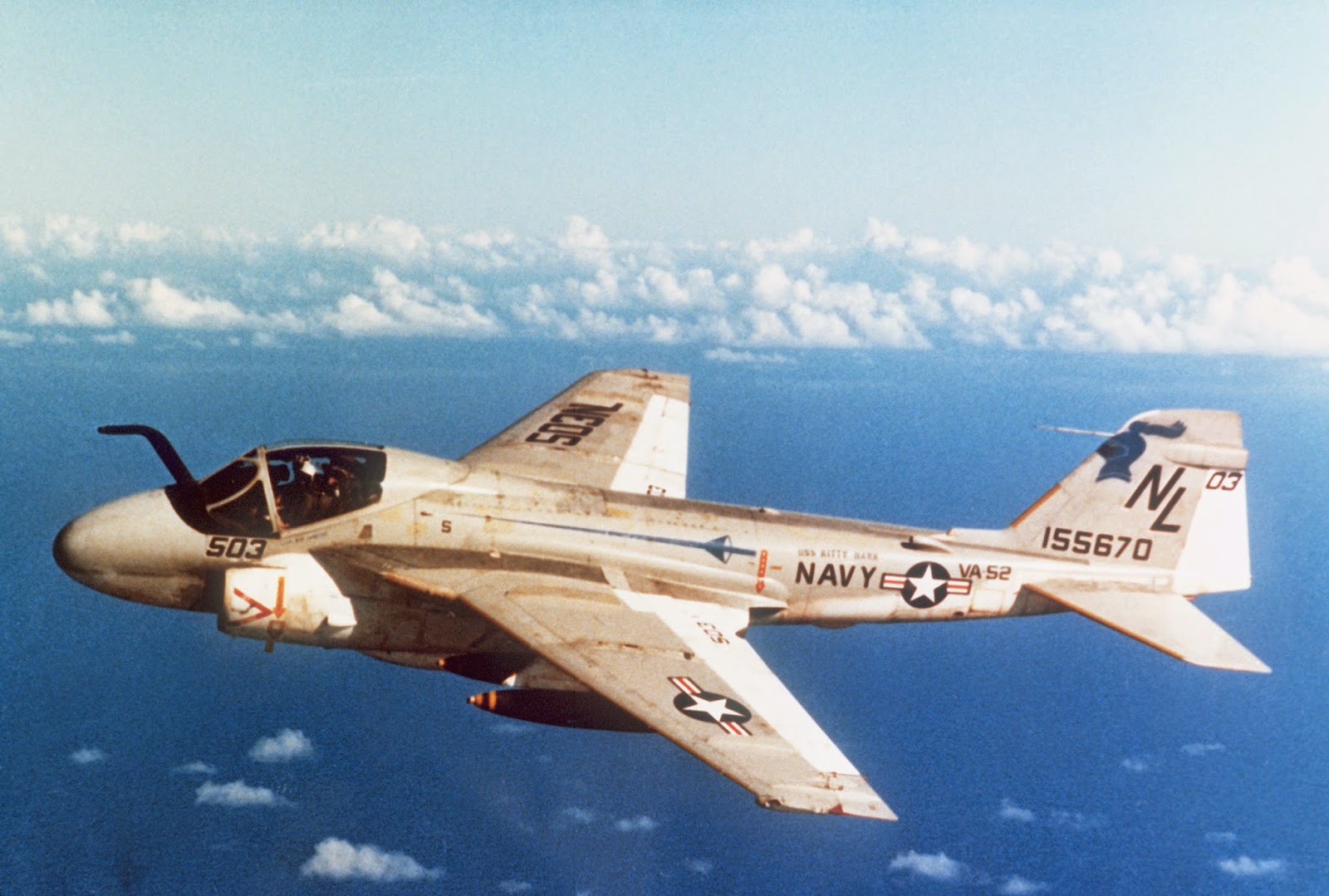 |
| The A-6 Intruder |
A significant rebalance of large carriers to the Pacific will augment U.S. strike and sea control capabilities there and not significantly undermine the U.S. ability to strike in European and Mediterranean waters if required. This concentration of heavy units may again enable a period of fleet experimentation on a scale not seen since the interwar "Battle Problems" that led to the concept of the fast carrier task force. It will reassure the nation's close allies in the Pacific that the U.S. remains committed to their defense. Most importantly, a large rebalance of heavy naval units will send a clear signal to potential adversaries that the U.S. is very serious about preserving its present position of naval superiority in the Indo-Pacific basin.
Tuesday, July 8, 2024
Hamas' Failed Amphibious Infil
Earlier today, Israeli Defense Force helicopters eliminated at least two of five Hamas commandos who landed on Zikim Beach near an IDF Base northeast of Gaza. The beach assault was likely an attempt to retaliate for yesterday's IDF assassination (also by air) of Mohammed Shaaban, head of the Hamas naval commando unit.
This is not the first Palestinian foray into amphibious combat swimmer attacks. In 2010, the Israeli Navy killed four scuba divers on a boat belonging to the Al Aksa Martyrs Brigades. Hamas has fielded a naval police force since taking over the Palestinian Territories and last year, they reportedly opened a naval academy. ID readers will also likely recall the Hamas Naval Police involvement in the flotilla episodes of 2010. A small maritime patrol force makes sense for a fledgling proto-state, especially given Israel's blockade of the Gaza coast and previous Israeli naval attacks on Gaza.
Yet a combat swimmer unit belongs in another category altogether. As we've noted, to build naval commandos into an real offensive special operations capability is beyond the reach of most non-state groups. These incidents highlight the importance of maritime capabilities to non-state actors, despite the expense and challenges associated with fielding these forces. Israel certainly does not take these adversaries for granted, nor should other navies. Mumbai provided the textbook example of how much damage a determined terror group can wreak with a sea-borne attack.
 |
| April 29, 2024 - Palestinian naval police loyal to Hamas inspect a boat after an explosion of unknown origin at Gaza City's port. REUTERS/Mohammed Salem |
The opinions and views expressed in this post are those of the author alone and are presented in his personal capacity. They do not necessarily represent the views of the U.S. Department of Defense or any of its agencies.
Subscribe to:
Posts (Atom)