
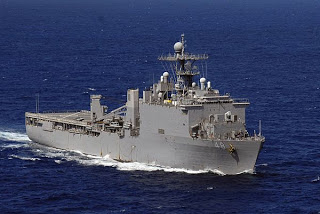
 As we continue to observe naval developments around Africa, we are very encouraged that regardless of how slow AFRICOM moves, the Navy has the right approach. We observe the latest from Navy NewsStand:
The dock landing ship USS Ashland (LSD 48) pulled into Antsiranana, a small port city on the northern tip of Madagascar, Tuesday, April 15.
Antsiranana is Ashland's third stop on her current deployment with U.S. 6th Fleet's Southeast Africa Task Force, promoting maritime safety and security in the region. The ship recently visited the Indian Ocean islands of Mauritius and Reunion.
Notably, this is only the second time a U.S. Navy ship has visited Madagascar since 1972. USS Normandy (CG 60) also called on the country last year during its assignment to the Southeast Africa Task Force.
Presence. The US Navy is there. I don't know where the 6th fleet was before last year, but starting last summer we began observing an increased tempo of engagement with Africa in a meaningful way. Meaningful naval engagement with Africa in the 21st century began in 2005 with the USS Emory S. Land (AS 39) mission to the Gulf of Guinea, but that deployment was the only US naval vessel to actually visit Africa in 2005. The tempo increase didn't begin until last year. There is a pattern developing in the way the Navy is approaching the global maritime environment in the non-integrating gaps, and the expeditionary ships are leading the way.
Most of the top Admirals in today's Navy were Captains and Cmdrs of some of the most important actions in the 80s and 90s. In those two decades, whether you are talking about Kosovo, the Gulf War, and virtually all of the other actions involving the US Navy, the carriers and surface combatants were centric to those actions. It is no accident therefore that naval leadership of today is dominated by former carrier commanders and commanding officers of surface combatants, they were the ones at the tip of the spear. However, we observe the 21st century is different.
We have a theory that the bulk of the Admirals of tomorrow are the CO's and XO's of expeditionary warfare ships and submarines of today. The expeditionary ships and submarines of today represent the sharp end of the spear in executing the maritime strategy. We see it everywhere, whether you look at the submarines in the Pacific or firing cruise missiles at terrorist targets, or the expeditionary forces that are expanding their roles as they engage nations in the non-integrated gaps from Southeast Asia to Africa to South America.
It is why whenever we talk about an expeditionary ship, whether it is the USS Whidbey Island (LSD 41) or the USS Oak Hill (LSD 51), we try to remember to talk about the Commanding Officers. When I took a look at the USS Ashland (LSD 48) webpage after reading this story, I was disappointed when I did not see biographies for the CO, XO, and CMC. While our theory is far from the minds of these Commanding Officers, it occurs to us that the biographies are important. If the Navy of tomorrow represents the men executing the most important naval activities of today, then Cmdr. Jeff Ward of the USS Ashland (LSD 48) could be an Admiral of tomorrow. Hiding his biography isn't doing him any favors.
The story concludes with this comment.
This is the second deployment of CTF-363's Southeast Africa Task Force. In 2007, CTF-363-assigned assets USS Forrest Sherman (DDG 98) and USS Normandy (CG 60) visited eight Southeast African nations. For many of these countries, it was the first time a U.S. Navy ship had visited in more than 40 years.
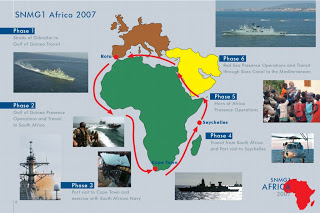 The USS Forrest Sherman (DDG 98) deployed with the Enterprise CSG last July, but spent the majority of the deployment visiting regional nations from the Black Sea to Africa. A similar mission is being conducted today by the USS San Jacinto (CG 56), which deployed with the Truman CSG. The USS Normandy (CG 60) was part of the Standing NATO Maritime Group ONE (SNMG 1) circumnavigation of Africa last year.
We like that the Navy is using expeditionary ships in the role of exercising with regional nations, in particular we imagine that without the MEU equipment, the USS Ashland (LSD 48) probably has that huge well deck filled with the right equipment to exercise efficiently with regional partners. In regards to that last sentence, the key word is imagine. I'm assuming a lot, because I'm assuming the Navy is testing mothership operations with a ship well designed for that role. I'd like to think it is loaded up with a bunch of small boats, unmanned vehicles, specialized training units, coast guard personal, and equipment to support Seabee's. If not, another missed opportunity.
Why do we constantly talk about motherships? Observe recent operations off Africa, including the recent French activity, and it is self evident. The USS Whidbey Island (LSD 41) was an offshore mobile forward operating sea base for 6 months, and piracy off Somalia is down in that region from last year. The USS Oak Hill (LSD 51) has replaced the USS Whidbey Island (LSD 41) in that role. The USS Ashland (LSD 48) is currently making the rounds in southeast Africa, I expect they will do good things on this deployment to a region who rarely sees the US Navy. The USS Fort McHenry (LSD 43) recently completed the African Partnership Station that is best described as DOEE with the MSC, a HSV, and a LPD. I still need to write up our conclusions on that mission.
Note none of those expeditionary ships mentioned in this post have Marines onboard. The Marines should be screaming for more expeditionary ships, because despite all the calls to get back to sea from the Marine community, when the Marines get out of Iraq they are going to find the Navy is using their ships for their own purposes. The Navy has good reason though, the mothership concept works, it is one of the strategical and tactical ideas of our time, its a shame the concept is being wasted on the small LCS design, although we have faith the Navy will 'eventually' realize this. Thomas Barnett used to talk about the future Navy being more ferry than warship (he still may). At the time who believed him? It is very difficult to take an objective look at how the Navy is approaching Africa today with these big expeditionary ships carrying alternative payloads and not acknowledge the Navy is basically validating through current operations he was exactly right.
We could produce an article the same length about the expeditionary ship deployments to South America and Southeast Asia conducting the same type of mission profiles, and those articles would include the Hospital ship deployments and large deck amphibious ships. With the upcoming Mercy and Boxer deployments, we eventually will. The expeditionary ship requirements for the Navy are plainly obvious, they are best reflected by the operational tempo of the expeditionary fleet, which is higher per class than any other ship class the Navy operates (besides submarines, see a pattern?). Who is ready to admit the needs don't match the plan inside the Navy? If your looking for a sign the Navy is adjusting to its own strategy with its resource priorities, keep an eye on the 10th LPD discussion for FY09, it is where the transition will begin.

No comments:
Post a Comment