
 Navy Times has an interesting article that overviews some of the Marine Corps discussions taking place on Capital Hill. We have mixed feelings on some of the press coverage, because in many ways it creates a perception that there is a conflict of interests in statements and desires.
Marine Corps leaders say they’re concerned about the Navy’s capability to support amphibious assault forces and is asking Congress to provide money for at least one new ship.
“Our nation needs this ship, and we need your help in procuring it,” Lt. Gen. James Amos, head of Marine Corps Combat Development Command, told a House Armed Services subcommittee Feb. 26.
Amos was referring to an additional LPD 17 San Antonio-class amphibious transport dock; the class is replacing a series of aging amphibious ships.
The Navy is on track to buy nine LPD 17s, and getting a 10th hull is the Corps’ top unfunded priority for the fiscal 2009 budget cycle.
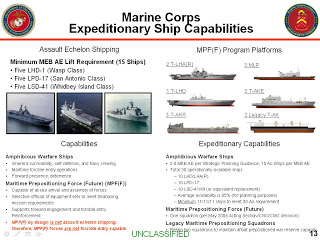
The article goes on to highlight several points. First the Marine Corps want 33 amphibious assault ships; 11 “big deck ship” amphibious assault ships, 11 dock landing ships, and 11 LPD 17s.
Second, the Marine Corps desire 2 MEBs for amphibious assault, and the article highlights an important point, a single MEB requires 17 amphibious ships for assault, meaning the Navy needs to maintain a total amphibious force of 34 ships, if the amphibious support mix retains the current three types of ships.
Finally, despite recent Navy comments, Congress Rep. Roscoe Bartlett, R-Md observes something we have been unsure about. Apparently we are not reading the FY09 budget incorrectly.
Navy budget documents for the fiscal 2009 proposal show the production line for San Antonios will shut down after nine ships. Restarting production would raise the cost of future amphibs.Rep. Roscoe Bartlett, R-Md., said the Navy’s decision to shut down that line seems like a bad one.
“With all the talk about controlling costs of shipbuilding, I was dismayed that the Navy would request and take specific steps that should only have the effect of increasing the eventual cost of the 10th LPD,” Bartlett said.
Thats the way we read it too, although we note the Navy has made several comments otherwise. While the press is giving some of the story, the testimony of General Conway in front of the Senate on Feb 28th makes clear in our opinion what the Marines are looking for at sea.
Based on strategic guidance, in the last several years we have accepted risk in our Nation’s forcible entry capacity and reduced amphibious lift from 3.0 Marine Expeditionary Brigade (MEB) assault echelons to 2.0 MEB assault echelons. In the budgetary arena, the value of amphibious ships is too often assessed exclusively in terms of forcible entry—discounting their demonstrated usefulness across the range of operations and the clear imperative for Marines embarked aboard amphibious ships to meet Phase 0 demands. The ability to transition between those two strategic goalposts, and to respond to every mission-tasking in between, will rely on a strong Navy-Marine Corps Team and the amphibious ships that cement our bond. The Navy and Marine Corps have worked diligently to determine the minimum number of amphibious ships necessary to satisfy the Nation’s needs—and look forward to working with the Committee to support the Chief of Naval Operation’s shipbuilding plans.
The Marine Corps’ contribution to the Nation’s forcible entry requirement is a single, simultaneously-employed two Marine Expeditionary Brigade (MEB) assault capability—as part of a seabased Marine Expeditionary Force. Although not a part of the Marine Expeditionary Force Assault Echelon, a third reinforcing MEB is required and will be provided via Maritime Prepositioning Force (Future) capabilities. Each MEB assault echelon requires seventeen amphibious warfare ships—resulting in an overall ship requirement for thirty-four amphibious warfare ships. However, given current fiscal constraints, the Navy and Marine Corps have agreed to assume greater operational risk by limiting the assault echelon of each MEB by using only fifteen ships per MEB—in other words, a Battle Force that provides thirty operationally available amphibious warfare ships. In that thirty-ship Battle Force, ten aviation-capable big deck ships (LHA / LHD / LHA(R)) and ten LPD 17 class ships are required to accommodate the MEB’s aviation combat element.
In order to meet a thirty-ship availability rate —based on a Chief of Naval Operation sapproved maintenance factor of 10%—a minimum of eleven ships of each of the current types of amphibious ships are required—for a total of thirty-three ships. The Navy has concurred with this requirement for thirty-three amphibious warfare ships, which provide the “backbone” of our maritime capability—giving us the ability to meet the demands of harsh environments across the spectrum of conflict.
Emphasis ours. There is a lot of good information here. Notice how this is breaking down.
For the 2015 MEB Assault Echelon (AE) the Marines require 17 ships (five LHD, five LPD-17, five LSD-41, two LSD-49), which as is confirmed in testimony means for the MEB ACE the Marines require 4 LHA/LHDs, 1 LHA(R), and 5 LPD-17s. Current plans leaves the Marines short 1 LHD, which is intended for the Sea Base. The primary equipment aspects include 18 LCACs, 30 JSFs. 48 MV-22s, 20 CH-53Ks, 18 AH-1s, 9 UH-1s, 2 MH-60s, and 8 UAVs. A full MEB ACE is basically 246 CH-46 equivalents. For the Sea Base, the 30 JSFs get put on CVNs, which could directly effect Navy specific aviation requirements.
The Marine Corps should never have accepted the reduced 2.0 capability, which was reduced to 2.5 during the cold war due to budget, because during the cold war it was actually 3.0. We continue to remind that the reduced 2.0 capability is counter to the studies leading into the 21st century, which noted the 3.0 MEB capability would become MORE important to meet irregular challenges in a world changing through globalization. The Marines are advocating for 33 ships to support a reduced 2.0 MEB assault capability, which actually requires 34 operational ships to fully assault with 2.0 MEBs, and all 34 would need to be 100% operational. This tends to imply what the Marines actually need is 36 ships. The Navy has no intention, and is under no obligation to support that.
To compound the problem, the Marine Corps are trying to squeeze this capability into the new Sea Base MPF(F). No wonder they have slowed down, no wonder they are looking for a new amphibious ship mix, and no wonder the Marines inch up the number of LPD-17s they need every year, from last years number of 10 to this years number of 11. All of this is absent the discussion of the JHSV, which has an entirely different but important role for expeditionary warfare.
 Absent from the discussion is the Amphibious Lift Enhancement Program (ALEP), which has never been tested but has five LKAs and four LSTs, providing a total of 201,000 square feet of vehicle lift capacity. Also absent from the discussion are the two Aviation Maintenance Logistics Ships (T-AVB), both of which will be retired by 2020. Each T-AVB carries a Marine Aviation Logistics Squadron (MALS) to a crisis area, without which would put a huge strain on strategic airlift to support.
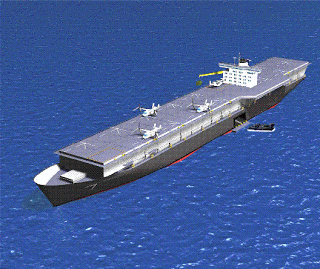
Does anyone believe at this point the LPD 17 class replaces four classes of older ships—LKA 113, LST 1179, LSD 36, LPD 4? Does anyone believe the Navy and Marines should really give up the LHA(R) for the Sea Base? Anyone remember the warnings in the Defense Science Board Study on Seabasing? This is why ONR had it absolutely right, what is needed to solve the sea basing aviation issue is something very large, something like the Maersk S-Class Conversion Concept. 2 on each coast would be the biggest boost to capabilities for virtually every Sea Basing mission ever convinced, and would allow both the Navy and Marine Corps to rightsize the amphibious fleet to support not only the amphibious assault requirements for major war, but the mothership requirements for peacetime.
Amphibious ships continue to be the most flexible platform in the Navy today, Congress should ask Sec. Winter to develop alternatives for amphibious ship strategies either with or without the Sea Base for supporting a 3.0 MEB capability afloat, with a 2 MEB Prepositioning requirement, and at least a 2.0 MEB forcible entry capability.
While the Navy might claim that is exactly what is currently in motion with the Sea Base, clearly the data continues to tell a different story.

No comments:
Post a Comment