Regular readers should know by now,
National Policy and the Transoceanic Navy published in Proceedings in May 1954 by Samuel P. Huntington is one of my favorite articles of all time. The article is so well written and timeless that I can quote it for dozens of very different discussions and it will be remarkably relevant.
As we begin the 2nd decade of the 21st century where the Army has been engaged in 2 wars while the Navy has quietly been doing its duty over the horizon, I am reminded the US Navy has been in a similar position before.
The Navy’s subordinate role during this Continental Phase of policy is well indicated by the miscellaneous nature of its military functions. These were basically threefold. First, there were the Navy’s responsibilities for coastal defense. From the time of Jefferson’s administration down through the 1880s this resulted in the construction of a whole series of gunboats and monitors designed solely for this purpose. Secondly, the Navy was responsible for protecting American commerce overseas and, in the event of war, raiding the commerce of the enemy. For this purpose the Navy was deployed in half a dozen squadrons scattered about the world from the Mediterranean to the East Indies and was largely equipped with fast frigate-cruiser type vessels. Thirdly, during the Mexican War and the Civil War, when the United States was fighting two nations powerless at sea, the Navy performed valuable functions in blockading the enemy and assisting in amphibious operations. These miscellaneous military functions did not, however, exhaust the activities of the Navy during this period. Since these military functions were of a general secondary nature, the Navy tended to acquire a wide variety of essentially civilian functions and directly related to any security threat. These included the support of general scientific research, the organization of a number of exploring expeditions, the frequent performance by the naval officers of diplomatic functions, and the utilizations of members of the naval service to administer civilian department of government. In general, during this period the Navy had no clearly essential role to play in meeting any major security threats and consequently tended to dissipate its energies over this wide variety of civilian and military functions.
The subordinate role of the Navy in implementing national policy was reflected in the weak public support which it received during this period. The continuous expansion of the nation westward tended steadily to decrease the political power of those sections most sympathetic to the Navy, and after the Federalists were swept out of office in 1800 it is not inaccurate to say that the government was generally dominated by political groups either indifferent to or actively hostile towards the Navy. The farmers of the interior tended to view the naval establishment as an unnecessary if not dangerous burden on the national economy. Consequently the Navy was frequently allowed to fall into fairly serious states of disrepair, reaching its lowest point the post Civil War years.
Since the Navy had no definite role to play in implementing national policy, it was unnecessary for it to have a type of organization which emphasized a distinction between its military and civilian functions. Consequently, although there was a major change in naval organization in 1842, when the bureau system was introduced, nonetheless the basic pattern of naval organization remained the same throughout the entire period. Neither under the Board of Naval Commissioners nor under the bureaus was there any clear differentiation between the military and the civilian functions of the naval department under the supervision of the Secretary. When during the Civil War the Navy was called upon to perform a significant military function, a special officer had to be designated to direct the military activities of the fleet. With this exception, however, naval organization reflected the inability of the Navy to develop a strategic concept relating it to the goals of national security policy.
I thought of what Samuel Huntington wrote when I saw
these interesting poll numbers taken by Gallop. I want folks to carefully consider what we are learning here. The first question:
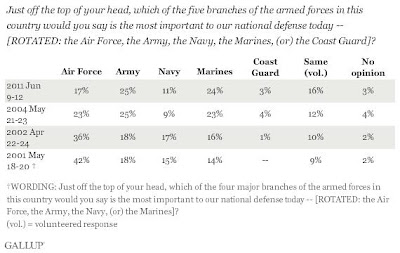
The Navy spends more money on aircraft than the Air Force does, but come fleet week the Navy finds average American people that don't even realize the Navy has aircraft. Unfortunately, that is when someone is forced to mention the movie Top Gun and memory kicks in, but without Top Gun as a reference point it really is remarkable how little attention naval aviation gets. I honestly blame the Navy for that, and the naval aviation community is the worst. Too much focus on the fighter jocks and not enough focus on everything else that makes the entire community great. Next time someone is putting bat wings on the MH-60s for an exercise, get some pictures and do an interview. Talk about the P-3 community more - these folks have incredibly interesting stories that always involve a handful of personalities that make up a single planes crew. The same is true of Hawkeye's. When was the last time Navy News published an interesting article on Top Gun? Ironic those pictures were intended to showcase the MH-60R, but all the focus went on the ship. Maybe it's because nobody outside the smallest possible audience understands the difference between Romeo's and Sierra's.
The second issue is submarines. Since the cold war the Navy has been completely unable to articulate the value of submarines, and now that the Navy is finally moving to build 2 per year - the American people really don't understand why we spend so much every year building two per year. We live in an age where technology is integrated into the lives of almost every American, and yet no one in the Navy can articulate all the amazing things a submarine can do?
You're not even trying. Most of the amazing things submarines can do are not even secret, they simply aren't openly discussed. The Navy needs to learn how to talk in detail without giving details, and start telling a story without revealing any secrets.
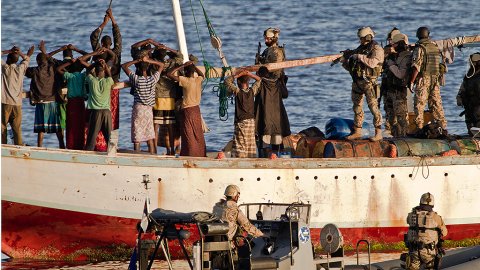
The third issue is that the surface fleet refuses to take on the difficult challenges of this era (stuff like piracy and narcotics submersibles) and is instead focused on meeting some enormous threat that may or may not materialize in the decades ahead. The surface fleet is the most distributed, thus visible force in the Navy, and the refusal by leadership to use the surface fleet today in the actual protection of commerce (see piracy) or in coastline defense (see narcotics smuggling) puts the Navy visibly out of step with what they say when explaining their strategic concept -
21st Century Seapower.
I've said it many times since I first read the phrase, and it is absolutely right.
It isn't that the Navy doesn't have a compelling story to tell, it is that the Navy doesn't know how to tell a compelling story for itself.Eleven Percent?!?!?No amount of PR is going to change that number. If the US Navy doesn't start addressing the little things, then the US Navy is going to find themselves being a little navy again only able to handle the little problems. Think otherwise? See the Royal Navy for a historical example. The rise of China alone is not going to help the Navy, because negative arguments on behalf of the Navy that focus on fearing the Dragon represent intellectually bankrupt arguments that aren't going to win in serious budget debates. The story must discuss the positive benefits of the US Navy, and by extension actions must align with words. The mismatch of budget, actions, and words by the US Navy is the single most obvious discrepancy the US Navy must overcome if they wish to be seen as more relevant by the American people.
There are serious problems at sea today, and the US Navy has been ineffective in even curbing those problems. Americans aren't as dumb as US Navy leadership thinks they are, and that 11% relevance is well
earned when the US Navy is widely known to give little more than token efforts to well publicized problems on the oceans today. To the average American, inability to prevent piracy in the 21st century doesn't give Americans confidence in the US Navy towards hedging China
.
Cold war generation naval experts will cry foul at my suggestion that piracy is a problem for the US Navy today, but that is because most cold war era folks I know are looking to fight the big war scenario with China in the future, and they put their focus there instead of admitting the Navy must address the problems of this era today first to have any credibility in the future.
The Navy could learn a lot from the Marines, who themselves had no desire to be a second land army in Asia, but accepted their role in this era even though it has obviously cost them in areas like the EFV. I honestly believe the Marine Corps benefits greatly from addressing the challenges they are needed for rather than the ones they would prefer to do, and this specific metric measured suggests the payoff exists when a service sacrifices desires for the needs.

Prestige is pure perception. Yeah, the USMC silent drill platoon looks like money on TV, so the other services can concede some points there, but there is more to it than that. There are signs everywhere, for example, the
US Marine Corps Facebook page has 1,677,000+ people following the page, where the
US Navy Facebook page has 333,600+ people following. Twitter is no different, with the
US Marine Corps primary account listing 47,000+ followers while the
US Navy News account has just over 26,000 followers while the
official US Navy account has over 22,000 followers. I cannot explain the enormous disparity, rather only observe it's existence might have something to do with the Marines constantly being in the news for doing what must be done - even if they are in reality doing the job of the US Army.
One of the things I try to do is watch what military related articles go viral in social media, and recently
this blog post at the Wall Street Journal went viral in a big way. Read it all, but tell me this quoted portion doesn't inspire respect and prestige among average Americans regardless of the issue being discussed.
Sgt. Maj. Barrett also tackled questions on the repeal of “Don’t Ask, Don’t Tell,” the military’s ban on gays serving openly in uniform. The Department of Defense is preparing to implement repeal, and Sgt. Maj. Barrett addressed that issue directly.
“Article 1, Section 8 of the Constitution is pretty simple,” he told a group of Marines at a base in South Korea. “It says, ‘Raise an army.’ It says absolutely nothing about race, color, creed, sexual orientation.
“You all joined for a reason: to serve,” he continued. “To protect our nation, right?”
“Yes, sergeant major,” Marines replied.
“How dare we, then, exclude a group of people who want to do the same thing you do right now, something that is honorable and noble?” Sgt. Maj. Barrett continued, raising his voice just a notch. “Right?”
Sgt. Maj. Barrett then described conversations with U.K. troops, who saw a similar ban lifted a decade ago, with little disruption. And to drive the point home, he produced a pocket copy of the Constitution.
“Get over it,” he said. “We’re magnificent, we’re going to continue to be. … Let’s just move on, treat everybody with firmness, fairness, dignity, compassion and respect. Let’s be Marines.”
When you're out with the Navy, who do you talk to? I really like to talk to NCOs, when allowed, but the face and voice of the Navy I end up spending most of my time with is almost all of the time is Officers. In the Marines, the face and voice of the Marine Corps on the battlefield and on the home front is mostly the NCOs, who say more in fewer words than officers ever do in public.
In January when I was out looking at the EFV at Camp Pendleton, the tour was led by a NCO with 20+ years in the AAAVs - and the tour was fantastic. Would an officer told us the history of problems, and how those challenges led to one of the greatest, most unaffordable amphibious vehicles in history? Probably not, we would have heard a similar story without all the raw details that made the Gunny's story so interesting. NCOs simply tell better stories when they are on duty...
The Navy in particular could learn a lot, and gain a lot, from letting NCOs loose in public. Yeah, the ugly side of stuff might be shown, as it was with the PBS special, but the Navy must accept that the public today responds positively to the bad when it is in context with the good, and the NCOs are the only folks who seem to handle the bad and the good (both, together) well in public. Officers, as they have been trained to do, too often hide the bad in public even though it is usually their focus in private. As one SWO once put it:
We're SWOs...we've been brought through a culture of "only brief the problems" and that begins to pervade everything so that we no longer see the bright shiny pony...just the one small speck of poop that got dropped 2 seconds ago.
And then we look for someone to work up a POAM on getting the poop cleaned up, someone else to put together the safety brief, and a third to figure out the ORM.
And in the end, it is a NCO who follows each step to job completion, and understands the details of the story better than the SWO ever could. When telling a story, the details matter more than the summary when your trying to connect with people, and that is why the Marines lead with NCOs out front.
These are just a few of my thoughts. The reasons for these numbers are many, but have a lot to do with the Navy ignoring the problems of this era. The Marine Corps talks about their big, ugly problems openly and describes the challenges they face, but the Navy conceals problems on the most visible issues like shipbuilding. Which method works better? Gallop appears to have data that suggests Navy leadership is getting it wrong. Pushing this poll off as a PR problem would be a mistake. These poll numbers don't reflect public relations, rather they reflect the absence of a viable strategic concept being aligned with direct, transparent communications.
You know what frustrates me the most? Once upon a time Bob Work knew this better than anyone -
and even wrote about it. Interesting he got to the Navy and is now in position to effect the culture there towards alignment of effort, money, and action..., but apparently no one in the Navy is ready for such a dramatic step.