
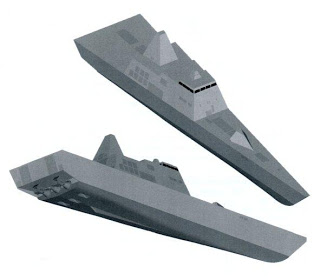
 Building upon yesterdays discussion on corvettes we want to add something a bit different to the discussion. The lines have become blurred between what a modern battleship, cruiser, destroyer, frigate, and corvette is, so we thought we would try to break down what we see as a frigate and what we see as a corvette in the modern era, and discuss another corvette option.
Using our modern rating system for warships, we see a modern frigate as a fifth-rate warship armed with 20-47 battle force VLS cells, and/or 20-47 battle force missiles. That means by our rating system, both LCS MMC versions would constitute a frigate. As we have previously discussed, the Lockheed Martin version of the multi-mission combatant offers 16 strike length VLS cells while the General Dynamics version of the multi-mission combatant offers 16 tactical length VLS cells. Both also feature at least 4 Harpoons, qualifying them both as fifth level frigates in our modern rating system.
Using the same rating system, we see a modern corvette as a sizth-rate warship designed specifically for the protection of shipping role, armed with either VLS cells or legacy missile systems, and armed with local air defense SAMs and anti-submarine and anti-ship cruise missiles for convoy defense; or a seventh-rate warship optimized for a single role, usually either anti-submarine or anti-surface warfare, or for general-purpose naval missions. The distinguishing feature of these ships is that they carry only terminal missile defenses—either in the form of rapid fire guns or short-range terminal defense SAMs.
The Perry class of today and the existing Littoral Combat Ship design both qualify as seventh-rate corvettes. Only the US Navy would operate ships between 3000-4000 tons with a weapons payload equal to or below a modern corvette.
However, just because the US Navy doesn't understand what a frigate or a corvette is, confusing the concept with a mothership in fact, and is demonstrating strategic absence in regards to the cruiser role, it doesn't mean the rest of the world is. In particular we go back to a July 13, 2024 article in Janes called TKMS unveils new reconfigurable patrol ship by Alex Pape, in which the Meko Class evolved into a modular platform. What is different? On a platform level, the payload is very different:
Planned mission modules incorporating existing naval systems into the modular architecture include the BAE Systems Bofors 57 mm gun, Saab Bofors Dynamics RBS 15 anti-ship missiles, as well as the latest generation of unmanned underwater vehicles (UUVs) from Atlas Elektronik and Saab Underwater Systems.If you can find it, there is also an excellent sales brochure called Modular Security Ships for Littoral Supremacy, which is sometimes available by this link (PDF), that details both of the MEKO Fusion concepts.
- The MEKO® Combat Ship for the Littorals: 108m, 2750 t, >40 kts, steel hull, composite superstructure, up to 21 MEKO® Mission Modules.
- The 84m MEKO® FUSION: 84 m, 1500 t, >40 kts, composite hull & superstructure, up to 15 MEKO® Mission Modules.
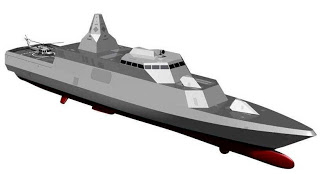 We don't highlight the MEKO Fusion because we think it is a better ship than the Littoral Combat Ship, this isn't about one ship vs one ship, rather we note the biggest difference here is that ThyssenKrupp Marine Systems (TKMS) is taking a total battle force network approach to littoral dominance with modularity. A ship compatible in a modular network doesn't necessarily have to be as big of a frigate to be effective, or small as a corvette even, rather it is about meeting requirements and metrics beyond a single purpose ship capability, even if the ship is modular.
Network-Centric Warfare in Navy terms was intended to get people thinking about ship designs as system of systems approaches to solving complex maritime problems, and modularity was one result. One of the questions we would pose is why modularity became the only result when the US Navy was thinking about a system of systems approach to the littorals?
When we think about the littorals, we don't believe one shoe in many colors can fit all, rather we believe we need to be looking at different sizes and styles of ships to fit all. The US Navy uses strike groups for naval aviation and expeditionary warfare, but chose to take a single system approach to what has been described as the most difficult challenge facing maritime forces today: the littoral. If the challenge really is as big as the US Navy claims, why did the Navy throw an unrated mothership at the problem?
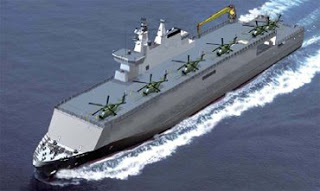
We keep thinking a truly modular, interchangeable approach to the littorals will include a large ship, preferably an amphibious ship, as the command node within a modular system of systems network. The mothership will be able to both support the modules itself, but also distribute modules to other platforms of all sizes. Modules don't have to be a complete set of systems, rather the set of systems is part of the distributed modular network. The idea of using amphibious ships in a modular naval network approach to the littorals isn't a unique thought, we note the existing LCS modules will be tested on Amphibious ships rather than Littoral Combat Ships, due to delays of the LCS platforms under construction.
 Maybe the LCS should be another platform in the littoral battle force network, but we expect the LCS is ultimately both too big and too expensive to truly distribute and dominate the littoral battle network that is required for the littoral challenges of war and peace, and the LCS is certainly not well armed enough to dominate enemy naval forces in any but the least threatening environments. Information dominance is critical to success, but it doesn't do the Navy any good if the Navy has complete information dominance but lacks physical presence due to lack of manned vessels necessary to follow up and engage for both war time and operations other than war.
The real advantage we note in regards to the MEKO approach over the US approach to modularity isn't the design characteristics of the corvette platforms themselves, nor the broad approach to the modular options per platform (even though it shows more creativity), rather the advantage of the MEKO approach to modular, system of systems networks is the concept of introducing more than one platform to contribute to the littoral challenge, and we really appreciate the total system of systems approach towards the strategic ends of littoral dominance.
After all, it is worth noting that when TKMS designed their modular corvette force, they just happened to design a mothership capable of supporting the modular battle force at the same time.

No comments:
Post a Comment