Showing posts with label Fire Support. Show all posts

Friday, October 31, 2024

The Specter of the Gun


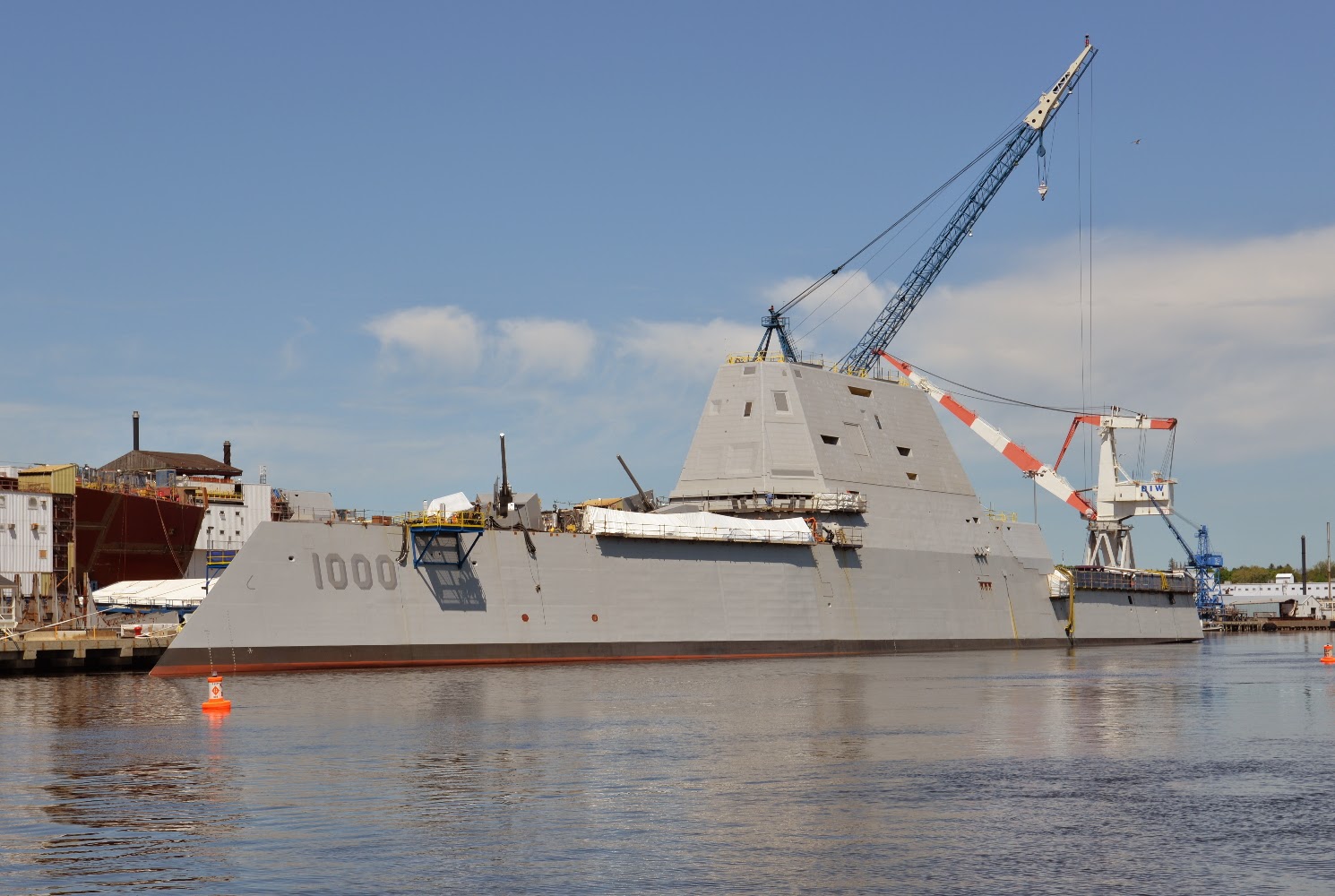
USS Zumwalt (DDG 1000)
     The DDG 1000 has again appeared in recent news. Its secondary armament was in the spotlight earlier this month as the ship’s Program Manager CAPT Jim Downey discussed the change in the ship’s close in gun (CIG) system. Downey said the planned MK 110 57mm gun did not meet expected standards of lethality while the MK 46 30mm weapon exceeded them. A recent Daily Beast article suggested the ship’s stability remained uncertain. These articles provide snapshots of possible problems, but more detail is needed to accurately assess the potential warfighting capabilities and limitations of the DDG 1000. It represents a remarkable number of both “returns” and “firsts” in warship design. The big question is whether or not the ship can overcome some significant potential flaws by exploiting its revolutionary technological advances.

DDG 1000, Note pronounced tumblehome hull form
      While discussion continues on the CIG, there is much less talk on the imminent introduction of the largest naval gun to enter active U.S. naval service since the Second World War. The 155mm Advanced Gun System (AGS) has undergone development since the early 1990’s as a component armament of the SC-21 family of warships. During this “high noon” of the American “unipolar moment”, there was much more attention toward achieving long-range, coordinated “fires” than concern about the sea control that made such activities viable. How effective can an AGS with a nominal range of 24 nm (nautical miles) for conventional shells and 63 nm for advanced long range land attack projectiles (LRLAP) be in an environment of advanced anti-access/area denial (A2AD) capabilities? The AGS is perhaps useful in attacking isolated locations outside an opponent’s home littoral and in the later stages of a conflict when an enemy A2AD system is significantly degraded. The DDG 1000 had few direct threats when first conceived and if employed close to shore as demanded by the range of its main battery guns, any gain in stealth from the ship’s tumblehome hull form will be offset by the danger of visual detection. The ship does have some formidable strike and defensive capabilities through its vertical launch system (VLS) mounted missiles and AN-SPY-3 radar system. It remains to be seen, however, if those capabilities justify deploying the ship on the front lines at the outset of a high-end conflict. The DDG 1000 is dominated by the AGS that can only be employed at the present time against land-based targets.

Armored cruiser USS Brooklyn, a US example
of late the 19th century tumblehome hull
     The Daily Beast article and others have discussed questions of the ship’s tumblehome (inward curving) hull form and stability in rough seas. The tumblehome hull was a familiar feature of many warships at the end of the 19th and the beginning of the 20th century. French,  Russian, and some American warship designers embraced it as a way of creating greater freeboard (height from water line to deck), better sea-keeping, and from these together, improved gunnery. The tumblehome hull's inward curve from the waterline to the main deck causes a reduction in reserve buoyancy, the amount of the ship outside of the water. Freeboard is the physical factor that allows steel ships to remain afloat. A small reduction in reserve buoyancy, especially if received off the center
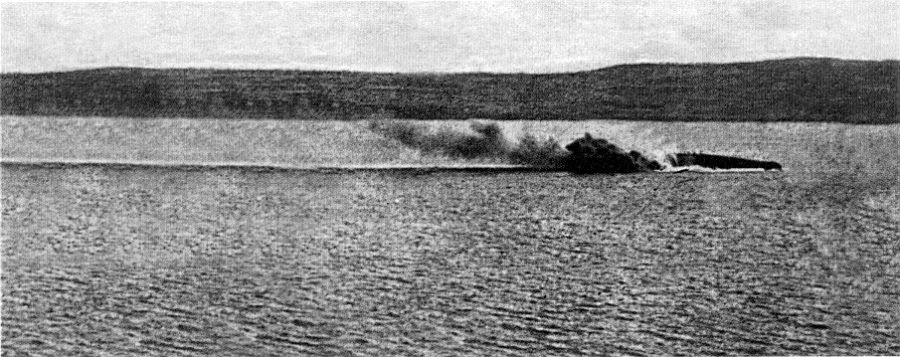
French battleship Bouvet sinks during 1915 Dardanelles attack

line of the ship in the form of flooding from battle damage or fire-fighting efforts could cause a sudden loss of stability and rapid sinking. The ship's reliance on automated damage control systems, combined with reduced reserve buoyancy could be a problem in the case of significant flooding.
Warship designers began to view the tumblehome hull as suspect after the Russo-Japanese War when several Russian warships with that feature capsized and sank quickly after only moderate damage. The feature was discarded wholesale after the First World War saw significant casualties in French warships with the unconventional hull form. The Bouvet (shown in above photo) struck a small mine (176 lbs) and sank in less than two minutes.

USS Lexington (CV 2) using her turbo-electric
engineering plant to provide power to
Tacoma, WA in 1929
     Despite these possible problems with its main armament and hull form, the DDG 1000 represents a return to a number of positive features and notable firsts worth further exploitation and development. The ship's electric drive system is the first for a U.S. “capital” warship since turbo-electric propulsion systems were installed on the U.S. aircraft carriers Lexington and Saratoga in the late 1920’s. These units were so capable that Lexington's powerplant was able to provide 25% the city of Tacoma, Washington's electricity in 1929/1930 after extreme drought conditions made hydroelectric sources in area useless. Turbo-electric power proved to be a very fuel efficient system and extremely robust in combat. Both ships sustained significant damage  during World War 2, and although Lexington was sunk at the Battle of the Coral Sea in May 1942, the ship's turbo-electric drive system remained operational until spreading fires made the ship untenable. The DDG 1000’s similarly large electric power plant is the first step toward fielding directed energy weapons at sea. These include electromagnetic rail guns with greatly increased range that may replace the AGS currently fitted. The AN-SPY 3 radar represents a significant advance in detection, and air and missile defense capabilities, especially in congested littoral areas. The 155mm gun still has a part to play. It has surface warfare potential if converted to a dual purpose land/surface attack weapon. While perhaps an interim step in the direction of a rail gun, the AGS could also play a useful anti-surface role. The main battery of the DDG 1000 could quickly smother an enemy warship in a barrage of 155mm projectiles from 24nm to 60+ nm. Defense against artillery and mortar shells is possible, as demonstrated by the U.S. Centurion Gun System, but it is not a capability currently found on the warships of potential aggressors. Experience from the employment of the AGS as a surface gunnery weapon is again also a step toward use of a railgun as anti-surface weapon with estimated ranges between 110 and 220nm.

Advanced Gun System
Assembly
     Potential operational and damage control issues aside, the DDG 1000 represents a good investment in future capability. It could be altered enough to make the ship a viable addition to a post-Post-Unipolar U.S. fleet. Enabling the 155mm AGS as a surface weapon would expand U.S. anti surface warfare capabilities and force opponents to spend money to undertake defensive measures against artillery shells. One or more of the ships could be altered (if stability conditions permit) as prototype cruiser platforms optimized for anti-air/missile defense by removing one AGS and substituting greater missile armament in its place. The ship’s stability after receiving damage remains a concern, especially as it relies on an automated damage control system to provide much of the immediate response to the effects of weapon strikes. The composite material deckhouse of the first 2 units, as opposed to the steel version on the third and final unit of the class represents an additional vulnerability. All such shortcomings, however, may be more effectively addressed if they are acknowledged as such. No warship is perfect and each represents a series of choices. The choices available to designers in the late 1990s are different from those that must be considered in the present. The DDG 1000 class represents a welcome addition to the fleet in that the technologies and capabilities they possess will likely be core components of the fleet of 25 years hence. Together they might form a valuable “squadron of evolution” for the 21st century and be useful elements in exercises and wargames.

     The famous naval author Joseph Conrad described the actions of an isolated warship conducting naval bombardment against unseen targets at the beginning of his most famous novel The Heart of Darkness. In it, his narrator Marlowe describes a French cruiser shelling unseen enemies ashore as follows:

“Once, I remember, we came upon a man-of-war anchored off the coast. There wasn't even a shed there, and she was shelling the bush. It appears the French had one of their wars going on thereabouts. Her ensign dropped limp like a rag; the muzzles of the long six-inch guns stuck out all over the low hull; the greasy, slimy swell swung her up lazily and let her down, swaying her thin masts. In the empty immensity of earth, sky, and water, there she was, incomprehensible, firing into a continent. Pop, would go one of the six-inch guns; a small flame would dart and vanish, a little white smoke would disappear, a tiny projectile would give a feeble screech—and nothing happened. Nothing could happen. There was a touch of insanity in the proceeding, a sense of lugubrious drollery in the sight; and it was not dissipated by somebody on board assuring me earnestly there was a camp of natives—he called them enemies!—hidden out of sight somewhere."

The original design of the DDG 1000 may have evoked a similar image of unimpeded naval surface fire support, but the unrestricted sea control that Conrad’s imagery conjures up is no longer a reality in the second decade of the 21st century. While perhaps not designed for such conditions, the DDG 1000 still has a significant role to play in the present as both a technology demonstrator and as a surface warship. The specter of its guns may yet haunt future opponents and it’s all-electric heart power future weapons of greater capability and effectiveness.


Side view of Zumwalt


Thursday, April 21, 2024

Still Thinking About the Swarm

Tonight I took a break from reading and did a bit of surfing on YouTube, something I almost never do anymore. Somehow or another I found myself watching videos on Iranian swarming boats, and picked out these two among the several I watched.


The two types of boats being shown are the Serag class Rocket Fast Speed Boats that shoot 107mm rockets, to good effect too btw; and the Zulfiqar class Missile Fast Speed Boats that I believe shoot an Iranian produced of the C-701 ASMs.

I do not know how many of these boats have been built, but I remember reading a PRESSTV news transcript that said Iran intended to build 300 Serag class Rocket Fast Speed Boats.

That ~1200 ton target the boats are shooting at ended up taking at least 18 hits (don't ask me how I know, I just do). It's easier to hit a bigger ship with unguided rockets, particularly a taller ship like both versions the Littoral Combat Ship. An even worse thought though is what 107mm rockets would do to the composite structure of the DDG-1000.

The Littoral Combat Ship is supposed to be optimally designed to fight that specific small boat swarm threat. Here is my problem though. Both versions of the Littoral Combat Ship have the Mk110 57mm multi-purpose, small caliber gun that can fire salvos up to 220 rounds per minute, and has a range of 9 miles (~15 km). Unfortunately the MK110 57mm only has 400 rounds in the turret and two ready service magazines with 240 rounds each. I just don't like the idea that if you shoot for only 2 seconds 30 times, you have consumed 60% of your turret ammo and have to begin thinking about reloading magazines in the middle of a fire fight.

Saturday, November 29, 2024

Thinking about Naval Surface Fire Support - Part IV

First of all, yep, I'm incredibly tardy with this post. But hey, better late than never, and Thanksgiving gives me both time off from the Real Job(tm) and enough tryptophan to force me to stay in one place long enough to both think (a very little) and write (hopefully enough).

When I left off, at least before the comments, I had finished advocating applique rocket fires for entry-phase and post-landing responsive fires, possibly using GMLRS/HIMARS fired from ship deck positions. Then we had a good go-around in the comments, which I won't rehash. What I had promised you was some discussion of the relevance and necessity of this capability (naval surface fire support) in the foreseeable future.

There are really only two uses for this capability. The first is to support an active amphibious landing, and the second is to provide fire support for troops within range of the littoral whether or not they were originally landed across the beach. Precision strike fires on high value targets and deep interdiction (at least according to my own windage last time) are not NSFS missions. So we have two situations that might come up - one, the U.S. maintains an amphibious forced entry capability which produces the concomitant fires requirement, or two, the U.S. or allied ground forces become engaged within NSFS range of the U.S. surface fleet in such a manner that their organic artillery support and aviation support are either unavailable or require augmentation.

Several modes of argument suggest themselves. We might argue this by force structure, by trends, or by strategy. Arguing it by force structure is almost circular, since the size of the U.S. Marine Corps is legislated at two divisions - and the Marine Corps defines itself by the ability to perform amphibious force entry. It's not completely circular, though - the USMC does a lot of things, and there's nothing that says this capability couldn't be dropped in favor of other ones such as airmobile assault. I'm going to skip the force structure argument for another reason, though - force structures and capabilities should, I think we'd all agree on this blog, be informed by strategy and requirements. While the opposite causal chain still holds due to the 'come as you are' nature of modern war, let's take the high road and think about this far enough into the abstract to actually tackle the question of 'why' or 'why not.'

We might argue it by trends. Here is a list (incomplete) of the past sixteen years of U.S. military actions where naval or ground forces were required.

1992 Kuwait - military exercises in response to Iraq's refusal to recognize border
1993 Bosnia - military intervention via NATO
1993 Macedonia - several hundred soldiers deployed
1994 Haiti - US troops deployed to Haiti (up to 20,000) in uncertain conditions
1996 Liberia - Embassy evacuation
1996 Central African Republic - Embassy evacuation
1997 Albania - Evacuation of U.S. personnel from Tirana
1997 Congo/Gabon - Standby deployment for evacuation
1997 Sierra Leone - Evacuation of U.S. personnel from Freetown
1997 Cambodia/Thailand - US forces deployed to Thailand on standby for evacuations from Cambodia
1998 Guinea-Bissau/Senegal - US forces deployed to Senegal on standby for evacuations from Guinea-Bissau
1998 Kenya/Tanzania - US forces deployed to Kenya to provide security and disaster relief after bombings of US embassies in Kenya/Tanzania
1998 Liberia - US forces deployed on standby for evacuations from Monrovia.
1999 East Timor - US forces deployed as per UN for stabilization.
2000 Sierra Leone - US naval forces deployed on standby for evacuations.
2000 Yemen - US forces deployed to Aden in response to USS Cole bombing
2001 Afghanistan - US forces engage in Afghanistan following 9/11
2002 Phillippines - US forces deployed to train with, advise and assist Phillipine forces
2002 Cote D'Ivoire - Evacuation of U.S. personnel from Bouake.
2003 Iraq - U.S. and allies invade Iraq to topple Hussein government.
2003 Liberia/Mauritania - U.S. forces sent to secure and if necessary evacuate U.S. embassy in Mauritania.
2003 Georgia - U.S. combat troops sent to Georgia for counterterrorist deployment.
2003 Djibouti - U.S. combat troops sent to Djibouti for counterterrorist deployment.
2004 Haiti - U.S. troops sent to secure Embassy and additional troops later to support U.N. mission.
2004 Various - 'GWOT' deployments in Georgia, Djibouti, Kenya, Ethiopia, Yemen and Eritrea.
2006 Lebanon - U.S. forces deployed to evacuate U.S. personnel/citizens from Lebanon prior to Israel/Hezbollah conflict.
2007 Somalia - US forces active in strikes on GWOT targets.
2008 Georgia - US forces enter Georgia for relief following Russian invasion.
2008 Somalia - US naval forces deployed in commerce protection off Somalia against non-state piracy from shore havens.

There has been no shortage of U.S. military deployments. While it is true that there is only one case where an actual forced entry might have been plausible - the 2003 invasion of Iraq - it is also true that there are at least two cases where the capability might have been called into play had circumstances turned out differently. I would identify the 1992 Kuwait deployment, the 1994 Haiti deployment, and the 2007 Somalia actions as possible forced-entry situations. I would also tag the 1992 Kuwait deployment, the 1994 Haiti deployment, the 2002 Philippines deployment, the 2003 invasion of Iraq, the 2004 GWOT actions and 2007 Somalia GWOT actions as possible use cases for offshore fire support for engaged troops even without a beach crossing.

This is not a scientific look at the particulars of these cases, I will be the first to admit. But it appears on first glance that while a full amphibious assault has not been seriously envisioned since the decoy maneuvers of the first Gulf War, there have been numerous potential situations where an amphibious capability and associated fire support have been applicable even if not applied.

I would argue that having a capability in order to not use it, after all, is in no way a strange position for U.S. armed forces. In this particular instance, the assurances that this capability is no longer relevant seem to be somewhat misleading unless we limit our discussion to 'full scale amphibious assaults.' Even then, the capability can serve without use; it is true that U.S. force movements, especially sea mobile ones, acquire a value they would not have without the ability (if not the inclination) to move those forces across the interface - and as the first three posts in this series pointed out, that capability is hand-in-glove with the requirement for the fire support of those troops.

From a strategy point of view, Galrahn has made the point better than I could that the capability for small, agile but capable intervention forces based around the MEU or MEU(SOC) offer the capability to handle most of the notional situations outlined above. One constant of American warfighting has been to consider American manpower a precious, scarce resource (I have written on this and the history behind it in the past prior to blogging here; I may consider posting some of my reasoning if I can get it cleaned up). Given that, American doctrine tends to emphasize the use of firepower as an augmenter of and substitute for troop presence whenever possible. If smaller, agile Marine units are to be used for intervention, then maximum support of those Marine units (whether transiting ashore in a hostile environment or carrying out missions within reach of the sea) is dictated - and as I discussed earlier, for particular phases of such operations, there is no substitute for high-volume responsive fires. If these interventions are kept small, there is even less likelihood that organic artillery assets will be available on shore, putting an even larger burden on external fire support capability.

Finally, I too am a reader of Capt. Hughes and his predecessors. With the U.S. Navy as a predominant fighting force in the blue water, there remains the ability of a materially inferior opposing force to choose its engagements carefully and do disproportionate damage to those targets that the U.S. Navy is tasked with protecting - such as commerce, support or seapower exploitation units rather than seapower combat units. One means of forcing an opposing fleet involved in a guerre de course to engage, fixing it for your own assets to address, is to provide it with a target that it cannot realistically pass up. The threat of a forced entry operation against coastline that fleet is tasked with protecting is perhaps one of the strongest such motivators - and that threat is only possible if the credible capability to wield it exists.

These are the reasons that I consider a plausible surface fire support capability to be necessary for U.S. operations and for U.S. strategic reasons for the next decade or two, at the minimum. Unless U.S. strategy is changed to de-emphasize the capability to exploit sea control via on-shore intervention, NSFS will be something looked for avidly in the heat of action if those interventions do take place. While I'm not suggesting that such interventions are impossible without it, it will certainly result in much after-action finger-pointing and soul-searching if the need for it arises and the capability is not there to answer the call.

Hence, I spend time and energy considering how best to perform the mission rather than (at present) wondering whether the mission will be required.

Friday, October 17, 2024

Thinking About Naval Surface Fire Support Part III

All right then, quick recap. We've isolated the need for the following types of fires:
  • Pre-landing Planned Fires - Short/Med range, high lethality, low/med volume, low responsiveness.
  • Entry Phase Responsive Fires - Short range, low-to-high lethality, med/high volume, high responsiveness.
  • Entry Phase Interdiction Fires - Med/high range, high lethality, low/med volume, medium responsiveness.
  • Post-landing Responsive Fires - Med range, low-to-high lethality, med/high volume, high responsiveness.
  • Post-landing Interdiction Fires - same as Entry Phase interdiction fires.
Let's take a moment to define terms. For the range parameter, I'm using the following. Short range is the range of the currently available NGS with simple shells, which means roughly 13-15nm. Medium range is from 15nm out to the maximum demonstrated usable range of shipboard artillery, using navigating munitions, which is presently around 40nm. Over 40nm is long range.

While I concede that using current system performance to define range buckets will somewhat lower the power of any recommendations this half-assed 'analysis' provides, I don't at this time want to get into deriving range parameters from the mission requirements - mostly because the mission requirements haven't been (in my opinion) adequately defined by the Marines or the Army. I accept that there may be a doc out there that does precisely this that I haven't seen, but I've been giving it the old college try. All the stuff I've seen has either been explicitly based on the system ranges or has not given an adequate link between range requirements and missions.

Now, let's see which of the above requirements we can cover using current assets.

For the pre-landing planned fires, I will argue that we have adequate missile fires to handle the requirement. Given that VLS with land strike options (TLAM, LASM, etc) are readily available throughout the fleet, I'm willing to call that requirement covered.

Entry Phase responsive fires are where we begin to run into trouble. While the current 5" mounts can reach out to short range, they suffer in terms of lethality. I'm willing to allow a 3-5 mile standoff range, since if we're presently landing troops via landing vessels I'm going to assume we have strong enough sea control within the landing corridor to enable a surface combatant (especially one with Phalanx/ESSM or other point defense AAW) to operate with acceptable risk. So current 5" fires satisfy on range and on responsiveness. Where they fall down is lethality - they're not going to do much against hard targets. They may be able to handle suppression fires, but not very many of them if each ship only has a load of 500-600 shells, given how small the shells are. So I'm going to say they fall down on lethality and (relatedly) on volume.

Entry Phase and Post-landing interdiction fires, due to their medium responsiveness, can still be handled by GPS-navigating missile fires or other high-value missile assets. I'm assuming that target-of-opportunity fires and fires on moving visible targets will be tasked to aviation. I'm going to assume this because even the travel time delay for a medium to long-range missile means that if the target is moving at all, and the missile does not have a seeking sensor, the number of rounds required to produce an adequate probability of hit will rise to unacceptable levels.

Post-landing responsive fires suffer from the same problems as entry-phase responsive fires, with the additional hurdle of having to operate at longer ranges. Once we get to the middle range, the cost of gun-based rounds goes up dramatically as navigation capability must be added.

So the real shortfall in NSFS at present can be limited to the entry-phase and post-landing responsive fires. The question is, of course, can we fix those problems without having to build really complicated and expensive ships? The DDG-1000, as has been noted, would only be available in limited numbers even if a full buy occurred (which is looking incredibly unlikely). Even if it was available, the AGS would again have a magazine capacity of several hundred rounds, which might be enough to handle responsive fires all the way through an operation if multiple ships were available - but probably not alone.

What are our options?

Here is where I'll start slinging pure opinion, and you folks can chime in an tell me I'm out of my mind. There are two basic options for the responsive high-volume fires, as I see it - guns and artillery rockets (as opposed to navigating missiles). If an artillery rocket such as the XM30, the standard rounds used for the MLRS and HIMARS systems can dispense enough submunitions to cover several hundred square yards of terrain with high enough lethality to force troops and light vehicles to cover, they can handle suppression fires - and if using DPICMS or FASCAM, they may be able to perform degradation of even armored vehicle units. They are cheap enough to compete with shells, and the GMLRS system (and, presumably, the HIMARS system using these improved rockets) can toss them out to 85 km, or 51 nm. That will get us out to the medium range bucket required for the responsive fires, and the cost per round seems to be roughly $100,000 according to one source (dunno its reliability but from what I can glean the total buy numbers seem to be right) - which means you can get a 404-submunition area suppression fire for one-fifth to one-seventh the the cost of a Tactical Tomahawk.

The problem remains, of course, as to where these will be fired from. We discussed in the comments the potential of fitting the XM30 rockets into VLS systems, but I'll argue that that is counterproductive. We already have two systems which fire this rocket independently - the HIMARS and the MLRS. One problem with simply transplanting land-based arty systems onto shipboard, as Rheinmetall discovered with the MONARC, is that the land-based systems aren't specced to handle the nastily corrosive marine environment. However, I see no reason we can't operate HIMARS and MLRS systems from a ship's deck. These systems, if they're going to deploy with the Marines or be deployed via sea, must be able to handle marine environments for some limited period of time. I would propose that either existing assets with flat decks expected to be in the landing corrider like LHDs be minimally modified to allow 'parked' HIMARS/MLRS systems aboard to fire from the deck. If armory space aboard the vessel is allocated to containerized XM30s, this would allow us to perform responsive fires without flowing materiel ashore, out to a range required to allow time for the organic artillery to flow ashore with the troops. Better yet, there's no real reason (at present) that the arty systems providing this fire can't be the ones that flow ashore to stand up with the troops, assuming that we can figure out a way to get them from a firing deck into an LCAC or other landing craft. Even if not, it can't be that much of a stretch to (for the short time they're needed) hoist dedicated units aboard ship and return them to a crane-equipped dockside when you're done with them. When they're not performing their shipboard role, you can use them as standard land arty.

I haven't looked in great depth at required modifications for this. But I can't see any reason we couldn't instead put them on cheap and disposable platforms with ammunition storage. For example, a surplus tanker or better yet container ship (for ammo hauling purposes; it'll have cranes) should have perfectly acceptable decking. Again, I'm willing to assume that we have enough sea control to protect this sort of asset while it's in use, but for further survivability, you could foam a bunch of a tanker's cargo areas to provide enough excess bouyancy and limit flammability.

There are other options, of course. Tube artillery, for example. But given the cost for gun ammunition that can reach out to the required 50 to 80 nm range (there is a 100km version of the XM30 under test) there would seem to be little benefit. A MONARC-like system, placing a 155mm or other standard ground gun on a ship, might be a good interim way to get fire support out of an existing hull - but I note that the Type 125 frigate (the one the MONARC was intended for) will not carry it, apparently due to navalizing problems with the turret.

I'm not sure if the HIMARS and MLRS are stabilized. I think they're not. So it's possible that this scheme would fall apart unless we could come up with a way to produce either a stable platform for the launcher, or stabilization capabilities for the launchers themselves. Since those systems were not designed to fire on the move, it might be prohibitive to modify the launcher systems and cope with the full RDT&E cycle. However, if you're using the GMLRS version of the X30, its guidance should be enough to compensate for any movement during firing; the computers would need to fire at optimum angle, which wouldn't require any mechanical changes to the launchers.

So there you have it. A lot of verbage for a relatively simple proposal. In the next (and last) post in this series, I want to go up the chain and address the question asked quite properly in the comments, namely, should we be bothering to provide ourselves with this capability? Are we likely ever to hit a defended shore? Is that likelihood high enough to warrant capabilities?

Tuesday, October 14, 2024

Thinking About Naval Surface Fire Support Part II

Moving right along with NSFS (and all hail The Armorer for the image).

Let's look at it from a tactical perspective. Realistically, NSFS is a crucial capability in certain very specific phases of Marine and Army operations. Bear with me in that my discussion of these phases will not jibe with official nomenclature - if you think that this disconnect is telling, chime in with whatever particular scheme you'd like to see the discussion use. NSFS is, essentially, the 'outsourcing' of artillery support to the Navy from the organic fire support elements of the Marines and the Army. There are a couple of reasons it makes sense to do this.

Pre-landing

Prior to any U.S. forces landing from the sea or via air, NSFS is traditionally used to 'soften' the landing area defenses (if any) and to interdict any enemy forces or logistics intended to support defensive forces in the landing area. It makes sense to do this because the organic artillery forces, at this point, cannot be operated - they are still packed aboard ship or aboard aircraft.

During Forced Entry

During the initial assault, again, artillery is not available on-shore since direct combat forces are still flowing into the landing area, and NSFS is tasked to provide both preplanned and on-call fires to support landing operations.

Post-landing

Once U.S. forces have been landed, organic artillery is meant to stand up as soon as possible to begin supporting forces. The further the operation deviates from plan (which, of course, it will) the safer it is to have fire support be tasked from the same service as opposed to relying on cross-service coordination - especially from platforms which have other jobs (ASW, ASuW, deep strike) to handle as well.

The primary advantage to NSFS with the current fleet for fires after there is a U.S. force ashore is one of efficiency. Fires provided from ships do not require any materiel to be moved onshore or mated up with the land-based artillery. They also provide additional capability, of course, so that more missions can be carried out in the same timeframe - until the line of contact moves far enough inland that NSFS cannot reasonably reach targets ahead of it.

In terms of effects, the situation is less clear-cut. While before, using the BBs, it made sense to discuss NSFS as something qualitatively different from land-based artillery, this is no longer the case now that the fleet is limited to the 5"/54 or new 5"/62 mounts. Missile fires can offer the destructiveness of the BB fire missions against point targets with good targeting information by trading on increased precision to offset lower payloads, and can do so out to a longer distance. This has resulted in a sharp increase in the reliance on missiles to perform the NSFS mission, both because of the range advantage and, just like with the BB guns, because they are what is most readily available.

Here we have a bit of a problem, because missiles optimized for ASuW cannot (in most cases) be used for land strike. Dedicated missiles must be used, which means that magazine capacity must be split and allocated in advance. The most significant difference, however, is that of cost. The cost-per-round of missile fires is much higher than that of gun fires. Although the argument can be made (and has been made in the comments) that a full fire mission from a BB is roughly on cost parity with a short-range land strike, say from a Standard missile, this only gets us partway there.

The real problem comes in when the required mission is for suppression, not for interdiction or destruction. Missiles are great at the latter, but for the former, it is more important to cover an area with continuous effects rather than to concentrate destructive power on a point target. In many cases, suppression fires are called for specifically because the observer does not have precise targeting data, or because the target is diffuse - dispersed troops, or an area which enemy forces are required to transit. In this case, using multiple missile rounds swiftly becomes cost-ineffective.

One approach is to use submunitions in your missile fires to achieve area effect, and this has been implemented on the Tomahawk TLAM-D. However, the TLAM-D costs enough that maintaining suppression over a target area for any period of time would be prohibitively expensive in terms of missiles, a scarce resource.

So there is a mostly-limited timeframe in which surface fire support (as presently available in gunfire form) is useful, due to range and payload limits. There is also a limitation on the usefulness of missile fires for the full range of fire support missions due to effects and availability. This gives us a few characteristics of NSFS solutions we can represent as axes: range, lethality per round, and volume of fire. I would add 'responsiveness' to this, to represent how quickly a call-for-fire can be answered using the various systems. The NSFS problem space requires solutions with a variety of these characteristics.

We can put numbers to these later; for the moment, relative ranges will suffice to differentiate the system requirements.

The Pre-landing phase requires systems with short to medium range, high lethality, and low to medium volume of fire, with low responsiveness. Most fires in the pre-landing phase, if not all, will be pre-planned fires against high-value defensive targets using high-quality targeting information gathered prior to action. Destruction is more important here than suppression.

During entry, two types of fires will be needed. Responsive fires will be required to support troop movement and troop security as they move into the operating area. These fires are of short range, low (suppression) to high (reduction) lethality, and will be of medium to high volume depending on the number of targets and the desired effects (over-time denial, suppression, etc.) They will need to be highly responsive to be useful. In addition, interdiction (deep strike) fires will continue to be used against high-value targets of opportunity, especially enemy troop movements or logistics targets. These are medium to high range, high lethality (destruction), of low to medium volume and of medium responsiveness.

Post-landing, organic artillery should be able to take up some of the direct supporting fires. However, continued responsive fires are desirable as they reduce the requirement for artillery logistics and increase capability. In this phase, with the line of contact pushed out from the landing area, responsive fires need to operate at medium range (at a minimum) and ideally out to long range. Lethality for responsive fires remains the same. Volume becomes more interesting, as it may (depending on system) be forced to rise in order to maintain the same lethality levels. Interdiction fires maintain the same requirement as in the entry phase.

So what does this give us? More as I manage to write it (and if I get really ambitious I'll try to put together some graphs because I know how rambly I get).

Monday, October 13, 2024

Thinking About Naval Surface Fire Support Part I


Today I'd like to start a quick dip into the quagmire that is Naval Surface Fire Support. This is a topic that has been touched on fairly regularly on this blog, and obsessively elsewhere, especially with regards to the DDG-1000 and its notional fire support capabilities. I'd like to step back for a moment and have a look at the problem not through the lens of shipbuilding or even the Marines' manifest need for the capability, but from the point of view of both national and maritime strategy.

First, a quick recap of the situation for those who don't follow it closely. If you do, feel free to skip this post and come in at the next one.

NSFS is the use of naval fires (gun and missile, but not aviation) to support troops ashore. This typically has meant Marines, but can include any forces within range of Naval assets who need fire support. Going back to World War II, NSFS was carried out by whatever naval units were within range of the targets. This was possible because the primary weapon system of most ships - the naval gun - was directly applicable to the task of fire support against shore targets. The targeting systems as well as the weapon effects matched up nicely - shells and guns designed to penetrate armor belts on enemy ships could throw heavy shells at high speed, and a land-based target was even easier to hit than a moving one at sea. As a bonus, the ships themselves were armored to withstand these same weapons, so most shore-based weapons would be hard-pressed to do them significant damage when they closed.

As the missile supplanted the naval gun as the primary ASuW weapon aboard ship, the organic fires capability of the fleet began to decline for two reasons. First of all, the number of tubes capable of performing well against ground targets began to shrink, as guns were increasingly viewed as AAW weapons, or for use against small soft targets. Secondly, the ships themselves began to give up their armor in order to increase maneuverability and stability and lower cost, especially since missiles could be addressed via interdiction (jamming, AAW) rather than armor. As a result, ships began to become more vulnerable to land-based weaponry, especially as those same missiles began to find their way onto cheap and mobile coastal defense launchers (think pickup truck with Exocet option).

The present bugbear for the NSFS argument is the Battleships, specifically the Iowa-class BBs that the U.S. Navy reactivated in the late 1980s. Although they were excellently suited for the NSFS role, that wasn't their only mission. As heavily armored and relatively fast large ships, the BBs were used to anchor task forces that didn't contain carriers - for example, it made sense to pair them with Marine task groups both as protection and for fires. This worked well for a time, until the Navy decommissioned them again in the early 1990s for cost reasons, largely over crewing requirements and upgrades that the ships would have required to remain viable in the modern fleet.

That set up the current brouhaha over NSFS. Without the battleships, the only guns remaining in the fleet were a very small number of 8" tubes on cruisers and the vast majority were the Mk. 45 5"/54 mounts as are found aboard both the DDG-51 and the CG-47 platforms. These guns, while rapid-firing in order to perform last-ditch AAW duties, fire shells which are miniscule compared to the 16" guns aboard the BBs, and have a range of around 13 NM compared to around 26 miles for the BBs. As a rough comparator, the 5" shells weigh around 70 lbs. in a unitary warhead, whereas the 16" shell weighed in (in their later incarnations) at around 1,900 lbs. Despite the much greater proportion of weight used for the shell construction in the latter, the size difference is still instructive.

This is the current situation. In the 1990s, a proposal was made for a dedicated NSFS platform which was named 'the Arsenal Ship.' What that was going to look like vacillated fairly rapidly - some proposals had it carrying an all-missile armament using Tomahawks and a cheaper navalised version of the ATACMS (the Army medium-range bombardment missile). Others had it fielding gun systems ranging from the mundane (remounting BB guns or minimally-changed versions of the Army's 155mm tubes) to the exotic, such as railguns or the less-futuristic Vertical Gun System. This latter would rely on guided munitions which would be fired straight up from the ship, using their onboard navigation to 'tip' towards their targets and glide down from their maximum elevation. This system had the advantage of being able to support larger propellant charges (since the gun mechanism wasn't required to be traversed or offset) as well as enabling the gun to 'hide' behind side armor.

The Arsenal Ship as a named platform was shot down in the 1997/1998, taking a while to die. However, as Galrahn has noted, the concept of the Arsenal Ship may well be alive and kicking inside the Navy bureaucracy. If so, however, it isn't usually spoken of using that name, as killed programs bear a superstitious weight all their own. As a result, in order to determine what is actually being done on this front, analysts sometimes need to resort to reading tea leaves rather than directly reading budgets or program descriptions.

This is a much-abridged version of the history, but for my purposes (soon to be revealed) it covers the major phases. Next up: laying out my argument.