 |
| USS Zumwalt (DDG 1000) |
The
DDG 1000 has again appeared in recent news. Its
secondary armament was in the spotlight earlier this month as the ship’s
Program Manager CAPT Jim Downey discussed the change in the ship’s close in gun (CIG) system. Downey said the planned MK 110 57mm gun did not meet expected
standards of lethality while the MK 46 30mm weapon exceeded them. A recent Daily Beast article suggested the ship’s stability remained uncertain. These
articles provide snapshots of possible problems, but more detail is needed to
accurately assess the potential warfighting capabilities and limitations of the
DDG 1000. It represents a remarkable number of both “returns” and “firsts” in
warship design. The big question is whether or not the ship can overcome some
significant potential flaws by exploiting its revolutionary technological
advances.
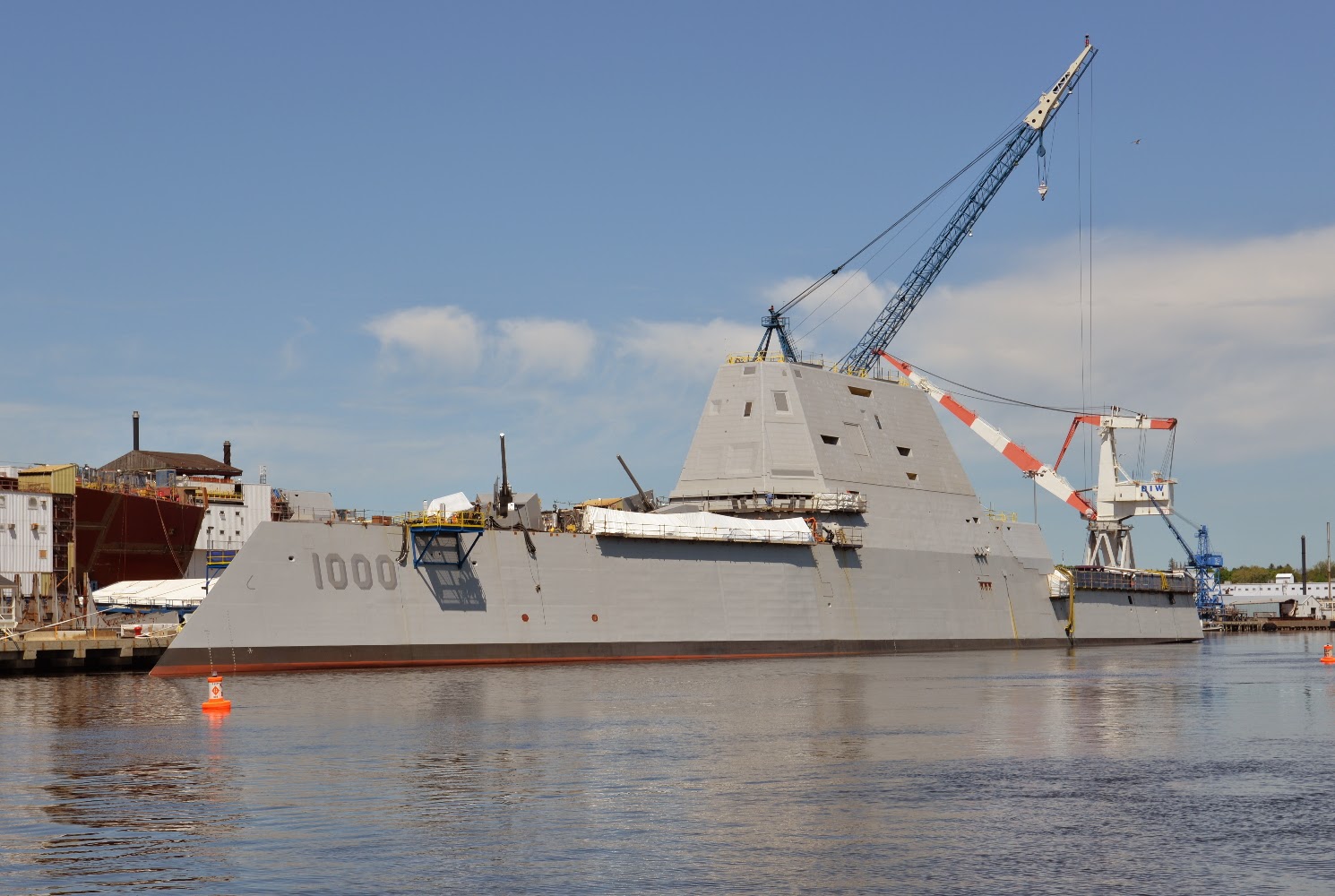 |
| DDG 1000, Note pronounced tumblehome hull form |
While
discussion continues on the CIG, there is much less talk on the imminent
introduction of the largest naval gun to enter active U.S. naval service since
the Second World War. The 155mm Advanced Gun System (AGS) has undergone
development since the early 1990’s as a component armament of the SC-21 family
of warships. During this “high noon” of the American “unipolar moment”, there
was much more attention toward achieving long-range, coordinated “fires”
than concern about the sea control that made such activities viable. How
effective can an AGS with a nominal range of 24 nm (nautical miles) for
conventional shells and 63 nm for advanced long range land attack projectiles
(LRLAP) be in an environment of advanced anti-access/area denial
(A2AD) capabilities? The AGS is perhaps useful in attacking isolated locations
outside an opponent’s home littoral and in the later stages of a conflict when
an enemy A2AD system is significantly degraded. The DDG 1000 had few direct threats when first conceived and if employed close to shore as demanded by the range of its main battery guns, any gain in stealth from the ship’s tumblehome hull form will be offset by the danger of visual detection. The ship does have some formidable
strike and defensive capabilities through its vertical launch system (VLS)
mounted missiles and AN-SPY-3 radar system. It remains to be seen, however, if those capabilities justify deploying the ship on the front lines at the outset of a high-end conflict. The DDG 1000 is dominated
by the AGS that can only be employed at the present time against land-based
targets.
 |
Armored cruiser USS Brooklyn, a US example
of late the 19th century tumblehome hull |
The Daily Beast
article and others have discussed questions of the ship’s tumblehome (inward
curving) hull form and stability in rough seas. The tumblehome hull was a
familiar feature of many warships at the end of the 19th and the
beginning of the 20th century. French, Russian, and some American warship designers
embraced it as a way of creating greater freeboard (height from water line to
deck), better sea-keeping, and from these together, improved gunnery. The
tumblehome hull's inward curve from the waterline to the main deck
causes a reduction in reserve
buoyancy, the amount of the ship outside of the water. Freeboard is the
physical factor that allows steel ships to remain afloat. A small
reduction in reserve buoyancy, especially if received off the center
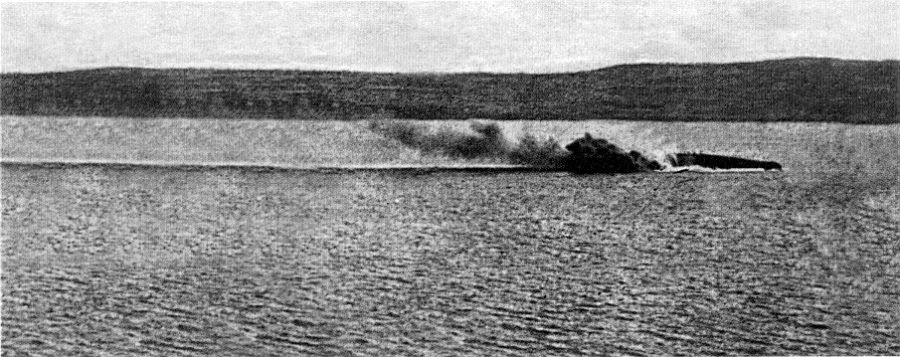 |
| French battleship Bouvet sinks during 1915 Dardanelles attack | |
|
|
line of the ship in the form of flooding from battle damage or
fire-fighting
efforts could cause a sudden loss of stability and rapid sinking. The
ship's reliance on automated damage control systems, combined with
reduced reserve buoyancy could be a problem in the case of significant
flooding. Warship
designers began to view the tumblehome hull as suspect after the Russo-Japanese
War when several Russian warships with that feature capsized and sank quickly
after only moderate damage. The feature was discarded wholesale after the First World War saw significant casualties in French warships with the unconventional hull form. The Bouvet (shown in above photo) struck a small mine (176 lbs) and sank in less than two minutes.
 |
USS Lexington (CV 2) using her turbo-electric
engineering plant to provide power to
Tacoma, WA in 1929 |
Despite these possible problems with its main armament and hull form, the DDG 1000 represents a return
to a number of positive features and notable firsts worth further exploitation
and development. The ship's electric drive system is the first for a U.S.
“capital” warship since turbo-electric propulsion systems were installed on the U.S. aircraft carriers Lexington and Saratoga in the late 1920’s. These units were so capable that Lexington's powerplant was able to provide 25% the city of Tacoma, Washington's electricity in 1929/1930 after extreme drought conditions made hydroelectric sources in area useless. Turbo-electric power proved to be a very fuel efficient system and extremely robust in combat. Both ships sustained significant damage during World War 2, and although Lexington was sunk at the Battle of the Coral Sea in May 1942, the ship's turbo-electric
drive system remained operational until spreading fires made the ship untenable. The DDG 1000’s similarly large electric power plant is the first step toward
fielding directed energy weapons at sea. These include electromagnetic rail guns with greatly increased range that may replace the AGS currently fitted. The AN-SPY 3 radar represents a
significant advance in detection, and air and missile defense capabilities,
especially in congested littoral areas. The 155mm gun still has a part to play. It has surface warfare potential if
converted to a dual purpose land/surface attack weapon. While perhaps an
interim step in the direction of a rail gun, the AGS could also play a
useful anti-surface role. The main battery of the DDG 1000 could quickly
smother an enemy warship in a barrage of 155mm projectiles from 24nm to 60+ nm.
Defense against artillery and mortar shells is possible, as demonstrated by the
U.S. Centurion Gun System, but it is not a capability currently found on the warships of
potential aggressors. Experience from the employment of the AGS as a surface
gunnery weapon is again also a step toward use of a railgun as anti-surface
weapon with estimated ranges between 110 and 220nm.
 |
Advanced Gun System
Assembly |
Potential operational and damage control issues aside, the DDG 1000 represents a
good investment in future capability. It could be altered enough to make the
ship a viable addition to a post-Post-Unipolar U.S. fleet. Enabling the 155mm
AGS as a surface weapon would expand U.S. anti surface warfare
capabilities and force opponents to spend money to undertake defensive measures
against artillery shells. One or more of the ships could be altered (if
stability conditions permit) as prototype cruiser platforms optimized for
anti-air/missile defense by removing one AGS and substituting greater missile armament
in its place. The ship’s stability after receiving damage remains a concern,
especially as it relies on an automated damage control system to provide much
of the immediate response to the effects of weapon strikes. The composite
material deckhouse of the first 2 units, as opposed to the steel version on the
third and final unit of the class represents an additional vulnerability. All such shortcomings, however, may be more effectively addressed if they are
acknowledged as such. No warship is perfect and each represents a series of
choices. The choices available to designers in the late 1990s are different
from those that must be considered in the present. The DDG 1000 class
represents a welcome addition to the fleet in that the technologies and
capabilities they possess will likely be core components of the fleet of 25
years hence. Together they might form a valuable “squadron of evolution” for
the 21st century and be useful elements in exercises and wargames.
The famous naval
author Joseph Conrad described the actions of an isolated warship conducting
naval bombardment against unseen targets at the beginning of his most famous
novel The Heart of Darkness. In it, his narrator Marlowe describes a French
cruiser shelling unseen enemies ashore as follows:
“Once, I remember, we came upon a man-of-war
anchored off the coast. There wasn't even a shed there, and she was shelling
the bush. It appears the French had one of their wars going on thereabouts. Her
ensign dropped limp like a rag; the muzzles of the long six-inch guns stuck out
all over the low hull; the greasy, slimy swell swung her up lazily and let her
down, swaying her thin masts. In the empty immensity of earth, sky, and water,
there she was, incomprehensible, firing into a continent. Pop, would go one of
the six-inch guns; a small flame would dart and vanish, a little white smoke
would disappear, a tiny projectile would give a feeble screech—and nothing
happened. Nothing could happen. There was a touch of insanity in the
proceeding, a sense of lugubrious drollery in the sight; and it was not
dissipated by somebody on board assuring me earnestly there was a camp of
natives—he called them enemies!—hidden out of sight somewhere."
The original design of the DDG 1000 may have evoked a similar image of unimpeded naval surface fire support, but
the unrestricted sea control that Conrad’s imagery conjures up is no longer a reality in the second decade of the 21st century. While perhaps not
designed for such conditions, the DDG 1000 still has a significant role to play
in the present as both a technology demonstrator and as a surface warship. The
specter of its guns may yet haunt future opponents and it’s all-electric heart
power future weapons of greater capability and effectiveness.
 |
Side view of Zumwalt
|


No comments:
Post a Comment