Showing posts with label DDG-1000. Show all posts

Friday, October 31, 2024

The Specter of the Gun


USS Zumwalt (DDG 1000)
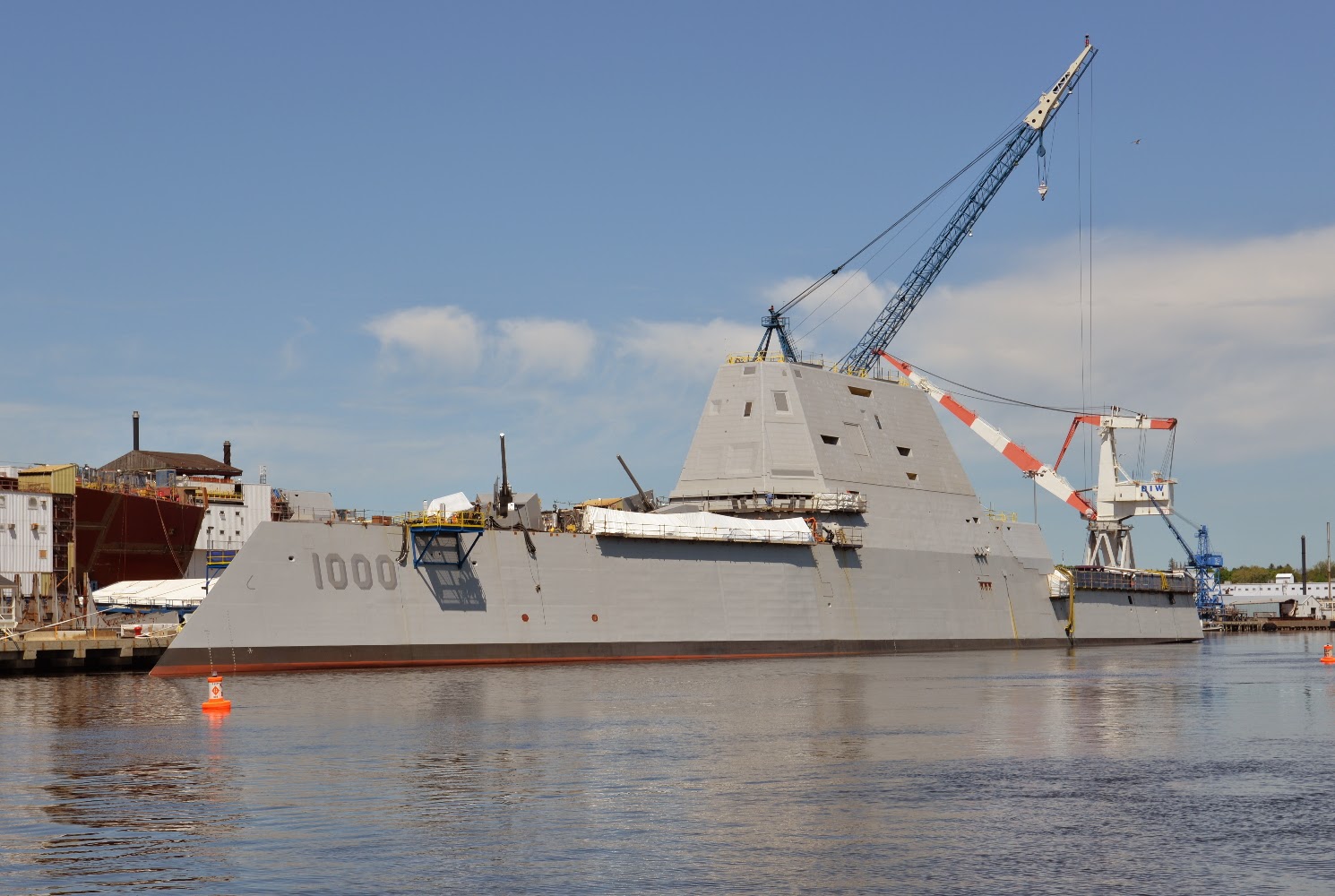
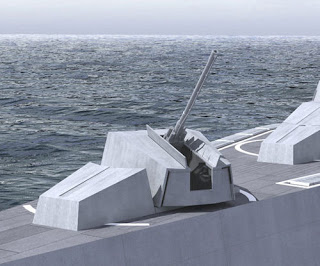
     The DDG 1000 has again appeared in recent news. Its secondary armament was in the spotlight earlier this month as the ship’s Program Manager CAPT Jim Downey discussed the change in the ship’s close in gun (CIG) system. Downey said the planned MK 110 57mm gun did not meet expected standards of lethality while the MK 46 30mm weapon exceeded them. A recent Daily Beast article suggested the ship’s stability remained uncertain. These articles provide snapshots of possible problems, but more detail is needed to accurately assess the potential warfighting capabilities and limitations of the DDG 1000. It represents a remarkable number of both “returns” and “firsts” in warship design. The big question is whether or not the ship can overcome some significant potential flaws by exploiting its revolutionary technological advances.

DDG 1000, Note pronounced tumblehome hull form
      While discussion continues on the CIG, there is much less talk on the imminent introduction of the largest naval gun to enter active U.S. naval service since the Second World War. The 155mm Advanced Gun System (AGS) has undergone development since the early 1990’s as a component armament of the SC-21 family of warships. During this “high noon” of the American “unipolar moment”, there was much more attention toward achieving long-range, coordinated “fires” than concern about the sea control that made such activities viable. How effective can an AGS with a nominal range of 24 nm (nautical miles) for conventional shells and 63 nm for advanced long range land attack projectiles (LRLAP) be in an environment of advanced anti-access/area denial (A2AD) capabilities? The AGS is perhaps useful in attacking isolated locations outside an opponent’s home littoral and in the later stages of a conflict when an enemy A2AD system is significantly degraded. The DDG 1000 had few direct threats when first conceived and if employed close to shore as demanded by the range of its main battery guns, any gain in stealth from the ship’s tumblehome hull form will be offset by the danger of visual detection. The ship does have some formidable strike and defensive capabilities through its vertical launch system (VLS) mounted missiles and AN-SPY-3 radar system. It remains to be seen, however, if those capabilities justify deploying the ship on the front lines at the outset of a high-end conflict. The DDG 1000 is dominated by the AGS that can only be employed at the present time against land-based targets.

Armored cruiser USS Brooklyn, a US example
of late the 19th century tumblehome hull
     The Daily Beast article and others have discussed questions of the ship’s tumblehome (inward curving) hull form and stability in rough seas. The tumblehome hull was a familiar feature of many warships at the end of the 19th and the beginning of the 20th century. French,  Russian, and some American warship designers embraced it as a way of creating greater freeboard (height from water line to deck), better sea-keeping, and from these together, improved gunnery. The tumblehome hull's inward curve from the waterline to the main deck causes a reduction in reserve buoyancy, the amount of the ship outside of the water. Freeboard is the physical factor that allows steel ships to remain afloat. A small reduction in reserve buoyancy, especially if received off the center
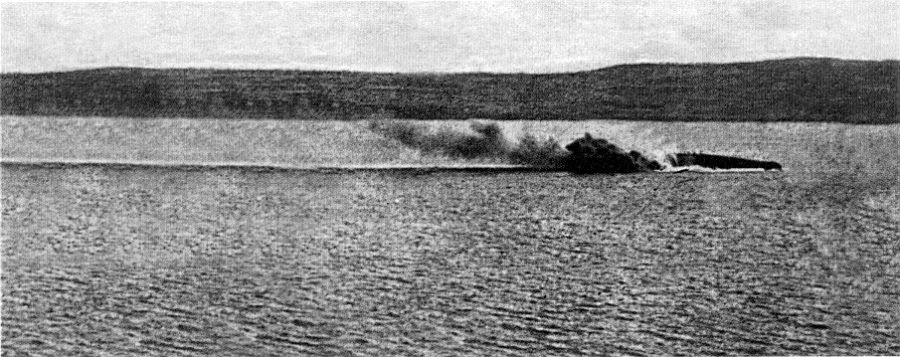
French battleship Bouvet sinks during 1915 Dardanelles attack

line of the ship in the form of flooding from battle damage or fire-fighting efforts could cause a sudden loss of stability and rapid sinking. The ship's reliance on automated damage control systems, combined with reduced reserve buoyancy could be a problem in the case of significant flooding.
Warship designers began to view the tumblehome hull as suspect after the Russo-Japanese War when several Russian warships with that feature capsized and sank quickly after only moderate damage. The feature was discarded wholesale after the First World War saw significant casualties in French warships with the unconventional hull form. The Bouvet (shown in above photo) struck a small mine (176 lbs) and sank in less than two minutes.

USS Lexington (CV 2) using her turbo-electric
engineering plant to provide power to
Tacoma, WA in 1929
     Despite these possible problems with its main armament and hull form, the DDG 1000 represents a return to a number of positive features and notable firsts worth further exploitation and development. The ship's electric drive system is the first for a U.S. “capital” warship since turbo-electric propulsion systems were installed on the U.S. aircraft carriers Lexington and Saratoga in the late 1920’s. These units were so capable that Lexington's powerplant was able to provide 25% the city of Tacoma, Washington's electricity in 1929/1930 after extreme drought conditions made hydroelectric sources in area useless. Turbo-electric power proved to be a very fuel efficient system and extremely robust in combat. Both ships sustained significant damage  during World War 2, and although Lexington was sunk at the Battle of the Coral Sea in May 1942, the ship's turbo-electric drive system remained operational until spreading fires made the ship untenable. The DDG 1000’s similarly large electric power plant is the first step toward fielding directed energy weapons at sea. These include electromagnetic rail guns with greatly increased range that may replace the AGS currently fitted. The AN-SPY 3 radar represents a significant advance in detection, and air and missile defense capabilities, especially in congested littoral areas. The 155mm gun still has a part to play. It has surface warfare potential if converted to a dual purpose land/surface attack weapon. While perhaps an interim step in the direction of a rail gun, the AGS could also play a useful anti-surface role. The main battery of the DDG 1000 could quickly smother an enemy warship in a barrage of 155mm projectiles from 24nm to 60+ nm. Defense against artillery and mortar shells is possible, as demonstrated by the U.S. Centurion Gun System, but it is not a capability currently found on the warships of potential aggressors. Experience from the employment of the AGS as a surface gunnery weapon is again also a step toward use of a railgun as anti-surface weapon with estimated ranges between 110 and 220nm.

Advanced Gun System
Assembly
     Potential operational and damage control issues aside, the DDG 1000 represents a good investment in future capability. It could be altered enough to make the ship a viable addition to a post-Post-Unipolar U.S. fleet. Enabling the 155mm AGS as a surface weapon would expand U.S. anti surface warfare capabilities and force opponents to spend money to undertake defensive measures against artillery shells. One or more of the ships could be altered (if stability conditions permit) as prototype cruiser platforms optimized for anti-air/missile defense by removing one AGS and substituting greater missile armament in its place. The ship’s stability after receiving damage remains a concern, especially as it relies on an automated damage control system to provide much of the immediate response to the effects of weapon strikes. The composite material deckhouse of the first 2 units, as opposed to the steel version on the third and final unit of the class represents an additional vulnerability. All such shortcomings, however, may be more effectively addressed if they are acknowledged as such. No warship is perfect and each represents a series of choices. The choices available to designers in the late 1990s are different from those that must be considered in the present. The DDG 1000 class represents a welcome addition to the fleet in that the technologies and capabilities they possess will likely be core components of the fleet of 25 years hence. Together they might form a valuable “squadron of evolution” for the 21st century and be useful elements in exercises and wargames.

     The famous naval author Joseph Conrad described the actions of an isolated warship conducting naval bombardment against unseen targets at the beginning of his most famous novel The Heart of Darkness. In it, his narrator Marlowe describes a French cruiser shelling unseen enemies ashore as follows:

“Once, I remember, we came upon a man-of-war anchored off the coast. There wasn't even a shed there, and she was shelling the bush. It appears the French had one of their wars going on thereabouts. Her ensign dropped limp like a rag; the muzzles of the long six-inch guns stuck out all over the low hull; the greasy, slimy swell swung her up lazily and let her down, swaying her thin masts. In the empty immensity of earth, sky, and water, there she was, incomprehensible, firing into a continent. Pop, would go one of the six-inch guns; a small flame would dart and vanish, a little white smoke would disappear, a tiny projectile would give a feeble screech—and nothing happened. Nothing could happen. There was a touch of insanity in the proceeding, a sense of lugubrious drollery in the sight; and it was not dissipated by somebody on board assuring me earnestly there was a camp of natives—he called them enemies!—hidden out of sight somewhere."

The original design of the DDG 1000 may have evoked a similar image of unimpeded naval surface fire support, but the unrestricted sea control that Conrad’s imagery conjures up is no longer a reality in the second decade of the 21st century. While perhaps not designed for such conditions, the DDG 1000 still has a significant role to play in the present as both a technology demonstrator and as a surface warship. The specter of its guns may yet haunt future opponents and it’s all-electric heart power future weapons of greater capability and effectiveness.


Side view of Zumwalt


Wednesday, October 10, 2024

This is Stealth?

DDG 1000's composite deckhouse was revealed this week down in Gulfport. The uniquely angled 48.8m long, by 21.3m wide, by 19.8m high balsa-wood core carbon fiber super-structure is designed to provide the Navy's newest guided-missile destroyer a low radar and infrared signature.  The deckhouse, combined with a low-profile tumblehome hull will likely achieve this goal, but is it truly fair to say that this design is "stealthy?"  Today's enemies will not operate long range maritime patrol aircraft and radar satellites like the Soviet Union did to locate U.S. fleets on the open ocean 30 years ago.  They will, however, use a network of tattletale fishing dhows equipped with satellite phones, cheap tactical UAVs, and HUMINT networks in nearby logistics ports with twitter accounts and smart phones to find ships operating in narrow seas such as the Arabian Gulf.  A singulary-unique profile 14,000 ton combatant is not likely to be able to hide from these intelligence platforms, no matter how innovative her design may be.  One hopes that the three staggeringly expensive DDG-1000 destroyers will validate many new naval technologies, but how to hide a ship in the littorals during 21st Century irregular warfare will not likely be one of them.
Ingalls Photo of the Week: Ingalls shipbuilders at the Gulfport Composite Center of Excellence watch as the DDG 1000 deckhouse begins its journey from the factory to the barge that will deliver it to Maine. Photo by Steve Blount.

The opinions and views expressed in this post are those of the author alone and are presented in his personal capacity. They do not necessarily represent the views of U.S. Department of Defense, the US Navy, or any other agency.


Friday, May 18, 2024

Lets Talk About Requirements With Clarity Sir...

At the USNI Joint Warfighter 2012 Conference this week, I wanted to talk about shipbuilding. The plan came together on the last day of the conference when I used the panel moderated by Peter Swartz's on acquisition as the setting. You can read about it at USNI.

Tuesday, April 17, 2024

USS Lyndon B. Johnson

Because I know how much some of you really, really care...
Secretary of the Navy Ray Mabus announced today the next Zumwalt-class destroyer will be named the USS Lyndon B. Johnson.

The selection of Lyndon B. Johnson, designated DDG 1002, continues the Navy tradition of naming ships after presidents and honors the nation’s 36th president.

The USS Lyndon B. Johnson is the 34th ship named by the Navy after a U.S. president.

“I am pleased to honor President Johnson with the naming of this ship,” Mabus said. “His dedication to a life of public service included bravely stepping forward to fight for his country during our entry into World War II.”

A Texas congressman, Johnson was the first member of Congress to enlist in the military following the start of World War II. After his naval service, Johnson was elected to the U.S. Senate in 1948, where he served as both minority and majority leader before being elected vice president Nov. 8, 1960.

Following President Kennedy’s assassination Nov. 22 1963, Johnson succeeded to the presidency, finished the remaining term, and was reelected for a full term as president, by the greatest percentage of total popular vote (61 percent) ever attained by a presidential candidate.

Johnson’s time as president was marked by the passage of programs that greatly influenced and impacted education, healthcare and civil rights for generations to come. He signed the Civil Rights Act of 1964 into law, enacting comprehensive provisions protecting the right to vote and guarding against racial discrimination. His work on civil rights continued with the passage of the Voting Rights Act, which guaranteed voting rights for all people, regardless of race.

Johnson signed legislation establishing Medicare, which allowed millions of elderly Americans access to cheaper medical services. He also launched the Head Start Program, which provided preschool children from low-income families with classes, medical care, and other services.

As a naval officer, Johnson requested a combat assignment after the attack on Pearl Harbor and served in the Pacific theater during World War II. After returning from active duty service, Johnson reported back to Navy leaders and Congress on what he believed were deplorable conditions for the warfighters, and continued to fight for better standards for all military members.

USS Lyndon B. Johnson will be the third Zumwalt-class (DDG 1000) destroyer. Construction began on the ship at General Dynamics-Bath Iron Works April 4 and is expected to deliver to the Navy in fiscal 2018. The multimission DDG 1000 class destroyers are designed for sustained operations in the littorals and land attack and will provide independent forward presence and deterrence, support special operations forces, and operate as an integral part of joint and combined expeditionary forces. This warship integrates numerous critical technologies, systems, and principles into a complete warfighting system. Zumwalt ships will be 600 feet in length, have a beam of 80.7 feet, displace approximately 15,000 tons, and capable of making 30 knots speed. Each ship will have a crew size of 148 officers and Sailors.
First, the Zumwalt class has had more good press in the last 3 weeks than it has in the last 3 years. As I have been saying for years, the Zumwalt class destroyers really is going to be the most incredible class of surface combatant ever built by man, and there are people very excited about what this ship is going to be able to do. These ships will have a wow factor that is legitimate, and I'll bet right now that at some point down the road they will be the 3 most capable surface combatants in the Navy by miles. I do not expect the Navy to build more Zumwalts (the hull form is the only mistake on the ship), but I do believe the class will serve as the foundation for the future surface combatant.

Second, I know people get all worked up about ship names, but in complete irony they often cite naval history as the reason they are all pissed off. Uhm, according to the naval history of the United States, the exception to the rules that govern ship names is as much the rule as the rule itself, so if you try claiming that Lyndon B. Johnson is an inappropriate ship name because of naval history, my reply will simply be that you appear to know absolutely nothing about Navy history as it relates to ship names.

I for one look forward to seeing what the SECNAV sends to the House now that he must deliver a report on ship names, because I imagine it will be a very interesting report that justifies - with historical clarity - why naming a ship after a politician is just as much Navy tradition as having themes guide naming conventions for Navy ships. I fully support the authority Congress has lent to the SECNAV to name US Navy ships, and I fully support the SECNAV in naming ships whatever the hell he wants.

BUT WITH ALL THAT SAID... that doesn't mean it's a good idea to ever name a Zumwalt destroyer the JOHNSON. Only Ray Mabus is apparently so tone deaf as to not see the irony that during April 2012 - also known as Sexual Assault Awareness Month (SAAM) in the Navy - that the 18-22 year old enlisted sailors are going to almost certainly come up with some highly creative (and crude) JOHNSON jokes. OK, so the silver lining is that at least we won't have a JOHNSON STRIKE GROUP in the Navy, but when a ship's most prominent feature is often described as 6" or 155mm, JOHNSON doesn't quite strike me as the appropriate name.

*sigh*

Who does the SECNAV listen to, and what kind of lame ass sense of humor and imagination do his advisers apparently have to miss where this is likely to go? I can already imagine a future conversation with my wife..."Honey, I'm going to Bath for a shakedown cruise on JOHNSON."

The jokes regarding the Navy's new JOHNSON may get old, eventually, but probably not this week. If you wish to channel your inner 14 year old to celebrate the Navy's new JOHNSON in the blog comments, I look forward to the laugh.

Wednesday, April 4, 2024

I'll Take DDG for 1000 Alex

So you want to talk about something Navy related and interesting? Let's begin with some excerpts from Additional Analysis and Oversight Required to Support the Navy's Future Surface Combatant Plans - GAO-12-113, Jan 24, 2024 as cited in Ronald O'Rourke's latest CRS report China Naval Modernization: Implications for U.S. Navy Capabilities—Background and Issues for Congress (PDF).
the Navy’s choice of DDG 51 as the platform for AMDR limits the overall size of the radar to one that will be unable to meet the Navy’s desired (objective) IAMD [integrated air and missile defense] capabilities. If the Navy selects a 12-foot AMDR—which may reduce the impacts on the ship and design—it may not be able to meet the requirements for AMDR as currently stated in the Navy’s draft capabilities document....

[The] Flight III [DDG-51] with a 14-foot AMDR will not be powerful enough to meet the Navy’s objective, or desired IAMD capabilities. The shipyards and the Navy have determined that 14-foot radar arrays are the largest that can be accommodated within the confines of the existing DDG 51 configuration. Adding a radar larger than 14 feet to DDG 51 is unlikely without major structural changes to the ship. AMDR is being specifically developed to be a scalable radar—meaning that it can be increased in size and power to provide enhanced capability against emerging threats.

According to AMDR contractors, the Navy had originally contracted for an investigation of a Variant 2 AMDR with a sensitivity of SPY+40,144 but this effort was cancelled. They added that the maximum feasible size of AMDR would be dictated by the ship and radar power and cooling demands, but that they had investigated versions as large as 36 feet. Leveraging AMDR’s scalability will not be possible on DDG 51 without major changes, such as a new deckhouse or adding to the dimensions of the hullform itself by broadening the beam of the ship or adding a new section (called a plug) to the middle of the ship to add length. Navy officials have stated that adding a plug to DDG 51 is not currently a viable option due to the complexity, and that a new ship design is preferable to a plugged DDG 51.

The Navy has not yet determined the size of AMDR for Flight III, and two sizes are under consideration: a 14-foot AMDR with a sensitivity of SPY+15, and a 12-foot AMDR with a sensitivity of SPY+11. According to a draft AMDR Capability Development Document, the Navy has identified that an AMDR with SPY+15 will meet operational performance requirements against the threat environment illustrated in the [destroyer] Radar/Hull Study. This document also notes that a significantly larger SPY+30 AMDR is required to meet the Navy’s desired capability (known as objective) against the threat environment illustrated in the MAMDJF AOA. The Navy could choose to change these requirements. The MAMDJF AOA eliminated the DDG 51-based SPY+15 solution from consideration in part due to the limited radar capability, and identified that a radar closer to SPY+30 power with a signal to noise ratio 1,000 times better than SPY+0 and an array size over 20 feet is required to address the most challenging threats. If a 12-foot array is chosen, the Navy will be selecting a capability that is less than the “marginally adequate” capability offered by a SPY+15 radar as defined by the Radar/Hull Study red team assessment. According to Navy officials, only through adding additional square footage can the Navy effectively make large improvements in the sensitivity of the radar the SPY+30 radar considered in the MAMDJF AOA could only be carried by a newly designed cruiser or a modified San Antonio [LPD-17] class [amphibious] ship, and only a modified DDG 1000 [destroyer] and could carry the approximately SPY+25 radar. According to the draft AMDR Capability Development Document, the Navy’s desired IAMD capability can only be accommodated on a larger, currently unspecified ship. As part of the MAMDJF AOA, the Navy identified that DDG 1000 can accommodate a SPY+25 radar. As part of a technical submission to the Navy, BIW—the lead designer for DDG 1000147—also identified a possible design for a 21-foot radar on DDG 1000. The Navy did not include a variant with this size radar in the Radar/Hull Study.

According to senior Navy officials, since the MAMDJF AOA was released the Navy has changed its concept on the numbers of Navy ships that will be operating in an IAMD environment. Rather than one or a small number of ships conducting IAMD alone and independently managing the most taxing threat environments without support, the Navy now envisions multiple ships that they can operate in concert with different ground and spacebased sensor assets to provide cueing for AMDR when targets are in the battlespace. This cueing would mean that the shooter ship could be told by the off-board sensors where to look for a target, allowing for earlier detection and increased size of the area that can be covered. According to the Navy, this concept—referred to as sensor netting—can be used to augment the reduced radar capability afforded by a 12 or 14-foot AMDR as compared to the larger radars studied in the MAMDJF AOA. For example, the Navy cited the use of the Precision Tracking Space System program as an example of sensors that could be leveraged. However, this program (envisioned as a constellation of missile tracking satellites) is currently in the conceptual phase, and the independent Radar/Hull Study red team stated that the development timeline for this system is too long to consider being able to leverage this system for Flight III. Navy officials told us that another option would be to leverage the newly completed Cobra Judy Replacement radar ship and its very powerful dual-band radar to provide cueing for DDG 51s. This cueing could allow the DDG 51s to operate a smaller AMDR and still be effective. The Cobra Judy Replacement ship is comparatively cheaper than DDG 51s (approximately $1.7 billion for the lead ship), and was commercially designed and built. However, it is not a combatant ship, which would limit its employment in a combat environment and make it difficult to deploy to multiple engagement locations.

Senior Navy officials told us that the concept of sensor netting is not yet well defined, and that additional analysis is required to determine what sensor capabilities currently exist or will be developed in the future, as well as how sensor netting might be conceptualized for Flight III. Sensor netting requires not only deployment of the appropriate sensors and for these sensors to work alone, but they also need to be able to share usable data in real-time with Aegis in the precise manner required to support BMD engagements. Though sharing data among multiple sensors can provide greater capabilities than just using individual standalone sensors, officials told us that every sensor system has varying limitations on its accuracy, and as more sensors are networked together and sharing data, these accuracy limitations can compound. Further, though there have been recent successes in sharing data during BMD testing, DOD weapons testers responsible for overseeing BMD testing told us that there have also been issues with sending data between sensors. Although sensor technology will undoubtedly evolve in the future, how sensor netting will be leveraged by Flight III and integrated with Navy tactics to augment Aegis and the radar capability of Flight III is unknown...

The Navy’s choices for Flight III will likely be unsuitable for the most stressful threat environments it expects to face....

We recommend that the Secretary of Defense direct the Secretary of the Navy to take the following three actions:...

2. Report to Congress in its annual long-range shipbuilding plan on its plans for a future, larger surface combatant, carrying a more capable version of AMDR and the costs and quantities of this ship....

DOD concurred with our second recommendation that the Navy report to Congress in its annual long-range shipbuilding plan on its plans for a future larger surface combatant carrying a more capable version of AMDR. Given the assessments that the Navy is currently conducting on surface combatants, the Navy’s next submission should include more specific information about its planned future surface combatant acquisitions.
The AMDR is going to determine what ballistic missile defense capabilities the surface Navy will have in the future, there is apparently still some confusion on the AMDR within the Navy. It is very much unclear what the future will hold as funding gets tight, because there is clearly no policy from the Obama administration right now that is informing a strategy that would then inform the DoD how to make decisions - FY13 is purely a budget shell game in the DoD, not a capabilities driven assessment. For example, that X-Band radar recently deployed in the Pacific to monitor the upcoming North Korean rocket launch is not funded in the FY13 budget, so even the technology we apparently need right now isn't protected for next year. For more on the latest budget news related to ballistic missile defense, see Chris Cavas's latest here.

The biggest question though is AMDR and the DDG-51 Flight III. To follow up on that topic, I highlight this Janes Analysis from February 3, 2024 titled Analysis: Arleigh Burke update costs and challenges mount up (subscription only). Pay attention folks, this is probably the most important article written about DDG-51 Flight III to date, and yet another reason why a Janes subscription is worth paying for (if you can afford it).
Efforts to adapt the Arleigh Burke-class destroyer (DDG 51) hull design - now more than 30 years old - to support the US Navy's (USN's) next-generation ballistic missile defence (BMD) radar are becoming costlier and more complicated than the service initially advertised.

A Naval Sea Systems Command (NAVSEA) report has indicated that space and cooling limitations within the hull mean that complex design changes will probably be required if the proposed Flight III Arleigh Burke design is to accommodate the Air and Missile Defense Radar (AMDR).
FYI, the report is called DDG51 Flight Upgrade Study Year 1 Technical Report.
Officials at NAVSEA have suggested that a 'high-end' Flight III destroyer could cost USD1 billion more than the navy's USD2.6 billion estimate for the lead ship. Furthermore, potential for growth will be severely limited and the new ship may have to lose weapon systems to comply with navy requirements, according to an internal NAVSEA study obtained by Jane's. The service declined to comment on the report.
Said another way, NAVSEA's own estimate for lead ship of a potential Flight III destroyer is $3.6 billion, and according to NAVSEA, the growth margins for this new class of ship will be zero - meaning the ship has no room to adapt to new technology throughout it's potential life well into the 2050s and 2060s! It is more than a little frustrating that according to NAVSEA, based on current plans to use the DDG-51 hull - the only surface combatants likely to have growth for future technologies anytime over the next several decades are the three DDG-1000s.
Notionally the AMDR requires five times more power - 2,684 kW - and 10 times more cooling capacity than the current SPY-1D (V) radar on a hull that is already among the most tightly packaged in the navy. According to the report, a suite of X- and S-band radars will consume almost half the power generated by a Flight IIA destroyer cruising in winter conditions. The deficit will require at least the installation of a fourth auxiliary gas turbine generator to allow the AMDR to operate.

Even with the additional generator, the 450 V electrical system in the Flight IIA ships would be too stressed to handle the increased loads, would suffer a high risk of failure and would be "highly unlikely" to be able to support future high-power weapons and sensors. A change to a more robust 4160 V system would require a comprehensive redesign. NAVSEA has studied a hybrid electric drive (HED) using a bidirectional electric rotating machine (ERM) that could power the main reduction gears from the electrical grid and provide power via the ship's prime movers to the grid in a Propulsion Derived Ship Service (PDSS) scheme. The installation of ERMs would mitigate the need for a fourth auxiliary generator but the PDSS variants would face a "complex integration problem in all HED variants" and be "technically risky", the report said. Having also evaluated an integrated propulsion system (IPS) similar to that in the new Zumwalt-class (DDG 1000) destroyers, NAVSEA found that the maximum speed achievable was below the required 30 kt and that it would have involved major equipment arrangement issues. The IPS study was put on hold pending technology developments.
You know it really is amazing to me the Navy is facing so many challenges related to power and energy today, and yet the focus and investment of Ray Mabus on power and energy technologies is related to fuel sources rather than actual propulsion systems. The difference is simple, Ray Mabus has spent his time as SECNAV trying to solve issues related to the US public transportation system rather than investing in the types of energy challenges the Navy faces related to driving ships and fielding unmanned underwater systems. Sorry Mr. Secretary, but Algae fuel and solar power aren't addressing the Navy's energy challenges, those initiatives are distracting attention and dollars away from the real energy challenges facing the Navy.
Mike Petters, the chief executive officer at shipbuilder Huntington Ingalls Industries (HII), told Jane's in December 2011 that additional changes to the Flight III would add cost and time. "My view is if this Flight III destroyer comes out and it's radically different [to the existing variants] then we will have missed the boat," Petters said.
I usually agree with Mike Petters, but passing up on a bad deal is not 'missing the boat.'
Meanwhile, inclusion of the AMDR and necessary power and cooling equipment to allow normal operation would push the Arleigh Burke hullform to near its practical limits and far surpass the USN's requirement for hull expandability.

Service Life Allowance (SLA) requirements call for a ship growth potential of 10 per cent by weight and an additional 30.5 cm of length in the ship's center of gravity while complying with survivability rules.

NAVSEA determined that in order for the Flight III to completely meet SLA requirements the ship's beam would have to be increased by 1.22 m, which would reduce the maximum speed by 1 kt and reduce its range by five per cent. The navy examined constructing the deckhouse from aluminum or composites, which would add an extra two per cent of SLA weight and an additional 8.5 cm to the ship's centre of gravity threshold - still far below navy minimums.

These concepts were among the costliest, with a lead ship price of USD3.58 billion, although a Government Accountability Office (GAO) report in January said the USN was unlikely to pursue a non-steel deckhouse.

Compromising on SLA requirements has plagued the USN in the past: the Ticonderoga-class cruiser lost weight from the deckhouse - to accommodate the Aegis combat system - and this led in part to severe hull-cracking problems that have shortened the life of the ship.

Since the NAVSEA report was written a year ago, technology developments have occurred that could increase some of the Flight III's margins.

Raytheon has announced it will use gallium nitride semi-conductors for its S-band AMDR bid. According to the company, the change would allow the same level of capability for one fifth of the power consumption. The USN has also suspended development of the X-band radar for AMDR, which could add short-term power and weight gains to the early Flight IIIs.
In other words, the Navy is cutting requirements to fit a square peg in a round hole. No matter how one looks at the problem, the best ship today for moving the Navy into the future with AMDR is DDG-1000, and if the Navy doesn't like that option - the Navy needs to design a new hull to carry the technologies of DDG-1000.

I find it pretty incredible that in 2012 one can credibly, supported by facts, figures, and analysis; make the argument that the F-22 is a less expensive, more capable option for the Air Force than the Joint Strike Fighter and that the DDG-1000 is a less expensive, more capable option than the DDG-51 for the Navy. I wonder what the cost of adding AEGIS BMD to DDG-1000 is, and if the costs of doing that are less than the costs of insuring the first block of Flight III destroyers still float in 2030, or the costs of insuring those same ships are militarily relevant in 2040.

There really is no way anyone could have known at the time that Admiral Roughead was potentially making the wrong choice when truncating the DDG-1000 in favor of the DDG-51, but it does appear the biggest mistake he made as CNO was betting against the solid work done by Jim Syring who set the DDG-1000 program on the road to success. In the end, Jim Syring was the only guy in the room who continuously beat the drum suggesting the DDG-1000 was the best option for the Navy in the future, and in hindsight Jim Syring was clearly the smartest guy in the room.

Look, if we know the fleet is going to be smaller in the future, the Navy might as well insure every plan insures the fleet fields the technology most likely to be relevant in that future. Stuffing the capabilities of today into every space possible just to produce a DDG-51 Flight III with full knowledge there is no growth margin on the ship is not a credible approach to 21st century seapower by any definition. Is the Navy truly paralyzed when it comes to making shipbuilding decisions because the last CNO had a gut feeling about DDG-1000 (that turned out to be wrong) and set about the Navy on the wrong course? Is there no such thing as a course correction anymore? Fitting square pegs in round holes is perhaps the worst way to plow ahead into the future - and yet, when it comes to AMDR and DDG-51 Flight III - here we are.

Friday, December 30, 2024

2012 Prediction Sure to Go Wrong, or Not

The only sure prediction for 2012 is that it will be an interesting year for surface warfare discussions. The DDG-1000 is going to be an amazing ship, assuming the software side works out. Will it be a better investment than the DDG-51 restart? The answer is starting to look more and more like YES everyday, primarily because the DDG-51 restart isn't restarting the DDG-51 you think it is. AVIATION WEEK has been discussing this topic all year, specifically Michael Fabey in his many DDG-1000 vs DDG-51 articles, which in hindsight will be the background material for events soon to unfold in the coming year.

Here is his latest, an important read. I'll predict it here and now (again) - the GAO is going to look very favorably on the DDG-1000 over the DDG-51 restart. I'm looking forward to observing the SWO community reaction, because I expect to observe a great deal of denial and irrational reactions resulting from the GAOs analysis. I could be wrong about that, but I don't think so. The ugly side of AEGIS is soon to go public, and AEGIS is not simply a technology in the Navy - it's something similar to a religion.

Interesting times.

Thursday, November 17, 2024

AMDR Will Bring Very High Fleet Costs

Sam Lagrone has a Janes Exclusive up behind the firewall. There is a lot to think about and discuss here, too much to cover in one post although I encourage folks to open fire in the comments.
The first of the US Navy's (USN's) future Arleigh Burke-class Flight III ballistic missile defence (BMD) destroyers could cost between USD3 billion and USD4 billion to build, Jane's has learnt.

The projected figures, which appeared in early USN estimates for a replacement for the cancelled next-generation guided missile cruiser (CG(X)), were confirmed by several industry and military sources. Shipbuilders Huntington Ingalls Industries (HII, formerly Northrop Grumman Shipbuilding) and General Dynamics Bath Iron Works (BIW) were asked to provide the cost data for the Flight III - which will perform the BMD role in lieu of CG(X) - as part of the navy's 2009 Hull and Radar Study.

One source familiar with the estimates said a BIW-built Flight III destroyer would cost about $2.7 billion in total while an HII ship would cost about $3.7 billion, both under fixed-price construction contracts.
As has been previously discussed, the DDG-51 Flight IIIs are expected to field the radar selected as a result of the Air and Missile Defense Radar (AMDR) study from 2009, and with that requirement alone the Navy is required to make several changes to the DDG-51 design. The end result means that DDG-51 Flight III is not really a DDG-51, but an evolved new class of warship based on the best and lessons from the DDG-51 and DDG-1000.
With a planned aperture of 14 ft, the AMDR will be less sensitive than the 22 ft variant that was planned for CG(X) but more sensitive than the SPY-1D air-search/fire-control radar that equips Flight IIA ships. The power-hungry AMDR will require a costly new electrical system encompassing a more robust electrical grid, and must be able to integrate follow-on systems, adding risk and uncertainty to the Flight III design.

In particular, ship designers will probably have to upgrade the 440 V grid in the current Arleigh Burkes to a 4,160 V grid to accommodate the 10 MW needed to drive the AMDR. Increasing the voltage in a Flight III grid would allow more power to flow safely and reliably to the ship's systems, but it would incur additional engineering and design expenditures.
Ballistic Missile Defense is now the primary combat specialty driving the future ship design in major surface combatants. The major surface combatant of the future is being designed, by intent, to fight not only under the ocean, on the ocean, against targets on land, and over the ocean - but is also now expected to offer naval forces superiority against weapons that maneuver in low orbit space.

The DDG-51 Flight III design will leverage a hull form similar to the DDG-51 but will apparently require a complete redesign internally in order to leverage DDG-1000 technologies like electric power systems in order to support the expanding mission areas. Preliminary design of the new warship is currently planned through 2012 with a contract design phase towards specific detail planned for 2013-2014.

It is important to note, that while this warship is being called DDG-51 Flight III, that is a Flag level communications snafu waiting to happen. This ship clas should be a new program. The Navy is basically going to try to design, build, and field a new high end destroyer in about a decades time, which for naval construction is remarkably fast. As an evolutionary design - thanks largely to R&D from DDG-1000 and the DDG-51 Flight IIA restart - the Navy is actually saving a lot of money in developing this new warship, but with cost estimates of between $2.7 - $3.7 billion for the first ship, the Navy finds itself right back where it started with DDG-1000.

This is why, and I discussed this many times on the blog at the time, the Navy never made a cost argument in Congressional testimony regarding the DDG-1000. The Navy said a lot of things, but neither the CNO nor admirals in testimony ever publicly used the high cost of DDG-1000 or the lack-of-AEGIS issue as justification for truncating the DDG-1000 program. Right about now, that whole on-cost, on-schedule DDG-1000 program after ship #3 is looking like a real bargain, but again, DDG-1000 is designed to be a warship with superior land attack and gun warfare capabilities, while this new warship is intended to give the Navy the ability to be superior against low-orbit threats like ballistic missiles.

The enormous cost of this new surface combatant in the context of an emerging age of global naval power growth and more capable anti-access, area denial capabilities raises legitimate questions regarding the future force structure of the US Navy. As the high end surface combatant suffers from legitimate mission creep, now requiring capabilities towards military superiority against ballistic missiles, combined with all the other tasks found in the development of multi-mission capable warships, is the Navy properly accounting from a holistic perspective the impacts of more and mroe investment in sustaining mutli-mission capable ships that can perform at the highest end of every mission area? How long can the Navy sustain generational growth at the high end of surface warfare at a cost of an extra ~$1 billion added cost per ship before the fleet is too small to meet the primary mission of the Navy vs the threats given primary mission focus for the Navy?

When the Navy increases the capability requirement at the high end of any mission capability of the surface force, an action that will almost certainly require a reduction in the size of the surface force to compensate for the new requirement cost trade-off, how does that impact the lesser assets of the surface force? The Navy has argued, and until now I have agreed, the Navy does not need a frigate because the Navy has a high quantity of major surface combatants capable of meeting the entire range of combat requirements a frigate would perform. However, in the context of the cost of the AMDR surface combatant, quantity at the high end is very much in doubt, and the argument the Navy does in fact need a higher quantity of surface combatants at the low end to compensate for the reduced quantity of high end vessels is a very compelling argument in favor of a frigate. I know one thing, I do not see how the Navy can justify construction of the current LCS designs after the existing contracts through FY15 are fully executed, because as the high end shrinks due to cost constraints, the low end of the force must be adjusted in capability to compensate.

With that said, the requirement to field unmanned systems in quantity doesn't simply go away, and the contributing combat role the LCS represents for the 21st century fleet is just as necessary but very different from a frigate. Throughout the history of the Navy, major influences to force structure - like adding BMD to the fleet or observing cost increases in aircraft carriers or submarines - required a holistic view of the fleet and adjustments across the total of force structure. This is why, for example, since WWII ships are introduced as part of a family. The ASW destroyer (Sprunance) and convoy escort frigate (Perry) were part of a family, a family that included the Sea Control Ship until that was canceled. The DDG-1000 and LCS were part of a family of ships that included the canceled CG(X). The current cruiser and destroyer warships of the US Navy are part of the AEGIS family of warships. I do not see how the Navy can change the high end of surface warfare to be centric to fighting low-orbit threats like ballistic missile defense at such a high cost and not compensate this major force structure without introducing a family of ships that addresses the cost relationship this major combatant will have on the total force.

Today the Navy is facing significant costs, and is adding significant risk to the total force, by following a pattern of force structure evolution that may have reached the end of it's ability to meet mission requirements for the United States. Evolving the Nimitz CVN -> Ford CVN, evolving the DDG-51 Flight IIA -> DDG-51 Flight III, evolving the Los Angeles class SSN -> Virginia class SSN, and evolving the Ohio SSBN -> to SSBN(X) has resulted in the Navy building bigger, more capable, but a much smaller and more expensive force where combat capabilities are being condensed into a very powerful, but numerically challenged fleet relative to the scope and scale of demand and requirements. Has the multi-mission fleet evolution model for naval force structure reached a point of risk where, by putting all eggs into fewer baskets, the Navy now potentially assumes risks too great to compensate for should the Navy suffer from attrition in warfare?

What is the red line, and who has the guts in OPNAV to admit it gets crossed when the institution isn't really designed to admit potential weaknesses in major program efforts. It's like the big deck nuclear aircraft carrier question, how will anyone really know when it becomes obsolete in an age of increasingly sophisticated long range and lethal military capabilities being proliferated globally? It's why I warn young naval officers, be very careful not to be too critical of the battleship admirals prior to Pearl Harbor in 1941, because that same scenario could easily be repeated with the carrier admirals of 2011.

If the Navy was to build a larger quantity of smaller, single purpose ships - when comparing the cost of just four DDG-51 Flight IIIs at a cost of $12 billion in shipbuilding, what are the trade offs from a cost/benefit risk assessment perspective when evaluated against alternative force structures? Would 6 smaller frigates at $1 billion each, 1 LPD-17 sized unmanned systems mothership at $2.5 billion, and 1 $3.5 billion major surface combatant be a better mix of combat capabilities at the same cost as 4 DDG-51 Flight IIIs? What ever happened to the large, simple single mission destroyer? You know, the Brits might be a lot smarter than we think for building so much empty space into the Type-45s to keep costs down. I do wonder, was the proposed expensive CGN(X) large ballistic missile defense cruisers that would serve as major networked radar vessels really a bad idea, or was it simply a bad idea in the context of a surface navy that appears completely unwilling to address the changes such a vessel would have to the rest of the force structure?

One thing is certain, this DDG-51 Flight III is so expensive that it appears irresponsible for the Navy to introduce it as simply a replacement program for major surface combatants. This warship should be part of a family of ships that are designed to compensate for the stresses a smaller high end surface force will inevitably place on the rest of the fleet.

Monday, September 26, 2024

Zumwalt: Still Looking Good

This Defense News article by Chris Cavas covers the three main points of the DDG-1000 program to date. The first is specific to shipbuilding, and whether this program is going to be well run or another in a long list of problematic programs that fail to perform.
"We're on time, we're on budget. We're within budget," Capt. James Downey declared during an interview earlier this month. "We're hitting the milestones within the program."

Zumwalt, lead ship of the class, is more than half complete, Downey reported, and will be more than 60 percent complete when a ceremonial keel-laying is held Nov. 17 at General Dynamics Bath Iron Works in Bath, Maine.

A construction contract for the second and third ships, the Michael Monsoor (DDG 1001) and yet-to-be-named DDG 1002, was awarded to Bath on Sept. 15. Construction of the Monsoor is more than a quarter complete; fabrication of DDG 1002 is set to begin next spring.
What about cost?
"Within about the next four to five months, all the negotiations will be done on all three ships, so you'll see what those numbers are," Downey said. "Except for life-cycle support, all procurement will be done."

Procurement for the Zumwalt was about $3 billion, Downey said. "I'm hesitant on specific numbers for the second and third ships, but they're coming below what the first ship was."

Zumwalt is being built under cost-plus contracts, he noted, but most of the work on the other two ships will be under fixed-price agreements.
I still believe it is very possible the first DDG-51 Flight IIA restart is going to cost more than any of the three of the DDG-1000s. There are too many rumors circulating discussing the high cost of the DDG-51 restart to ignore that possibility. One might get the impression the Navy is going well out of their way lately to hide the real costs of both destroyer programs for that specific reason - the Navy believes they need to get the DDG-51 restart going before they reveal any cost problems.

Finally, the big challenges ahead.
"We tested the complete propulsion system in local control," Downey said. "It pretty much passed with flying colors," although some test equipment needed upgrading. "We made no changes to any of our [ship] equipment."

The advanced induction motor (AIM) - heart of the integrated power system - "has performed very well," Downey said. "It met all the requirements at land-based testing. It exceeded the requirements."

Officers and crew of the DDG 1000 have already been reporting for duty, Downey said, with several members spending time this summer underway on British Type 45 destroyers, which also use AIM engines.
That is good news, but this is the area I'm watching.
Work on the sixth and final set of software needed to deliver the ship, the machinery control system programming, will be refined beginning in January with tests in Philadelphia and final delivery from Raytheon expected in January 2013.

Another software release will follow for the combat system after the ship is launched, Downey added.

"Most of the software work is done, however, many of the risks have yet to be retired because the systems aren't running in full form up in the ship. So we have two to three years yet to go on that work.
If Raytheon can deliver on the software for DDG-1000 on time and on budget, this program is going to end up being the exception to every shipbuilding program over the last decade. Delivering on the software side is a bigger challenge than this article leads the reader to believe, but it is still possible.

Pretty soon we will start seeing pictures from BIW. A few are already starting to surface.

Wednesday, September 14, 2024

GAO Will Investigate DDG-1000, Report on DDG-51 Flight III

Overall, DD(X) will have a ten-fold better capability against anti-ship cruise missiles than the current force, improve strike group defense three-fold, have a 50-fold radar cross section reduction compared to current destroyers (reducing total numbers of missiles required in an engagement by half), ten times the operating area in shallow water regions against mines, and improve naval surface fires coverage by a factor of three.

Admiral Vern Clark, July 19, 2024 in testimony before the House Armed Services Committee
It all began that day - the day the Navy decided to move forward with the DDG-1000. A number of people who attended that HASC hearing fully expected the Navy to announce it was dropping the DDG-1000 program and moving onto the CG(X) program. It wasn't to be, and the result was a lot of money spent to invest in the new technologies intended for what became the DDG-1000. Three years later, the Navy changed course.
The DDG-1000 program is developing a capable ship which meets the requirements for which it was designed. The DDG-1000, with its Dual Band Radar and sonar suite design are optimized for the littoral environment. However, in the current program of record, the DDG-1000 cannot perform area air defense; specifically, it cannot successfully employ the Standard Missile-2 (SM-2), SM-3 or SM-6, and is incapable of conducting Ballistic Missile Defense. Although superior in littoral ASW, the DDG-1000 lower power sonar design is less effective in the blue water than DDG-51 capability. DDG-1000's Advanced Gun System (AGS) design provides enhanced Naval Fires Support capability in the littorals with increased survivability. However, with the accelerated advancement of precision munitions and targeting, excess fires capacity already exists from tactical aviation and organic USMC fires. Unfortunately, the DDG-1000 design sacrifices capacity for increased capability in an area where the Navy already has, and is projected to have sufficient capacity and capability.

-- Vice Admiral Barry McCullough, July 31, 2024 in testimony before the House Armed Services Committee
It didn't take long for this high profile written statement in a HASC hearing to get discredited though, including by VADM McCullough himself. By September he had changed his tune noting "as currently configured, DDG-1000 cannot perform area air defense.", and "Additional Research and Development investment through 2013 would be required for DDG-1000 to have these capabilities."

VADM McCullough sounded like he was trying to cover his tracks by making a point in time statement - 'DDG-1000 can't support Standard missiles because DDG-1000 doesn't exist' - which is a weird defense except that someone probably mentioned to the Vice Admiral that his testimony under oath was a false statement.

Keep in mind, in the FY2012 budget - the one Congress is about to vote on - you can still find R&D investment for Standard missiles for the DDG-1000 (see PDF page 523 here) listed in the US Navy budget. That budget item is dated February 2011 - earlier this year. If you go back, that item has been in there every year both before and after VADM McCullough's testimony. When people say the DDG-1000 won't support Standard missiles, maybe those people can explain why the Navy has a budget item that says taxpayers are spending $17 million this year on software that says otherwise.

In subsequent hearings the Navy has already stated the DDG-1000 is equal to DDG-51 in ASW, with DDG-1000 much better against quieter SSKs in the littorals and about equal to DDG-51 in blue water. The gun fire argument was complete nonsense. An Admiral will tell Congress the Marines have enough fires support from the sea during a budget hearing, but Admirals are rarely foolish enough to try that line with a Marine General around holding a microphone to refute. Finally, DDG-1000 would certainly be able perform area air defense with the proper radar, and for the record - Raytheon still says their combat system can support BMD modifications to the DDG-1000 combat system. On that last point, I'll take Raytheons word for it - but only if they can deliver the combat system for DDG-1000 on time and schedule. I'm still not sold that is going to happen.

As for the radar, because there is no official AMDR program, the Navy cannot say it but AMDR is absolutely going to replace the now cancelled S-band radar on to DDG-1000. The Navy will have some kind of AMDR on DDG-1000 before the first Flight III with AMDR is built - bank it.
The reason for this history lesson is because Michael Fabey of Aviation Week has had a series of articles all summer on DDG-1000 that have been pushing the history of Zumwalt class in a newer, more modern narrative.

A few of the noteworthy articles include U.S. Navy's AMDR Program Sets Big Goals, Potential DDG-51 Flight III Growth Alarms, Navy Radar Efforts Solidify BMD Commitment, Zumwalt Destroyer Supporters Hope For Revival, DDG-51 Restart Raises Questions, Zumwalt Destroyer Remains On Course, Now May Be Time To Weigh Destroyer Options, and this weeks major news that GAO Probing U.S. Navy DDG-51 Line Restart.

From that last article:
GAO is trying to determine the underlying basis for the Navy decision to select DDG-51 as the “best hull form to meet future surface combatant requirements” Belva Martin, GAO director of acquisition and sourcing management for a variety of programs, including Navy ships, tells Aviation Week.

GAO’s acknowledgment of the investigation comes in the wake of recent Aviation Week news articles and analysis about the impact of the restart decision and updated Navy plans for the Arleigh Burke and DDG-1000 Zumwalt destroyer—the ship-class type whose fleet was truncated to accommodate the additional DDG-51s (Aerospace DAILY, June 28, Aug. 1).
It goes on to note:
Still, the program remained on cost and schedule—until the latter half of the last decade when the Navy brass abruptly changed course, truncating the Zumwalt buy to three ships and restarting Arleigh Burke production with an eye toward a redesigned Flight III DDG-51 to accommodate, among other things, AMDR. Indeed, Navy officials say the main impetus behind the destroyer acquisition change was the growing mission need for AMDR and ballistic missile defense (BMD). Citing a “hull-radar” study, the Navy brass said the Aegis defense system-equipped DDG-51s offered the most affordable and quickest way to get BMD-capable ships into the fleet. Zumwalts, they said, would not be able to accommodate the standard missiles used for BMD.

But Navy and industry sources familiar with the hull-radar study say it was narrowly focused and molded to support a Navy preference for Aegis-equipped Burkes. Further, Navy and industry documents and sources say the launching equipment on the Zumwalts can be tweaked relatively easily to accommodate any standard missile. Further, the Zumwalt was designed to support new technological developments for BMD and other missions, while the older DDG-51 design does not.

Navy officials say they want the DDG-51s to be redesigned for technology improvements, but there are no cost projections. As a production model ship, the Zumwalt now will cost about $3 billion and a Flight III DDG-51 less than two-thirds that amount; but analysts expect the DDG-51 projection to grow significantly, especially with the desired technology accommodations.

GAO’s probe will focus on the cost, schedule and other related issues associated with the restart program, Martin says. The report, expected in January, also will examine the DDG-51’s projected ability to integrate new technology, she says, especially AMDR.
Let me add a few points. First, the Navy kept talking about an Analysis of Alternatives when it came to truncating DDG-1000 in favor of DDG-51. Here's a tip - that AoA doesn't exist. The AMDR radar study was later cited as the Analysis of Alternatives, but that study came long after the Navy had already changed from DDG-1000 to DDG-51. GAO can look all day, but I don't believe they are going to find any sort of requirements process that was followed prior to the switch that dropped DDG-1000 for DDG-51. Alot of folks might have a 'gut' feeling that this was a good move, indeed today I believe this was the right decision, but when this much of the shipbuilding budget is on the line, I just don't believe the Navy can easily justify going with ones gut feeling. That really wasn't the best process to follow for the future surface combatant of the Navy, and the GAO is likely to reveal that in their investigation.

Personally speaking, I hope the GAO can dig up is where VADM McCullough got his data that supported his written and stated testimonies on July 31, 2008. Was that an CNO memo to N8 that was nothing more than a judgment call, or a legitimate course change based on some unknown and never previously cited researched study?

I don't think the GAO will cite any Navy leaders by name in their investigation, rather it will stay very generic when pointing fingers. It is impossible to believe that the House, Senate, or GAO would ever say anything negative about an Admiral or General even when their decisions cost tens of billions of dollars - after all the F-22 didn't fly for over 4 months and none of our elected or appointed officials appeared to care. Oversight of military Flag and General officers today doesn't exist, because oversight of military leadership is only exercised for the most parochial of politically correct reasons anymore. If an O-6 grounds a ship, his career is ruined. If an O-8 oversees a strategic level dumpster fire with a major portion of a military service, more often than not that guy will get promoted again.

But in the end, the Navy needs only to be open and honest with GAO why they have picked an alternative path forward than DDG-1000, and they will be OK. I think the honest answer starts by saying it loud and proud - DDG-1000 doesn't use AEGIS, and AEGIS is the combat system of the US Navy. AEGIS is not a Lockheed Martin owned product, as much as Lockheed Martin's public relations folks want you to believe otherwise. The US Navy owns AEGIS, and when Raytheon decided to write a new combat system from scratch at enormous cost to the US Navy (and taxpayers), and didn't build the DDG-1000 combat system leveraging government furnished software - AEGIS - the DDG-1000 becomes worthy of sacrifice in my opinion.

The additional software overhead costs of a new combat system and hardware costs found in the 14,500 ton stealth hull combines to form a lethal combination that kills the DDG-1000. ADM Roughead should be praised for truncating the program, because he did the right thing at the right time even if GAO finds he did it the wrong way.

People sometimes ask, "Why is the US Navy building three Zumwalts?" First, the US Navy cannot ignore the industry component - they are building three to insure the nations best shipyard - Bath Iron Works - has legitimate work. That isn't the only reason though.

The DDG-1000 is going to be fantastic. There are technologies in the DDG-1000 the Navy needs in the future surface combatant force of the US Navy, and the DDG-1000 has become an umbrella for a massive R&D program for surface warfare in the early 21st century. It's a legitimate program that allows the Navy to develop some critical technologies that will be found in every single naval ship in the future - starting with all-electric drive but also the AMDR and other technologies. During a time of potential rising peer competitors where our nation enjoys a great lead but technology of war is rapidly changing, not to mention during a time of tight budgets where R&D funding is scarce, an R&D program for building a small number of big ships like DDG-1000 that will be operational assets makes a ton of sense strategically to reset a new series of technology baselines to build 21st century surface combatants from. Is there any smarter way for the Navy to use our lead in naval capabilities than to evolve towards the next generation?

There is also historical precedent. USS Long Beach, USS Bainbridge, and USS Truxtun represented a very similar approach in the 1960s when the US Navy was looking at guided missile technologies and nuclear power on ships. But other technologies were evolving at the same time - greater use of helicopters on ships for combat roles, for example. The decade of the 1960s was a period of innovation for the Navy, and the decade of the 2010s should be too.

So this is what I would do if I was the US Navy knowing a potentially embarrassing GAO investigation is coming - I'd embrace it as the genuine opportunity it is. I have heard a number of people quietly suggest the DDG-51 Flight III is undergoing a major redesign to incorporate a number of technologies from DDG-1000, including all-electric drive. If this is true, I'd give the GAO all the information for their investigation and more. I would talk about how AEGIS baselines and new Standard missiles combined with AMDR and all-electric drive and new VTUAVs etc. etc. etc... ideas that a large DDG-1000 has spawned potential for, and leverage the DDG-1000 as a program that is leading the Navy into a new century with a similar hull form to that of the existing fleet. Maybe it isn't really a Burke, but maybe it is also close enough in hull form to be a Burke. It really doesn't matter if it is or isn't a Burke as long as the final product for DDG-51 Flight III is forward thinking.

The real point is to give the GAO a ton of new information not currently known to the public, which should be easy for NAVSEA since they are pretty terrible about telling the public what they are doing anyway. Giving a bunch of new information will mean the GAO report breaks so many new news items about the Navy's future major combatant force that any bad news in the GAO investigation will likely get buried by new details - because lets be honest, the embarrassing news that the GAO will probably find regarding the DDG-1000 requirements process will be old news, and DDG-1000 isn't very popular due to it's high cost anyway.

Finally, in addition to all of the new details on the DDG-51 Flight III, I would also advise including a smartly written letter from the soon to be new CNO, ADM Greenert, that basically spells out not only how DDG-1000 has evolved over the last ten years but what it means to him going forward as CNO. ADM Greenert is a submariner, so I believe this GAO report offers him a unique opportunity to include a vision statement for how he sees DDG-1000 and DDG-51 Flight III in the context of his vision for surface warfare as CNO.

If the Navy gives the GAO everything they want - plus a whole bunch of new details that shape the history of DDG-1000 into a narrative for the future of surface warfare, this GAO investigation becomes nothing more than a communication tool by which the Navy can move their agenda publicly through an alternative medium. If the narrative is good, but the GAO craps on it, then the Navy might find people are questioning the GAO instead of the Navy.

The Navy probably won't take that approach, but that is how I'd handle this GAO investigation of DDG-1000, because in reality the process by which the ship class was truncated was really not good at all - and I have already documented a lot of it here on the blog if you want to know what to expect.

Wednesday, July 27, 2024

There Will Be Three.

From Chris Cavas at Defense News.
"The Navy has reached an agreement with General Dynamics-Bath Iron Works for pricing, terms and conditions for DDGs 1001 and 1002," Sean Stackley, the Navy's top acquisition official, said in a statement.

"This is an important step in the process to ensure a fixed price contract in line with the Navy's 'should cost' estimates," Stackley said. "While we continue to complete final mechanics of the contract award, we can proceed with funding material and other work to keep 1001 and 1002 on track, until actual contract award before the end of the Fiscal Year."
It will be interesting to see the totals for the final contract. There are little if any savings from economy of scale with the Zumwalt class, so the nation is basically paying full price. Luckily, the maturity of design hasn't raised any red flags with GAO or CBO yet in terms of cost creep, so at least the program is being well run despite the high cost.

What I find most noteworthy however is how nobody can yet find anything about the ship to complain about except for the cost. The Zumwalt is going to be amazizng. When the Navy fields this ship with its new technologies (specifically integrated power system), it will change everything we think we want to do with future surface combatants. DDG-1000 is looking to be the greatest surface combatant in the world the day it is commissioned, and it won't be close.

Zumwalt is basically the gold plated Iowa-class version of HMS Dreadnought.

The third Zumwalt has not been named yet, and I'm hoping that Ray Mabus aims high with a name to the third Zumwalt - something like Earnest Evans for example. The Navy set a sky high bar when they named DDG-1001 Michael Monsoor, and I hope DDG-1002 gets the same treatment.

Friday, March 25, 2024

The Missing Capabilities from Sea

Some comments by the CNO.
Roughead said the Navy can continue supporting operations as long as it takes.

"That's what you get when you have a global Navy that's forward all the time," he said. "We don't surge, and we don't ride to the sound of the guns. We're there, and when the guns go off, we're ready to conduct combat operations, or, as you see in Japan, ready to conduct some pretty extensive humanitarian operations."

In the run-up to the operations, the admiral told the group, the Joint Chiefs of Staff deliberated on the military actions that would be required. Roughead said he was particularly concerned about Moammar Gadhafi's integrated air and missile defense system. Though the system was old, he said, "I don't take any of that for granted. If someone is going to put a missile in the air, you don't say, 'Oh, it's an old one, I'll worry about it later.'"

Roughead said logistics was another concern, but the Navy's robust presence in the Mediterranean comes with re-supply ships afloat and depots ashore. The global supply chain has worked well, he said, adding that he anticipates no problem in keeping operations going.
The Navy has done everything right, including not bringing an aircraft carrier into the fight. However, I have not heard anyone point out yet that the Navy is missing one capability that would sure be handy right now for Libya. If you pull out a map of the nation, you will notice a coastal road the runs all the way across the country through many of the largest cities in the country, and it includes all the cities right now that are seeing the most combat.

Wouldn't it be nice if instead of all these air strikes to slowly plink targets outside the town, the Navy could shell those positions with naval gunfire from sea? Clearly the DDG-1000 could do it, but the cost of those shells will make the Tomahawk missile strikes look like monopoly money.

Lets ask the tough question. What role would the Littoral Combat Ship play in the Libya scenario? Would the LCS be for interdiction operations for the embargo? Isn't the bigger issue here that the Littoral Combat Ship lacks the combat capability to influence activity on land from the littorals?

I am all for the LCS as an unmanned mothership, but I am also unaware of any unmanned system deployed by the LCS that will add credible combat capability for supporting operations on land. What is the legitimate Naval Gunfire Support alternative that was supposed to come as part of the truncated purchase of DDG-1000s, and why isn't it being tested in Libya?

Tuesday, February 15, 2024

Budget Focus: The Zumwalt Class

So as I keep going through all the budget documentation, I thought I'd start by going over something that still annoys me. If you decide to download the 44MB Research & Development, Navy (BA 5) (PDF) and go to PDF page 523, you'll find $17,348,000 for Standard Missile Improvements described as follows.
A. Mission Description and Budget Item Justification
Modifications to SM-2 BLK IIIB are required for use on DDG-1000 class destroyers. The Joint Universal Waveform Link (JUWL) will be integrated with ESSM and Standard Missile to communicate with the DDG-1000 SPY-3 radar. SM-2 missile software will be updated with interrupted continuous wave illumination (ICWI) in order to allow operation with DDG-1000.

B. Accomplishments/Planned Programs
Description: DDG-1000 Pre Plan Product Improvement (P3I)Link Integration/Interrupted Continuous Wave Illuminator (ICWI)

FY 2010 Accomplishments:
ESSM conducted Preliminary Design Review (PDR), assembled Proof of Design (POD) assets, and conducted Design Verification Testing (DVT). SM-2 conducted System Requirements Review and System Functional Review, and began design development. ICWI development delayed 16 months as a result of FY10 reduction.

FY 2011 Plans:
ESSM conducts Critical Design Review (CDR), orders and assembles Production Representative Model (PRM) assets, and conducts qualification testing. SM-2 conducts PDR for JUWL only and orders POD hardware.

FY 2012 Plans:
ESSM completes qualification testing and Test Readiness Review, and completes the Inert Operational Missile (IOM) to aid in ship-to-missile integration. SM-2 conducts DVT on POD hardware, conducts PDR for ICWI, conducts CDR for JUWL only, and orders PRMs.
Yes, American politicians and people like the Secretary of Defense, the CJCS, and the CNO are intentionally ignoring what might have been perjury that took place in 2008 to truncate DDG-1000. Why? I have no idea, no one thinks it was questionable how Navy leaders unilaterally shifted hundreds of billions of taxpayer dollars around based on what appears to have been blatantly false and misleading statements under oath.

Because Senators, Congressmen, and military leaders have all ignored the questionable approach the Navy took in truncating the DDG-1000, I am left to draw the conclusion that the Navy as an institution, and maybe OSD and Congress as well, believes Raytheon apparently sucks that bad when it comes to developing combat systems for warships. How else are we supposed to explain it? I do not know how else to reconcile this when the FY10, FY11, and FY12 budgets all continue to fund Standard missile development for the DDG-1000, yet Vice Admiral Barry McCullough testified under oath in August of 2008 that the DDG-1000 "cannot successfully employ the Standard Missile-2 (SM-2), SM-3 or SM-6."

Look, I get it. The ESSM is the primary weapon system of the DDG-1000 - but that is also by choice. The option to integrate SM-2 missiles has always existed, and the R&D investment assured it always will be an option. For some the ends justify the means.

Raytheon has apparently reinvented every possible wheel to avoid using AEGIS in the DDG-1000 combat system. That makes no sense at all to me, because AEGIS is government owned and would have been a perfectly good starting place for development. The question I have is whether or not there are any delays with the DDG-1000 combat system software?

I ask for this reason - the awards for DDG-1001 and DDG-1002 are excepted to come sometime over the next 2 and half months. Since the the FY 2010 DOT&E Annual Report (PDF) somehow decided not to include the DDG-1000 in the unclassified report this year, we do not have a good status on the development of DDG-1000. Considering we have testimony about the DDG-1000 under oath by current Navy leaders that is... inaccurate, and contracts about to be issued, oh and the DDG-1000 program is the largest new surface combatant program of record with an actual contract right now... I'm thinking honest information about this program would be a nice change of pace.

Tuesday, August 10, 2024

Happy Thoughts and DDG-1000

The editor at the Navy Times should have titled this article by (my friend) Chris Cavas "Softballs for Jim Syring." I love Chris, and I don't think anyone in the Navy deserved their star more than Jim Syring (whom I have never spoken too or met, but recognize the shit water he has been told to swim in the last few years) - but this Navy Times article is just a bit too much happy half-the-story for me.

Here is how half the story gets told.
Syring said the ships’ design has seen only one significant change in the past year: In the spring, the Navy deleted the Volume Search Radar from the ship’s Dual Band Radar during the program review triggered by the Nunn-McCurdy process.

Although the radar works, Syring said, “producibility problems” with the radome material protecting the S-band radar persisted, and the Navy’s 2008 decision to base future missile defense on the Arleigh Burke-class destroyer and its Aegis weapon system eliminated the needed growth path for the VSR on the Zumwalts.

Raytheon’s X-band multifunction radar, the other half of the DBR, will meet all of the ship’s requirement capabilities, Syring said.
It annoys me how the official Navy line in any shipbuilding program named DDG-1000 must be confusing and cast doubt on the product. Basically what Chris is doing in this article is reporting the absolute truth based on what Jim Syring is saying. Look, there was a time about 2 years ago where Capt Syring was doing everything possible to tout the DDG-1000 - before ADM Roughead decided to move his cubicle to Siberia while he CNO worked with Congress to truncate the DDG-1000 program. While in cubicle Siberia, Jim Syring was a team player and fell off the press map, and by doing so the DDG-1000 was able to be characterized as whatever the Navy wanted it to be - which ultimately means it had to be a significantly worse capability and enormously more expensive option than a DDG-51. Depending upon how much it costs to restart the DDG-51 line, the DDG-1000 could actually end up neither.

But that isn't the point. What the article tries to do is push more of the official Navy FUD, this time discussing the cancellation of the VSR from the DDG-1000. The reason cited for the VSR cancellation is the program review triggered by the Nunn-McCurdy process led to the radar being dropped. It isn't the real reason, just the excuse for the change. Someone could misread this article and believe there is some problem with the radar, that Lockheed Martin is run by morons, or that there is some integration problem being covered up... but those aren't the reasons either.

The real reason the Navy is dropping the VSR on DDG-1000 is because the Navy intends to put the same AMDR on the DDG-1000 that is being planned for the Block III DDG-51s, because the timeline works out. The thing is the Navy can't actually say this because there is no official AMDR program yet and the DDG-1000 isn't supposed to be a ballistic missile defense ship - remember? This story in Navy Times is what it is because when it comes to US Navy shipbuilding, the Navy under CNO Roughead is never completely honest with the American people about what the Navy is doing.

Sorry if the truth hurts.

The DDG-1000s are going to end up being really fantastic ships that don't serve very long in the fleet because they will ultimately be seen by some future CNO as too expensive to maintain (as the Seawolf class is proving today). While the program doesn't have significant cost growth yet, I suspect it eventually will. I also suspect the final cost growth of the DDG-1000 will be significantly below most peoples expectations of a very high number, and the capability will ultimately be significantly higher than the expectations set by the Navy to date of a ship lacking in any capability. In other words, these ships will exceed expectations, and that won't change the fact that building only 3 was the right move in the current fiscal environment. With that said, even today, I would still support building 4 of these ships because I still believe if we wanted them to be - the DDG-1000 class could be the Iowa class of 21st century.

Because the Zumwalt class will represent a significant power projection capability and because they will have smaller crews than other large surface combatants, the Zumwalt class represents the desired characteristics of a major surface vessel alternative to an aircraft carrier for the kind of power projection, presence, partnership, and deterrence missions the US Navy will be conducting well into the 21st century in the Pacific and Indian Ocean theaters.

I believe there might be an important strategic calculation ignored in the DDG-1000 discussion - at the end of the day countries like the Philippines and Vietnam want major US Navy assets to visit their countries, but those same countries do not want lots of sailors visiting - and no surface platform on the US Navy chalkboard better represents this necessary set of characteristics desired by potential Pacific partner nations than the DDG-1000.