Showing posts with label JSF. Show all posts

Thursday, May 23, 2024

MQ-4C Triton Takes Flight

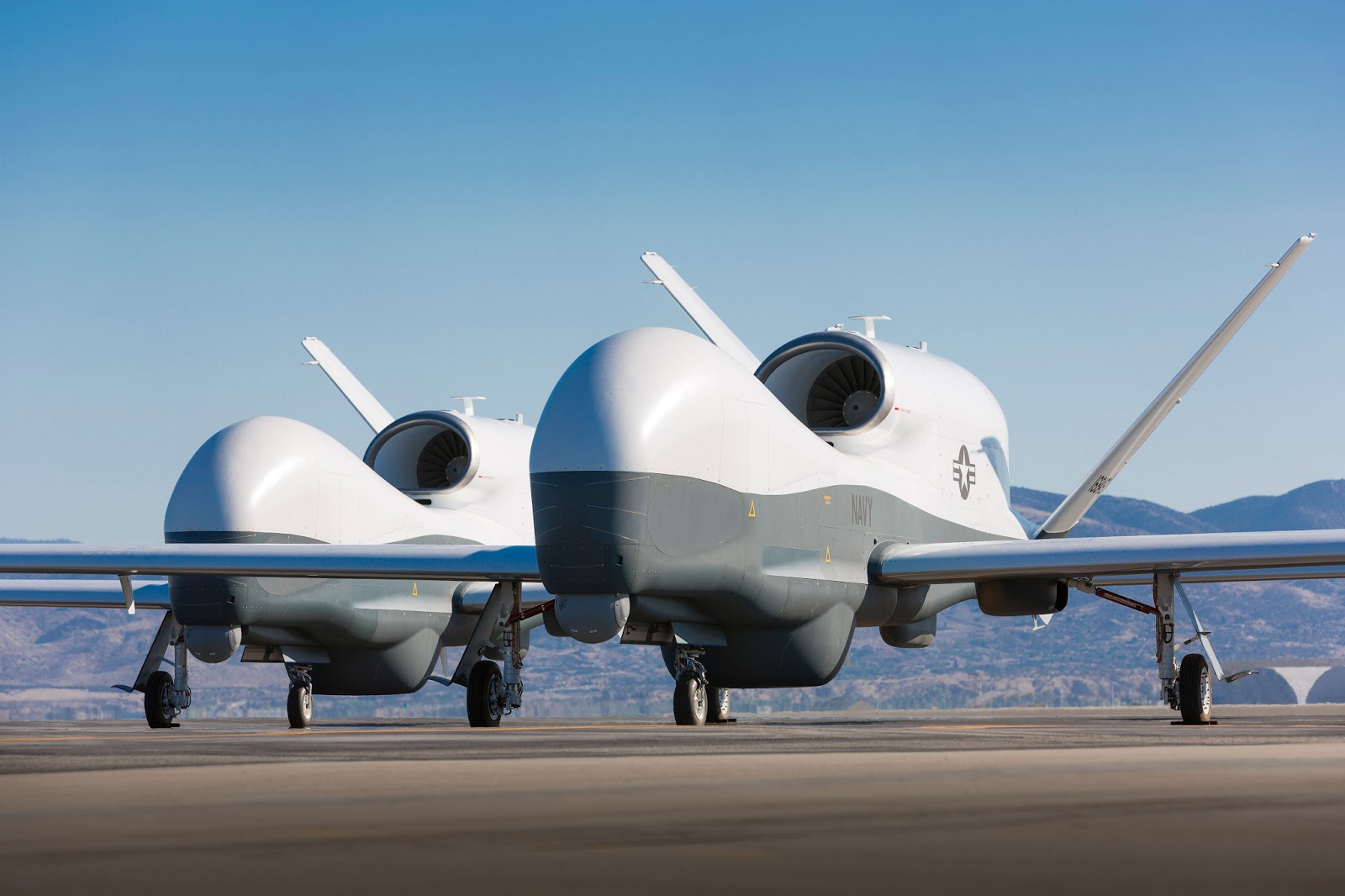
ALMDALE, Calif. (May 21, 2024) Two Northrop Grumman MQ-4C Triton unmanned aerial vehicles are seen on the tarmac at a Northrop Grumman test facility in Palmdale, Calif. Triton is undergoing flight testing as an unmanned maritime surveillance vehicle. (U.S. Navy photo courtesy of Northrop Grumman by Chad Slattery/Released)

From Danger Room.
The MQ-4C Triton took off today for the first time from a Palmdale, California airfield, a major step in the Navy’s Broad Area Maritime Surveillance program. Northrop Grumman, which manufactured the 130.9-foot-wingspan drone, said the maiden voyage lasted an hour and a half. The Navy even announced it via Twitter.

“First flight represents a critical step in maturing Triton’s systems before operationally supporting the Navy’s maritime surveillance mission around the world,” Capt. James Hoke, Triton’s program manager, said in a statement.

If the Triton looks familiar, it should. It’s a souped-up version of the Air Force’s old reliable spy drone, Northrop Grumman’s Global Hawk. The Navy’s made some modifications to the airframe and the sensors it carries to ensure it can spy on vast swaths of ocean, from great height. (It’s unarmed, if you were wondering.)

The idea is for the Triton to achieve altitudes of nearly 53,000 feet — that’s 10 miles up — where it will scan 2,000 nautical miles at a single robotic blink. (Notice that wingspan is bigger than a 737's.) Its sensors, Northrop boasts, will “detect and automatically classify” ships, giving captains a much broader view of what’s on the water than radar, sonar and manned aircraft provide. Not only that, Triton is a flying communications relay station, bouncing “airborne communications and information sharing capabilities” between ships. And it can fly about 11,500 miles without refueling.

Read the rest at Danger Room.
The Navy has taken a very patient approach to large unmanned systems, too slow for some. With the MQ-4C Triton the Navy decided to go with a mature hardware design and take on the risk with the software. Despite the June 2012 crash in Maryland of a Global Hawk used for developing the Triton, I think everyone can agree the Navy has done a great job with the BAMS program.

Some will cite how the US Air Force has stepped back from the Global Hawk in favor of the U-2. That makes sense when the vast majority of US Air Force Global Hawk missions were being flown in dedicated missions to monitor specific targets, something the U-2 has been doing effectively for decades - and is still capable of doing at less cost. But over vast oceans, that 11,500 mile range at ten miles up role is much better suited for an unmanned aircraft because the platform's role is constant surveillance of a broad area, not dedicated surveillance of a specific area.

Thus the name: Broad Area Maritime Surveillance (BAMS).

Between X-47B carrier launch and MQ-4C Triton, the US Navy has achieved major successes with two of the most important new Navy programs being worked on today in a span of just over a week. Northrop Grumman is having a good month.

When you count the first vertical takeoff of the F-35B earlier this week, the Department of the Navy is having a good month too.

Monday, March 18, 2024

Navy Stuck Between the Rock and Hard Place on Joint Strike Fighter

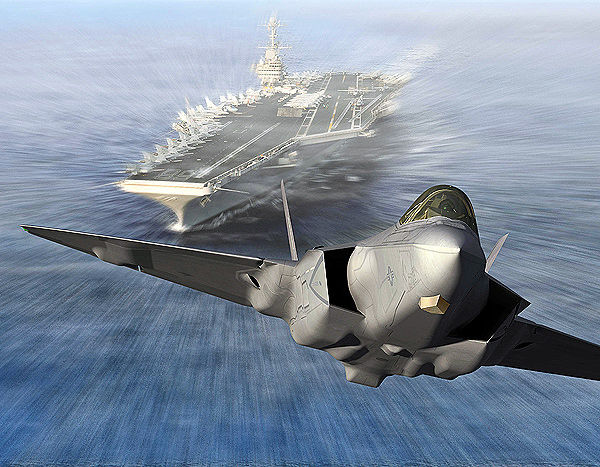
F-35C Art
National Defense Magazine blog has what appears to me to be the most insightful tidbits of information to date on the Navy perspective of the F-35C. At the March 12 Credit Suisse/McAleese defense programs conference in Washington, D.C. Air Force LT. General Christopher C. Bogdan, program executive officer of the Joint Strike Fighter, and Admiral Jonathan Greenert, Chief of Naval Operations, both made comments that in my opinion, gives the current view of the F-35C program from DoD perspective. The implications of these comments are worth consideration.
Throughout his presentation, Bogdan repeatedly hammered the point that the F-35’s eight international partners — the United Kingdom, Canada, Australia, Italy, Turkey, Norway, Denmark and the Netherlands — are losing patience and becoming increasingly alarmed by the trends in the program.

“The cost is up by tens of billions,” Bogdan said. “Our partners are starting to put really big dollars into this program.” By the time F-35 reaches lot 8 low-rate production, more than half of the aircraft will be for non-U.S. customers. “They need to know where their money is going,” he said.

Adding insult to injury, the JSF program office classified all documents as “U.S. only,” which upset partner nations. Even if they are all buying the same aircraft, each country has its own air-worthiness qualification processes and other administrative procedures that require they have access to the aircraft’s technical data. JSF officials are working to re-classify the documentation, Bogdan said. “These airplanes are important to them [our partners], politically.”

Pressure to keep allies happy might be one reason why the U.S. Navy will not be allowed to dump the F-35C. It has been known for years that some Navy leaders would prefer to continue to buy the F/A-18 Super Hornet, and not have to bother with the expense and trouble of having to bring a new type of aircraft into the inventory.

Chief of Naval Operations Adm. Jonathan Greenert insisted that the Navy is fully on board.

“We need the F-35C,” he said at the Credit Suisse conference. “It has to be integrated into the air wing.” He said the Navy has not yet decided how many it will buy, however. And he recognized that the Navy ultimately has no choice but to buy the F-35C. “If we bought no C's, it would be very detrimental to the overall program” and to international partners, he said.
As most of you know, the F-35A is the Air Force version of the Joint Strike Fighter (JSF), the F-35B is the Marine Corps version of the Joint Strike Fighter, and the F-35C is the Navy carrier launched version of the Joint Strike Fighter. Lockheed Martin is the prime contractor, and in order for all three versions of the Joint Strike Fighter to reduce costs per unit, the schedule for all three must improve. Scheduling delays and design flaws have turned the JSF program into the biggest runaway train wreck in modern DoD acquisition, if not of all time. The only version of the F-35 that everyone appears to agree is truly needed is F-35B, the vertical takeoff and landing version. The F-35A is the single most important of the three versions because current plans call for building thousands of these aircraft, and alliance interest is primarily for this version of the aircraft. The US Navy is the only purchasing client in the world for the F-35C, and my sense for the last year is that the US Navy would bail out of the program if they could.

In public statements, it has become very common to hear Admirals say the Navy 'needs the F-35C,' but it has become uncommon to hear any Admiral praise the aircraft. Why the Navy needs the F-35C is never addressed in context, primarily because the well documented problems of the F-35C make it clear that the Navy needs are not yet met by the F-35C at this time, and it is unclear if some of those problems can ever be truly fixed. Anyone who has read the latest annual report released by the Pentagon’s director of test and evaluation, J. Michael Gilmore, - not to mention the latest GAO report on the Joint Strike Fighter, knows that the Joint Strike Fighter program still has very serious problems. The GAO report in particular is the kindest report to date for the Joint Strike Fighter program, but after reading that report my primary takeaway is that the Joint Strike Fighter is at least as technologically and electronically complicated as even our most sophisticated Unmanned Aviation platform concepts. Quite honestly I find it hard to believe that any aircraft with so many technological moving parts will ever be reliable on any modern battlefield. The Joint Strike Fighter is a logistical nightmare, and is literally a helmet malfunction away from being a mission kill during wartime - with hundreds of proverbial helmets built into the aircraft.

LT. General Christopher C. Bogdan is emphasizing the multinational partnership of the program for a good reason, and the reason is specific to bringing down the cost of the F-35A. Stable funding across all 3 models of the Joint Strike Fighter is required if the F-35A price is going to have any chance to drop to $90M per aircraft. That means the Navy must stay completely invested in the R&D of F-35C, and must - at least initially - buy F-35C aircraft at the scheduled rate to maintain stability in the production schedule. When  Adm. Jonathan Greenert mentions the Navy still hasn't determined how many F-35Cs the Navy will purchase, the implication is the CNO is looking for the bare minimum threshold the Navy must spend to stay invested in the program.

What is important about the comments of both LT. General Christopher C. Bogdan and Admiral Jonathan Greenert is that when it comes to the F-35C, the F-35C is now being purchased by the Navy primarily for reasons of National Security Policy and not for any reason related to maritime policy or strategy. The Navy is now required to continue to pay for the F-35C for purposes of cost consideration of the entire program - all variants, and that consideration is primarily being driven by the multinational character of the program. It is now fair to say that Navy budget spending for the Joint Strike Fighter is now more important to the Department of the Air Force and the Department of State than it is for the Department of the Navy, because it is more important for the National Security Policy of the United States for the F-35A to be affordable to multinational partners than it is for the F-35C to fly off US Navy aircraft carriers.

While it is extremely frustrating that the Navy is essentially being forced to spend huge sums of money on an aircraft the Navy no longer appears to want, it is also valid that the Navy be forced to continue investment in the Joint Strike Fighter for National Security Policy purposes - even when that purpose is primarily for insuring the cost of the platform is affordable to allies. It is completely legitimate that the Navy buying the F-35C is the right thing for the National Security interests of the country even while buying the F-35C itself is not good for advancing naval aviation. This is not a zero sum game.

It would be a mistake to interpret validity and legitimacy as good or bad, because the context matters. National Security Policy trumps maritime strategy, even if I would like to see maritime strategy have more influence in the crafting of National Security Policy. In my opinion if (and this is a BIG "if") the cost of the F-35A comes down to $90 million per aircraft because the Navy spends money on the F-35C, and if international partners ultimately buy a bunch of F-35As at that price, then the Navy's investment in F-35C is simultaneously a poor investment for the Navy and a good investment for the country. What makes all of this really frustrating though is that a poor investment for the Navy and a good investment for the country is the best case outcome of the Joint Strike Fighter as things are today, and it should be noted there is no evidence to date that this represents the most likely outcome. At this point, all it takes is one country to bail out and the whole plan falls apart.

Tuesday, August 7, 2024

Used Cars and F-35s

The following guest contribution is from Jonathan Jeckell.

Knowing and using your Best Alternative to Negotiated Agreement (BATNA) to your best advantage is a fundamental skill in negotiations.  Your BATNA determines the point where it is in your best interests to walk away when your interlocutor pushes for more concessions from you, while up to that point you still have room to accommodate an agreement.  If your interlocutor knows your BATNA, they have the substantial advantage of knowing how far they can push you before you walk away…if you can walk away.

Consider the US Air Force’s position with the F-35A. The F-15 Silent Eagle program continues to quietly reach new milestones and spawned from one of the most successful aircraft in US Air Force history.  The F-15 Silent Eagle seems to provide highly advanced and competitive features at a reasonable price.  It might seem that the F-15 Silent Eagle would be just the leverage they are looking for to provide a credible alternative to the F-35 and the limited quantity of F-22s.  Theoretically, the US Air Force could threaten to abandon the project and go with a safer, more evolutionary pathway, like the US Navy did with their F/A-18E/F “upgrades” rather than suffer a risky transition to a whole new platform with commensurate new technological S-curves.  Technological S-curves require higher degrees of engineering effort and money to improve performance at the beginning, when the technology is immature and experimental, and at the end, where mature technologies begin to reach fundamental limits, than the middle where advances come relatively quickly.  Such radical jumps to new S-curves often promise major shifts in performance, but also require enormous engineering effort and entail substantial technological risk.  Meanwhile, others may continue to squeeze performance from the older platform.  Clayton Christensen contrasted IBM’s aggressive moves to new disk drive technologies and Hewlett-Packard’s heroic engineering efforts with supposedly obsolete technology to get almost the same performance and cost. (pages 10-14, “Innovator’s Dilemma”, and “Exploring the Limits of the Technology S-Curve,” Production and Operations Management, Fall 1992)

Consider also the comparable performance of the US Marine Corps UH-1Y Venom and AH-1Z Viper, based on platforms long abandoned by the US Army for the UH-60 Black Hawk and AH-64 Apache respectively. Different types of technology improve at different rates and a system may be capable of accommodating the most rapidly changing parts through modular upgrades and remain competitive (Kopp, Technology Strategy, Joint Forces Quarterly).  Likewise, while the US Air Force pursued the F-22, a completely new platform, the US Navy convinced Congress to spend money on “upgrades” to the Hornet fleet to produce the F/A-18E & F fighters. They also positioned the EA-18G electronic warfare aircraft to compensate for lack of stealth airframes in the rest of the air fleet.  Radical jumps are risky when the operating environment they were designed for changes, which is particularly important with long development times.  Their key technologies could lead to a dead end, or enemies they were designed to fight adapt to make their capability moot. 

So could the US Air Force credibly use the F-15 Silent Eagle, either as a negotiating tactic, or as a gap-filling purchase to lower risk while waiting for the F-35A?  No.  The US Air Force is caught in conflicts with two negotiating partners, not just one.  The US Air Force is counting on the capabilities promised by the F-35A, to them, the F-15 Silent Eagle would be a disappointing replacement if Congress took their threat seriously.  Moreover, allied buyers and the US Air Force have had their purchases cut as costs soar and budgets plummet. All the F-35 buyers are locked into a high-stakes game of Prisoner’s Dilemma.  Each cut in the number of aircraft purchased increases the cost per aircraft each remaining F-35 buyer must pay to amortize fixed costs, such as research and development. Any defector for another platform or reduction in purchases could trigger a stampede.  The US Air Force, as the single biggest buyer, could trigger such a stampede merely by acknowledging the possibility alternatives.  Unlike the US Air Force, many value minded F-35 buyers find other aircraft, such as the Eurofighter Typhoon, Rafael, used F-16s, Su-30, or the Saab JAS 39 Gripen, just to name a few, quite competitive alternatives.  Early defectors would beat the crowd to get these alternatives early, while laggards either get stuck footing the bill, or get put on the waiting list.

Meanwhile, the US Marine Corps is just as desperate.  F-35B performance setbacks, costs and delays threaten the Marine Corps Marine Air-Ground Task Force (MAGTF) triad of maneuver, artillery and aerial support by devouring a disproportionate share of the budget.  Yet the Marine Corps has enormous sunk investments in the doctrine and infrastructure supporting Short Takeoff and Vertical Landing (STOVL), and has no viable STOVL alternatives to turn to as age forces AV-8B Harrier airframes into retirement.  This begs the question…how much of the Marine Corps, and what proportion of their budget are they willing to sacrifice to acquire this aircraft?  What kind of radical alternatives could the Marine Corps get for that kind of money?  Rotary wing platforms, like attack helicopters lack the payload capacity, speed, altitude and survivability to completely replace a manned CAS platform for the Marines.  Losing the F-35B would mean that Marines would be tied to land bases or US Navy carriers capable of supporting the F/A-18 or other high performance jets.  All this, while the F-35B itself isn’t particularly good at what a Marine Corps aircraft fundamentally exists to doprovide close air support to Marines on the ground.  The F-35B has a tiny payload capacity, both in terms of weapons in the bay or on the wings, and the magazine capacity for the gun.  Deck plates on ships and tarmacs on land bases had to be modified to keep the engine from melting them or starting them on fire from the engine exhaust.  What will F-35B exhaust do to AM2 matting in a forward aerial rearming and refueling point (FARP)?  Will the F-35B’s high strung engine be able to survive ingesting all the dust and debris kicked up landing at such a forward site?  Even aircraft designed to facilitate operations on dusty, unpaved airfields, such as the C-17 and the V-22 Osprey cause additional damage to their purposely robust engines when they do this.  If it cannot, the very purpose of the F-35B’s STOVL capabilities are moot.  Could the US Marine Corps use an aircraft like the Super Tucano or modified T-6 Texan II’s, or even a purpose-built remotely piloted aircraft (aka drones) with support from existing Marine Corps aircraft to fulfill the other tasks proposed for the F-35B?  These aircraft have ideal characteristics for CAS and could still launch from Marine Corps assault ships and have proven ability to land on rough forward airstrips.  This would have the side benefit of maintaining commonality among US Navy and Marine Corps high performance aircraft aboard their carriers for training and limited space for repair parts.

But if the US Marine Corps gives up on the F-35B, the Royal Navy is royally screwed.  If design changes in the Queen Elizabeth II carrier class have been finalized, closing the door on CATOBAR and committing them to STOVL, they have even fewer viable alternatives than the US Marine Corps.  The Royal Navy has no other high performance, multirole or support aircraft to fall back upon and don’t have the luxury of a sister service providing deck space for Catapult Assisted Take Off Barrier Arrested Recovery (CATOBAR) aircraft to make up for lost high end capabilities on their ships.  Either the Royal Navy would be forced to undergo an outrageously expensive development program of a new aircraft by itself, or go back and convert the QE IIs back to handle CATOBAR aircraft and chose from the small palette of options in this class.

The US Navy alone has the leverage to sit on the sidelines and watch the show with the satisfaction of being able to walk away.  The Chief of Naval Operations clearly signaled as much in an article recently at Proceedings.  His post downplayed the importance of stealth and the advantages brought by this technology over a range of other options available to the US Navy, including the electronic warfare capabilities of the EA-18G Growler in support of various aircraft as “trucks” for payloads. The Super Hornet is also a large aircraft with lots of internal capacity for modular upgrades and modifications to facilitate rapid adaption against emerging threats, balancing the best qualities of standardization and variety. But is a modular, adaptable aircraft good enough to compete with integrated high-end fighters like the F-22?  I don’t know. But the US Navy has the breathing room to make that decision deliberately and calmly.  The US Navy alone has avoided painting itself into a corner and now has the intellectual bandwidth free to focus on new ways to use its payloads and platforms in new ways by focusing on the interaction among its systems and doctrine, rather than fixating on making a particular technology work. 

Thanks to @Jscottshipman, @CJSchaefer, @Jeffemanuel and especially @NC_Prime for their thoughts on this topic on Twitter on 2 August 2012.

Jonathan Jeckell is a US Army officer specializing in logistics, planning, and technology. His opinions are his own and do not necessarily represent the views of DoD or its components. Jonathan Jeckell can be reached on Twitter at @jon_jeckell.

Wednesday, July 11, 2024

CNO Hints Towards the (New?) Future of Carrier Launched Naval Aviation


Contrary to a recent suggestion regarding the decline of influence by the US Naval Institute and the organizations flagship product Proceedings magainze, Chief of Naval Operations Jonathan Greenert has penned an article in Proceedings magazine this month that is already getting a lot of attention. Payloads over Platforms: Charting a New Course is a really important article, indeed there are several aspects of the article that jumped off the page the first, second, and every other time I've read the article.

In general I have been less than impressed with the analysis of the Proceedings article to date, indeed I think most people who have publicly commented either missed the point, or failed to connect the dots. The whole article is important, not just the pieces that made headlines, and I believe it really informs us on modern ideas being circulated inside the Navy - many of which are very smart.

Please, if you have not done so, go read the entire article before reading any further. Once you have read the article, come back and read what I'm saying, then go back and read the article to see if I have this right. I'm not certain I am reading it correctly, but I think I am.

Ready? OK...

First, I have to address something. This kind of industry shrilling by think tank people who I thought were credible analysts needs to stop. The suggestion through fear by Mackenzie Eaglen that the end of manned military aviation will occur if any aspect of the Joint Strike Fighter program is changed by the Navy is either the definition of jumping the shark, or perhaps more appropriately the act of 'credibility hara-kiri.' If the defense analyst community continues to promote political fear in lockstep support of industry and policy failures instead of legitimate ideas for the DoD to deal with programs and policies that have gotten way out of control (too big to fail, a meme that applies to both the JSF and Afghanistan), then the defense analyst community is damaging their credentials beyond the ability of those folks to ever effectively lead the defense establishment in the future, and a new source of expertise needs to be sought after.

The fine line between think tank analyst and defense industry lobbyist is being blurred today by a lot of folks who were once thought of as highly credible, and I absolutely include folks at CNAS in the same category as Heritage Foundation and AEI. There is a lot of self-licking Ice Cream cone BS coming out of DC today, and that article in AOL Defense pissed me off with it's new extreme in hyperbole.

Second, Phil Ewing got it right, TWICE, but failed to connect the dots. Did the CNO just take a big swipe at the F-35? You bet the CNO did. The CNO absolutely made clear that the cost of stealth and exactly what the capability advantage of stealth is has forced the Navy to evaluate with clear eyes how to use stealth in naval aviation in the future, but the stealth issue is bigger than just the F-35C - it also must be applied to unmanned carrier aviation as well.

The CNO starts out by stating clearly that the Navy needs "to move from ‘luxury-car’ platforms—with their built-in capabilities—toward dependable ‘trucks’ that can handle a changing payload selection." Because the use of the word "truck" has historically only been applied to ships in the context of modularity or swapping out equipment on ships, it is assumed he is speaking only about ships when he mentions trucks. That would be a bad assumption, because I think he is talking about naval aviation as well.

If you recall, Bob Work sent out a memo on July 7, 2024 to Navy acquisition chief Sean Stackley, Vice Chief Of Naval Operations Adm. Jonathan Greenert and assistant Marine Commandant Gen. Joseph Dunford to form a team to develop three alternative tactical aviation force structures, respectively representing cost savings of $5 billion, $7.5 billion and $10 billion across the future years defense plan. Ultimately, Work expects to determine “the best-value alternative, factoring in both cost and capability. The purpose of the study was to determine whether the Navy and Marines could operate fewer than the 40 squadrons of JSFs currently planned and to look at the possibility of accelerating development of unmanned alternative systems."

Everybody knows the costs of the Joint Strike Fighter has grown too high for the Navy to afford the future carrier air wing, indeed there is no future for unmanned carrier aviation unless the Navy reorganizes current plans of the Joint Strike Fighter, the F/A-18E/F Super Hornet, and existing Unmanned Carrier Launched Systems programs in an effort to find more money. That memo last year was the study of plans to determine what the options are. We have never seen the results of that memo, although my impression is the CNO just hinted what they might be.

What I believe the CNO is basically saying is that the F-18E/F works effectively as a manned truck, if new weapons are brought online to support the aircraft's ability to strike at long range - which is the cover story that Captain Hernandez ran out to Phil Ewing after his original post. Like I said, Phil Ewing got it right, twice!

What the CNO is also saying is that the stealthy UCAS-D is too expensive, and that unmanned carrier launched aviation doesn't need to be stealthy, rather it needs to be capable of endurance/range and high payloads. This has been coming awhile, because one of the worst kept secrets is how many problems there are with UCAS-D. UCAS-D weighs way too much, costs too much, has less than desired endurance, and has a limited payload capacity in favor of its stealth profile. My bet is the Navy isn't going down that road long term, although the Navy will use UCAS-D as a technology demonstrator.

But the CNO emphasized stealth was important? You bet he did, and how he discusses the importance of stealth in that Proceedings article reminded me of a concept I heard discussed with regards to the future of unmanned naval aviation at a recent USNI conference where the Joint Strike Fighter will still play an important role in future naval aviation that includes unmanned systems.

Basically, the Navy would field carrier launched aviation platform "trucks" that carried a variety of long range missiles forward, and escorting these large flying trucks - trucks which would include F-18E/F manned fighters and unmanned carrier launched medium payload delivery vehicles - would be stealthy F-35Cs that basically functioned as forward observers that helped targeting for the payload trucks that could operate at stand off distances. By taking that approach, fewer F-35Cs would be needed, because the internal strike payload of the F-35C is no longer as important relative to the payload capacity of the overall strike package - which would be offloaded to manned F-18E/Fs and medium capacity carrier launched UAVs.

So that is basically where I think this is going. The Navy is going to address the very real concerns about the future carrier air wing in FY14, and they will restructure the various programs. The F-35C program will likely be restructured in the same way it was last time, by reducing the number of squadrons fielded per carrier. Last time the F-35C was reduced to 2 squadrons per carrier, this time it will likely be reduced to 1 squadron per carrier. With F-35C IOC currently scheduled for FY14, but expected to be delayed, the purchase of fewer F-35Cs and the delayed IOC will mean more F-18E/Fs will need to be purchased. This comes just in time too, because the production line for F-18E/F only goes through FY14, so more F-18E/Fs will keep that production line open longer.

The rest of the savings, which will be either $5 billion, $7.5 billion and $10 billion across the FYDP will decide the details of the F-35C and F-18E/F program changes, and also determine to what degree unmanned carrier aviation will play in the future Carrier Air Wing by 2020 and beyond. I believe it is a very good bet that unmanned carrier launched aviation will find funding, that the F-35C purchase will be reduced, and that the F-18E/F production line will stay open beyond FY14 - but the details of what unmanned carrier launched aviation will look like by 2020 is still very much unclear.

It is also important to recognize that under the CNO's emerging vision of payloads instead of platforms, platforms like the F-35C still have a primary role, but that role is changing. In part, the F-35C is still a very necessary stealth capability that will perform the always important intercept function - although the payloads for intercept will be carried at stand-off range. F-35C will also function in the forward observer role - again in support of weapons held at safer, stand-off distances. These roles for the F-35C would be vital to the tactical and operational level execution of air superiority and combat air support by carrier aviation well into future decades, which means that while the total number of F-35Cs might be fewer in the future Carrier Air Wing, it's existence in the future Carrier Air Wing becomes even more vital than it is today - particularly if the unmanned "truck" options materialize as legitimate. In many ways, I could see these changes seen as a mixed result for Lockheed Martin, on one side the F-35C is purchased in lower quantity but on the other side the platform becomes the most critical piece of the puzzle, something the platform is not under current plans.

In the end, all I believe can be said with any certainty is that based on the CNO's Proceedings article and the fiscal reality of naval aviation heading into the next two very, very tight budget years, the UCAS-D is the least likely full production approach for the future of unmanned carrier aviation.

Tuesday, April 17, 2024

This is Obscene

I find this incredible. It leaves me speechless. Hat tip to Paul Vebber. From page 12 of this report (PDF).
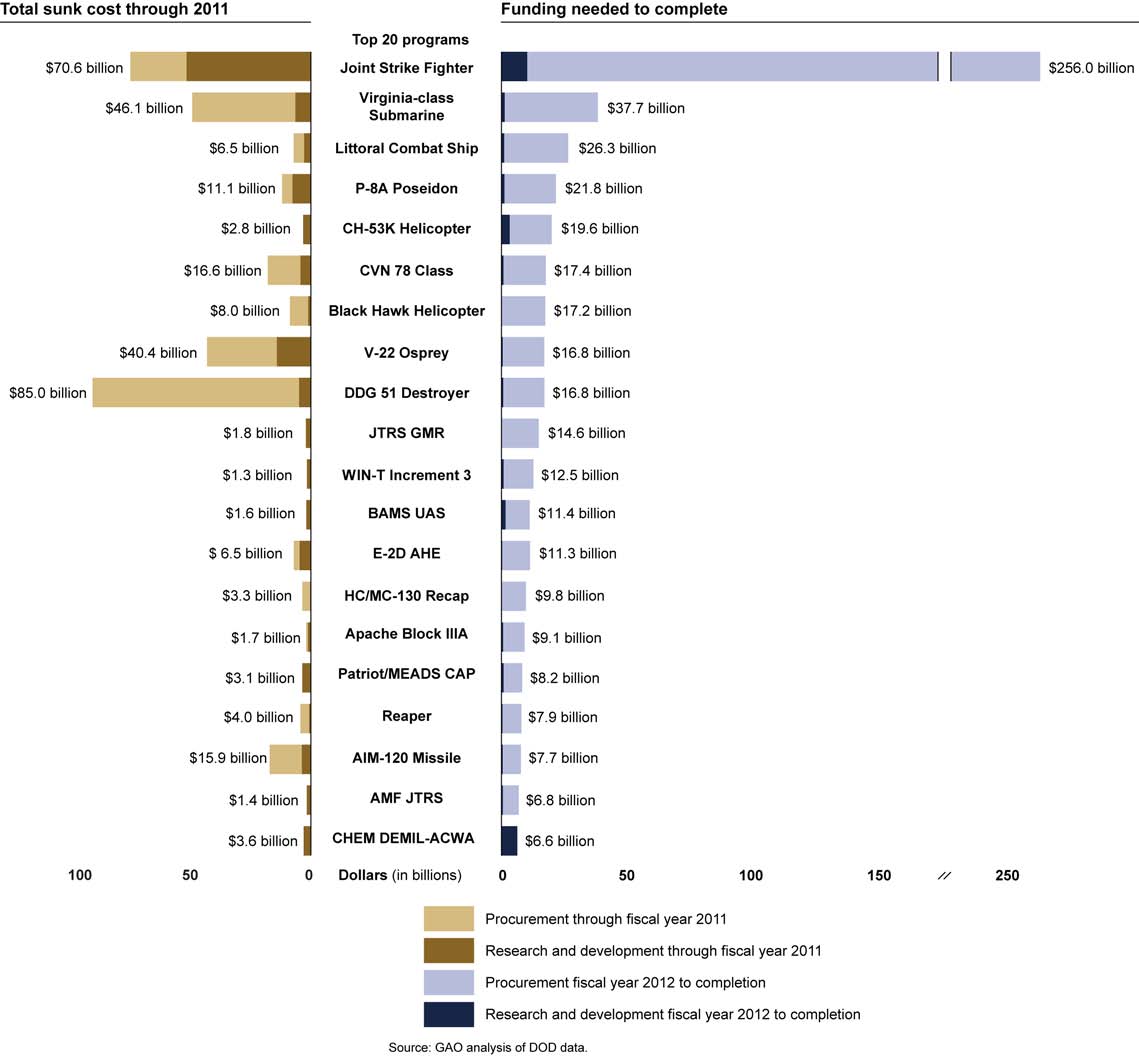
The Joint Strike Fighter is driving much of DOD’s poor portfolio performance and it will continue to drive outcomes for the foreseeable future. Among the 96 programs in DOD’s 2011 portfolio, the Joint Strike Fighter is the costliest, the poorest performer in terms of cost growth, and the program with the largest remaining funding needs. The Joint Strike Fighter accounts for 21 percent, or nearly $327 billion, of the planned total acquisition cost of the portfolio. It is also responsible for the most significant research and development, procurement, and total acquisition cost growth in the past year, as shown in figure 1. This growth took place without any change in procurement quantities by the program.

Most of the remaining funding for the 2011 portfolio is for procurement. Over 91 percent of the almost $705 billion needed to complete the programs in the 2011 portfolio consists of procurement funding; therefore, any future funding cuts to these programs will likely result in quantity reductions. The Joint Strike Fighter program alone is expected to account for 38 percent—or almost $246 billion—of the future procurement funding needed. This amount is enough to fund the remaining procurement costs of the next 15 largest programs.
The graphic is on page 14 of the same report (click for larger). You are reading that correctly, the Joint Strike Fighter is 38% of all DoD procurement for all current defense programs.

Joint Strike Fighter is not too big to fail, it's way too big to ever possibly succeed.

Tuesday, January 17, 2024

Boondoggle

This article from blog friend Eric Palmer on F-16.net last week has been picking up some traction, with a story picked up in The Telegraph yesterday, and even on the CNN blog. Apparently Lockheed Martin forgot to design the tailhook on the F-35C correctly, and the aircraft cannot land on aircraft carriers. From Eric Palmer's original article:
a November 2011 U.S. Department of Defense (DOD) quick-look report relating to engineering challenges arising from what is being called “concurrency issues” revealed that all eight run-in/rolling tests undertaken at NAS Lakehurst in August 2011 to see if the F-35C CV JSF could catch a wire with the tail hook have failed.

The report also mentions that the tail hook on the F-35C CV JSF is attached improperly to the aircraft. The distance from the hook to the main landing gear is so short that it is unlikely the aircraft will catch the landing wires on a ship's deck. This graphic from the review explains part of the problem. It illustrates the distance between the main landing gear and the tail hook of previous warplanes qualified to operate from aircraft carriers and compares these distances with that found on the F-35C CV JSF. In this regard, the report refers to the F-35C CV JSF as “an outlier”.

An industry expert who is a graduate Flight Test Engineer (FTE) of the U.S. Naval Test Pilot School (USNTPS), Peter Goon, stated that, "Given the limited amount of suitable structure at the back end of the JSF variants, due primarily to the commonality that was being sought between the three variant designs and the fact that the STOVL F-35B JSF is the baseline design, there was always going to be high risk associated with meeting the carrier suitability requirements."
The F-35C program no longer makes any sense at all to me. The extra cost of the F-35C over the F-18 Superbug all drive towards capabilities in the strike role; specifically stealth and range. Considering the strike role for naval aircraft is in decline over other alternatives (like submarine and surface launched cruise missiles), I can no longer support the Navy down the F-35C road. I still believe the F-35B is important, but I have no idea if the Marine Corps can afford it.

There are many reasons why the US Navy needs credible fixed-wing manned aircraft, but the strike role appears to be the primary reason for fixed-wing aircraft the naval aviation community is focused on, when in fact fleet defense, early warning, electronic warfare, and battlespace information dominance (among many others) is where fixed wing naval aviation is required. Is the JSF a good interceptor? Maybe, and maybe that is the reason to buy a few, but certainly F-35C is not an optimal intercept fighter and I have serious questions if the F-35C cost difference represents a meaningful value advantage in capability for intercept relative to the Superbug.

I have read a lot of procrastination following SNA regarding the challenges facing the Navy and some have even severely elevated the importance of certain shipbuilding programs like LCS to the level that it's success or failure will somehow make or break the the surface force. That sounds like some ignorant hot air and nonsense to me, because the future of the surface force depends on the high end capabilities, not LCS. The LCS program is no longer discussed publicly with any attempt towards objectivity in perspective - by the Navy, by LCS supporters, or by the LCS critics.

So here is some perspective for why I think the LCS criticism is a complete distraction from serious challenges facing the Navy today. The program of record that is killing the US Navy budget and - in my opinion, causing severe damage to the future of US naval aviation - is the Joint Strike Fighter program. For even bigger context, keep in mind the cost growth of just the first Ford class aircraft carrier is already greater than the cost growth of the entire Littoral Combat Ship program to date. Some have suggested LCS is too big to fail. What utter nonsense; in context of the Navy's budget, LCS really is too small to matter.

The JSF is the program apparently too big to fail, at least in the mind of some, and all evidence suggests failure is the rule rather than the exception. Lockheed Martin has made a mess of JSF, and there is no evidence things are getting better despite the actions taken to date regarding program management and leadership. I believe the Ford class still makes sense with or without JSF, and even if some roles of naval aviation are in decline relative to alternative methods for conducting those roles, but the naval aviation community does not appear to believe that. How the JSF has survived this long is a mystery to me, but in my opinion, it is past time for the naval aviation community to evolve past F-35C.

Tuesday, October 25, 2024

F-35B Costs

This is not perfect analysis by Bill Sweetman, but when your talking about a money target the size of the Joint Strike Fighter program, it doesn't need to be a bulls-eye to hit the target.

What Bill has done is break down an estimate for how much STOVL capability has cost the Joint Strike Fighter program. After long hand analysis, he is able to produce an estimate:
Total Pentagon investment for 340 F-35Bs, according to the program of record: about $92 billion, or $270 million per unit.
It's probably closer to $300 million per, because there are some commonality savings between F-35A and F-35C that cannot be calculated. The question I would ask is whether commonality with other variants of the JSF has cost the Marine Corps more than it could ever potentially save in the future? I think the safe answer is yes.

We really cannot afford to make these types of mistakes in weapons development in the future - the Joint Strike Fighter is the mother of all bad ideas by being Joint and International Acquisition. It is hard to believe any politician would allow that many hands into a cash filled cookie jar the size of JSF and think it is a good idea. Lack of wisdom and foresight is an understatement.

I will note one thing though. If the F-35B was a separate program today and not integrated with the rest of the Joint Strike Fighter program, during these times of budget cuts does anyone honestly believe a unique Marine Corps VSTOL stealth fighter aircraft would survive the accountants? As part of the JSF program, the F-35B will almost certainly will survive. As a unique program - even if it was less expensive, on cost, and on schedule - Congress would have probably canceled it today.

So while I think it is safe to say the Marine Corps paid more for STOVL by participating in the JSF program, I think it is also true to suggest the Marine Corps also paid the extra cost as a form of insurance from the politics of Washington.

No one has ever suggested watching the sausage get made in Washington DC was worth the price of admission.

Friday, August 26, 2024

Navy Reviews Options for JSF

Bill Sweetman at Aviation Week is reporting what might be the most consequential news yet regarding upcoming Navy budget cuts: Bob Work has ordered the Department of the Navy to go back and examine the Joint Strike Fighter program.
Work also directed service leaders to study whether the Navy and Marines could operate fewer than the 40 squadrons of JSFs currently planned (supported by 680 aircraft, divided equally between Bs and Cs) and to look at the possibility of accelerating development of unmanned alternative systems. Canceling both the F-35B and F-35C was not identified as an option.

The instructions were included in a July 7 memo from Work to Navy acquisition chief Sean Stackley, Vice Chief Of Naval Operations Adm. Jonathan Greenert and assistant Marine Commandant Gen. Joseph Dunford. Work told the leaders to form a team to develop three alternative tactical aviation force structures, respectively representing cost savings of $5 billion, $7.5 billion and $10 billion across the future years defense plan. Ultimately, Work expects to determine “the best-value alternative, factoring in both cost and capability.
The analysis was expected to be completed by July 28th. In other words, this review was conducted and completed before the Budget Control Act of 2011 was passed.

Thursday, July 14, 2024

Congressman Kissell Throws Three Strikes

The House Armed Services Subcommittee on Readiness hearing that focused on Navy Readiness on Tuesday is a gold mine of good information. Unfortunately, most of the real eyeopening information to those outside the bubble (like me) came from the Committee members, not the Navy. My impression was VADM Burke and VADM McCoy walked into a lions den of tough questions and came off looking unprepared, for example, the uncomfortable long pauses followed by very short answers to tough questions didn't project much confidence in the answers being given by the Navy. That is a body language analysis, but a fair one - I think. With that said, both Vice Admirals did remarkably well considering there is no question the questions being asked by Congress were really tough questions almost throughout.

What made this hearing better than most Congressional hearings is that Steve Palazzo of Mississippi was the only subcommittee member to ask parochial questions that really seemed out of place in the context of the hearing. Did you get your Northrop Grumman check for that series of questions Steve? If you didn't get paid, then keep in mind you sounded unprepared and out of place for free. Sorry dude... you have a long way to go if you want to fill Gene Taylor's shoes. Every one else in the hearing asked tough, probing questions to the topic on hand. People familiar with Congressional hearings will recognize just how rare it is for any House subcommittee hearing to be absent the parochial non-sense one usually finds in a Navy budget hearing.

The Navy is in a maintenance mess and everyone knows it. This was a tough hearing for the Navy, because nobody wants to go testify under oath about public, obvious problems that have difficult, long term solutions. For me, what is great about this hearing is that it provides plenty to write about - indeed I hope this will be the first of several posts because my time is limited and this hearing produced a cart load of low hanging fruit.

Lets kick it off with three important issues raised by Larry Kissell from North Carolina, who in my opinion really did some top quality work probing the Navy with these questions and getting the responding, revealing answers.
FORBES: Chair recognizes the gentleman from North Carolina, Mr. Kissell.

KISSELL: Thank you, Mr. Chairman. And thank you, gentlemen, for being with us today. Admiral Burke, you said a couple times, "a limited supply of forces." What were you referring and -- in the big picture there and what does that affect?

BURKE: What I'm referring to when I say we have a limited supply is we only have 285 ships. And I'm - as a submariner, I'm most familiar with the submarine model, where COCOM demand is for about 16 or 18 sub SSNs at any one time. We deliver about 10 SSNs at any one time. So why do we only deliver 10? Because that's all we can afford to deliver. So...

KISSELL: When you were talking about limited supply of forces, you were talking about specifically ships, not personnel, not aircraft, not missiles or equipment for the ships? You were talking specifically for ships?

BURKE: I'm talking about ships as a representative of the entire Navy. So the same sort of thing happens with aircraft. But the aircraft in the Navy are typically on ships. So they're part of that process. So, in other words, we frequently get asked to deliver more carrier presence with the carrier and the aircraft than we can deliver.

KISSELL: So for every ship that we're short, then you're saying there's just a multiplied shortness there of everything that you could want or imagine or need with that ship, and that's what kind of - I was just curious more about, when you say, limited supply of forces, just, you know - so that's kind of a - for every ship, then, what comes with that ship, we're missing?

BURKE: Yes.
VADM Burke is hitting home the impact of a small fleet in high demand, the impacts at both the operational end and how that cascades in the cycles towards training and maintenance. The Navy struggles with these challenges, and Navy leaders do a good job juggling priorities in meeting COCOM demands while also meeting engineering and training requirements. It's a tough situation that leaves only tough decisions where something gets missed due to circumstances.

Fewer ships under higher demands equals higher tempo, and the administration appears to be ignoring the impacts of that equation to the Navy while Congress is struggling to deal with those impacts.

The key detail provided by VADM Burke is, I think, an important topic, and I'll likely repeat this revealing detail in future posts - "COCOM demand is for about 16 or 18 sub SSNs at any one time. We deliver about 10 SSNs at any one time."

WOW! Will the Navy please communicate challenges like this more often! Unfortunately, that probably won't happen. When this tidbit was discussed among folks in social media yesterday after the hearing, several very bright military savvy folks started asking the questions the Navy doesn't have a public answer for, like:
  • "Why do COCOMs have such a high demand for submarines?"
  • "What do submarines actually do that makes them this important?"
  • "Could this be true? What do submarines do?"
As much as folks email me to answer these questions publicly, I won't - it's not my job to answer these questions; it is the Navy's job. All I will say is this... and encourage folks to think about it.

What would you do in the modern technological age with an invisible nuclear power source off a country where bad things are taking place? Here is another question... if you don't have a submarine to conduct operations, does that mean you have to fill that requirement gap with secret bases filled with spooks? Give it some thought.

The American people don't seem to understand that a smaller Navy offshore means more US presence on land inside other countries will be a required result to compensate for the lack of ships. The American people aren't alone in failing to see how this cause and effect activity takes place, because even think tank policy shops like the Center for American Progress are apparently unsophisticated enough in national security affairs analysis to figure out how lack of ships translates into other activities. Policy will be executed... one way or the other. That will never change without a massive overhaul of US foreign policy, and President Obama rejected the option to overhaul US foreign policy when his turn to make the choice came. It is a safe bet that future Presidents will maintain current policy as well. Frustrating..., but true.
KISSELL: OK. And Admiral McCoy, you mentioned a percentage of ships being deployed. And I know we had some charts here, and I probably - it's on there somewhere and I just missed it. But is there an optimum level that we operate against in saying this is the percentage that we would like to have deployed at any one time, in order to have the rest and retrofitting and everything else that we need going on at one time? Is there a percentage that we shoot for, or does it just kind of vary to tempo levels, or...

BURKE: Let me take that one.

KISSELL: OK.

BURKE: There are - first of all, there are about 12 percent of our forces forward deployed. In other words, it is home ported in Sasebo, Yokosuka, Japan or in Bahrain. So those forces are always forward, if you will. That number has essentially doubled over the last 10 years, effectively doubled, given the increase in forces forward and the decrease in overall forces. But 40 percent - so the 40 percent includes that. What we've done over the last several years is, by increasing those that are forward deployed, we have taken those that are rotationally deployed - those that deploy from Norfolk and Groton and San Diego and Hawaii go other places. We've taken that number and kept it the same, even though the force size is dropping. So where we are today is we're not at a sustainable level. Forty percent is not sustainable in the long term.

KISSELL: Is there a percentage that would be, you know, all things being equal, more sustainable?

BURKE: Well, in the submarine force, that number is about 22 percent.

KISSELL: OK.

BURKE: So 22 percent are forward at any one time.
This is a very interesting answer, and represents the kind of 'process model' answer the Navy isn't very accustomed to giving as an answer under oath. I'm curious if VADM Burke knowingly let slip this answer, because he may regret being bluntly honest (the Navy doesn't reward revealing their thought processes to Congress). Basically VADM Burke is admitting that as the Navy shrinks, more ships will have to be forward based in order to meet the deployment requirements. This is an even more curious issue because the Navy has already announced they intend to forward base several Littoral Combat Ships. The answer by VADM Burke raises a serious question just how far away the 284 ship Navy of today actually is from being able to meet the COCOM demand for naval forces?

The LCS program with it's dual crew model, modular engineering, and massive offshore maintenance infrastructure requirement is supposed to offer the Navy more deployment time than the ships the LCS replaces. So more deployment time + more forward based Littoral Combat Ships means the Navy is hoping to leverage the LCS as a way of meeting the COCOM demand that is currently being unmet with a 284 ship fleet. The real problem here though is that the argument VADM Burke is making makes it sound like even 313 or 324 ships wouldn't come close to being enough to meet the COCOM demands either, and that demand is being driven by US foreign policy.

I honestly don't know how Congress can read VADM Burke's answer and come to the conclusion that 313 or 324 ships is a legitimate number of ships to meet COCOM requirements when so many of the ships in that plan yet to be built (LCS) don't exist yet and are attempting to meet forward deployment requirements well above existing capacity for forward presence. From my perspective, COCOM demand seems to be suggesting the Navy has a quantity problem, while the Navy is busy focusing force structure on developing quality solutions which ultimately reduces the quantity of available ships to the COCOMs.

The way I read this answer, the Navy has a square peg (COCOM requirement), round hole (Navy Force Structure plans) problem that VADM Burke's comments contribute more skepticism towards.
KISSELL: And one other question, Admiral Burke, you talked about that, with aircraft, that there's a certain number of hours you get to fly them. And with the delayed delivering of the F-35 and the more hours that we're flying on the wings we have now, where are we heading to? Are we heading towards to the point we don't have the aircraft that we need? And how soon might we be there or the consequences - what do you foresee there?

BURKE: The delay and the arrival of the F-35 is a challenge for us. It will add hours on those other aircraft that we call legacy aircraft. It will add hours to them. And those hours are costly, particularly at the end of the aircraft's life.

KISSELL: And how many more hours do you think we have there? When are we going to reach the point where those lines start coming too close to each other?

BURKE: Well, we're addressing that now. We have a surface life assessment program and a service life extension program for our F-18s. And we're in the middle of actually assessing and extending some of those aircraft. So they're built as a 6,000-hour aircraft. And we're doing the engineering analysis. And we think we can get them to 8,000. And then there's additional analysis that's going on, to try to get longer life out of them. But there's only so far you can go.

The other thing we're trying to do in that regard is to add simulation time. So if we can simulate our hour as one cheap - if we can make if effective, we can reduce the hours on the actual airplane.

KISSELL: Mr. Chairman, I'd like to ask the admiral to give some more information on that and to kind of project where these lines may be going, because if we don't get the F-35 in and we can't get there, you know, how soon is that crisis point coming?

BURKE: I'd be happy to do that.

KISSELL: Thank you, Mr. Chairman.

FORBES: Thank you, Larry.
Everything about the Joint Strike Fighter stinks. Everything. It is time for Congress to start asking if a larger quantity of enhanced F-18E/Fs is a better value than the cost nightmare quality of the F-35C. I still support the F-35B - it is past time to replace the AV-8s, but someone explain to me how an aircraft carrier with 2 squadrons of F-35Cs and 2 squadrons of F-18E/Fs is better than an aircraft carrier with five 12-plane squadrons of F-18E/Fs supported by 2 squadrons of EA-18Gs. With 70 F-18 E/F/Gs, would the Navy save more money in procurement, maintenance, training, support, etc (every category) than they will by adding the F-35C into the mix? I think the numbers would be very close.

When quantity is less expensive than quality, something doesn't add up. If the X-47 can support the carrier based refueling role, then I no longer see the value of the F-35C on an aircraft carrier. JSF is the modern A-12, only no one will admit it. I still say the Navy would be better off modifying a version of the F-22 for naval operations to fill the intercept role than chasing the F-35C any longer - and even that radical idea could potentially be less expensive if the Navy is willing to accept 10-15% less capability in the navalized version of the F-22.

Regardless, the F-35C is a serious challenge and I just don't know how the platform fits the Navy anymore, particularly if it continues to get more and more expensive making the actual aircraft carrier expected to carry the JSF no longer affordable for the Navy.

Friday, May 20, 2024

Lockheed Martin Takes a Broadside in the Senate

When Dr. Ashton Carter testifies in front of the Senate that your program is unaffordable in this fiscal climate, the only hope left is to find enough politicians that will sell out. Something drastically changes, or the Joint Strike Fighter is done.
"Over the lifetime of this program, the decade or so, the per-aircraft cost of the 2,443 aircraft we want has doubled in real terms," said Ashton Carter, the under secretary of defense for acquisition, technology and logistics.

"That's our forecast for how much the aircraft's going to cost.

"Said differently, that's what it's going to cost if we keep doing what we're doing. And that's unacceptable. It's unaffordable at that rate."

The cost of the plane has jumped to $385 billion, about $103 million per plane in constant dollars or $113 million in fiscal year 2011 dollars, said Christine Fox, the Defense Department's director of cost assessment and program evaluation.

Republican Senator John McCain called the figure "truly troubling," considering the original price was $69 million per airplane.

"The facts regarding this program are truly troubling," said McCain. "No program should expect to be continued with that kind of track record, especially in our current fiscal climate," said McCain.

"It seems to me we have to start at least considering alternatives"
CNA almost had it right. The tipping point wasn't the point at which the Navy fleet was unaffordable, it was the point where naval aviation became unaffordable. Most folks don't realize that the Navy consistently spends more budget money on aviation than the Air Force does, but they in fact have for many, many years.

Here is the biggest problem facing the Air Force, Navy, and Marine Corps not to mention all the other nations invested in the Joint Strike Fighter program. The cost per aircraft is now so high that it doesn't justify the expenditure, meaning the combat capability of the less capable F-15, F-16, and F-18 alternatives exceeds the combat capability investment one gets with plowing ahead with the Joint Strike Fighter. Quite frankly, there simply isn't enough difference in the payload, range, speed, electronics, or stealth that separates the 5th generation JSF from it's 4th generation alternatives to move ahead.

The UCAS, on the other hand, has game changing range and endurance, not to mention lower manpower costs so even if it runs at a higher cost that estimated per platform, the capability opportunity in the investment is so much more than lesser alternatives that the cost justification is there.

The only thing left is for reality to set in among elected officials, not to mention entrenched interests in defense. The Joint Strike Fighter is the modern A-12, and only the F-35B VSTOL version (which is also the most expensive variant) is the capability that is unique and lacks a legitimate replacement. It is also the most likely version of the JSF to find international interest in continuing the program at very high cost even if the F-35A and F-35C is canceled.

Perhaps there is another way ahead, but right about now the Air Force would be wise to propose a F-22 high and F-15/F-16 low mix of fighters just to streamline maintenance to three specific platforms.