
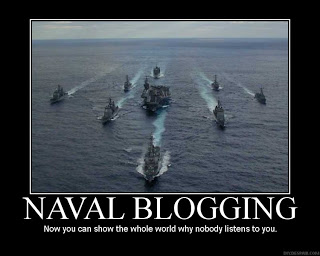
 Major Jakob Bruhl, who is running a blog called "Soldiers in the Blogosphere" is asking an interesting question, one I have been thinking a lot about since we began seeing more service centric blogs pop up. My observations are just "one bloggers take" regarding why the DoD "social media" experiment is slow to gain "social" traction outside its core community. This is Major Jakob Bruhl's question.
So, how could we best educate our Soldiers to be effective in helping to tell the Army's story - helping to get some more of the good news out there - while ensuring they're fully aware of the challenges (security and otherwise)...My observations may or may not answer Major Jakob Bruhl's question, but it may help him frame the debate regarding what the Army wants out of blogging. My comments are mostly directed at the Navy blogs I monitor daily. I fit every "official" Navy blog I have seen, yes including Destroyermen (Chris knows what I mean), into one of two categories:
I'm most interested in how best to educate/train our Soldiers to be effective communicators - people who can clearly articulate the story they have to tell, make it readable and interesting, and the best ways to get that story out to the most people possible. That's were we really should focus our education and training efforts - that's the part that we're not capitalizing on right now and, I believe, missing out on because of it!
- They are either diary's that give a chronicle of either a ships or personal adventure;
- They are a primarily a content information website.
These new government blogs we see popping up may be built with Web 2.0 or social media software, but it is my observation most government "blogs" are missing the "social" aspect of their intent. It drives to the core of the question between a blogger and a reporter, if you do the job of the PAO or the reporter, you are not a blogger. If your content is self focused, it is a journal, not a blog.
Bloggers offer opinions, give analysis, and frame context. Reporters are limited by their professionally mandated objectivity driven requirements from doing these things.
There is no question that the military services have a story to tell, and it can be effectively articulated from a first person perspective. Once the security and other issues are overcome, the message is often compelling and interesting, and Kaboom was the best first person diary the Army ever had in my opinion.
But what do the services want out of Social Media? Major Bruhl appears to desire bloggers "to tell the Army's story" and to "get some more of the good news out there." A PAO can do that, and in my experience observing PAOs, many are good at it... is that really what the Army believes a bloggers role is? If it is, ask the PAOs how they are trained and mission accomplished. I sense Major Bruhl wants more.
Seems to me the blogger role is about insuring the news that gets out from outside sources is accurate, in context, and gives the Army's perspective to insure it is fairly represented. News is simply the event, but it is told from an abstract position relative to the storyteller, usually a reporter unaware of the full context of the event. Events about the Army have more than one perspective, and in my view blogging should be about offering the Army's perspective as part of the story.
With this in mind I have prepared my 6 Commandments for Official Military Service Blogs. Read these in the "from a blogger for bloggers" context. Admiral, it isn't personal, your blog simply makes for a good scapegoat since you are one of the newbies.
1) Be Interesting.
Every Command, every unit has a brand. Leverage it wisely. It is why ships have a Coat of Arms, a slogan, a history behind the name, etc.. When writing, be the brand and sell it in the context of your style, it gives you context for framing discussions and an opportunity to leverage some humor or broader entertainment driven example. Can't think of something to write, expand on who you are. For example, the average citizen has no idea what Rat-Pac means, but if the target audience includes the average citizen, then assume less and explain more. Once explained, it is easier to refer back to that explanation than to explain again, a link back works well.
2) Be Insightful.
A blog is not where to put your press release, it is where you give your opinion. A blog is attractive when the viewer learns something. I don't visit any news blogs that don't come with some editorial content (like Danger Room - solid editorial with the news). Why repeat the work of the media, or the PAO? If there is a 'rest of the story,' tell it. If there is missing context, give it. If something reminds you of a personal experience... share it.
3) Be Social
If your blog doesn't engage what is happening elsewhere on the internet, if it is absent links to other places within the blogs content, then it is a journal, not a blog. A blog is a social medium that engages socially on the internet. Link to other websites, comment on other blogs, and participate in the social experience of the internet. If you see something on the internet of interest, link to it and discuss it. Take on bloggers directly by linking to them and being heard, that is the social experience of Web 2.0, and failure to do exactly that is to misunderstand what "social" means in "social media." You will learn as much from them as they learn from you. Bloggers track conversations that spawn from their blogs through Technorati and other similar sites. Bloggers know who has linked to them using their statistics tools, and will see your participation on the internet. That exchange leads to more discussions, which one would think is part of the objectives of service blogging. No one talks about the blog story that never gets linked, and there are ZERO popular blogs that link to nowhere.
4) Be Interactive
If you have comments turned on, engage the commentary. This is particularly important for the service blogs who are trying to engage the conversation regarding their content. Feedback matters, it is a great way a blogger can understand the blogs audience.
5) Set Expectations
Rules work when applied with consistency. When discussing professional content, have professional expectations from those who engage the discussion. The best blogs will at some point produce content that people disagree with, meaning expectations for conduct will foster better debate. Also set expectations in a blogs content. Example, there are 1359 posts on this blog, 15 are political with half of those about my own Senators and Representatives. The 1% of political content is an example of me setting expectations regarding political content on this blog. The 99% of other content establishes the expectations of what content to expect here.
6) Be Relevant
From the services perspective, if you are the story, be apart of the story, otherwise you concede the discussion and details to others. When Admiral Willard punted the discussion of GW Fire story, as a social media tool his blog became as useful as toothbrush cleaning the mess hall floor of any military installation in North America. When an event occurs in your AOR and makes the news, that is when your blog is relevant. Bad news usually represents a challenge, but for a blogger, every challenge is an opportunity for discussion.
---
While not a commandment, I would encourage the services to leverage social media tools. Haloscan for example is good for comments, feedburner or feedbuzz for feeds, and any number of other social media extras that add value to the interaction and distribution of a blog. In social media, little things do matter.
I encourage readers here to go make recommendations to Major Jakob Bruhl. It will help him as he learns the value of #4 listed above. Why do you read the blogs you choose to read? That is basically his question in a nutshell, and I'd be interested in knowing why you read here.

No comments:
Post a Comment