
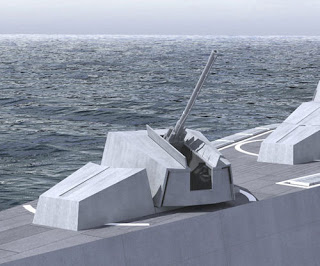
 We talk about Navy credibility a lot, but as a wise sage has advised me, this description is accurate when narrowly focused, and lacks meaning when broadly used. The Navy's credibility problem is specific to surface combatants and shipbuilding, and the DDG-1000 represents the disconnect incredibility between the various factions. Chris Cavas, in subscription article DDG 1000 Takes Another Hit- From JROC, notes a recent meeting of JROC that almost canceled the necessity of the DDG-1000, but stopped short of taking official action. The Joint Requirements Oversight Council (JROC) appears ready to cancel the requirements that led to the development of the DDG-1000, namely naval gunfire support, but stopped just short. If an official decision to cancel those requirements is met, the necessity for the DDG-1000 would be dropped.
What catches our interest in this article is the reactions from a couple of observers. The first observer, Bob Work of CSBA, sees this action as the nail in the coffin for third ship. In particular, he expresses a lack of confidence in the cost estimating for the first two ships.
Reacting to the news of the JROC meeting, Bob Work, an analyst with the Center for Strategic and Budgetary Assessments, said “the key Navy argument [to cut the program] is they made their decision on the requirements, not cost. If this is true, the JROC essentially agrees with them… It would mean, definitely, the end of the DDG 1000 program.”Ironic that cost is not the justification for the JROC decisions, requirements is, but Bob Work makes his final assessment based on cost. Cost, specifically the expected cost overrun of the DDG-1000, is the inescapable hydra where each head represents a massive bite into the shipbuilding budget of the future fleet. You will not see the Navy say as much though, the Navy appears in complete denial regarding the possibility of cost overruns in the DDG-1000. This will only hurt the Navy's credibility more in the future, but apparently everyone in leadership today expects to be long gone before that becomes a problem so the cost element of the decision can afford to be ignored by this round of leadership.
Work, who has extensively studied the program, is not optimistic about the latest DDG 1000 just approved by Congress.
“To me, the likelihood of a third DDG 1000 being built is relatively low, Work said. “That ship may very well be used to cover overruns on the first two ships.”
Enter Joe Sestak, offering up a Congressional view. During the July 31 hearing in the House, Joe asked the Navy about the JROC analysis regarding the cancellation of the DDG-1000. These comments are typically political, as they are inconsistent, broad, unfocused, partly absurd, and partly wise. Joe is half clever with these comments, and half silly.
Sestak expressed confidence the program will not be canceled outright.Come on Joe, the DDG-1000 is useful in the Global War on Terror? Can someone explain that one to me? Either we have no idea how to fight the GWOT from the sea, or Congressman Sestak is drinking the Clark/Rumsfeld kool-aid. The DDG-1000 can be a lot of things, but does Joe actually believe this $3+ billion dollar battleship is the Navy's solution to GWOT operations?
“I do think the three ships will be built,” he said. “At least two - and I think the third has strong probability.”
Sestak, a supporter of the DDG 1000s, said the ships remain useful in the Global War on Terror. “They still fill a need that’s out there. They may not be 100 percent right for the requirements, but it’s not been a complete waste,” he said.
The former vice admiral also had praise for Roughead’s actions.
“I give great credit for his strength in questioning” whether the DDG 1000s are the right ship to build, Sestak said.
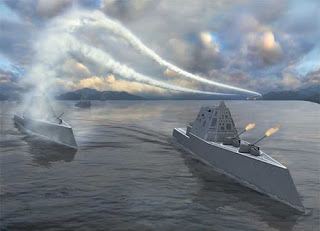 Everything else Joe says makes sense though, although I'm solidly in the "Bob Work" camp on this. The 3rd DDG-1000 will be funded, then the funds will be used to complete ship 1 and 2 when the cost overruns come in. It may not be enough to cover the bill, but it could be.
However, lets deal with the meat of the changing requirements. Ignoring the naval gunfire fire support issue, which is a major issue that is simply being put off for now, lets focus in on the "new requirements" driving surface combatants. The Navy has previously mentioned the three threats as Ballistic Missile Defense, anti-ship missile defense, and blue water submarine threats. The article locks onto this in a bit of detail.
Chief of Naval Operations Adm. Gary Roughead said Sept. 26 he made the decision to cut the program because the ship was “optimized for a particular mission… It is a gunship. It can shoot a bullet about 80 miles.We need to think clearly, and discuss openly, this emerging threat. The article goes on to suggest Joe Sestak believes Congress should see the data, and if the data was given to the JROC to make a decision with, then the data exists. We agree, Congress should see this, and it should become something the Chinese are asked about publicly. This is a great example where there is plenty of whitespace where blogs can contribute to the discussion, so I'll open the floor:
The Zumwalts have been in development for more than a decade, but now, on the cusp of production, it’s not the ship the Navy needs.
“DDG 1000 was conceived in the early ‘90s. The world has changed a lot,” Roughead said.
The Navy cites the emergence of a new and unspecified “pacing threat”— widely thought to be a targetable derivative of the Chinese Dong Feng 21/CSS-5 intermediate- range ballistic missile — and says more DDG 51 Arleigh Burke-class Aegis destroyers are needed to combat that weapon. Upgrading the Zumwalts to handle the threat would simply be too expensive, McCullough said.
This "pacing threat" of a targetable ballistic missile is clearly a major tactical threat. It should be noted first that the weapon does not yet exist, but also note it is widely known to be in development (including in Chinese professionally published discussions on weapons capable of attacking the US Navy). It is a weapon unique to technologically advanced nations who possess advanced capabilities in detection and tracking at sea, and a weapon that is almost certainly dependent upon satellite and other networked technologies. We acknowledge this to be a big time conventional weapon system only available to the most advanced state actors, most likely only Russia and China for the next several decades. As a tactical threat, we would categorize as high, but as a strategic threat? Lets be honest, war with Russia or China is going to involve so many strategic threats, including the potential for nuclear exchange, that this weapon really isn't very high on the strategic threat scale. This threat is in the same ballpark strategically as a nuclear torpedo, and I don't see us making anti-nuclear torpedo investments.
The point is, major tactical capability or not, this is not a game changing weapon strategically. I am thoroughly unimpressed with the argument made regarding the C-802 fired from a truck in Lebanon as being a reason to cancel the DDG-1000, based solely on the suggestion that the littoral battleship was supposedly developed over a period longer than a decade and yet no one ever considered the truck mounted anti-ship missile a possibility? Bullshit. However, in the greater context, while a truck mounted C-802 is less of a threat tactically than a ship seeking ballistic missile, the fact it was fired from Hezbollah makes this truck mounted anti-ship capability a much greater strategic threat than the modified Dong Feng 21.
And that leads us right back to the requirements discussion. Are we building more DDG-51s to address the tactical threat of anti-ship ballistic missiles only available to perhaps 2 potential adversaries, and even then only under certain optimistic conditions? Or perhaps we are building more DDG-51s to address the strategic threat of possible widespread export of relatively cheap but effective anti-ship missiles?
Being that the strategic threat is more likely to pop up in more places in the world, specifically ungoverned regions of Africa where we will be sending our unrated ships like the LCS, how do we justify building DDG-51s to fight anti-ship missiles while also building the LCS without ESSM? There is some serious lack of consistency here, a disconnect between requirements for the platforms sold as surface combatants all the while clouded by the very important cost question for these platforms.
Tactical requirements? Strategic requirements? Cost vacuum? What about naval gunfire support? The shipbuilding issues and questions regarding surface combatants are center to the leadership credibility questions. I'd love to be a fly on the wall in one of those JROC meetings.
Bottom line, when someone talks about shipbuilding platforms and decisions being driven by operational capabilities, the question is whether those considerations are being made against the strategic threats or the tactical threats at sea. A whole bunch of truck mounted, or FAC mounted anti-ship missiles is a serious strategic threat, but a tactical threat that most existing capabilities can match up against. A whole bunch of ballistic missiles able to hit ships at sea is a serious tactical threat, but isn't much of a strategic threat since when even looking 3 decades out it is unlikely that capability will be available to any but the most powerful state adversaries anyway, and those nations have nuclear capabilities that go far and beyond this conventional weapon system.

No comments:
Post a Comment