
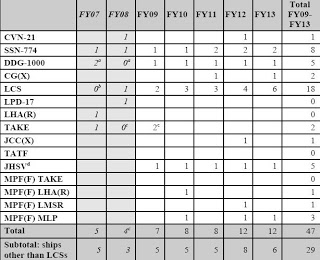
 With Congress back in session, we want to get some stuff up on the blog since the debate will soon begin again. The following list of budget battles and force decisions lay ahead for the Navy over the following months in Congress. We are about to find out who the leaders are. The following highlights are quoted from this excellent summery called Defense: FY2009 Authorization and Appropriations Updated June 18, 2024 by Pat Towell and Stephen Daggett Specialists in Defense Policy and Budgets Foreign Affairs, Defense, and Trade Division.
Our commentary is in italics following each section.
F-18 Shortfalls
Some analyses of the number of F-18 strike fighters available to the Navy show a substantial shortfall of aircraft from about the middle of the next decade until about 2025, when the full planned number of F-35 Joint Strike Fighters becomes available. The number of available aircraft, however, depends on assumptions about the number of hours that current aircraft can fly, and at what cost for maintenance, upgrades, and overhauls. Boeing has recently offered to sell additional F/A-18E/F versions of the aircraft to the Navy for about $50 million apiece, as much as 10% cheaper than planned for additional aircraft, if the Navy agrees to buy 170 aircraft in a multiyear contract that would have early termination penalties.Essentially this would be $8.5 billion for 170 aircraft, in our opinion the easiest decision for lawmakers in regards to aviation ifor the next several decades. The Navy is asking to buy the most affordable, most cost effective aircraft available to sustain the aircraft fleet rather than use the same money to get much fewer F-35s sooner.
The LPD-17 Debate
For the past two years, the Marine Corps has included a request for an additional LPD-17-class amphibious ship, which would be the 10th to be bought, at the top of its unfunded priorities list. There has been some support in Congress for adding a 10th LPD, but funding might have to come at the cost of financing for surface combatant ships such as the DDG-1000 destroyer. Support for shifting money from the DDG-1000 to LPDs or other ships that have been in production for some time comes partly from advocates of the Marine Corps and from legislators who represent the Gulf coast, where the ship would be built. In addition, there has been some support for a shift because the cost and design of the LPD-17 — as for TAKE auxiliary ships and DDG-51 destroyers — has been stable for some time.We held off 8 full days after starting the blog before we began advocating for the 10th LPD-17. The inability of the Navy to support the LPD-17 program, which fits in better than any other shipbuilding program to the Navy's own maritime strategy, is one of the obvious reasons Navy leadership suffers from credibility problems.
The DDG 1000
A directly related issue is whether Congress will agree to continue funding DDG-1000 acquisition. The Administration’s FY2009 request includes $2.6 billion for a third DDG-1000. Several legislators on the defense committees have proposed eliminating the funds and using the money instead to buy a mix of LPD-17, TAKE auxiliary ships, and DDG-51 destroyers. This would spread available shipbuilding money more widely to sustain the industrial base, provide funding to programs in which costs are stable and more predictable, and also allocate funds to less expensive ships that might be built, in the long run, in larger numbers to sustain the Navy’s 313 ship fleet.The first two, already funded and soon to begin construction, make excellent technology demonstrators for the future CG(X). The remaining 5 DDG-1000s that have not been funded need to be canceled. Failure to do so will insure a small future Navy. Anyone supporting the construction of battleships to meet the existing and potential emerging 21st century maritime environment is thinking industrial, not strategic. The Navy needs BIWs to be building a whole bunch of small combatants right now, not more battleships.
The Littoral Combat Ship
The Administration has also requested $920 million for two Littoral Combat Ships (LCS). This is a relatively small, lower cost ship with a common hull to support modular designs for several purposes. It is intended to be bought in large numbers over time for operations in relatively close-to-shore waters. The program has suffered significant cost growth, however, raising questions about the number of ships that can be afforded. Last year, Congress cut funding for all but one ship and shifted the savings to purchase other ships. This year may again be a test of congressional support for the ship in view of continuing cost issues.The Navy will need to build a few of these if they are going to realize the value of motherships in the 21st century. Lets stop pretending these are surface combatants, they are unrated mini motherships that represent an important means of implementing maritime strategy in the 21st century for both war and peace. Motherships will be to the 21st century what the aircraft carrier was to the 20th century. Freedom and Independence represent the Langley of the 21st century.
The CG(X) Discussion
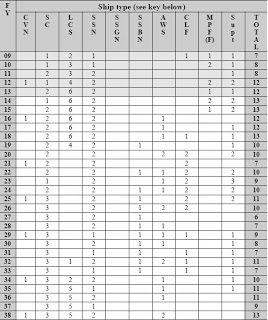
The CG-X is the current designation for a new ship dedicated to missile defense missions. Its design was, for many years, expected to be based on the DDG-1000. Now, however, it appears that the Navy is inclined to build a substantially larger ship. Some defense committee members have raised questions about the status of the Navy’s design and about the affordability of the program. There has also been some support in Congress for building a nuclear powered cruiser.We are intentionally holding off on this discussion, too much information still yet to read. We tend to be leaning towards this position though, as it is both practical and evolutionary, capitalizing on the two DDG-1000 technology demonstrators current funded.
Shipbuilding - House
In its report, HASC criticized the Navy’s shipbuilding plan as both unaffordable and unwise — the latter in that it would end production of proven ship classes while investing large amounts in expensive, new, unproven designs: the DDG-1000 destroyer and the Littoral Combat Ship. Compared with the Administration’s request, H.R. 5658 significantly increases or decreases funding for most major shipbuilding programs.The House bill reduces the number of Littoral Combat Ships in FY09 to one, cancels the DDG-1000, and builds more amphibious ships, logistics ships, and submarines while setting $400 million aside for surface combatants. Sounds like an alignment of resources to strategy to us! This approach to reset priorities via political action works once though, essentially Congress needs to become smart on maritime strategy and start asking the tough questions to insure long term change.
The bill denies the $2.5 billion requested in FY2009 to build a third ship of the DDG-1000 class. Instead, it adds to the budget a tenth ship of the LPD-17 class of amphibious landing transports ($1.7 billion) and $278 million to buy long lead-time components for use in two additional T-AKE-class supply ships, designed to replenish warships in mid-ocean, that would be funded in FY2009. It also authorizes $400 million, which the Navy could use either to buy components that could be used to build an additional DDG-1000 or to resume production of the much less expensive DDG-51-class destroyers. HASC Seapower Subcommittee chair Gene Taylor has urged the Navy to use the funds to continue DDG-51 procurement.
To buy two additional Littoral Combat Ships, the bill authorized $840 million rather than the $920 million requested, on grounds that the contractors could use components previously purchased for ships of this class that had been cancelled.
The bill authorizes $722 million more than the $3.4 billion requested for acquisition of Virginia-class submarines. The request would buy one sub in FY2009 and long lead-time components (including a nuclear powerplant) to be used in another sub slated for purchase in FY2010. The bill’s addition would let the Navy buy enough long lead-time components in FY2009 to allow the purchase of two subs in FY2010, thus accelerating by one year the time when the Navy could begin buying subs at the rate of two per year.
Reflecting HASC’s concern that the Administration’s shipbuilding plan shows little progress toward meeting its avowed goal of increasing the size of the fleet to 313 ships, the bill did not grant the Administration’s request that Congress waive a provision of law (10 U.S.C. § 5062) that requires the Navy to maintain 11 aircraft carriers in service. To avoid the cost of refueling the nuclear-powered carrier Enterprise, the Navy wants to retire that ship in 2013, which would cause the carrier force to drop to 10 ships for four years or more, until the carrier George H. W. Bush, which was funded in FY2005, enters service. Instead of including the requested waiver in the bill, HASC directed the Secretary of the Navy to report how much it would cost and how long it would take to return to service the recently retired carrier John F. Kennedy and to retain in service the carrier Kitty Hawk, which is slated for retirement.
HASC also directed the Navy secretary to report on the cost and feasibility of extending the service life of existing Los Angeles-class submarines, many of which are nearing their scheduled retirement dates.
Shipbuilding - Senate
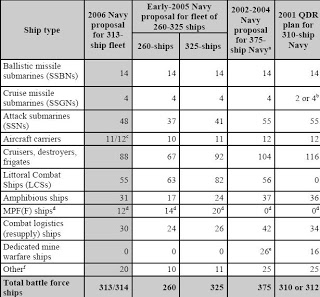
Unlike the House bill, S. 3001 authorizes $2.5 billion requested for a third DDG-1000 class destroyer. However, the Senate bill also would expand the Administration’s shipbuilding plan, rejecting the request for $103 million to shut down production of LPD-17 class amphibious landing transports and adding to the bill $273 million for long lead-time components that would allow the Navy to budget for an additional LPD-17 in FY2010. It also adds $79 million to the $1.3 billion requested for long lead-time components to allow the Navy to begin budgeting for two submarines per year starting in FY2011.Senate takes DDG-51 modernization seriously, very important (the report said 61, but there are 62 total DDG-51s planned). The Senate is also thinking about Sea Basing, although does anyone know what the Navy is really thinking regarding Sea Basing anymore? When it comes to the Senate, the future force, and shipbuilding this budget does what the Senate always does, exactly what the president tells them.
Noting delays in the construction of helicopter carriers at the Northrop Grumman shipyard in Pascagoula, MS, that was damaged by Hurricane Katrina, SASC concluded that the contractor was unlikely to proceed as quickly as the budget assumed to assemble long lead-time components for an LHA(R) class helicopter carrier slated to be part of the planned Maritime Prepositioning Force (Future). Accordingly, the bill authorizes $178 million of the $348 million requested for that purpose. It also includes a provision (Section 1432) requiring the Navy to fund that ship — and others slated for the MPF(F) that are basically amphibious landing ships — through its ship construction account instead of through a revolving fund for sealift ships, which gives the service more leeway to reallocate funds.
The bill adds $25 million to the $165 million requested to begin a $10 billion, long-term program to modernize the 61 Arleigh Burke-class destroyers — its most numerous class of warships — so they can operate for 40 years, rather than the 20 years that the committee cited as the norm for vessels of that size. But the committee also directed the Navy to provide detailed justification of its decision to have the ships upgraded in several stages by shipyards near their homeports instead of having each one get a full upgrade from either the Northrop Grumman yard in Pascagoula or the General Dynamics-owned Bath Iron Works in Bath, ME, the two yards where all the ships were built.
Citing delays in finalizing the design of a new class of cruisers (designated CG(X) that would replace the 22 Aegis cruisers in the anti-aircraft and missile defense mission, the bill cut $121 million from the $313 million requested to prepare to begin building the first CG(X) in FY2011.
Prepositioning Ships - House
The bill denies the $348 million requested for long lead-time components to be used in a modified version of the LHA-class helicopter carriers used to carry Marine combat units. The ship — for which the projected total cost is $3.5 billion — would be the first of a new Maritime Prepositioning Force (Future) (or MPF(F)) comprising 10-12 ships from which a Marine Expeditionary Brigade (typically numbering 20,000 troops with several dozen supporting helicopters and combat jets) could be put ashore.The nuclear power issue is something we will continue to observe unfold without much analysis, because we haven't seen serious analysis towards this discussion yet. What are the real cost increases, including shore infrastructure, of moving towards nuclear power? Who is discussing the strategic consequences, like battle damage cleanup in the littoral or lack of forward presence in ports because nuke ships aren't allowed? You can power a ship with the steam coming from this issue, but steam is the right word, because a lot of this is hot air without serious analysis. What is interesting is the House is struggling with the MPF(F), weighing the issue as an amphibious force vs commercial shipping solution. We still don't understand the 2 MEB Rumsfeld metric, and hate the idea that the Sea Base concept is being built from the top down instead of bottom up. Why not start with the forward operating base at sea able to support a battalion before you go all in trying to support multiple brigades? Sea Basing needs a healthy dose of evolution, not all this budget blowing transformation, and wake me up when the concept is ready to be joint service instead of Navy/Marine. If the House wants to hold off on the LHA(R) for the Sea Base to get better answers to tough questions, we see it as a good thing. Who the hell thinks building a $3.5 billion dollar civilian run aircraft carrier is a good idea anyway!
Unlike the currently deployed maritime prepositioning force, which consists of container ships and vehicle-carrying “roll-on, roll-off” (or RO-RO) vessels, the proposed MPF(F) would include three modified versions of the big helicopter carriers that are part of the Navy’s amphibious warfare fleet. However, like the current prepositioning ships, the MPF(F) is not intended to land a force that would have to fight its way ashore. Such so-called “assault” landings are to remain the province of the amphibious landing ships. Accordingly, MPF(F) vessels based on amphibious ship designs — such as the helicopter carriers — will be built without some of the communications equipment and damage-control features found in their combatequipped counterparts.
In its report, HASC challenged the idea of using non-combatant ships — like those envisioned for the MPF(F) — rather than amphibious landing ships designed as combat vessels. It directed the Navy to report the number and types of amphibious ships that would be needed to carry out the MPF(F) mission.
The bill also includes a provision (Section 1013) requiring that helicopter carriers and other large amphibious landing ships be nuclear-powered. A similar provision requirement covering aircraft carriers, large surface warships and submarines was included in the FY2008 defense authorization bill.
------
If you have read this far, think you have learned something, and want to see some serious gouge... check out the full report. The ballistic missile defense part is brilliantly done, and the tables on the last several pages makes mud transparent in regards to the FY09 budget on virtually all defense programs.

No comments:
Post a Comment