
 We acknowledge for a blog entry, this one is particularly long. However, we believe that those who read in full will feel rewarded for committing the extra few minutes.
Quote of the Week:
Executing the Navy’s most recent 30-year shipbuilding plan would cost an average of about $27 billion a year (in 2009 dollars), or more than double the $12.6 billion a year that the Navy has spent, on average, since 2003. (Unless otherwise indicated, the cost figures presented in this letter are expressed in billions of 2009 dollars of budget authority, and years denote fiscal years.) Since CBO testified on this topic on March 14, the Navy provided additional information that led CBO to increase its estimate of the annual cost of the shipbuilding plan from $25 billion to $27 billion.This is quoted from page one, a letter from the CBO to Gene Taylor, in a newly released assessment by the Congressional Budget Office titled Resource Implications of the Navy's Fiscal Year 2009 Shipbuilding Plan put together by Eric J. Labs and Raymond Hall. For those who don't like the assessment or disagree, your in luck, the CBO lays out one of the most detailed cost assessments of current shipbuilding you will find. Feel free to debate math estimates, but when you do, note the Navy's own estimates are provided in every case, and the Navy's track record for cost estimates and shipbuilding is pretty horrible. Eric Labs on the other hand, has been mostly on target in estimates for several years now, and when he is off, it is still always closer than the Navy.
Because it would be impossible to cover all aspects of this report in one post, we are going to concentrate on the two surface combatant programs in particular. We note that this report contains all of the additional information one would require to have a broader perspective on the state of shipbuilding in general, and just because we don't discuss it specifically, it doesn't mean the content isn't extremely important to the total discussion. In particular this report does an excellent job explaining shipbuilding index for inflation and other aspects of the larger shipbuilding discussion that add context to the problems facing the Navy. We will likely revisit several of those topics over time.
DDG-1000
The CBO report highlights the cost estimate issues regarding the DDG-1000. This argument has been adjusted based on new data provided by the Navy, and does not match exactly previous CBO testimony we have quoted on the blog. The new data does very little to add confidence to the cost considerations of the DDG-1000 or add viability to the program as a whole from a national investment perspective.
The service’s 2009 budget suggests that the Navy expects the first two ships to cost $3.2 billion each and the next five to cost an average of $2.2 billion each—a cost increase of about $200 million per ship for the last five ships compared with the cost in the Navy’s 2008 budget. CBO, by contrast, estimates that the first two DDG-1000s would cost $5.0 billion apiece and that the next five would cost an average of $3.6 billion each.
The Navy’s estimate for the two lead-ship DDG-1000s prices the ship at about $250 million (in 2009 dollars) per thousand tons of lightship displacement (the weight of the ship minus its crew, fuel, ammunition, and stores). In comparison, the lead ship of the DDG-51 class destroyer cost about $390 million per thousand tons, and the lead ship of the Ticonderoga class cruiser cost more than $400 million per thousand tons (see Figure 4). CBO used the DDG-51 lead-ship cost as its basis for estimating the cost of the lead ship of the DDG-1000 class, adjusting for the size of the ship....
Comparing the Navy’s estimate for two additional DDG-51s and the Navy’s estimate for the seventh DDG-1000 to be purchased in 2013 illustrates the risk for cost growth in the latter program. Last year, the Navy stated that if the Congress authorized and bought two new DDG-51s in 2008—ships that would have the benefit of substantial efficiencies and lessons learned because of the 62 similar ships built previously— the cost would be between $3.1 billion and $3.2 billion, or about $1.6 billion each in 2009 dollars. At the same time, in its fiscal year 2009 budget submission to the Congress, the Navy stated that the cost to build the seventh DDG-1000 in 2013 would be about $2.4 billion in 2013 dollars. Deflating the cost of the seventh DDG-1000, using the inflation index for shipbuilding that the Navy provided to CBO, brings the Navy’s estimate for that ship to about $1.9 billion in 2009 dollars. The lightship displacement of the DDG-1000 is about 5,000 tons (or more than 50 percent) greater than the lightship displacement of the DDG-51s under construction today. In effect, the Navy’s estimates imply that those 5,000 extra tons, as well as the 10 new technologies being incorporated into the DDG-1000 class, will add only 15 percent, or about $300 million, to the ship’s cost.
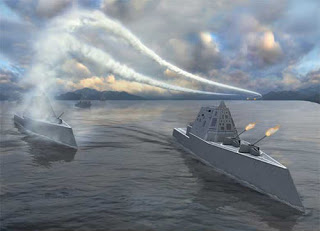 Using the CBO estimate of $5 billion dollars a piece for the first two DDG-1000s, the combined cost of the first pair of DDG-1000s would cost as much as the first Ford class aircraft carrier, 5 Block III Virigina class submarines, the entire SSGN conversion project including full tomahawk loads, or 6 additional LPD-17s. Is there any argument where two more battleships adding to the existing 84 AEGIS battleships adds more value than any of the above options? We do not think so, although we do admit it is hard to guage the value the two ships could hold for the future Navy as technology demonstrators. If the two destroyers go on to provide a cost effective solution towards the generation of a future fleet to replace the existing CGs and DDGs, in the future it is possible the investment would be worth it.
However, the remaining 5 DDG-1000s yet to be built, which the CBO estimates will cost $18 billion dollars in shipbuilding over the next 5 years is a tragedy of maritime strategy, resource management, and national investment. Since the first article published by Christopher P. Cavas on shipbuilding problems, we note that only three people have come to the defense of the DDG-1000: 2 Republican Maine Senators and John Young, an administration appointee. The Navy is... silent. This is troubling in many ways, and the biggest problem is how the silence is contributing to a nrgative perception in the Navy, in the industry, and in Congress regarding the leadership of the Navy. The perception of SWO's in particular is taking a beating, which we think is a big problem considering one SWO in particular in line for next CNO seems to get it, leveraging the right platforms for the environment and conditions the Navy needs vision addressing in the 21st century.
Littoral Combat Ship
The CBO report focuses in on the costs of the Littoral Combat Ship hulls, and gives us all the information we need to finally get good calculations for estimating costs of the LCS program and comparing it in context of previous programs. Before we get started with this analysis, we want to make one point clear: We do not have a problem with the Littoral Combat Ship costs, we have a problem with the Littoral Combat Ship as a strategic direction. Motherships should be big, a fleet of battleships and an unrated flotilla is not strategic. Unmanned platforms will be to warfighting in the 21st century what the aircraft carrier was to warfighting in the 20th century. Ultimately, we believe small combatants are for executing peacemaking roles in maritime strategy, and the LCS is missing the most important metric for successful execution of that strategy: manpower.
With our usual disclaimer regarding our opinion of the LCS, we move on...
The Navy intends for the LCS to be a relatively affordable ship that will be fairly simple to design and build. Originally, each sea frame was expected to cost about $260 million (in 2009 dollars, or $220 million in 2005 dollars). The Navy’s 2009 budget would allow the purchase of 18 LCSs during the 2009-2013 period, at an average cost of about $450 million per sea frame. That is 11 fewer than the 2008 plan envisioned for the same time period. In the summer of 2007, the Navy requested that the cost cap for the fifth and sixth LCSs be raised to $460 million. Based on the effects of a higher production rate and experience gained between the construction of the first and subsequent ships, that figure suggested that the total construction cost of the first ships would be about $600 million each. In the 2009 budget, the Navy estimates the cost of LCS-1 at $631 million and LCS-2 at $636 million. In recent testimony, the Navy indicated that the costs of LCS-2 will likely grow further but did not indicate by how much.
Historical experience indicates that cost growth in the LCS program is likely. In particular, using the lead ship of the FFG-7 Oliver Hazard Perry class frigate as an analogy, historical cost-to-weight relationships indicate that the Navy’s original cost target for the LCS of $260 million in 2009 dollars (or $220 million in 2005 dollars) was optimistic. The first FFG-7 cost about $670 million in 2009 dollars to build, or about $250 million per thousand tons, including combat systems. Applying that metric to the LCS program suggests that the lead ships would cost about $600 million apiece, including the cost of one mission module. Thus, in this case, the use of a historical cost-to-weight relationship produces an estimate that is less than the actual costs of the first LCSs to date but substantially more than the Navy’s original estimate.
Based on actual costs the Navy has incurred for the LCS program, CBO estimates that the first two LCSs could cost about $700 million each, including outfitting and postdelivery and various nonrecurring costs associated with first ships of a class but excluding mission modules...
Overall, CBO estimates that the LCSs in the Navy’s plan would cost about $550 million each, on average, excluding mission modules. That estimate assumes that the Navy would select one of the two existing designs and make no changes. As the program advanced with a settled design and higher annual rates of production, average ship costs would probably decline. If the Navy decided to make changes to that design, however, the costs of building future ships could be higher than CBO now estimates.
 The important numbers here are the CBO estimate of $550 million average LCS cost exclusing mission modules, and $670 million to build the FFG-7s at $250 million per thousand tons. The CBO is estimating the LCS hull will cost $550 million. Using GAO figures from March 2008, the mission modules will have an average unit cost of $47.5 million average for 64 modules based on the three module procurement costs (pages 119, 121, and 123). That makes the cost of 1 LCS hull and 1 mission module roughtly $597.5 million a piece. That means:
FFG-7 4000 tons $670 million = $167.5 million per 1000 tonsFor gains and losses, the Navy gains modularity, the most important technology of the Littoral Combat Ship program. Another way to look at tradeoffs is to compare the Perry to the ASuW module, where tradeoffs would include 2 helicopters on the Perry for 1 helicopter and 3 VSTOL UUVs on the LCS, a 76mm on the Perry for a 57mm on the LCS, a CIWS on the Perry for a SeaRAM on the LCS, 36 SM-1s and Harpoons for 45 NLOS, and a bow mounted sonar for an offboard towed sonar. Additionally the LCS comes with 2 30mm guns.
LCS 3100 tons $597.5 million = $192.7 million per 1000 tons
However, as we have previously stated, the costs of the LCS are not our problem, here is why. When taking a look at the LCS program from the perspective of the fixed cost requirement of $460 million, things look a lot different.
LCS Hull = $460 million, LCS module = $47.5 millionIn other words, with the fixed cost price of $460 million per LCS hull, and with the $47.5 million average cost of the mission modules as calculated using the GAO figures, the LCS would ultimately be cheaper to produce than the Perrys by by $3.8 million per 1000 tons! For further perspective, remember a few months ago we did a similar exercise with the Avenger class, and greenbooked its costs at $197.5 million per 1000 tons. That means the LCS would be $33.8 million per 1000 tons cheaper than the Avenger class, making the LCS arguably the most cost effective minesweeper the Navy has built in the last several decades!
LCS 3100 tons $507.5 million = $163.7 million per 1000 tons
While some may try to argue the CBO metric of "$670 million to build the FFG-7s at $250 million per thousand tons" applies only to first in class, I remind that the Perry's experienced major cost increases in the program later in construction, and based on old SAR reports and greenbook calculations, my math kept producing averages higher than $670 million per hull, so I am using the $670 million figure because it was lower.

No comments:
Post a Comment