
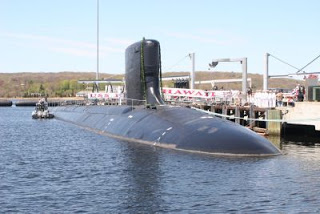
 Not once but twice we have made the argument that the submarine forces of the US Navy are critical to the successful execution of maritime strategy. Our argument is that the Navy needs to shift more of the wartime responsibilities to the submarine fleet to allow the Navy to better shape the surface fleet to deal with 21st century challenges. This strategic view of fleet constitution makes the assumption that submarines will be the most important weapon of war against a near peer competitor in the future should war break out, while recognizing that the contributions of submarines to the special mission sets for successful peacetime maritime strategy are limited.
Our argument examines the metrics for fleet constitution as outlined by the Navy to make this case. The Navy had three priorities for the future fleet.
The Arsenal Ship - This platform has been realized through the conversion of four Ohio class SSBNs to SSGNs, offering the US Navy a unique capability for massive strike from a stealth position against even the most dangerous anti-denial networks while also offering unique mission sets in peacetime for special operations. This is the most successful aspect of the Navy's force planning leading into the 21st century.
The 21st Century Surface Combatants - This program went under a number of names and has been the center of attention for the future fleet since the mid 90s, finally defined on November 1, 2024 to be the LCS, DDG-1000, and CG(X). This series of 21st century surface combatants includes a mini-mothership, large surface combatant, and cruiser replacement. As we have highlighted many times in the past, we think the idea was right and based on the right testing metrics, but the implementation was partially backwards and ultimately reflected the previous Navy, not the Navy needed looking forward. In our opinion the Navy should build big motherships, small surface combatants, and a cruiser replacement.
Sea Basing - This blog has spent considerable time discussing the strategic view for Sea Basing. We believe Sea Basing will ultimately be the most important strategic concept in peacetime in the future, and will define forward sustained presence in the 21st century the way carrier battle groups defined the naval era following WWII.
However, to augment the Arsenal ships, to shape a 21st century surface combatant force relevant to the 21st century mission set, and to establish forward regional sea bases in forward theaters tailored to the regional requirements, the Navy must have a force to win war and control the sea under all conditions. That force is the attack submarine fleet.
We have offered analysis for discussion regarding different ways to examine the appropriate size of the submarine force. We don't claim to have the right answer, but each time we generate the discussion it is noted that 48 submarines does appear to fit into historical comparisons and ratios as a 'right sized' force for the US Navy. Assuming the 48 number the Navy has established in its force requirements is 'right sized,' the submarine questions for FY2009 have very little to do with expansion of the current plans for submarines, rather focus on the quality of the submarine design industry. A new CRS report by Ronald O'Rourke on submarines (PDF) addresses this issue.
Navy and industry officials appear to agree that preserving the submarine design and engineering base over the next several years will require funding substantial submarine design and engineering work in the near term. The Navy plans to address the issue by accelerating into the near term the start of design work on the next generation SSBN. Given the ages of the Navy’s 14 current SSBNs, work on a replacement SSBN design would normally not need to start for several years. The Navy, however, is accelerating the start of this project into the near term, with an eye toward carrying out the project as a steady-state effort over several years, rather than as a more-concentrated effort starting several years from now. The Navy’s plan will provide a significant amount of submarine design and engineering work for several years, and engage a wide range of submarine design and engineering skills.The report goes on to cite a RAND report released in 2007 regarding sustainment of the submarine industry design base. The RAND report made the following recommendations.
— Seriously consider starting the design of the next submarine class by 2009,
to run 20 years, taking into account the substantial advantages and disadvantages
involved.
If the 20-year-design alternative survives further evaluation, the issue of a
gap in submarine design is resolved, and no further actions need be taken. If that
alternative is judged too risky, we recommend the following:
— Thoroughly and critically evaluate the degree to which options such as the
spiral development of the Virginia class or design without construction will be
able to substitute for new-submarine design in allowing design professionals to
retain their skills.
If options to sustain design personnel in excess of demand are judged on
balance to offer clear advantages over letting the workforce erode, then the Navy
should take the following actions:
— Request sufficient funding to sustain excess design workforces at the
shipyards large enough to permit substantial savings in time and money later.
— Taking into account trends affecting the evolution of critical skills, continue
efforts to determine which shipyard skills need action to preserve them within the
sustained design core.
— Conduct a comprehensive analysis of vendors to the shipyards to determine
which require intervention to preserve critical skills.
— Invest $30 million to $35 million annually in the NSWC’s Carderock
Division submarine design workforce in excess of reimbursable demand to
sustain skills that might otherwise be lost.
We have spent a lot of time on the blog discussing the importance of sustaining the submarine industry, why R&D investment is very smart and has led to reduced costs in the Virginia class submarine, which has resulted in a more capable yet cheaper Block III design for the Virginia class for the near future. We believe the suggestion of a 20 year sustained design program for submarines in the RAND report is very smart, and something Congress should commit to.
For example, lets assume the Navy commits $100 million dollars to submarine design every year for the next 20 years. That amounts to $2 billion dolllars. Sounds like a lot of money, except that by sustaining that design base, you build a group able to work interchangeably with those who might develop unmanned systems for submarines, or the future SSBN project, or new modifications to the Virginia class, or the often discussed Tango-Bravo project, or if among other things, perhaps the Navy could and should design a conventional submarine. This is something also discussed in the CRS report.
Diesel-electric submarine for Taiwan. In April 2001, the Bush Administration announced a proposed arms-sales package for Taiwan that included, among other things, eight diesel-electric submarines. Since foreign countries that build diesel-electric submarines appear reluctant to make their designs available for a program to build such boats for Taiwan, some observers have proposed that the United States develop its own design for this purpose. This option would generate a substantial volume of work and engage many skill areas. Uncertainty over whether and when this project might occur could make it difficult to confidently incorporate it into an integrated schedule of work for preserving the U.S. design and engineering base. Although the project would engage many skill areas, it might not engage all of them. Skills related to the design of nuclear propulsion plants, for example, might not be engaged. In addition, this project might raise concerns regarding the potential for unintended transfer of sensitive U.S. submarine technology — an issue that has been cited by the Navy in the past for not supporting the idea of designing and building dieselelectric submarines in the United States for sale to foreign buyers.
The lack of alternative designs is the problem in the surface fleet. Nuclear powered submarines will require 60 months to build in the future, five full years. Congress and the nation would be wise to have designs ready for conventional submarines which are much smaller and can be built much quicker. Even if the US Navy never builds a conventional submarine, it is a good idea to have a design for one just in case, particularly if the nation is paying to sustain the submarine design industry anyway.
There is a trend in shipbuilding, the more time spent on design the cheaper the ship is when built. The LCS, a small ship often described as uncomplicated in design went from design to water in less than 5 years, and can accurately be described as a first in class cost nightmare. On the other hand, the design of the Virginia class was over a decade, and despite a few problems on the first in class, costs continue to be reduced despite improvements in capability and most importantly, even though it is the second most expensive shipbuilding program in the Navy, cost increases are only 11%, well below every other class built in the modern era.

No comments:
Post a Comment