
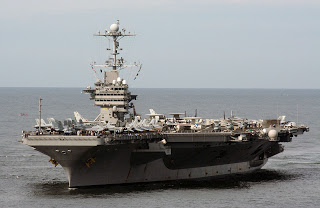
 The Brazil Naval Blog has photography up of the USS George Washington (CVN 73) pulling into Rio de Janeiro harbor. The George Washington (CVN 73) is currently participating in the Partnership of the Americas (POA 2008) deployment as the ship travels to Japan. Other ships participating include the USS Farragut (DDG 99) and USS Kauffman (FFG 59).
As I was looking over the Partnership of Americas 2008 (POA) homepage I came across this podcast (WMV 3:30), which is a short discussion by Rear Adm. Phil Cullom on the GW mission for POA 2008. It is actually well done, a bit of internet outreach that probably hasn't been very successful. Why? The POA 2008 link from the USS George Washington (CVN 73) homepage is broken. The link is supposed to redirect you to either the Carrier Strike Group page or the POA factsheet page for the CSG. Either way, navigation is a bit complicated, but we really like the content of the factsheet as it explains what the Strike Group will be doing over the next two weeks.
In mid-April we will conduct flight operations with Brazilian naval and air force units for combined air defense and strike training. We will test our interoperability and learn from each others’ capabilities and experience.The Brazil Navy Blog indicates there are 4 US ships, 3 escorts for the USS George Washington (CVN 73). While we know of two of them (linked above), it is unclear what the fourth ship might be. It would be nice to know which ships of the Brazilian and Argentinian Navies are participating, as all we really know is Argentina will be exercising with 3 ships and a submarine. Not much detail there.
During the in-port and underway phases of exercise UNITAS Atlantic, we will work with Brazil and Argentina (and other navies that may accept Brazil’s invitation to participate). We will train together in multi-warfare exercises designed to increase coalition skills of all navies involved. The carrier and air wing’s participation will accomplish several things:
- Allow us to integrate with officers and sailors from our Brazilian sister ship, Sao Paulo, and naval aviation squadron VF-1.
- Build relationships by giving pilots, landing signal officers, air traffic controllers and fighter controllers from Brazil, Argentina, and the U.S. opportunities to train together.
- Provide a unique opportunity for air, sea, and subsurface participants to train in an integrated 3-dimensional maritime exercise: above, on, and below the sea.
- And, build coalition working relationships across a robust composite warfare command structure. This will include introduction of a strike warfare commander……..and the process by which naval aircraft support all warfare areas, from surveillance to dropping bombs.
We really like the information being put out by SOUTHCOM here, and the GW CSG in trying to communicate its mission with the American people, but that broken link needs to be fixed. Luckily, part of the service encouraged for use is an email address at the bottom of the fact sheet, which we used send a tip to fix the link and also encouraged better links from the SOUTHCOM PAO 2007 page.
It strikes us that this is an excellent topic for a blogger roundtable. The Navy did not run a blogger roundtable for its African Partnership Station that we are aware of, and someone deserves a swift kick in the rear for not having a blogger roundtable regarding that Sea Base off Liberia, that is damn near unforgivable IMO. This on the other hand is another opportunity for outreach, and with the Navy finding no media attention, why not try untraditional methods?
Navy headlines tend to focus on the Middle East, Western Pacific, or force structure news and rarely spend time discussing "all that other good stuff" the Navy does everywhere else, despite the fact that other stuff represents a bulk of US Navy activity worldwide. These other mission sets like POA, and exercises including UNITAS XLIX in that context, are opportunities to the highlight the global nature of the Navy working in cooperation with friendly nations. There is an interesting discussion regarding the maritime strategy waiting to happen in regards to these exercises, and there are far fewer OPSEC issues associated with those mission sets and cooperative exercises.
Some questions worth asking for example. Why has interest in UNITAS been dropping over the last few years, 3 nations marks an all time low for participation? What can the US Navy do to regain interest among South American navies to participate in UNITAS? What are the primary challenges of the Navy in regards to South America? What is the role of the US Navy in South America? I want to know how the Navy explains the value of US naval operations to the US public in regards to forward deployed, sustained regional forces to South America.
Those questions are easier to answer for places like Africa, where very few of the coastal nations have Navies, but most nations in South America have operational Navies. I'd wager good money very few Americans understand the Navy's role in South America, or why it matters to them.

No comments:
Post a Comment