
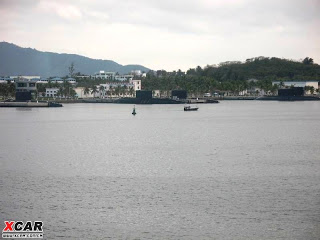
 In discussing PLAN submarines lately, we thought it might be interesting to put the recent shipbuilding production into context. Based on our discussion and review the other day, we note that in the 5 years from January 2003 to December 2007 we can account with a good deal of certainty China has built 15 attack submarines, broken down as follows:
Type 093 SHANG class SSN - 2
Type 039 SONG class SSK - 10
Type 039A YUAN class SSK - 3
This figure may be low, in fact there is some evidence there could be as many as 5 more built over that time period, but for our purposes we can estimate based on legitimate photography and sources. We note the construction rate has actually increased, not decreased in recent years, but assuming China maintains a steady build rate for Submarines China could easy build 30 new submarines between 2003-2012, which is an average of 3 per year. This is not counting the 17 Ming class, 12 Kilo class, and 3 Song class built prior to 2003. In total, by 2020 China may be operating between 65-82 attack submarines. Based on testimony, official publications, and Chinese writings we estimate the number will be 75 by 2020.
The US Navy FY09 30-year shipbuilding plan, the US Navy expects to have in operation 48 SSNs in 2020. Depending upon this years budget, that number could potentially be 49, or even 50. For our purposes, we will estimate 49. There are also 4 SSGNs, 2 in the Pacific. Using these numbers, and that 60% of the submarines operate in the Pacific, we estimate 30 SSNSs will operate in the Pacific in 2020. That makes the ratio between China and US Navy submarines either 75/53 total or 75/32 in the Pacific. We break out the Pacific numbers because unlike the cold war, the US Navy today has other obligations and does not focus its entire fleet on China.
According to Bob Work, in 1990 the US Navy operated 93 SSNs, who were expected to match up against a Soviet tactical submarine force of 72 guided missile submarines, 64 nuclear-attack submarines, and approximately 65 conventional submarines, a total of 210 total submarines. The ratio between the US Navy and the Soviet Navy in 1990 was 210/93.
210/93 = a ratio of 2.16/1 Soviet submarines / US submarines
75/53 = a ratio of 1.42/1 PLAN submarines / US submarines
75/32 = a ratio of 2.34/1 PLAN submarines / US Pacific submarines
Broken down, current plans for the US Navy have them facing a higher number of Chinese submarines in ratio in the Pacific than they faced total Russian submarines in the cold war, but the advantage is that the US Navy has a reserve (in the form of the Atlantic fleet) of up to 21 SSN/SSGNs, potentially 22 depending upon what happens this year.
However, what if we only look at the construction of Chinese submarines of only the last 2 years? It is widely estimated, from the discussion at the Heritage Foundation in April of 2007, to testimony in Congress, to the difference between the ONI report from 2007 and the Taiwan Defense Report for 2007, that China has built 8 SSKs and 4 SSNs in 2006 and 2007, basically an average of 4 SSKs and 2 SSN per year. If that remains the steady rate, the PLAN would build new48 SSKs and 24 SSNs by 2020. Add that to what we believe has been built by 2008, specifically 13 Songs, 3 Yuans, 2 Shangs, and 12 Kilo's the PLAN could have as many as 102 attack submarines by 2020, with almost all less than 20 years old.
102/53 = a ratio of 1.92/1 PLAN submarines / US submarines
102/32 = a ratio of 3.19/1 PLAN submarines / US Pacific submarines
The overall ratio is still more favorable than against the Soviets, but the ratio is the Pacific would be very skewed to China's favor. The question that needs to be asked is what differences contribute to making it easier or more difficult dealing with China today compared to the Soviets in the cold war. We believe based on the 2 Island strategy, China in 2020 under that scenario would be much more difficult than the Soviets in the cold war, because the Soviet submarine force wouldn't have had air support in the middle of the Atlantic. Those kinds of factors could potentially make the challenges more difficult in the future, although there might be other technologies available today that make it easier.
This exercise highlights how important it is to insure the exact number of submarines China has and is producing is known. We note that China is the only nation among at least the top 50 economies that still conceals its military purchases. Transparency is important, and it appears it is very important when judging how to rightsize the nations fleet based on emerging threats.

No comments:
Post a Comment