Here's an article on the implications of the Libya intervention to terrorism in the region that is pretty much spot on. Well done, Mr. Al-Tamimi. What's interesting to note is that the US State Department currently considers Boko Haram an insurgent movement rather than a terrorist group. We've seen this progression before. AQ is parasitic organization and latches onto tribal conflicts and insurgencies. This tactic has repeated itself over and over again: al Qaeda’s core found safe haven with the Taliban in Afghanistan while we watched from the sidelines until 9-11; al Shabaab's leadership in Somalia is indistinct from AQ East Africa; the Southern Secessionist movement and AQAP fight together in Yemen; AQ in the Islamic Maghreb exploits the Tauregs; and now apparently AQ has found partners in the Libyan revolution and Boko Haram. Rather than binary decisions that lock down foreign policy options, a more liberal interpretation between the two definitions (terrorism v. insurgent) is required. Unfortunately, our policy always tend to lag reality.
The opinions and views expressed in this post are those of the author alone and are presented in his personal capacity. They do not necessarily represent the views of U.S. Department of Defense, the US Navy, or any other agency.

Monday, September 19, 2024

Chinese 500 ton FAC for Pakistan
In late February 2010, PN issued a tender for procurement of two 500-ton Fast Attack Craft (FAC).
In December of last year, a Chinese firm was selected to build these boats. In March of this this year, the keel laying ceremony of Fast Attack Craft FAC(M) of Pakistan Navy was held at Xinggang Shipyard, Tianjin.
Note that the last part stated this ship will be completed by October of this year. We have received a couple of photos of it just last night. I'm still waiting for more photos to come out before making assessments.
This FAC will probably end up looking something like this:
The main characteristics for the FAC as follows:
-Full load displacement of 500-600 tons
-Overall length of 60 meters (196.8ft)
-Radius of action equal to or greater than 500 nautical miles, max speed 30 knots
-Complement of 55-60 personnel
-And fitted with the following weapon and sensor systems:
-8 Chinese C-802A SSMs
-Two 25mm close range semi-automatic EO/IR AA guns
-Two 12.7mm machine guns
-Chaff and IR decoys
-Air/Surface search radar with track while scan (TWS) function
-Electro optical director and fire control radars for associated weapons
-Identification Friend or Foe (IFF) System
-Modern C3 System
In December of last year, a Chinese firm was selected to build these boats. In March of this this year, the keel laying ceremony of Fast Attack Craft FAC(M) of Pakistan Navy was held at Xinggang Shipyard, Tianjin.
Tuesday. Vice Admiral Tanveer Faiz Ahmed HI (M) was Chief Guest in the ceremony.
Pakistan Navy has signed a contact with China Shipbuilding & Offshore International Company Limited (CSOC) for construction of two state-of-the-art Missile Craft.
Construction of two crafts in parallel i.e. one in China and other in Pakistan at KS&EW;, is in progress as a joint venture of two countries. Upon completion of construction activities in October 2011, the first Missile Craft will join the PN Fleet.
Note that the last part stated this ship will be completed by October of this year. We have received a couple of photos of it just last night. I'm still waiting for more photos to come out before making assessments.
This FAC will probably end up looking something like this:
Roughead's Last Week - Interview With Defense News
 Chris Cavas of Defense News has done what we might call a parting interview with ADM Gary Roughead. These are the last two questions, but the whole interview is worth a read.
Q. When do you see the first LCS moving to Singapore? 2014?It is interesting to note ADM Rougheads opinions on this subject. We are years away from knowing if perceived gaps have been closes, or if the acquisition organization has improved significantly, but we do know one thing for sure - ADM Roughead was the successor as CNO who was bit in the butt by the constant requirement creep pushed by previous CNOs, so it is easy to see where he is coming from on this.
A. You will see LCSs in the western Pacific sooner than that. And they’ll deploy with combat capability.
Q. As you leave office, what’s your assessment of the division of responsibilities between the Navy’s uniformed and civilian leaders, defined by the Goldwater-Nichols act?
A. From the very beginning, I put a focus on acquisition, because I knew that if we did not get stability on shipbuilding and aviation, it was going to be very problematic. There was no question we were going to come to a downturn on my watch — that was a function of just looking at defense budgets and how they cycle. I will admit that I didn’t see the severity of the economic pressures that struck the country.
I also believed that the perceptions and interpretations of Goldwater-Nichols as it applied to service chiefs and acquisition, that we in uniform had stepped away without the imperative to step away. I think we read too much into Goldwater-Nichols.
I set requirements, and I take that very seriously. I believe that in the requirements side we had become not ambivalent, but less exacting. If we came across a good idea we’d simply add that requirement on with little regard for how it would perturb the acquisition cycle. And we tended not to think in terms of what costs would come back around a couple of years later to bite a successor in the butt.
I also have the budget. I told my folks that we have an obligation to make sure we’re getting what we wanted. There were a couple of things that were very helpful. One is, I had the privilege and pleasure of serving under two secretaries who are very open to this collaborative approach. And in Sean Stackley, we have probably the best person in acquisition you’re going to find. The other thing we have going for us is very strong systems commanders.
If you go back three years, I brought all my ship program managers into a room, all my requirements folks into the room, and we had one of the best conversations for well over half a day that I’ve had. It was remarkable. You had conversations like, is that what you wanted me to do? I thought you wanted me to do this.
The point being that even though you can interpret into Goldwater-Nichols this bifurcated system, it need not be that way. What you saw over time was the CNO staff and the secretary and the acquisition executive coming together on things like LCS and saying we’ve got to fix the program; how do we fix it? And no one individual has all the levers.
I would say these perceived gaps have been closed down. I think that what has happened is that a really good environment has taken place between the acquisition organization. I think we’ve improved that significantly.
Also noteworthy - the interview focused on legacy, not the future.
Saturday, September 17, 2024
Some Advice for Republicans on Defense Spending
George Will had a column in yesterday's Washington Post devoted largely to the issues Secretary of Defense Panetta faces with the possibility of sequestration looming. It isn't a particularly memorable column, save for this little tidbit:
"Time was, when Democrats looked at the defense budget with a skeptical squint, Republicans rallied round it. No more. Few Tea Partyers remember Washington’s hawk-vs.-dove dramas. They live to slow spending, period. They are constitutionalists but insufficiently attentive to the fact that defense is something the federal government does that it actually should do. And when they are told that particular military expenditures are crucial to force projection, they say: As in Libya? Been there, don’t want to do that."
With this statement, Will brings up what appears to be a rising dichotomy within the Republican Party, one in which the old-style R's have a hard time seeing even minor cuts in defense spending as anything other than a threat to our national security, and the new style Republicans who are also strong on national defense, but who question the efficiency and effectiveness with which it is provided.
I am a partisan Republican, as some of you know and as the rest of you could find out with a simple Google Search. I blog elsewhere under the "nom de cyber" of The Conservative Wahoo. I spent a week in Iowa earlier this summer volunteering on the Romney Campaign. The overwhelming majority of my political contributions have gone to Republicans. I pretty much bleed Red.
That said, I truly believe that Republicans are mishandling the debate on defense spending. I offer this post as food for thought for the Congressional Republicans as they wrestle with how to reconcile strong national defense and fiscal discipline--which should be bedrock Republican principles and which do not necessarily have to be in opposition.
In it, I propose five principles of my own, guiding statements on how Republicans should view defense, strategy and resources.
PRINCIPLE 1: It is not now, nor has it ever been, sufficient to "listen to the generals" when it comes to matters of national security. You are paid to use YOUR judgment to balance needs within the defense establishment and the tension between providing for "the common defense" and promoting "the general welfare". The budget they defend is rarely a reflection of their best military judgment, rather it is the leavings of a process that values consensus over innovation and comity over effectiveness. Their system and culture demand that they defend it nonetheless. You have to go deeper, you must make them uncomfortable. You must force them to link resources and strategy, and you must expose the inefficiency and wasteful spending that flows from a lack of differentiation among the Services and hesitance to make choices.
PRINCIPLE 2: We can be more secure and spend less money on defense. Sounds too good to be true, right? As long as we continue to permit the type of budgeting described in Principle 1 to be the way things get done, we will invariably spend unwisely and inefficiently--while attempting to cover up these sins with vast amounts of money. Duplication and lack of differentiation--along with the inability to make strategic choices because of risk averse behavior--drive up defense budgets and deprive more strategically important investments of funding that is channeled to less important programs in order to buy consensus. Take up the mantle of efficient and effective spending--which we as a Party are so fond of elsewhere--and apply it to DoD. Make DoD reform its QDR process, figure out how Goldwater-Nichols has stifled useful Service tension in favor of Jointness--dig. No Republican worth his salt would stand idly by while HHS or Energy inefficiently wasted money, so why they would enable the behavior at DoD by failing to force real choices is beyond me. Republicans need to remember the welfare reform debate of the mid-1990's--and the hysteria of Democrats who felt that spending less on welfare would doom the underclass. They were wrong, and Republicans who will not cut defense today, are just as wrong. They just need to be as smart about it as they were with welfare reform.
PRINCIPLE 3: Military personnel are no more noble or sacrosanct than local firemen, policemen, or teachers. Republicans across the country have gotten downright giddy as politicians at the state and local level have taken on entrenched interests in the public sector unions, whose lavish pensions and healthcare benefits are seen as horrible drains on public coffers and the result of unusually cozy relationships between union leaders and elected officials. Yet for some reason, Republicans cannot bring themselves to apply the same flinty scrutiny to military benefits. This must change--as the resulting costs are not only rising at an astronomical rate, and they are crowding out investments in new capabilities that are essential to future defense needs. We have had an All-Volunteer Force for decades now, and the overwhelming majority of people who have served in the Armed Forces have never been in combat. There is no coherent justification for draft era, wartime expansion policies that have not been seriously questioned. The rhetoric must be supportive and high-minded, but the result must be the same. Sky-rocketing costs must be reined in, and the change should begin sooner rather than later.
PRINCIPLE 4: If you build it and maintain it, it will be used. Military forces maintained in combat-ready status are more likely to be employed than those which require time, effort and potentially a call-up to attain readiness. This reality is not a Democratic or a Republican practice, it is the legacy of post Cold-war world leadership married to a strong executive branch. While Congress does not make foreign policy, and it does not prosecute wars, it funds both. Placing more of our combat power in the Guard and Reserve will make its promiscuous use less likely, and will cause decision-makers to employ that which is retained in high readiness more judiciously.
PRINCIPLE 5: The nation must be prepared to fight and win the war it cannot afford to lose--in order that it may never be fought. The suppression of untidy insurgencies, the prosecution of Islamic terrorism, and the nimble response to natural disasters are important, but they pale in importance to the necessity to being prepared to fight and win war with a peer or near-peer. Let's face it--we could walk out of Iraq and Afghanistan tomorrow, and our survival as a nation would be little impacted. Become involved someday in a war with China--for which we were under-prepared--and our very way of life would be could be threatened.
The defense budget did not cause our current fiscal crisis, and even the draconian cuts under sequestration would have little impact on the true cause of the coming debt crisis-runaway spending on healthcare. That said, Republicans must return to the virtues of small and efficient government, and they must cease to turn a blind eye to the excesses of the Pentagon simply because it feeds district largess. Efficiency and strength are not inconsistent, nor are economy and effectiveness.
Bryan McGrath
"Time was, when Democrats looked at the defense budget with a skeptical squint, Republicans rallied round it. No more. Few Tea Partyers remember Washington’s hawk-vs.-dove dramas. They live to slow spending, period. They are constitutionalists but insufficiently attentive to the fact that defense is something the federal government does that it actually should do. And when they are told that particular military expenditures are crucial to force projection, they say: As in Libya? Been there, don’t want to do that."
With this statement, Will brings up what appears to be a rising dichotomy within the Republican Party, one in which the old-style R's have a hard time seeing even minor cuts in defense spending as anything other than a threat to our national security, and the new style Republicans who are also strong on national defense, but who question the efficiency and effectiveness with which it is provided.
I am a partisan Republican, as some of you know and as the rest of you could find out with a simple Google Search. I blog elsewhere under the "nom de cyber" of The Conservative Wahoo. I spent a week in Iowa earlier this summer volunteering on the Romney Campaign. The overwhelming majority of my political contributions have gone to Republicans. I pretty much bleed Red.
That said, I truly believe that Republicans are mishandling the debate on defense spending. I offer this post as food for thought for the Congressional Republicans as they wrestle with how to reconcile strong national defense and fiscal discipline--which should be bedrock Republican principles and which do not necessarily have to be in opposition.
In it, I propose five principles of my own, guiding statements on how Republicans should view defense, strategy and resources.
PRINCIPLE 1: It is not now, nor has it ever been, sufficient to "listen to the generals" when it comes to matters of national security. You are paid to use YOUR judgment to balance needs within the defense establishment and the tension between providing for "the common defense" and promoting "the general welfare". The budget they defend is rarely a reflection of their best military judgment, rather it is the leavings of a process that values consensus over innovation and comity over effectiveness. Their system and culture demand that they defend it nonetheless. You have to go deeper, you must make them uncomfortable. You must force them to link resources and strategy, and you must expose the inefficiency and wasteful spending that flows from a lack of differentiation among the Services and hesitance to make choices.
PRINCIPLE 2: We can be more secure and spend less money on defense. Sounds too good to be true, right? As long as we continue to permit the type of budgeting described in Principle 1 to be the way things get done, we will invariably spend unwisely and inefficiently--while attempting to cover up these sins with vast amounts of money. Duplication and lack of differentiation--along with the inability to make strategic choices because of risk averse behavior--drive up defense budgets and deprive more strategically important investments of funding that is channeled to less important programs in order to buy consensus. Take up the mantle of efficient and effective spending--which we as a Party are so fond of elsewhere--and apply it to DoD. Make DoD reform its QDR process, figure out how Goldwater-Nichols has stifled useful Service tension in favor of Jointness--dig. No Republican worth his salt would stand idly by while HHS or Energy inefficiently wasted money, so why they would enable the behavior at DoD by failing to force real choices is beyond me. Republicans need to remember the welfare reform debate of the mid-1990's--and the hysteria of Democrats who felt that spending less on welfare would doom the underclass. They were wrong, and Republicans who will not cut defense today, are just as wrong. They just need to be as smart about it as they were with welfare reform.
PRINCIPLE 3: Military personnel are no more noble or sacrosanct than local firemen, policemen, or teachers. Republicans across the country have gotten downright giddy as politicians at the state and local level have taken on entrenched interests in the public sector unions, whose lavish pensions and healthcare benefits are seen as horrible drains on public coffers and the result of unusually cozy relationships between union leaders and elected officials. Yet for some reason, Republicans cannot bring themselves to apply the same flinty scrutiny to military benefits. This must change--as the resulting costs are not only rising at an astronomical rate, and they are crowding out investments in new capabilities that are essential to future defense needs. We have had an All-Volunteer Force for decades now, and the overwhelming majority of people who have served in the Armed Forces have never been in combat. There is no coherent justification for draft era, wartime expansion policies that have not been seriously questioned. The rhetoric must be supportive and high-minded, but the result must be the same. Sky-rocketing costs must be reined in, and the change should begin sooner rather than later.
PRINCIPLE 4: If you build it and maintain it, it will be used. Military forces maintained in combat-ready status are more likely to be employed than those which require time, effort and potentially a call-up to attain readiness. This reality is not a Democratic or a Republican practice, it is the legacy of post Cold-war world leadership married to a strong executive branch. While Congress does not make foreign policy, and it does not prosecute wars, it funds both. Placing more of our combat power in the Guard and Reserve will make its promiscuous use less likely, and will cause decision-makers to employ that which is retained in high readiness more judiciously.
PRINCIPLE 5: The nation must be prepared to fight and win the war it cannot afford to lose--in order that it may never be fought. The suppression of untidy insurgencies, the prosecution of Islamic terrorism, and the nimble response to natural disasters are important, but they pale in importance to the necessity to being prepared to fight and win war with a peer or near-peer. Let's face it--we could walk out of Iraq and Afghanistan tomorrow, and our survival as a nation would be little impacted. Become involved someday in a war with China--for which we were under-prepared--and our very way of life would be could be threatened.
The defense budget did not cause our current fiscal crisis, and even the draconian cuts under sequestration would have little impact on the true cause of the coming debt crisis-runaway spending on healthcare. That said, Republicans must return to the virtues of small and efficient government, and they must cease to turn a blind eye to the excesses of the Pentagon simply because it feeds district largess. Efficiency and strength are not inconsistent, nor are economy and effectiveness.
Bryan McGrath
Friday, September 16, 2024
Here Comes Spearhead
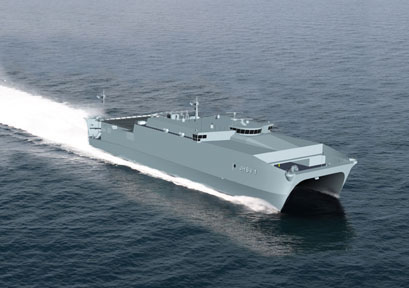 This is the press release from Austal.
The Navy will christen the Joint High Speed Vessel (JHSV) Spearhead Saturday, Sept. 17, 2011, during a 10 a.m. CDT ceremony in Mobile, Ala.I have quoted the entire press release to highlight something folks may not be fully aware of. You know that electrolysis issue the USS Independence (LCS 2) had? Well, the dirty little secret is that the Navy fully expects to have the same problems with the JHSV, but hasn't yet decided how to handle it. One of the important things to remember is that Westpac Express (and HSV Swift for that matter) is constantly on the go - it doesn't spend much time in port so the electrolysis issue doesn't have time to occur. Navy ships operate differently though, they tend to spend more time in port than say, commercial ships, which is where the bulk of Austal's experience is.
Chief Warrant Officer 4 Kenneth Wahlman, U.S. Army (Ret.) will serve as ship’s sponsor. His daughter Catherine, a Staff Sgt. in the Army ROTC attending Virginia Tech University, will assist her father in the christening, Mr. Wahlman’s wife, Chief Warrant Officer Five, Linda Wahlman, will be supporting the proceedings from afar, while on deployment with the 645th Regional Support Group in Kandahar.
The 338 foot-long aluminum catamaran, Spearhead, is being constructed by Austal USA in Mobile, Ala. Spearhead and the nine other JHSVs under contract are ideal for fast, intra-theater transportation of troops, military vehicles, supplies and equipment. They are capable of transporting 600 short tons, 1,200 nautical miles at an average speed of 35 knots and can operate in shallow-draft ports and waterways, providing U.S. forces added mobility and flexibility. The JHSVs also have an aviation flight deck to support day and night air vehicle launch and recovery operations. JHSVs have berthing space for up to 146 personnel and airline-style seating for up to 312.
Military commanders will have the flexibility to use the JHSV in a variety of roles to include supporting overseas contingency operations, conducting humanitarian assistance and disaster relief, supporting special operations forces and supporting emerging joint sea-basing concepts.
The Westpac Express, an Austal-built aluminum catamaran used as a prototype for the JHSV, has, over the past decade, served as a logistical transport for the Third Expeditionary Force (IIIMEF) of the U.S. Marine Corps based in Okinawa, Japan. The Westpac Express has paved the way for the JHSV, supporting disaster recovery operations after the Indian Ocean earthquake and Tsunami in 2004 and the Japanese earthquake and Tsunami in 2011.
Upon delivery to the U.S. Navy’s Military Sealift Command (MSC), Spearhead will be designated as a United States Naval Ship (USNS), and will have a core crew of 21 civilian mariners who will operate and navigate the ships. The first four JHSVs - including Spearhead - will be crewed by federally employed civil service mariners, and the remaining six will be crewed by civilian contract mariners working for private shipping companies under contract to MSC. Military mission personnel will embark as required by the mission sponsors.
Construction of the JHSV began at Austal USA in July, 2010. As a world leader in the design and construction of customized aluminum and defense vessels, Austal USA is based in Mobile, AL, a city with a long history of shipbuilding. Austal USA employs more than 2,000 employees. “Our workforce is our foundation. We have the finest ship designers and builders in the country, and their dedication to this project and others is immeasurable,” said Joe Rella, Austal USA President and Chief Operating Officer.
In fact, despite a lagging economy Austal USA has continued to grow, in vessel contracts and work force, making it Mobile, AL’s largest industrial employer with 2,000 shipbuilders. Spearhead was the first ship built from modules fabricated entirely in Austal’s state-of-the-art Module Manufacturing Facility. The company is in the midst of a $160 million facility expansion and plans to nearly double its workforce to complete an estimated $5.2 billion in contracts with the U.S. Navy.
Think about it.
I honestly don't see the problem as a big deal because the problem is well understood, so a solution can be found. I also look forward to seeing the Navy operate more JHSVs, because I think the Navy is going to find a lot of new ways to use these ships once they get several out operating in numbers. That's the key IMO, get ships to sailors and let them innovate. I still believe the Navy should design a JHSV version that was armed and operated by a Navy crew as a Navy ship (instead of a MSC crew) for the sole purposes of building a SOCOM capability from the sea.
More on the JHSV here.
Subscribe to:
Posts (Atom)