
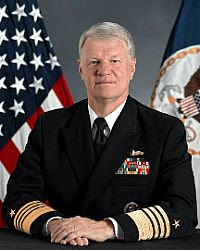
 Chris Cavas of Defense News has done what we might call a parting interview with ADM Gary Roughead. These are the last two questions, but the whole interview is worth a read.
Q. When do you see the first LCS moving to Singapore? 2014?It is interesting to note ADM Rougheads opinions on this subject. We are years away from knowing if perceived gaps have been closes, or if the acquisition organization has improved significantly, but we do know one thing for sure - ADM Roughead was the successor as CNO who was bit in the butt by the constant requirement creep pushed by previous CNOs, so it is easy to see where he is coming from on this.
A. You will see LCSs in the western Pacific sooner than that. And they’ll deploy with combat capability.
Q. As you leave office, what’s your assessment of the division of responsibilities between the Navy’s uniformed and civilian leaders, defined by the Goldwater-Nichols act?
A. From the very beginning, I put a focus on acquisition, because I knew that if we did not get stability on shipbuilding and aviation, it was going to be very problematic. There was no question we were going to come to a downturn on my watch — that was a function of just looking at defense budgets and how they cycle. I will admit that I didn’t see the severity of the economic pressures that struck the country.
I also believed that the perceptions and interpretations of Goldwater-Nichols as it applied to service chiefs and acquisition, that we in uniform had stepped away without the imperative to step away. I think we read too much into Goldwater-Nichols.
I set requirements, and I take that very seriously. I believe that in the requirements side we had become not ambivalent, but less exacting. If we came across a good idea we’d simply add that requirement on with little regard for how it would perturb the acquisition cycle. And we tended not to think in terms of what costs would come back around a couple of years later to bite a successor in the butt.
I also have the budget. I told my folks that we have an obligation to make sure we’re getting what we wanted. There were a couple of things that were very helpful. One is, I had the privilege and pleasure of serving under two secretaries who are very open to this collaborative approach. And in Sean Stackley, we have probably the best person in acquisition you’re going to find. The other thing we have going for us is very strong systems commanders.
If you go back three years, I brought all my ship program managers into a room, all my requirements folks into the room, and we had one of the best conversations for well over half a day that I’ve had. It was remarkable. You had conversations like, is that what you wanted me to do? I thought you wanted me to do this.
The point being that even though you can interpret into Goldwater-Nichols this bifurcated system, it need not be that way. What you saw over time was the CNO staff and the secretary and the acquisition executive coming together on things like LCS and saying we’ve got to fix the program; how do we fix it? And no one individual has all the levers.
I would say these perceived gaps have been closed down. I think that what has happened is that a really good environment has taken place between the acquisition organization. I think we’ve improved that significantly.
Also noteworthy - the interview focused on legacy, not the future.

No comments:
Post a Comment