Pay attention big Navy, Michael is pushing talking points on AEGIS BMD. If you want the core mission, then tell the American people why you should have it.
Shaping the issues and addressing the argument early: what the Navy does worst.

 In case you missed it, the news that seems ready to break out from under the radar is in regards to a letter from nuclear proliferation scientist A. Q. Khan that was sent to his wife. The details of the letter may give us some idea of the questions the US has wanted to ask A. Q. Khan about for some time, although access to the scientist has repeatedly been denied by the Pakistan government.
“We put up a centrifuge plant at Hanzhong (250km southwest of Xian).” It went on: “The Chinese gave us drawings of the nuclear weapon, gave us 50kg of enriched uranium, gave us 10 tons of UF6 (natural) and 5 tons of UF6 (3%).”This was before the civilian nuclear agreement between China and Pakistan in 1986 and before the Chinese supplied Pakistan with a civilian reactor in 1989. Makes it somewhat tough to believe what the Chinese say when they are proliferating nuclear weapons in private while playing up the non-proliferation position in public.
Iran's Islamic Revolution Guards Corps (IRGC) has targeted and downed an unidentified shining object after sighting it over Persian Gulf waters.Serious topics by me shall resume shortly.
"Glowing objects were sighted over the Persian Gulf. IRGC air defense targeted one of the objects successfully, forcing it to plummet and sink in the seas off Boushehr (Province)," said top regional commander, Brigadier Ali Razmjou.
"The three bright objects were detected by our radars when flying over the Persian Gulf Islands of Khark and Khargou," he added, according to a Monday report posted on IRNA.
Brig. Razmjou explained that when the radars indicated that they were not Iranian aircrafts, the IRGC fired at the three objects. He also added that the fallen objects' remains have not been found yet.
The exact time and location of the sighting and downing of the weird aircraft has not been announced.
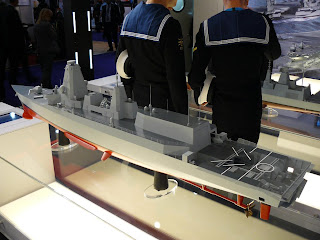 The Royal Navy is beginning to discuss their Future Surface Combatant. Janes covered the emerging ideas at DSEi 2009. The model in the picture is the BVT, described by Janes here.
A model unveiled at the show by BVT Surface Fleet has provided an initial indication of the key characteristics of the C1 variant of the Future Surface Combatant (FSC), intended to begin replacing the RN’s current Type 22 Batch 3 and Type 23 frigates from around 2020. And while officials caution that the model represents only an “early visualisation” of the C1 design concept, it nevertheless highlights some of the key attributes of flexibility, modularity and open architecture desired by the FSC programme.Then Janes discusses this.
Initial concept design work for the C1 variant of FSC has been completed by the Naval Design Partnership (NDP), a ‘rainbow’ team of naval architects and engineering specialists bringing together Ministry of Defence personnel and industry resource drawn from BVT Surface Fleet, Babcock Marine, BAE Systems, QinetiQ and Thales. The result is a baseline monohull platform, displacing in the region of 6,000 tonnes, equipped for anti-submarine warfare, naval fires, special forces support and possibly precision land attack.
One novel characteristic of the model displayed at DSEi is the stern ramp and aft payload bay area. This concept of a mission bay is intended to afford the ship the flexibility to embark different payloads, such as a towed array sonar, torpedo countermeasures, special forces boats or unmanned vehicles.There are obviously differences in what the Royal Navy needs and the US Navy needs, but it is worth noting the trend here. The Littoral Combat Ship is essentially an all out effort to maximize flexibility for various deployable payloads, where the Royal Navy needs a Type 23 replacement, a warship capable of independent operations to be the fleets workhorse. For the US Navy, the DDG-51 handles this role, but emerging European designs including FREMM and now the FSC for the Royal Navy are attempting to add partial capability for deployable payloads.
