
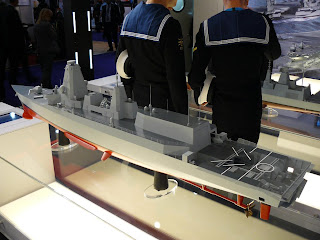
 The Royal Navy is beginning to discuss their Future Surface Combatant. Janes covered the emerging ideas at DSEi 2009. The model in the picture is the BVT, described by Janes here.
A model unveiled at the show by BVT Surface Fleet has provided an initial indication of the key characteristics of the C1 variant of the Future Surface Combatant (FSC), intended to begin replacing the RN’s current Type 22 Batch 3 and Type 23 frigates from around 2020. And while officials caution that the model represents only an “early visualisation” of the C1 design concept, it nevertheless highlights some of the key attributes of flexibility, modularity and open architecture desired by the FSC programme.Then Janes discusses this.
Initial concept design work for the C1 variant of FSC has been completed by the Naval Design Partnership (NDP), a ‘rainbow’ team of naval architects and engineering specialists bringing together Ministry of Defence personnel and industry resource drawn from BVT Surface Fleet, Babcock Marine, BAE Systems, QinetiQ and Thales. The result is a baseline monohull platform, displacing in the region of 6,000 tonnes, equipped for anti-submarine warfare, naval fires, special forces support and possibly precision land attack.
One novel characteristic of the model displayed at DSEi is the stern ramp and aft payload bay area. This concept of a mission bay is intended to afford the ship the flexibility to embark different payloads, such as a towed array sonar, torpedo countermeasures, special forces boats or unmanned vehicles.There are obviously differences in what the Royal Navy needs and the US Navy needs, but it is worth noting the trend here. The Littoral Combat Ship is essentially an all out effort to maximize flexibility for various deployable payloads, where the Royal Navy needs a Type 23 replacement, a warship capable of independent operations to be the fleets workhorse. For the US Navy, the DDG-51 handles this role, but emerging European designs including FREMM and now the FSC for the Royal Navy are attempting to add partial capability for deployable payloads.
This is why when I look at the LCS, I believe the US Navy has the concept exactly right. Every Navy in the world wants the capability of unmanned vehicles for their fleet forces, but no other Navy can afford to do it in the quantity the US Navy is attempting to do. With that said, it is yet to be determined if either LCS design will be sufficient to effectively bring unmanned technologies for integration with fleet forces. The logistics issue specifically comes to mind, although there are several question regarding the US Navy approach towards unmanned system deployment.
The Royal Navy is already hinting the next round of defense reviews will likely result in even more cuts, which suggests the fleet will potentially fall below 20 surface combatants. This hybrid design example by BVT is about the best the Royal Navy can hope for in efforts moving towards unmanned technology at sea while sustaining a surface combatant force of 20 ships. We will see, this ship is suggested to cost £400 = US$660m, but Royal Navy cost estimates are about as reliable as US Navy cost estimates. I have huge doubts a 150 meter, 6000 ton steel ship will cost less than $1 billion, and I see 0% chance of the US Navy ever building a 6000 ton ship without wanting AEGIS (in other words, only as a competitor to existing DDG-51s).
More on FSC here (PDF).

No comments:
Post a Comment