Showing posts with label Taiwan. Show all posts

Tuesday, June 2, 2024

Potential Chinese Anti-Ship Capabilities Between the First and Second Island Chains


Chinese Active Defense Layers (Office of Naval Intelligence graphic). Note that the range lines reflect where PLA aircraft and submarines might be expected to operate in wartime based on evidence to date. While PLA aircraft would be unlikely to fly further east from the second layer's line if U.S. and allied air coverage from bases along the Second Island Chain was strong, the same might not be true for PLAN SSNs. Also note that the maritime approaches to Luzon and the northern/central Ryukyus fall within the PLA's middle layer, and Taiwan and the southern Ryukyus within the inner layer.

There was a pretty lively debate in the comments to Chris Mclachlan’s post last month about the Combat Logistics Force. No one took issue with his observations that the CLF might be undersized for sustaining high-tempo forward U.S. Navy operations in the event of a major Sino-American war. Nor did anyone contest his argument that our replenishment ships lack the basic self-defense capabilities their Cold War-era predecessors carried. Instead, the debate focused on Chris’s assertion that CLF ships ought to be escorted during wartime by a small trans-oceanic surface combatant possessing medium-range anti-air and anti-submarine capabilities.
Needless to say, I agree with Chris’s view. Such an escort would be a necessary part of the overall combined arms solution set to protecting not only CLF assets but also the shipping that would surge reinforcements and materiel to embattled U.S. allies in East Asia, provide steady logistical sustainment to the U.S. and allied forces deployed to or based in those countries, and maintain the flow of vital maritime commerce to and from those countries. One rarely sees any of these four critical tasks acknowledged in discussions within the security studies community. I believe that represents a dangerous analytical oversight, as an American failure to adequately protect its own and its allies’ sea lines of communications in a war with China would be strategically disastrous. In today's post, I'm going to outline China's ability to threaten these lines in a notional major war. On Thursday, I'll outline how the U.S. and its allies might offset that threat.
Let’s first look at the strategic geography of the problem. The sea lanes in question pass through the waters between the First Island Chain and the line stretching from Hokkaido through the Bonins and Marianas to the Palaus (e.g,  the “Second Island Chain”). I’ve recently written about the PLAAF’s effective reach into the Western Pacific, and it’s been widely understood for years that late-generation PLAN submarines possess the technological capability to operate for several weeks in these waters before having to return to port. China would be hard-pressed to achieve localized sea control anywhere within this broad area; its own surface combatants and shipping would be just as vulnerable to attack. It wouldn’t need sea control, though, to achieve its probable campaign-level objectives of bogging down (or outright thwarting) an effective U.S. military response, or perhaps inflicting coercive economic pain upon one or more embattled American allies. The use of PLA submarines and strike aircraft to pressure U.S. and allied sea lines of communications would be entirely sufficient. And as Toshi Yoshihara and Martin Murphy point out in their article in the Summer ‘15 Naval War College Review, these kinds of PLA operations would be consistent with the Mao-derived maritime strategic theory of “sabotage warfare at sea,” albeit at a much greater distance from China’s shores than the theory originally conceived. Such operations have been widely discussed in Chinese strategic literature over the past two decades.[i]
It bears noting that our East Asian treaty allies like Japan, South Korea, and the Philippines would have inherent roles and responsibilities defending their sea lines of communication. Nevertheless, they probably would not be able to fulfill the mission entirely on their own given their maritime forces’ sizes and capabilities. There would probably need to be a geographical line of responsibility similar to what the U.S. and Great Britain worked out in the Atlantic during the Second World War; shipping protection west of the line would primarily be the ally’s responsibility, and the U.S. would be primarily responsible for shipping protection east of the line. Even so, the U.S. would probably still need to contribute escorts and supporting forces to assist the ally in protecting sea lanes that were within some threshold distance of the Chinese mainland. Shipping protection in the approaches to the Ryukyus, Taiwan, or western Luzon particularly come to mind.
While it is true that U.S. and allied forces could probably pressure the PLA’s ability to push submarines and aircraft through the Ryukyus’ various straits or the Luzon Strait in a war, they would probably not be able to fully seal those doors—at least not during the conflict’s early phases. The biggest reason for this would be the straits’ sheer proximity to the Chinese mainland: PLAAF/PLAN fighters would be readily able to escort their strike aircraft brethren out into the Western Pacific and back, not to mention threaten any U.S. or allied anti-submarine aircraft or surface combatants patrolling the straits. Granted, Chinese fighters would be exposed to any sea-based and mobile land-based area air defense systems covering the straits and their approaches. They might also be confronted by U.S. or allied fighters operating from austere island bases in the vicinity of the straits, or from aircraft carriers or land bases located at various distances “over the horizon” to the east. U.S. and allied defenders could additionally use any number of countertargeting tactics to reduce their susceptibility to attack.
However, even if the PLA could not damage or destroy many of these forces per raid, it could still take actions that effectively suppressed the straits “guardians.” One tactic might be to salvo land-attack or anti-radar missiles to distract the defenders or induce them to keep their “heads down” shortly before or during a straits transit. Another might be to damage runways or austere airstrips as possible in order to constrain the defenders’ air operations; repairs could take precious hours. Electronic attacks and tactical deception could also be used to screen transiting PLA aircraft and submarines. Periodic PLA suppression raids would neither be small undertakings nor without risk to the forces performing them, but they might be sustainable on an as-needed operational tempo for several weeks or months at minimum.
The other factor that would make it impossible to hermetically seal the First Island Chain barrier would be the difficulty in maintaining persistent U.S. or allied submarine coverage in all of the requisite straits. The U.S. presently has thirty-one non-special-purpose SSNs stationed in the Pacific; three are homeported in Guam and twenty in Pearl Harbor. Only a small number would be deployed at sea within quick steaming of the straits, though, unless timely indications and warning of an impending crisis or conflict were received and then acted upon by U.S. leaders. The high-readiness Guam boats would be able to arrive on scene fairly rapidly once sortied, but it would take several more days for them to be reinforced by Pearl Harbor boats—not all of which might be immediately surgeable due to inter-deployment maintenance. Japan could surely contribute a number of its sixteen modern SSs in active service, but again not all of them might be surge-ready at any given time. And while the U.S. and Japanese fleets will be receiving additional boats over the coming decade, it will not be at a rate and scale that would dramatically change the straits coverage math. Hypothetical seabed-mounted sonar arrays in these straits or their approaches might help improve these odds by cueing available U.S. or allied submarines (or other anti-submarine forces) to a PLA submarine transit. The probability of a friendly submarine intercepting a PLA submarine detected this way, though, would depend upon the time between when the cue was broadcast and when it was received by the friendly sub, how the friendly sub's effective sonar ranges in those waters affected its ability to redetect the trespasser, and whether the friendly sub could cover the distance from its starting point to have a chance at redetection before the cueing data "aged out." More than one boat might be required to cover any particular strait with a certain margin of confidence; this would be especially true for the wider straits. Nor would anti-submarine patrols in the straits be the two sub fleets’ sole mission at the beginning of a major war: there would be equal if not greater demands for land-attack strikes, anti-submarine and anti-surface patrols inside the First Island Chain, anti-submarine patrols between the two island chain lines, special forces insertion/extraction, and far-forward intelligence/surveillance/reconnaissance. U.S. and Japanese submarine coverage of the straits simply could not be absolute.
It would be excellent if U.S. and allied forces could attrite the PLA forces making or supporting straits transits by a few percent each time without suffering equivalent attrition; the cumulative effects on the PLA’s overall warmaking capacity would be significant. But it would take weeks if not months for those effects to really show. That’s why the ability to logistically sustain the land-based forces waging the protracted frontline fight would be so crucial to U.S. war strategy. If the PLA were to inflict enough pressure on these logistical flows, the barrier defense would eventually wither on the vine.
It’s also important to remember that this imperfect barrier would only function in an open war—not during a crisis. Any PLAN submarines sortied prior to the outbreak of open hostilities could in theory patrol between the two island chain lines for campaign-significant amounts of time before having to hazard a trip back through the First Island Chain gauntlet. Modern PLAN SSNs like the Type 093 and its Type 095 follow-on would have an obvious endurance advantage over Air-Independent Propulsion (AIP) boats like the Type 041, but even the latter could probably remain underway for a few weeks before requiring a return to port. During that time, the mere fact that PLAN submarines were unlocated in the Western Pacific would undoubtedly affect U.S. operations (and tempo) in theater. The Royal Navy’s experience coping with a single unlocated Argentine submarine during the Falklands War is instructive on that point.
It would not take many PLAN submarines to generate such effects. For instance, let’s assume that the PLAN allocated its Type 041s, Type 093s, and Type 095s for war-opening operations between the two island chain lines while simultaneously holding its Type 035A/B/G, Type 039, and Kilo-class diesel-electric boats back for operations within the East and South China Seas. Let’s also assume China had its planned twenty Type 041s and five Type 093s in commission, plus perhaps five Type 095s as well, when a conflict erupted. Lastly, let’s assume that these boats’ material conditions of readiness were high enough to sortie two-thirds of them into the Western Pacific as the crisis phase peaked. Thirteen AIP boats and six SSNs might not seem like a lot within such a broad expanse. However, as Julian Corbett pointed out a century ago, the most “fertile” areas for hunting ships are “the terminals of departure and destination where trade tends to be crowded, and in a secondary degree the focal points where, owing to the conformation of the land, trade tends to converge.”[ii] If the PLAN followed Corbett’s logic, it might position its submarines in waters the U.S. and its allies would have to traverse to access (or break out of) selected major ports along the First Island Chain during the war’s first weeks. Or it might assign those duties to the Type 041s and deploy its SSNs in the waters just west of the Marianas that shipping from Guam, Hawaii, or the continental U.S. might seek to traverse. Or if the Chinese Ocean Surveillance System’s (COSS) coverage between the island chain lines remained adequate after the war started, China might try to steer its SSNs into mid-transit contact with U.S. or allied shipping.[iii] What’s more, the lingering effects of a PLA conventional first strike against major U.S. and Japanese bases in the Japanese home islands and Okinawa, subsequent PLA suppression operations against U.S. or allied straits-guarding forces along the Ryukyus-Luzon line, and in-theater U.S. and allied anti-submarine-capable forces’ sheer combat load prior to the arrival of reinforcements from the U.S. suggest that at least some PLAN submarines could complete at least one full cycle from their patrol areas to port for replenishment and then back into the Western Pacific before the “happy time” window began to close. This would especially be true for PLAN submarines patrolling the approaches to the Ryukyus, Taiwan, or Luzon.
Add the PLAAF/PLAN strike aircraft threat back into the mix and it should be apparent that U.S. and allied use of the Western Pacific’s surface between the two island chain lines would likely be opposed early in a notional war. The key variables driving China’s anti-shipping potential within these waters would be COSS’s ability to provide PLA aircraft and submarines with actionable targeting cues despite intense U.S. (and possibly allied) efforts to degrade and deceive this system-of-systems, the PLA’s ability to push those forces through contested First Island Chain straits when and where needed, and the operational range and endurance of those forces. 


The views expressed herein are solely those of the author and are presented in his personal capacity. They do not reflect the official positions of Systems Planning and Analysis, and to the author’s knowledge do not reflect the policies or positions of the U.S. Department of Defense, any U.S. armed service, or any other U.S. Government agency.


[i] For instance, see Chapter 3 of Roger Cliff, et al. “Entering the Dragon’s Lair: Chinese Antiaccess Strategies and Their Implications for the United States.” (Santa Monica, CA: RAND Corporation, 2007).
[ii] Julian Corbett. Principles of Maritime Strategy. (Mineola, NY: Dover Publications, 2004), 263.
[iii] For more detail on COSS, see Section 2 of Jonathan F. Solomon. “Defending the Fleet from China’s Anti-ship Ballistic Missile: Naval Deception’s Roles in Sea-Based Missile Defense.” (Master’s Thesis, Georgetown University, 2011).

Friday, September 14, 2024

Armed Maritime Lawfare with Chinese Characteristics

Photo from a Kyodo News aircraft shows the Chinese marine surveillance ship Haijian 51 (front) in Japanese territorial waters near the Japan-controlled Senkaku Islands in the East China Sea on Sept. 14, 2012. China also claims the islets and calls them the Diaoyu Islands. At back is a patrol ship of the Japan Coast Guard. (Kyodo)

China's policy of armed lawfare for control of island territories continues, this time with Japan.
Japan says six Chinese patrol ships have entered its territorial waters near disputed islands in the East China Sea, further heightening the tensions over the uninhabited archipelago claimed both by Tokyo and Beijing.

Japan's Coast Guard said two Chinese vessels entered Japanese waters early Friday, and four more vessels arrived soon after.  The Coast Guard says it has issued a warning for them to leave.

China's official news agency, Xinhua, Thursday quoted the Ministry of Agriculture as saying the vessels would be dispatched on routine patrol near the islands to assert China's sovereignty and protect fishermen.

The rocky islets, known as Senkaku in Japan and Diaoyu in China, have been the focus of recurring flare-ups between the two sides.
Additional reading material...

Down South at Scarborough Islands near the Philippines

3 Chinese ships seen in Scarborough - PCG
Philippines ready to redeploy ships to Scarborough Shoal—PCG

A few important opinions from China

Unity brings power: this concept holds good today
Diaoyu Islands baseline announcement significant: Chinese diplomat

This map in Google Earth may help with geography to understand which islands Japan is claiming.

There is a Typhoon expected in Okinawa by Sunday night, so that may impact the ability of Japan to sustain vessels in the area. The use of civilian maritime security agency vessels has consistently been a successful tactic by China in staking claims to maritime territories, and no one appears to have a credible idea how to standing up to China's provocations. This is the new normal, and apparently a very successful way China continues to discredit the US Pivot to Asia policy rhetoric as it relates to disputed territories.

Everyone needs new ideas towards managing China's aggressive presence with government maritime agency vessels, because all indications are China has stumped the diplomats with this tactic. Secretary Panetta will be in China and Japan this weekend. He should have plenty to discuss.

Monday, April 2, 2024

BMD and Theater Stability in Northeast Asia

This is another interesting development in the context of the upcoming North Korean rocket launch. It would appear it isn't just South Korea and Japan preparing to shoot the rocket down if necessary, but Taiwan as well.
A military spokesman yesterday refused to comment on media reports alleging that two advanced anti-missile systems — the Patriot Advanced Capability-3 (PAC-3) and Tien Kung-III “Sky Bow” (TK-III) air defense systems — had been deployed in eastern Taiwan to deal with the possible launch of a North Korean rocket later this month.

Ministry of National Defense spokesperson David Lo (羅紹和) said the military was collecting information about Pyongyang’s anticipated rocket launch and added that the military had requested its anti-missile units monitor and respond to the situation as appropriate.
Something has been on my mind, and it goes back to something discussed on the blog last week by Bryan McGrath. A lot of people were up in arms about the President making the comment that he would be better positioned to negotiate with Russia on nuclear issues after the election - because he won't be running for reelection. In a democracy we elect our leaders to represent us, and we bestow upon them through that election process the trust to make decisions for the people in scenarios like a nuclear agreement with Russia. Some are really bent out of shape that the President would suggest this issue would be easier to manage after an election. I am not one of those people, the exchange itself didn't bother me, what bothered me was what Bryan quoted in the speech given the next day by President Obama in his attempt to address the issue. Specifically:
"I don't think it's any surprise that you can't start that a few months before a presidential and congressional elections in the United States, and at a time when they just completed elections in Russia and they're in the process of a presidential transition where a new president is going to be coming in in a little less than two months.

So it was a very simple point, and one that essentially I repeated when I spoke to you guys yesterday, which is that we're going to spend the next nine, 10 months trying to work through some of the technical aspects of how we get past what is a major point of friction -- one of the primary points of friction between our two countries, which is this whole missile defense issue. And it involves a lot of complicated issues. If we can get our technical teams to clear out the underbrush, then hopefully, in 2013, there's a foundation to actually make some significant progress on this and a lot of other bilateral issues.

So I think everybody understands that -- if they haven't they haven't been listening to my speeches -- I want to reduce our nuclear stockpiles. And one of the barriers to doing that is building trust and cooperation around missile defense issues. And so this is not a matter of hiding the ball, I'm on record. I made a speech about it to a whole bunch of Korean university students yesterday. I want to see us, over time, gradually, systematically, reduce reliance on nuclear weapons."
Bryan McGrath is right, the two issues of Russian nuclear weapons and Ballistic Missile Defense cannot be linked, and the President needs to seek better advice regarding Ballistic Missile Defense if he has somehow confused it with an issue he appears to care a lot about - which is a nuclear free world. I appreciate that President Obama has high goals regarding nuclear weapons, but I am not convinced at all that President Obama appreciates Ballistic Missile Defense and the strategic role it is playing in the 21st century that has absolutely nothing to do with cold war era nuclear exchanges.

Playing out before our eyes in Asia is politics of the highest order with North Korea, and it is almost certain that the President's own National Security Council has warned him by now that under no circumstances can North Korea be allowed to launch the rocket planned for launch sometime during the next 2 weeks. The Obama administrations policy for North Korea has been to break the cycle of North Korean provocations and specifically to get North Korea to stand by agreements made within the six-party talks framework. By every definition the rocket launch will repeat a cycle of breaking agreements within the six-party talks, and if allowed to be successful will signal to regional partners that the US policy for North Korea has failed - again. Given the amount of attention without detail that China is putting into North Korea over the last few weeks, it appears that China is becoming increasingly frustrated with Pyongyang like everyone else.

The US is pulling back food aid to North Korea because the US claims that the food deal agreed to last month included a moratorium on long range missile tests, and the rocket launch is seen as a long range missile test. North Korea sees the suspension of US food aid as us breaking the agreement first. Whether you agree or not that the US should be pulling back food aid, it is very hard to claim the US has broken the cycle of provocation with North Korea, and many experts are suggesting that no matter what happens - North Korea will simply test another nuclear weapon at the end of this current diplomatic dustup - which is the very definition of repeating the cycle of provocation the Obama administration policy for North Korea claims to be aimed to prevent.

All we are learning is that the Obama administration is not having any more success than the Bush administration or the Clinton administration did, and that US diplomacy with North Korea is struggling to be relevant in curbing North Korean provocative behavior under any internationally agreed upon process model. It is unknown what impact shooting down the North Korean rocket may have, although it is noted in several circles that taking aggressive action like this with North Korea is in itself a way for the US to attempt to break the cycle of provocation by North Korea - by being provocative ourselves.

I think the US should allow nations in the region deal with the rocket, and the US should simply sit back and provide support for those nations - any and all support requested, but no more or less.

Bigger Picture

Consider for a moment what it looks like if the North Korean rocket goes over Japanese soil. Would a successful shoot down of a North Korean rocket make it more or less likely that Japan would develop nuclear capabilities? What happens if Japan tries to shoot down the rocket and fails? How many scenarios exist in the upcoming North Korean launch where the outcome leaves the Japanese public asking whether they need nuclear weapons to protect themselves? I imagine the Chinese are studying the various possible answers to that last question with considerable detail.

Ballistic missile defense is playing out in Northeast Asia in front of all of us as a major strategic capability bringing allies together against a common foe. South Korea, Japan, and Taiwan are all fielding US Ballistic Missile Defense technology to - perhaps - be used to shoot down the North Korean rocket. At its core, Ballistic Missile Defense is the strategic capability in play right now that forms the foundation of our regional alliances dealing with the regional threat of North Korea, and most importantly (and something President Obama needs to apparently get a briefing on) strategic Ballistic Missile Defense is acting as an alternative for Japan to developing nuclear weapons to counter North Korean nuclear and ballistic weapons development. As a capability, the diplomatic value of Ballistic Missile Defense at this moment in time may be higher than it has ever been in the capabilities history, because BMD serves as a visible reminder of what it means to be in a working strategic relationship where United States is in full support of a nation.

I believe the scenario playing out leads to an important question and discussion - could China or Russia shoot down the North Korean rocket even if they wanted to? Short of the rocket turning towards the Chinese mainland, I am not certain even if under those conditions China could shoot the North Korean rocket down. As for Russia, they have the capability to shoot the missile down, but whether that capability is deployed, trained, and ready to respond in immediate crisis is certainly questionable - and it is important to note that the naval forces of both nations is currently not capable of deploying for purposes of strategic protection from a ballistic missile attack against a partner, friend, or in support of allies.

Both Russia and China have some of the most sophisticated ballistic missiles in the world, but neither country has a credible defense from ballistic missiles that is fielded within the context of an alliance like the US capabilities are, nor are they globally deployable like the BMD capabilities of the US Navy. BMD is a strategic capability that neither Russia nor China has as an offering to friends as a protection in a time of need. When you consider the enormous advantage legitimate Ballistic Missile Defense gives the United States at the strategic and geopolitical level with our Asian allies today, it strikes me as remarkably foolish that on any level the President could potentially be considering conceding that advantage to any competitor for any purpose in a diplomatic negotiation.

The United States should not take for granted the strategic advantage of Ballistic Missile Defense, nor how Ballistic Missile Defense capability translates throughout our alliances to our friends and allies. With all due respect to the President, the suggestion that Ballistic Missile Defense is in play in negotiations with Russia related to nuclear arsenals is a serious miscalculation on his part.

In 2012 Ballistic Missile Defense has become one of the big puzzle pieces that is keeping several of our allies (like Japan and Saudi Arabia, to name a few big ones) from developing their own nuclear arsenals, and removing that incentive from our allies in an effort to simply reduce Russia's nuclear stockpile is counterproductive towards efforts of curbing development of nuclear weapons, and potentially destabilizing in the specific parts of the world the US defense strategy is specifically committed to maintaining stability.

Tuesday, July 26, 2024

Talking Taiwan

Lots of coverage over the last few days regarding this incident last month in the Taiwan Strait.
Taiwan's Defense Ministry sent two F-16 fighters in late June to intercept two Chinese aircraft that crossed into its airspace in what it described as the first such incursion by China since 1999.

The ministry said Monday that the Chinese planes quickly turned around, and that it believed the brief incursion, which it said took place on June 29 over the Taiwan Strait, was an accident.

Luo Shou-he, a spokesman for the ministry, declined to comment on a report Monday in a Taiwan newspaper, the United Daily News, that the Chinese aircraft were SU-27 fighter jets trying to drive away a U.S. U-2 reconnaissance plane.
I don't buy this is the first time that Taiwan has had to send up fighter planes to repel an incursion by China in Taiwanese airspace since 1999, rather this happens much more frequently than we are told, and there is a reason why we are learning about this specific incident right now.
It also comes just days after John Cornyn, a Republican senator for Texas, quoted Secretary of State Hillary Clinton telling him the U.S. would make a final decision on whether to sell 66 new F-16 C/D fighters to Taiwan by Oct. 1.
Yep, that would be the reason.

Two points here. First, this incident came during the period where the US was exercising and working with the nations of the South China Sea back on June 29th. China was trying to be aggressive because they were not happy about the US activities in the South China Sea. The second and perhaps most important point here is that the Chinese actually confirmed the incident to the Financial Times before the US military confirmed it to folks like the Washington Times.

That's new.

Taiwan is the source of this incident and the opinion of this news has divided the country along political party lines. The reason we are hearing about it is almost certainly due to the discussions regarding selling F-16s to Taiwan. A lot of folks believe that selling 66 advanced F-16s to Taiwan will boost the defense of Taiwan substantially. The folks who believe that are political scientists, not tacticians.

China is aiming well over 1000 ballistic missiles at Taiwan, and 66 F-16s will go boom if a war ever breaks out between China and Taiwan. If Taiwan wants to be nasty in a fight against China, they will need high quality submarines and other sea based denial capabilities to prevent the landing of men and material from the mainland. Air superiority would be nice, but 66 F-16s can't fly from runways taking a pounding by ballistic missiles and they aren't going to be enough against China, who has the worlds largest air force. F-16s represent a symmetrical response by Taiwan to a symmetrical threat by China. This path to defense is industry driven, thus political, not strategic.

Lets be blunt though - it really doesn't matter. If for any reason war breaks out between China and Taiwan, it represents a failure of US policy in maintaining peace and stability in the Pacific, and it would represent the biggest crisis in the Pacific since Vietnam, if not World War II.

I do not know if the US will come to help Taiwan should a war break out along the Taiwan Strait, but I do know that in Section 2, Part B of the Taiwan Relations Act it states "It is the the Policy of the United States to maintain the capacity of the United States to resist any resort to force or other forms of coercion that would jeopardize the security, or the social or economic system, of the people on Taiwan."

The Taiwan Relations Act also discusses arming Taiwan, but I think that quoted section is the most important aspect of the law. Few Americans realize the Taiwan Relations Act is one of the very few laws that directly informs the Department of Defense regarding what specific purpose US military forces must be organized to do. That is not trivial, and something to keep in mind when thinking about the complexity of these issues.

----

Worth noting: Have you seen this analysis from The Jamestown Foundation by James Holmes and Toshi Yoshihara on Taiwan's Naval Strategy for the 21st Century? Worth checking out, and well timed release based on current news.

Thursday, February 11, 2024

Unpredictable Reactions

Three interesting developments with US and China.
China sent contradictory signals on Thursday about its policies toward the United States following the Obama administration's decision on Jan. 29 to sell $6.4 billion worth of arms to Taiwan.

The Chinese Foreign Ministry had threatened the day after the administration's announced [sale] that it would halt some military exchanges with the United States and would take unspecified steps to punish American companies that produced the weapon systems. On Thursday, China seemed to ease its objections to military cooperation with the United States, but the country's flagship carrier, Air China, announced that it would buy 20 A320 jets from Airbus, a European consortium, rather than from Boeing, one of the manufacturers of arms for Taiwan.
I am sure Boeing was expecting to win the deal, but the Airbus A320 is a great plane so it is possible China simply picked it over the Boeing option. Possible...

But that isn't all, earlier this week China sent an envoy to North Korea to discuss their nuclear program.
A senior Chinese Communist Party official held talks with North Korea on Sunday, state media said, as Pyongyang comes under growing pressure to return to nuclear disarmament talks.

The trip by Wang Jiarui, head of the Communist Party's international department, comes shortly before UN chief Ban Ki-moon's top political adviser Lynn Pascoe is due in Pyongyang.
May seem like no big deal, but both the engagement with North Korea on 6-party talks and allowing the Nimitz to call port in Hong Kong are activities one could have expected China to snub because of the Taiwan weapons deal.

These are very noteworthy shifts, for no other reasons than they don't conform to conventional wisdom, or said another way, the way China has historically dealt with a US policy they disagree with.

Monday, January 11, 2024

The AEGIS Perry Frigate Mod

What would an Oliver Hazard Perry class frigate with AEGIS look like? We may soon find out, if Taiwan is serious (big if). According to news reporting today, Taiwan wants to buy 8 Perry class frigates from the US, and wants to put AEGIS on them.
Taiwan plans to buy eight second-hand Perry-class frigates from the United States despite improved ties with once-bitter foe China, a local newspaper reported Monday.

The island hopes to arm them with a version of the advanced Aegis Combat System, which uses computers and radar to take out multiple targets, as well as sophisticated missile launch technology, the Taipei-based China Times said.

The defence ministry said in a reaction to the report that ageing frigates now serving the navy needed to be phased out, but that it had not yet decided on the type of vessels that would replace them.

"The overall strategy of the armed forces will be taken into consideration as the defence ministry evaluates the plan," it said in a statement, adding that the budget would be another factor to be weighed.
Taiwan already owns 8 Perry frigates, but they use the SM-1 missile that has been retired from US Perry class frigates. Adding AEGIS to the Perry class is a very interesting move, but uhm, can it be done?

Very unclear. Could a Perry class support a SPY-1F, or would it need a SPY-1K? I think significant work would be required to add AEGIS to a Perry class, but when you are paying I am sure anything is possible. With that said, I do have serious questions on the cost.

Given the interest in the Perry class among those in Congress, I am sure many are going to be watching the cost of this proposal. The SM-1s would need to be replaced, but would the replacement be SM-2s or ESSMs? I'm thinking a 64 cell ESSM launcher, but you never know. We will have to wait and see what the final 'redesign' looks like I suppose.

I don't think AEGIS is likely to happen. China will not like it at all, but more than that, AEGIS will add considerably to the costs likely making an effort to refit the Perry class cost prohibitive.

Sunday, December 13, 2024

The Never Ceasing Export Rumor

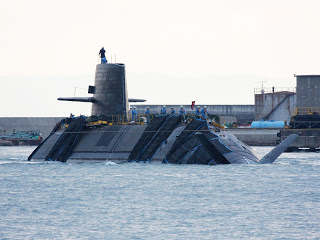
Within a week of news reporting that the construction schedule for nuclear submarines will likely change in the next budget, this was a news item I should have predicted. It can be said that new administrations often bring new policies, and this would be an interesting development, but this rumor has been around a very long time.
Washington is likely to agree to the sale of submarines to Taiwan as a gesture of good faith, according to a high-ranking ROC military official Dec. 10.
The article continues.
“Taiwan and the U.S. are still negotiating the contents of the arms sales,” a high-level security official in Taiwan said, adding that “it is incorrect to say that the decision has been finalized.”

According to this official, the U.S. Department of State is still reviewing the submarine deal. Once it notifies Congress, it will mean the administration has approved the sale. However, as far as is known Congress has not been notified, because if it had been, the ROC military should have been informed, the official pointed out.

Neither the Bush nor the Obama administration has ever agreed to the sales of F16 C/D fighter jets to Taiwan, though Taiwan budgeted funds for their purchase, the official noted.

In the military’s analysis, President Obama would first announce the sales of the less controversial 60 Black Hawk helicopters and perhaps even the diesel-electric submarines to show his goodwill toward Taipei. “The F16 C/D fighters will be put at the bottom of the list for future consideration,” the analysis indicated.
I would think the submarine deal would be a lot more controversial than the F-16s, so I am thinking this "analysis" being cited is a bit sketchy. With that said, I would not be surprised at all if President Obama approves the conventional submarine deal with Taiwan where President Bush never did. Bush was always predictable with China, but Obama has proven he is not.

This would be an interesting way to boost the submarine industry despite reducing total nuclear submarine purchases. With that said, it should be noted that neither Newport News or Electric Boat would necessarily get the contract; it could be that smaller shipyards, like Marinette Marine, would bid on any export deal given the export potential of a successful US conventional submarine design.

Thursday, October 8, 2024

Taiwans Secret New Littoral Warship

This article popped up today as the most interesting development for the Taiwan Navy in a long time. Here is a translation/summary courtesy of ID regular Altoid.
The 2010 defense budget was sent to the Legislative Yuan for approval, where the existence of a 900-ton coastal-defense missile-boat development program was inadvertently placed in the non-classified budget. This ship will have stealthed features, and will be the ROC Navy's first multi-hull (catamaran) ship class, and will be equipped with eight Hsiung Feng III anti-ship missiles.

Taiwan's mid- and small- warships were once very numerous 30 years ago, but by modern standards they are old with anemic firepower. The current main strength of Taiwan's missile craft fleet is the Hai Ou class (Dvora), and 2 200-ton Lung Chiang class, one of which was built in Taiwan, with extremely poor capabilities, with long dock stays. The other ship also has had operational difficulties, including fire. Additionally, the more recent domestically-produced Ching Chiang class has not performed to initial expectations.

Because the PLAN has recently introduced the stealthy, high-speed Type 022 into mass-production and operational service, our missile systems will be hard-pressed to counter this, and our small and large warships will be severely threatened, and our military has been grasping for a solution.

Under the DPP administration, the navy designed the Kuang-Hwa VI class missile boat, but during the contract bidding process, the contractors used business and political connections to influence the selection committee, resulting in a unfair process and numerous corruption scandals. This delayed construction, and although the program is now in mass-production, it is already inferior to the Type 022.

To match communist China's strength, the navy has secretly started a new development program, and has completed it's twin-hull design, but not the systems loadout. The 2010 defense budget has allocations for the development of the necessary systems.

According to legislative sources, this new missile-craft will have a 900-ton displacement, will be used for coastal defense, but also have the flavor of larger missile corvettes, and be specifically designed to counter the Type 022. It will have a dual-hull, stealth capability, eight Hsiung Feng III antiship missiles, auto-cannons, with a total length of 40 meters, and a crew complement of 45.
The translation is correct, but it is possible the reporter has the details wrong. Maybe not though? What exactly does a 40 meter, 900 ton SWATH armed like a FAC with a rather large crew of 45 look like? At 900 tons, it sounds like the design trades speed for sea keeping.

I have discussed the Type 022 as the Chinese Streetfighter several times on the blog, but reading this article has me wondering if perhaps Taiwan has decided to counter with its own version of the proposed SEA LANCE. A creative SWATH idea sourced to the Naval Postgraduate School, SEA LANCE (26 MB PDF) was around 50 meters and 600 tons, and was designed with 51 VLS cells. That is about the only warship design I can think of similar to what the news article is discussing.

Considering this ship is about the same dimensions as a Type 022, which is 43 meters long and goes for about 220-250 tons; is it possible the extra weight comes from armor and this design represents a new theoretical approach to littoral warfare? We don't usually put much emphasis in armor on ships anymore, and I'm not sure if armor would make a difference on a 900 ton ship.

With that said, there have been design ideas floating around to put a sort of double hulled, cage type armor around littoral ships to protect them from modern anti-ship missiles, and cover the cage with a stealth composite material to produce small stealthy missile corvettes that were survivable against a direct attack.

I'm just speculating. I look forward to seeing whether the size of this ship is reported accurately, and if so what it looks like. Building missile boats to fight missile boats strikes me as an odd approach, as helicopters are obviously the more effective approach. Still, Taiwan is smarter to build large numbers of littoral streetfighters than building more larger western frigates and destroyers, as the challenge they face is quantity not quality.

The image above is from the 26 MB report on the SEA LANCE cited in this entry.

Wednesday, August 12, 2024

Observing Typhoon Morakot

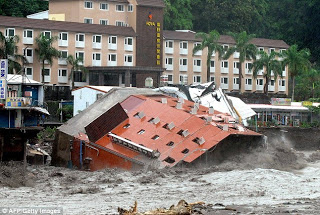
When Typhoon Morakot slammed the Taiwan coast on Sunday, news reports suggested rain would be the primary cause of damage. Those reports have proven true, as a record 118 inches of rain has been suggested to fall in some places of Taiwan, burying villages and triggering massive mudslides. This storm has created a broad disaster on the island nation, but what is remarkable is how few people the storm has apparently killed relative to the amount of rain that has fallen. There is something to be said about the preparation efforts prior to the storm, and upon observation, there is also something to be said for the emergency response by the Taiwan military.

This is an older BBC report with some video of the damage, and this is another video. I quote from this is the latest AFP article that sets the discussion.
"We have found around 700 people alive in three villages last night and 26 more this morning. We are deploying 25 helicopters to evacuate them," said Major-General Richard Hu.

Rescuers said Tuesday around 100 people in Hsiaolin were feared dead, while some media reports had speculated that up to 600 people had been killed in the landslide triggered by torrential rains brought by Typhoon Morakot.

As of late Tuesday, 219 people from Hsiaolin and several nearby villages had been airlifted to safety, Hu said.

"We believed that some were buried but it's not possible to estimate how many at this moment as almost 90 percent of the houses were buried," he said.
The latest death toll is 66, with another 61 missing and 35 injured. Rescue operations to date have included over 17,000 troops using armored vehicles, marine landing craft, and RHIBs for rescue operations. In several southern villages, the roads have been washed out. The typhoon has caused at least $225 million US in agricultural damage, and 30,000 houses were still without power. AFP also reports that 750,000 homes are without water as of Wednesday.

The storm has also moved into China, although now it is out to the Yellow Sea moving towards South Korea at much reduced strength. Among the damage reported, 6 apartment blocks collapsed due to the storm, and officials say they have managed to pull six people alive from the rubble in the town of Pengxi in Zhejiang province. The death count due to the current Tropical weather in Asia over the last week includes 23 in the Philippines due to Typhoon Morakot, 14 in Japan due to Typhoon Etau (16 have additionally been reported missing in Japan), and 6 in China due to Typhoon Morakot. To add to mother natures fury, Japan suffered from a 6.4 magnitude earthquake prompting the government to deploy 400 troops for disaster response.

What I find noteworthy though is how the USS George Washington (CVN 73) pulled into Manilla yesterday for a 4 day stay, and immediately Rear Admiral Kevin Donegan offered assistance to areas recently devastated by the Typhoon. In other words, in 2009 the forward deployed 7th fleet can get an aircraft carrier to the Philippines following a Typhoon faster than FEMA can get to the Superdome in New Orleans in 2005.

Storm season is approaching, and as it does weather is sure to be a topic of emerging interest on the blog this storm season as it has over the last few years. As is always the case, the maritime services almost always play a role not only in national response to disaster, but international response to emerging crisis following disaster in places less fortunate than the United States for resources managing crisis.

The Obama administration has made 'smart power' the emphasis of the new administrations foreign policy, and two legs of the smart power stool are humanitarian aid and disaster response. It is unclear if the DoD has been given any special political guidance beyond the Bush administration HA/DR policy in regards to these activities, but it is very clear from a political examination that HA/DR carries more emphasis as political policy for this administration, an emphasis sometimes inconsistent in the last administration. As climate change is also a major political position of this administration, it will be interesting to see if there is any noticeable activities by the maritime services in preparing for, or perhaps prepositioning for DR scenarios. After all, there is no question the 2004 Tsunami response was the major foreign policy achievement of the Bush administration, not only wiping out piracy in the Strait of Malacca but also creating a massive favorable, measurable shift in public opinion in several areas throughout Southeast Asia. That point is often overlooked, because the Bush State Department was so initially mediocre compared to the DoD in that effort.

With the George Washington arriving in Manilla just days after the Typhoon, clearly 7th Fleet gets it. It is about being in the right place, at the right time, with the right equipment. After all, according to this latest report in Science Daily, it was only last year the world saw the eighth deadliest cyclone recorded worldwide in history with a death toll that may have exceeded 138,000. Given the devastation of the 2004 Tsunami, Hurricane Katrina in 2005, and other recent Cyclones, Typhoons, and Hurricanes there will be few excuses for not being ready to respond to tragedy with prompt reassurance, - as outlined in maritime strategy.