Showing posts with label Submarines. Show all posts

Wednesday, April 22, 2024

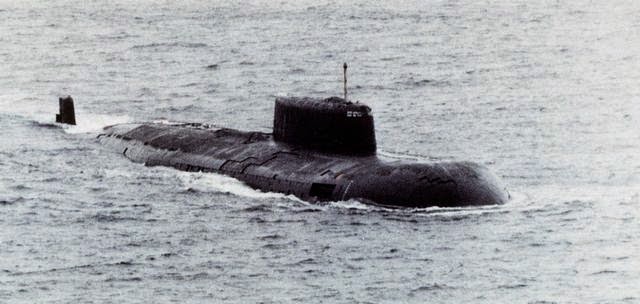
Oscar II SSGN Modernization


Oscar-class SSGN, Undated (U.S. Department of Defense)


A few weeks ago a colleague passed me a Google translation of a TV Zvezda report on the Russian Navy’s plans for fielding advanced cruise missiles . Written in reaction to ADM William Gortney’s Congressional testimony in March that touched on Russian cruise missile threats to North America, the article initially highlights how Yasen-class attack submarines will carry up to 24 3M-55 Oniks (SS-N-26) ASCMs or 3M-14 Kalibr LACMs; presumably the sub can also carry 3M-54 Klub (SS-N-27) ASCMs. This information is not new in open source reporting.
What was new, at least to me, was the article’s assertion that the surviving Oscar II SSGNs’ 3M-45 Granit (SS-N-19) ASCM launchers will be replaced with “universal launcher” cells that can each contain up to three Oniks or Klub missiles. In doing some online digging, there have been rumors on non-authoritative sites for the last few years that Oscars undergoing modernization will receive this upgrade. The Zvezda report is the first one that is authoritative.
It’s impossible for me to say whether a launcher cell that can house three Oniks or Klub missiles can actually be integrated within the former space occupied by a Granit cell. That kind of question is never as simple as ‘does the peg fit in the hole?’ For the purposes of this piece, though, I’m going to assume that the hull and mechanical implications of the change can be readily accommodated.
The takeaway is that an Oscar II with the new launcher cells would be able to carry up to 72 advanced cruise missiles. That’s very impressive. Not only would the sub pose a formidable threat to naval battleforces, but it could also pose a medium-range land-attack threat. It is reasonable to interpret Oscar IIs with these capabilities as ‘gapfillers’ that account for fiscal or technical difficulties building out the Yasen-class.
A key follow-on question, though, concerns the means by which a modernized Oscar II would receive over-the-horizon anti-ship targeting cues. The Cold War-era method for doing this was fraught with exploitable vulnerabilities. A more modern approach would still likely be dependent upon cues from reconnaissance aircraft, space-based sensors, or perhaps a shore-based fusion apparatus. None of these are devoid of exploitable vulnerabilities, either. While there is no guarantee that a U.S. or NATO battleforce would be able to effectively blind, deceive, or otherwise degrade Russian oceanic surveillance-reconnaissance-strike systems in the event of a conflict, there is no guarantee that those systems would be able to successfully target their prey either. The principles I proposed last fall for maritime scouting and anti-scouting competitions would almost certainly apply.
Another question concerns their patrol areas. I have never seen any open source reporting of an Oscar deployment outside Russia’s maritime periphery. From their 1980s introduction through the present, their principal task has been serving as part of the Russian homeland's ‘outer layer’ defense against U.S. carrier strike groups. Oscars simply could not conduct over-the-horizon anti-ship engagements very effectively outside the coverage of Russian oceanic surveillance-reconnaissance systems. With a notional land-attack capability, however, modernized Oscars could conceivably be deployed further forward. For example, modernized Oscars might be used to threaten land targets reachable from the southern Norwegian Sea, the North Sea, the Sea of Japan, or the Northwestern Pacific. This bears watching.

The views expressed herein are solely those of the author and are presented in his personal capacity. They do not reflect the official positions of Systems Planning and Analysis, and to the author’s knowledge do not reflect the policies or positions of the U.S. Department of Defense, any U.S. armed service, or any other U.S. Government agency.

Wednesday, February 4, 2024

The Coming (Invisible) War of the UUVs?

In my post earlier this week, I talked about how the neutralization or destruction of unmanned scouts during crises might not be terribly escalatory.
Following that post, a colleague pointed out to me some important and subtle differences between how anti-scouting unfolds at and above the surface versus how it unfolds underwater. The beauty of undersea operations is, of course, that their effects are almost always plausibly deniable. This is the case today with submarines, and is sure to be the case with underwater unmanned vehicles.
Nevertheless, while a submarine that fails to come home cannot be covered up, the same will not be true with respect to their future unmanned brethren. Indeed, the fact that unmanned underwater operations will generally not be publicly disclosed means that even if a country employing these vehicles realizes that one or more were lost due to hostile action during a crisis, it is extremely unlikely that its leaders would be willing to escalate outside the unmanned underwater realm. Nor would it be easy for the victim to make a strong (and publicly-releasable) case attributing the loss of an Unmanned Underwater Vehicle (UUV) to a hostile act by a specific actor.
Much like history’s many invisible peacetime ‘wars’ between countries’ intelligence agencies, it seems quite likely that there will be an continuous invisible peacetime conflict in which countries boldly employ UUVs within their opponents’ territorial seas. As detailed in works such as Blind Man’s Bluff, we saw a preview of this to some extent with respect to how special-purpose submarines were used during the Cold War. UUVs will only increase these kinds of operations’ breadth, audacity, and maybe even frequency. An even greater change will be the introduction of parallel efforts to neutralize, capture, or destroy opponents’ UUVs that enter one’s own seas. UUV proliferation might lead to the creation of ‘undersea defense identification zones’ and surveillance sensor networks that support them, with countries publicly asserting the right to interdict others’ UUVs that enter these zones. Ironically, the very creation of these networks will only encourage countries to use UUVs to map, probe, closely inspect, and even meddle with the networks’ sensor arrays and communications paths during peacetime.
All the same, countries could enforce—or trespass within—these zones with minimal escalatory risk. The greatest strategic risk would be the public and diplomatic embarrassment resulting from the capture and open display of a UUV whose nationality was clearly marked or otherwise unmistakable. Perhaps, then, the most critical defensive capability installed in a UUV will be its ability to recognize it has been discovered, break back out into international waters, and break contact with its hunters. It certainly won’t hurt to design unmarked UUVs with difficult-to-attribute technical origins for use in the most audacious of missions, either.

The views expressed herein are solely those of the author and are presented in his personal capacity. They do not reflect the official positions of Systems Planning and Analysis, and to the author’s knowledge do not reflect the policies or positions of the U.S. Department of Defense, any U.S. armed service, or any other U.S. Government agency.
Tuesday, January 29, 2024

Arguing for Submarines, The Advanced Course

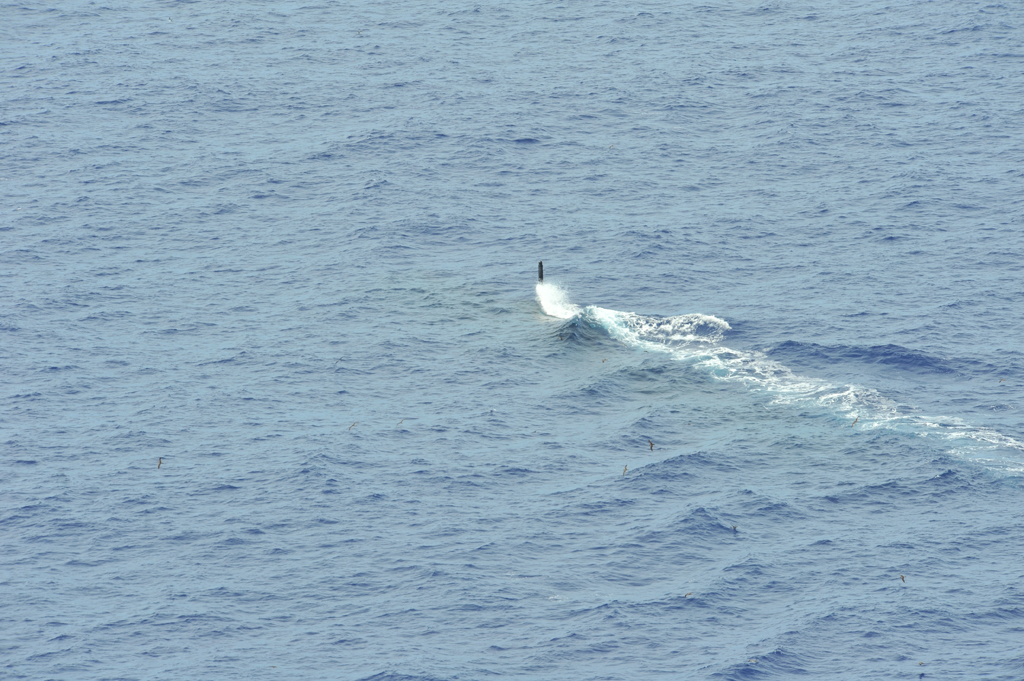
The Periscope of HMAS Farncomb, on the Pacific Missile Range Facility (PMRF) off Hawaii, moments after a successful Sink Exercise (SINKEX) at RIMPAC 2012. HMAS Farncomb fired a Mark 48 Torpedo into the hull of former US Navy Ship Kilauea striking the ship below the bridge. The hulk broke in two and sank. Mid caption: Australia is one of 22 nations attending RIMPAC that includes six submarines, 40 surface ships and an aircraft carrier participating in a realistic maritime warfare scenario. Australian soldiers from 1 RAR are also participating in the amphibious aspect of the exercise, alongside US Marines. RAAF AP-3C Orions and a Wedgetail are also providing air support. Link
Submarines and Maritime Strategy - part 1. When was the last time you read an argument for submarines like that from a US Navy officer of any rank in the context of maritime strategy?

No seriously, that wasn't a rhetorical question, I'm curious when the last time was and what the article was, so I can go read it.

That's a pretty impressive post Justin. I actually sympathize with Nic Stuart, because I have made some arguments on this blog more than a few times that resulted in a Navy Captain response that made me feel really foolish. If Nic didn't feel that way after your post, he may need to read it again.

Thursday, November 10, 2024

Venezuelan Navy Chases Off Nuclear Submarine

President Hugo Chavez told the media yesterday that his military forces detected a nuclear submarine near the island of La Orchila, where the Venezuelan military is currently conducting training.
"It was pursued. It escaped because it's much faster than ours," Chavez said, referring to Venezuela's diesel-powered submarines. He said that judging by its speed and size, "it's a nuclear-powered submarine."

Chavez said his government was unable to say what nation might have sent the sub. "We can't accuse anyone," Chavez said, adding that his government is investigating.

The leftist leader has long had tense relations with the United States, and has recently called the U.S. together with its European allies "the empires."

"Now you know how the empires are used to going around the Caribbean Sea and going everywhere, and they also use their satellites for espionage. It's espionage," Chavez said.
Chavez is correct - it is espionage.

If this story is true, what is noteworthy is that the submarine CO apparently realized the submarine had been detected and was able to get his submarine away and disappear.

There is nothing to analyze from this incident without more information, but any detection of a possible US, UK, or French nuclear submarine that makes its way into the media under any circumstances is noteworthy.

Monday, November 7, 2024

The Future Of The Norwegian Submarine Force

Just as any other Western country at the moment, the Norwegians are conducting a defence review.
Their most recent study is into the submarine force. The Ula-class submarines are expected to be end-of-life in 2020.
And like anyone would expect, the first conclusion of the study was that nothing but a submarine can replace a submarine.
In the study, three different options for a  future submarine capability have been assessed:
1. No investment. This means no more Norwegian submarine capabilities after 2020.

2. Keep a submarine force. This may involve several solutions, including extending the life of the current Ula-class, or acquisition of new submarines.

3. Alternatives for submarines. The alternative is existing and new equipment in the military that together can fulfill the tasks the submarines are currently performing. Think increased weapon and sensor outfits and a higher availability of platforms.

The study concludes that option 2 seems to be the best solution to meet requirements after 2020.

The government has decided they want continuation of the submarine force after 2020.
The next decision to be made is the choice between life extension for the existing Ula-class submarines and the acquisition of new submarines, or a combination of these two.

Expect a preliminary decision in 2014 at the earliest and a final one in 2017.

Wednesday, November 2, 2024

Acceptable Asymmetry

I have some thoughts on submarine proliferation over at WPR:

As the threat of war with the Soviet Union faded and then vanished, many of the platforms necessary for ASW also disappeared, as did the tightly integrated systems of cooperation necessary for sharing information. As the theater of operations became increasingly undefined, the knowledge of local ocean and weather conditions crucial to locating and attacking submarines became harder to access and catalogue. The relationships tying organizations and nations together also weakened as hunting submarines became a less pressing priority. As the “system of systems” on which ASW depended disintegrated and uncertainty took its place, the balance of power shifted in favor of submarines and access denial. In the absence of an effective ASW capability, preparing to control a battle space in the South China Sea, the Sea of Japan or the Arabian Sea became a daunting prospect.

But the perceived effectiveness of submarines as an area-denial weapon in some ways led to their emergence as power-projection platforms. The threat of enemy submarine attacks can make a navy wary of dispatching aircraft carriers or surface warfare vessels on strike missions. In such an environment, however, submarines can still carry out strike missions at relatively little risk to themselves. The conversion of four Ohio-class ballistic-missile submarines into cruise-missile platforms represents one manifestation of such a shift to conventional offensive strike capabilities, whose effectiveness was demonstrated by the performance of USS Florida during the Libya operation. This shift means that even as countries like Iran build their anti-access capabilities in part through expanding their submarine forces, the United States and the United Kingdom retain difficult-to-counter strike assets.

Friday, October 28, 2024

SSNs for Canada - Potentially a Bargain

CBC News is reporting that the Harper Government is at least pondering the idea of cutting their losses with the Victoria class submarines and replacing them with nuclear submarines. The Victoria class submarines have been plagued with problems since being acquired from the UK, and despite being described as the "military bargain of the century" when purchased for $750 million in 1998, they have become anything but.

The submarines are currently all out of service, with HMCS Victoria the soonest to potentially return to service by late next year. The article describes the issues.
One of the subs, HMCS Chicoutimi, has been in active service of the Royal Canadian Navy exactly two days in the 13 years since it was purchased from the Brits.

The Chicoutimi caught fire on its maiden voyage from the U.K. to Canada, killing one sailor and injuring a number of others.

It has been in the repair shop ever since, and isn’t expected back in service for at least another two years and $400 million more in repairs and retrofits.

The article goes on:

The other three would remain out of service until at least 2013. One may not be out of the repair shop until 2016.

By that time, the submarines will have cost taxpayers an estimated $3 billion, almost enough to have bought all new subs in the first place.

But the real problem is that by the time the whole fleet is in active service for the first time in 2016, the submarines will already be almost 30 years old with only perhaps 10 years of life left in them.

High-ranking sources tell CBC News the government is actively considering cutting its losses on the dud subs, and mothballing some if not all of them.

Defence Minister Peter MacKay is hinting they might be replaced with nuclear submarines that could patrol under the Arctic ice, something the existing diesel-electric subs cannot do.
I'm not sure how the costs break out over a single budget year, but based on the article it sounds like Canada has already spent $1 billion and will spend $2 billion more by 2016, which suggests costs that average around $500 million over the next 4 years. That's a lot of money just to get 10 years out of four SSKs.

If we do the math, basically the Harper government is faced with the very real problem. The repair costs will earn Canada 4 Victoria class SSKs that are already old for an investment cost of at least $75 million annually per submarine, and at the same time India is leasing the significantly more capable and new Russian SSN K-152 Nurpa for $900 million over 10 years - $90 million annually.

Something tells me Rep. Joe Courtney (Conn) could come up with a few ideas here - just saying. What would it cost to refuel and refit a Los Angeles class submarine for a second time to add 15 or so more years to the submarine? In 2005 the cost was slightly over $200 million, so even if we estimate the total refit per submarine to be around $350 million (serious modernization), Canada would only be spending $1.4 billion for four SSNs with a service life of 15 years vs $2 billion for four SSKs with a service life of 10 years. Another big advantage for Canada would be they could use the rest of the money to put their sailors through existing US Navy submarine training schools and use existing US contractor services for upkeep, both of which would allow Canada to save a bunch of money.

The cost difference for the hardware would be $25 million per sub per year for SSNs vs $75 million per sub per year for SSKs. While it is true the operational, maintenance, and personnel costs will be higher for SSNs than it would be for SSKs, there are likely enough cost savings to be gained through existing US infrastructure that it's hard to believe the SSNs would be so much more expensive as to make it a bad deal.

I'm just floating this idea, but really trying to highlight that leasing Los Angeles class SSNs would likely be cost neutral (or perhaps even cost saving) for the Harper government given the big problems Canada is facing with the Victoria class.

I don't know if the US Navy even has four 688s that they would be willing to sell to Canada (although in a time of short term budget cuts impacting the Navy, now is the time to talk about this type of thing). I also don't know if the US and Canada can work out a realistic agreement that would give Canada the ability to utilize US Navy infrastructure for training and other services related to 688s. I do know that going down the road of supporting foreign SSNs would be good for either/both Electric Boat and Newport News, because when one looks at the trends they are having in Australia with their submarine industry - a deal with SSNs with Canada now would go a long way towards getting process and framework for this type of high end military deals in place so when our next very close ally comes along - we have a system and experience in place to support such agreements.

Friday, September 23, 2024

Blame the Vodka

I am in disbelief in the epic fail described in this Associated Press story.
The Russian navy says that one of its nuclear submarines has been hit by a fishing trawler and suffered minor damage.

The Interfax news agency quoted Pacific Fleet spokesman Roman Martov as saying that the collision occurred Wednesday in the Avachino Bay on the fareastern Kamchatka Peninsula.

Martov said Thursday that the incident caused no injuries and inflicted only "insignificant" damage to the anchored submarine. Interfax quoted the navy as saying that there was no radiation leak.

Martov said the submarine's crew had seen the approaching trawler and tried to warn it of the imminent collision, but the vessel ignored the signals. Interfax reported that a navy inspection team checked the trawler and found all of its crew drunk.
The submarine that was reported to have been hit is the Svyatoy Georgiy Pobedonosets (Saint George the Victorious) (K-433), a Delta III class submarine capable of carrying 16 nuclear ballistic missiles. At anchor in the bay it is unlikely the submarine was carrying the missiles, although that has not been confirmed.

I nominate Russian fishing trawlers as the asymmetrical weapon of choice for the next attack against the Pacific fleet Russian nuclear submarine fleet, because apparently all one needs is a little vodka to get right up to the hull of a Russian nuclear ballistic submarine. I find that more than a little disturbing. Where is the armed escort for an anchored nuclear ballistic submarine? Someone please tell me it isn't this easy...

Stories like this seriously makes me wonder how well the Russians protect their nuclear technology.

Monday, September 12, 2024

Magnifying our Sub Force's ISR Capabilities


Submarines bring an amazingly unique and valuable capability across the spectrum of operations from irregular warfare to sea control. This recent post brought some interesting discussion on the roles of submarines, including the usual debate on purchasing SSKs vs. SSNs.

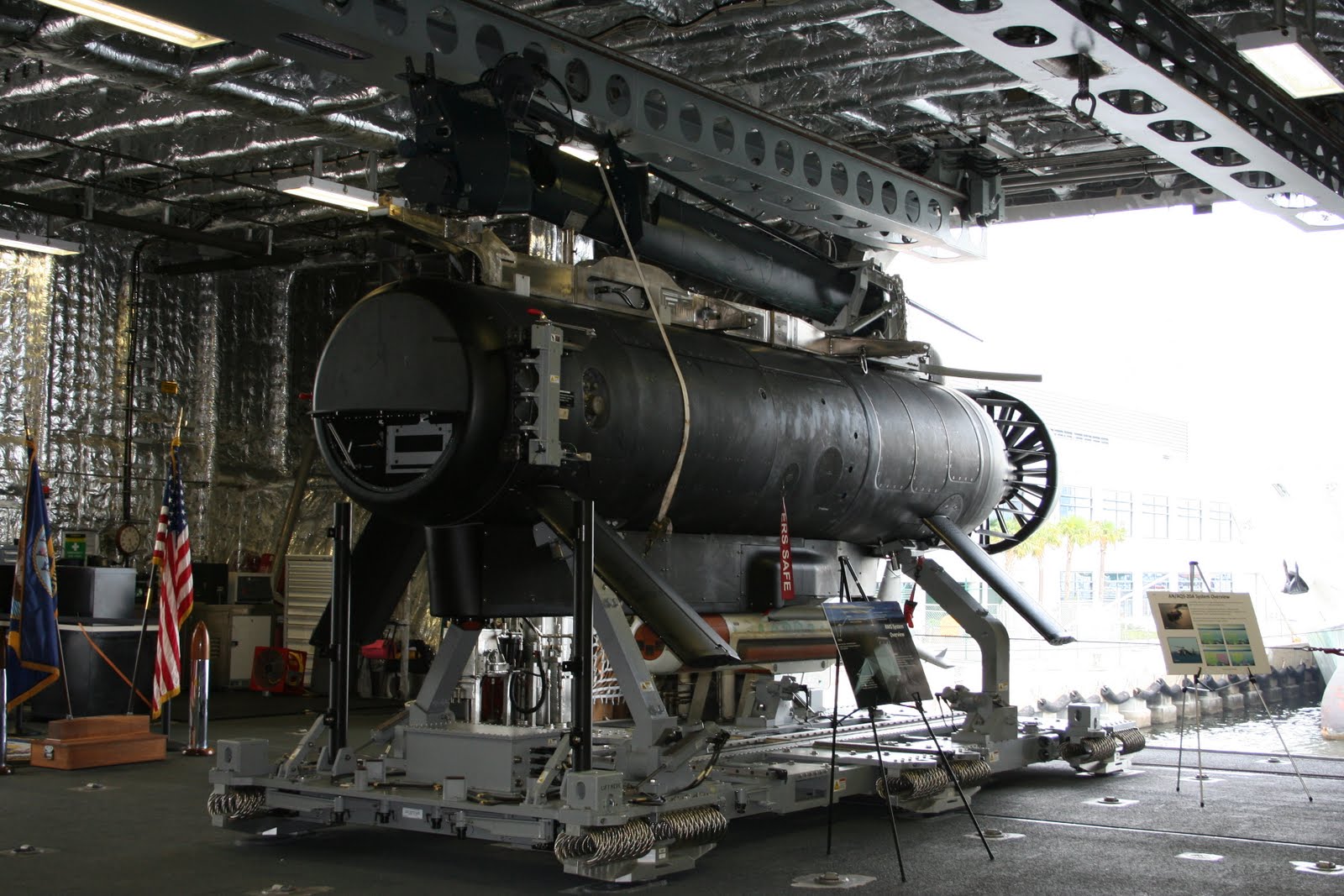
One of the important missions for subs in both wartime and peacetime is ISR. See this article for a good explanation of this and other sub roles. Mainly, "the unique look-angle provided by a submarine operating in the littoral region enables it to intercept high interest signal formats that are invisible to reconnaissance satellites or other collection platforms." Submarines bring two primary traits to intelligence collection operations: stealth and persistence. There may be another, even more affordable way to bring additional sub-like ISR capabilities to the US Navy than acquiring SSKs. The above photograph is the AN/WLD-1 semi-submersible autonomous vehicle/Remote Mine hunting System with attached AQS-20 (inside the mission bay of LCS-2). The system’s low profile, endurance, and remote operating capability could be married to submarine mast sensors to enable surface ships - LCS, HSV, or practically any combatant. The system can also be launched and controlled from the shore, which would work in some situations to surveil coastal areas. The “black boxes” and ISR dissemination infrastructure is already in place.

Modern nuclear submarines are very expensive, but worth every penny. However, it is unlikely that near to mid-term acquisition budgets will be able to increase the size of the force much, if at all. Rather than moving to less capable diesel subs, modifying some WLD-1s for ISR duties would allow our SSN and SSGN forces to focus on other missions.

The opinions and views expressed in this post are those of the author alone and are presented in his personal capacity. They do not necessarily represent the views of U.S. Department of Defense, the US Navy, or any other agency.

Wednesday, July 6, 2024

It's Cruel to be Kind...

Here's an uncharacteristically poor post from ThinkProgress Security:
The Defense Department’s budget request calls for $24 billion to be invested in Shipbuilding and Maritime Systems. Of these funds, $3.2 billion is to be invested in the construction of two new first-rate Virginia-class nuclear powered submarines. The true value in these boats lies in “deep ocean anti-submarine warfare.”

However, it’s unclear what practical value these submarines will serve. These subs probably aren’t particularly useful in combating non-existent al Qaeda and Taliban submarines on missions taking place in land-locked Afghanistan. Moreover, as CAP’s Larry Korb, Laura Conley, and Alex Rothman noted, “The U.S. Navy currently possesses more firepower than the next 20 largest navies combined — many of which are U.S. allies.” The U.S. has 11 aircraft carriers. In comparison, Italy, the second largest carrier fleet, maintains two. Morever, Yet, the Navy has shown no desire to cut the production of these vessels.

Meanwhile, in his recent address laying out his Afghanistan policy, President Obama said, “America, it is time to focus on nation building here at home.”

Okay... dude's an intern. Keep that in mind; most of this post is going to contain very little that's new for the readers of this blog. First things first, there are entirely plausible arguments that one could make against the procurement of additional Virginia class submarines. I don't think that the arguments are all that great; the Virginia class seems to me, on balance, to be a pretty good investment. But here are two arguments that are really terrible:
  1. Submarines can't fight the Taliban.
  2. We have lots of aircraft carriers.

Let's take these one at a time. The first one is a) irrelevant, and b) wrong. Even those who believe that the United States should concentrate on the wars it's fighting right now would normally allow that there may, in the future, be different kinds of wars that require different systems. While the war in Afghanistan continues, we probably shouldn't invest every single penny of the defense budget in Virginia class subs, but maintaining a balance between current and future needs is altogether sensible. Second, nuclear attack submarines are equipped with VLS tubes that can launch Tomahawk missiles that have been used against targets in Libya, Afghanistan, and elsewhere.

Second, aircraft carriers aren't submarines. They are different platforms with different and complementary capabilities. The problems that are solved by one can't always be solved by the other. That the United States possesses superiority in aircraft carriers tells us very little about the requirements for nuclear submarines; indeed, given that aircraft carrier battle groups normally operate with nuclear attack submarines, more carriers means that more subs are needed.

Moreover, American predominance in the aircraft carrier arena simply doesn't extend to submarine dominance. The USN currently operates fifty-four nuclear attack submarines. The PLAN currently operates sixty-one attack and diesel-electric submarines of various types, and is building subs at a faster rate than the USN. China's subs are older and less effective, but the PLAN lacks the global commitments of the USN. The United States Navy maintains superiority by having newer, more capable boats, like the Virginia class. Finally, Chinese subs aren't the only guests at the party; lotsa folks in East Asia are buying subs. The bulk of the US attack submarine force consists of Los Angeles class boats, which are 15-30 years old and retiring at the rate of roughly two per year. There are also a host of issues associated the industrial capacity to build nuclear submarines; long story short, it's not so easy to ramp production up and down.

That's a lot, but the gist is that you need to have an idea of what you're talking about before you write a post like this. There are many assumptions underlying the notion that building two new Virginia class submarines is a good idea. Maybe the United States Navy doesn't need to maintain its edge over the PLAN, maybe 688 class subs can be life-extended, maybe the Virginia class has problems, maybe the USN should rein in its global commitments, maybe the defense budget is too large and should be cut, etc. A post contesting plans to build the two submarines should deal with at least some of these assumptions in specific terms; it's not enough to justify the cutting of a specific program with the argument that "we need to do nation-building at home."

Friday, July 1, 2024

Pakistani Deterrent

I don't completely hold to the notion that more nuclear weapons produce a more peaceful world. Nuclear countries tend not to fight, but expanding the number of nuclear powers increases the chance of accidents, misunderstandings, and general unpleasantness. The stability-instability paradox also needs to be taken seriously; nuclear power can undertake brinksmanship if they don't believe that general war is possible. Finally, while I think that the established nuclear powers have some responsibility for (not to mention interest in) helping emerging nuclear powers deploy their weapons in the safest possible manner, I don't think that this extends to shipping a "triad in a box" to whomever manages to detonate a nuke. All that said, I'm not sure that I hold to the gist of Galrahn's argument regarding Pakistani submarine acquisitions:
For those who got lost in the trade speak, basically China is exporting submarines specifically designed to deliver nuclear weapons. The submarines will be armed with cruise missiles designed, built, and delivered by China to Pakistan intended to launch Pakistan nuclear warheads.

The most troubling part of this article is that it is very probably accurate. The article is worth reading in full, as it also claims China is giving the Pakistan Navy two Jiangkai I-class Type 054 frigates.

Okay... but let's be clear about just what is troubling. Pakistan may, with Chinese assistance, be building a submarine based nuclear deterrent. India is doing the same thing, only with Russian assistance. Whereas India's program is similar in nature to the submarine based nuclear deterrents of Russia, China, the US, France, and the UK, Pakistan seems to be opting for a path similar to that of Israel. The submarine leg of the nuclear triad, as we know, is the most survivable, although cruise missile equipped subs are more vulnerable and less useful due to the fact that they must close with their targets before launching.

And so, what's the problem? While Pakistani second strike capability isn't great if your goal is to nuke Pakistan, on balance I think reducing Islamabad's paranoia is a good thing. If the concern is Pakistan's tight relationship with China, I think that ship has already sailed; China and Pakistan have compelling reasons for the close strategic relationship they've maintained for the past fifty years. If the concern is the political unreliability of the Pakistani Navy, then this is something we obviously need to take seriously and deal with productively. The idea of a Pakistani submarine equipped with nuclear armed cruise missiles and operated by a rogue crew is genuinely alarming. The best way of dealing with this might be to expose the Pakistani Navy to the best practices of established nuclear powers for maintaining control of their submarine based nuclear deterrents (which would presumably go somewhat beyond repeated viewings of Crimson Tide and Hunt for Red October). Reminding the Chinese of the potential negative effects of a nuclear armed sub controlled by Islamists might also be called for.

But in any case, as with most threats we should be as specific as possible regarding which value is actually threatened, and how that threat is manifested. This is important in terms of the ongoing discussion about the merits of a cooperative vs. competitive/hegemonic maritime strategy; is the problem posed by nuclear-equipped Pakistani submarines fundamentally of a competitive monitor/hunt/kill nature, or is it a cooperative training/socialization nature? This matters quite a bit, and not just for Pakistan. I think, for example, that in light of nuclear deterrence theory, focusing US capabilities around hunting and killing Soviet boomers in the Arctic probably wasn't either the best use of resources or particularly wise on its own merits. This is to say that even in the context of strategic relationship that are broadly hostile/competitive, there are almost always substantial gains to be realized through a cooperative focus.

Wednesday, June 29, 2024

China Exporting Submarines For Pakistans Nuclear Triad

From the June 2011 issue of FORCE magazine, an Indian National Security and Defense magazine, comes this remarkable article.
Pakistan’s efforts to have a sea-based minimum credible nuclear deterrent vis-a-vis India took a significant step forward last month when the state-owned, Wuhan-based China State Shipbuilding Industrial Corp (CSIC) ferried the first Qing-class conventional attack submarine (SSK) to Shanghai to begin a year-long series of sea trials, which is likely to include the test-firing of three CJ-10K submarine-launched, 1,500km-range land attack cruise missiles (LACM) capable of being armed with unitary tactical nuclear warheads. Called the Qing-class SSK, it is a variant of the Type 041A Improved Yuan-class SSK, which is also due to begin its sea trials later this month.

It is now believed that the contract inked between CSIC and Pakistan early last April (see FORCE April 2011, pages 16-17) calls for the CSIC’s Wuhan-based Wuchang Shipyard to supply six Qing-class SSKs, all of which will be equipped with a Stirling-cycle AIP system and will be able to carry up to three nuclear warhead-carrying CJ-10K LACMs each. The double-hulled Qing-class SSK, with a submerged displacement close to 3,600 tonnes, bears a close resemblance to the Russian Type 636M SSK, and features hull-retractable foreplanes and hydrodynamically streamlined sail. The first such SSK was launched in Wuhan on September 9 last year, and a total of three such SSKs are on order from China’s PLA Navy as well. The AIP system for the Qing-class SSK was developed by the 711th Research Institute of CSIC. R&D work began in June 1996, with a 100-strong team of scientists and engineers led by Dr Jin Donghan being involved in developing the Stirling-cycle engine, while another team led Professor Ma Weiming of China’s Naval Engineering University began developing the all-electric AIP system. The two projects entered the production engineering stage in 2007, with the Shanghai Qiyao Propulsion Technology Ltd, a wholly owned subsidiary of the 711th Institute, becoming the principal industrial entity charged with producing the AIP system. Incidentally, the Qing-class SSK’s all-electric propulsion system is a derivative of a similar system that was developed about a decade ago for the PLA Navy’s six Type 093 Shang-class SSGNs and three Type 094 Jin-class SSBNs.
For those who got lost in the trade speak, basically China is exporting submarines specifically designed to deliver nuclear weapons. The submarines will be armed with cruise missiles designed, built, and delivered by China to Pakistan intended to launch Pakistan nuclear warheads.

The most troubling part of this article is that it is very probably accurate. The article is worth reading in full, as it also claims China is giving the Pakistan Navy two Jiangkai I-class Type 054 frigates.

Thursday, May 19, 2024

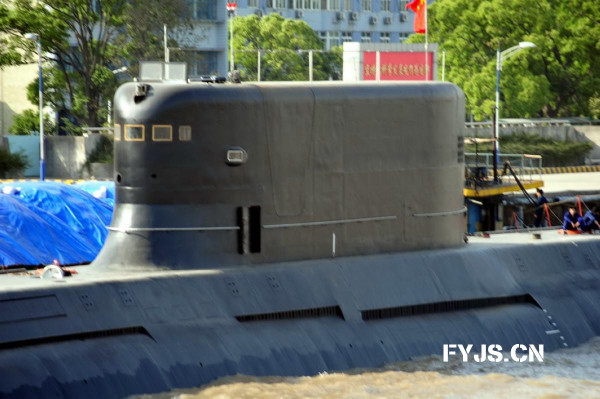
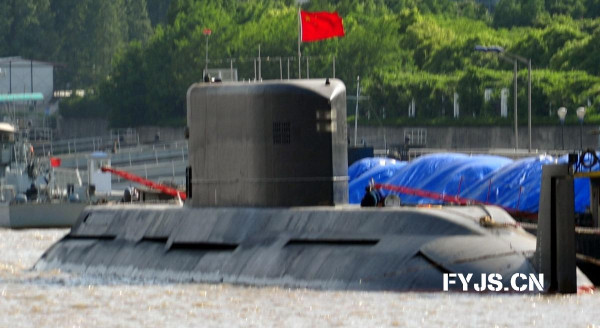
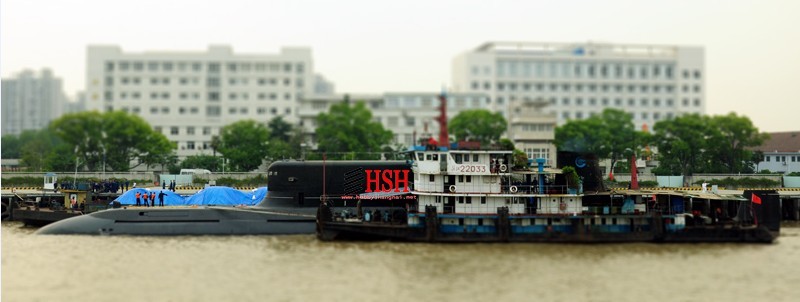
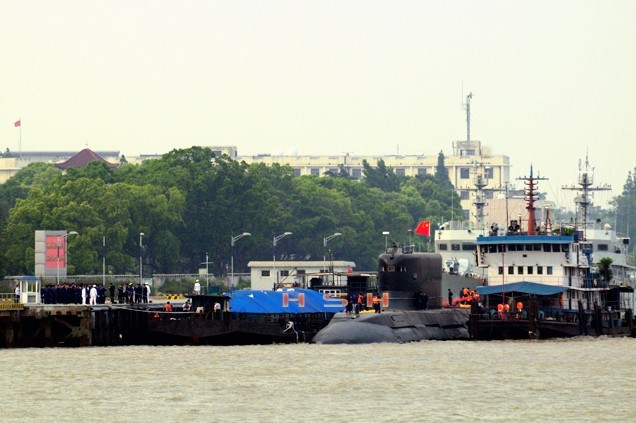
Submarine Speculation on New PLA Navy SSK

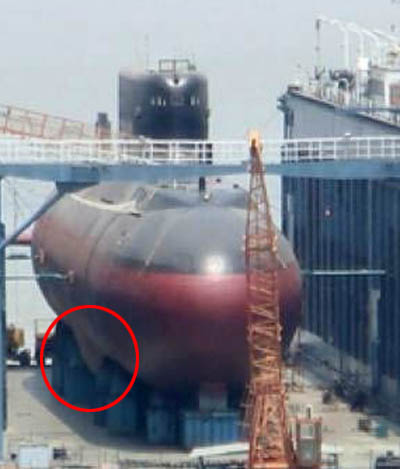
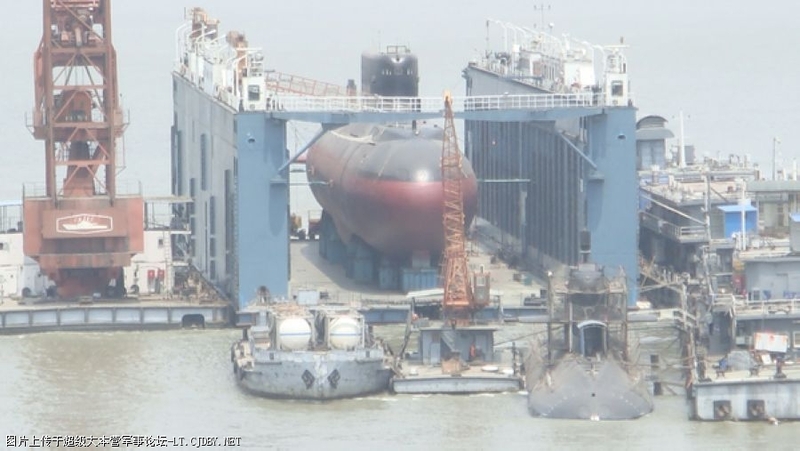
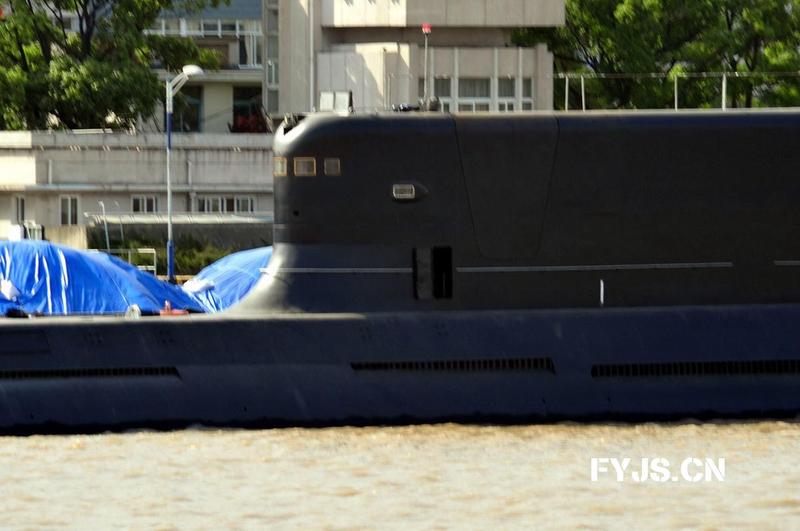
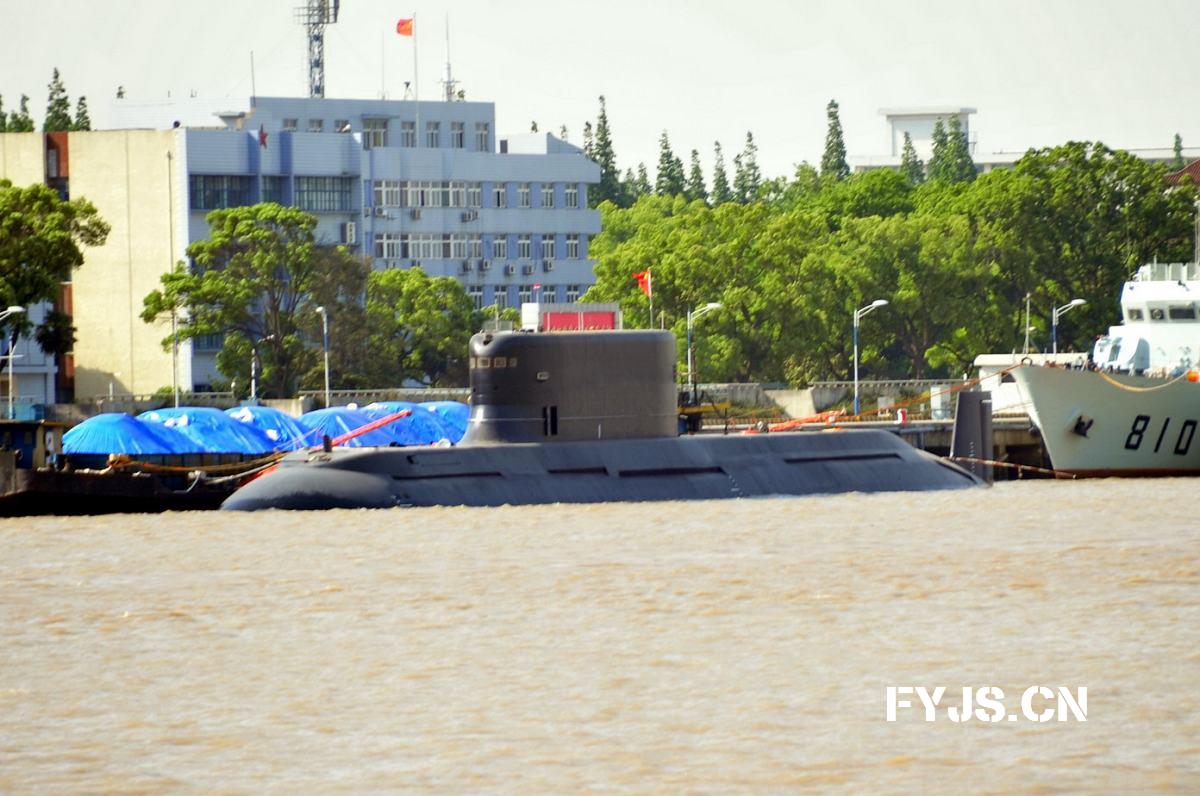
When I first saw these pictures of the new PLA Navy SSK, my first thoughts were of the old Golf class conventional ballistic submarines like the K-129 discussed in Norman Polmar's latest book Project Azorian. But as I look closer and think about it, I think what I am seeing is something of an evolution leveraging a similar design concept.

You may have to open the third picture up and look closely to see what I'm talking about, but there appears to be some sort of large hatch built into the sail. If I was to guess based on what I am seeing, I think China has developed a special operations SSK to augment their Yuan class SSKs.

I haven't seen this idea floated around anywhere except on an old Russian navy forum back in the late 90s, but the concept is very similar to what the US Ohio SSGNs do today with special operations, but instead of using a large SSBN type hull, one would accomplish the same thing on the cheap using a SSB type design similar to the old Golf class.

Just as the old Golf class used to launch ballistic missiles out of the sail, the special operations SSK would require a larger sail to act as stores for a special operations capability.

Another thought... look at the size of that submarine. For a SSK, it is flat out huge, and likely runs somewhere between 3000 - 3500 tons displacement when fully loaded (if not more). Is it even possible the Chinese are fielding SSBs for the purpose of taking their anti-ship ballistic missile like the DF-21 to sea as a way to make that capability mobile, or as a way to extend the range from the Chinese coast even further?

From a naval tactical theory perspective, it would be very similar to old Soviet tactics where SSNs and SSKs functioned as US fleet hunters for Soviet SSGN shooters, and it might actually work if indeed the anti-ship ballistic missile homing system was effective enough to organically detect and strike at the largest target in a general area as is claimed.

Like I said, I am guessing. It looks like a big ole fleet SSK with some extra features, but that is the analysis from my untrained eye. I'd appreciate the opinions of more experienced observers.

PS: In the second photo, the submarine in the water is a new Yuan class. According to some sources, both submarines in the top two pictures (photos that are now several days old) are claimed to have recently moved to a naval base near Shanghai for sea trials, which may explain why we now see this latest photo of this new SSK in the water.

HT Kursed

Thursday, January 27, 2024

Nimrod Gap

I do wonder if the key problem in the loss of the Nimrod was the inability to explain the importance of the aircraft in relatively simple and coherent terms.
Former British military chiefs said Jan. 27 the scrapping of a fleet of Nimrod surveillance aircraft will create a "massive security gap" and leave Britain's Trident nuclear submarines vulnerable.

In a letter to the Daily Telegraph, they said the decision to shelve the program for nine MRA4 Nimrods to save money is "perverse" and could inflict serious long-term damage to Britain's interests.

Ministers took the decision last year to scrap the 4 billion pound ($6.4 billion, 4.6 billion euro) fleet of planes, the latest version of the veteran sub-hunter, as part of deep defense cuts.

The Nimrods can detect and sink submarines and play a key role in drug-smuggling and counter-terrorism operations.

I also suspect that the division of ASW responsibilities between the RAF and the RN helped undermine advocacy efforts for the aircraft.

Saturday, January 22, 2024

On Spooks and Subs

Very rarely do people talk about all the interesting things submarines do, except maybe this article.
Revelations by prominent British journalist and author Gordon Thomas in his latest book, Inside British Intelligence: 100 Years of MI5 and MI6 , published last year, show Britain's foreign secret intelligence service mounted an operation to thwart the Chinese arms delivery to Zimbabwe in April 2008.

"Britain's intelligence services have increased surveillance of China over the years because of China's activities in Africa. In April 2008, MI6 asked for one of the Royal Navy's nuclear Trident-class submarines to track a floating arsenal of weapons and bombs dispatched by the Beijing regime in China on board a rust-stained freighter, the An Yue Jiang, to President Robert Mugabe's pariah state of Zimbabwe," Thomas says.

"On board were 1000 rocket-propelled grenades, 2000 mortar rounds, and three million rounds of ammunition. MI6 agents in South Africa believed the arsenal was intended to further cow Zimbabwe's starving population (after the disputed elections)."

Thomas says Britain, using its MI6 operatives and the Royal Navy's nuclear Trident-class submarine, tracked the Chinese ship - nicknamed "Freighter of Death" - along the coast to ensure it did not offload the cargo, while London and Washington ratcheted up diplomatic pressure to prevent any country in the region from allowing the delivery of the arms to Mugabe.

"Denied landing rights by dockers in South Africa's Durban port, the freighter began to wander around the South Atlantic while Chinese officials in the home port of Ningbo sought other ports in Africa where the cargo could be unloaded and sent by road to Zimbabwe," Thomas says.

"Intelligence sources in London confirmed that secret approaches had been made to Equatorial Guinea, Benin and Ivory Coast. None, however, allowed the ship to dock and off-load its weapons."

Thomas says his sources had told him Mugabe could even approach Venezuelan President Hugo Chavez to repackage the arms and ship them to Zimbabwe under disguise.

"The Trident - one of the four in the fleet which is based in Faslane on Scotland's Clyde - continued to track the freighter until it suddenly hurried to its home port late in May 2008," Thomas says.

"The black-hulled Trident submarine covered with sonar-absorbing anechoic tiles tracked the Chinese freighter, sending short-burst communications to the Admiralty in London."

The Chinese ship eventually sailed back home after all countries in the region refused to allow it to offload the weapons.
A 'spill the beans' spy book written by an Englishman. Sounds like something I need to read.

This is the side of China that Hu should have been asked about by reporters during his visit. If he was asked - send me a link.

I wonder how many ships with arms are at sea right now with destinations of Tunisia, Sudan, and Algeria? Also, does anyone else see the irony of a "nuclear Trident-class submarine" tracking "a floating arsenal of weapons and bombs."

Friday, December 3, 2024

The Other Side Speaks

A Colombian narco-submersible skipper talks to Der Spiegel:
At dawn, after traveling for several hours by car and motorboat, the group reached its destination: an island in the coastal mangrove thicket. From the boat, Alonso could see one of the shipyards people had always gossiped about in Buenaventura, where submersibles are built out of fiberglass in the jungle, out in the open, to be used for transporting cocaine.

The narcos had developed a reliable system. The boats are almost invisible from the water, and they don't appear on radar. The only way to reliably locate the vessels is through thermal imaging performed by air surveillance crews. But the drug gangs quickly found a way to overcome this problem. They attached thick pipes to the hulls of the submersibles, allowing exhaust gases to be fed into the water, which cools the gases. A third of the cocaine bound for the US market is now transported with submersibles.

"I was afraid when they showed me the boat," says Alonso. He knew his way around ships. On a ship, you could always go on deck and look at the sea. But now he was looking at a tiny, fragile submersible, and he could see how tight it would be inside. Ten tons of fuel, canned food and water in canisters were already stored in the hull -- and three-and-a-half tons of pure cocaine. The entire crew was ordered to get on board at nightfall.

Tuesday, October 26, 2024

Another Pacific Nation Increases Sub Fleet Size

It is not uncommon to read someone asking serious questions about the value of US Navy submarines. At a very high cost of over $2 billion and with very little information regarding the capabilities of the Virginia class submarine discussed in public, a reduction in the number of US submarines is an easy target for folks who wish to take a political shot knowing that there will be no official push back.

But the trend in submarines is not one anyone, anywhere, can deny. We observe in imagery the growth of the Chinese submarine force on this blog. Authors here have also noted the increase in the submarine force of Malaysia, Australia, South Korea, Indonesia, Vietnam, Singapore, Russia, and India. Now we see news from Japan.
The Defense Ministry said a bigger submarine fleet is under consideration, with a firm proposal likely to come as early as December. Officials who spoke to The Associated Press on Tuesday refused to give further details because the plan has not yet been formally tabled.

According to Japanese media reports, the number of submarines would be increased from 16 to 22 over the next four years, a substantial rise that could generate concern from neighboring China.

Though well outnumbered by the Chinese — who have about 60 subs — the Japanese navy's submarine fleet is significantly augmented by U.S. subs deployed throughout the region. Japanese subs are generally believed to be better equipped than many of the Chinese vessels and are hard to detect.
The submarine industry in Japan is remarkably healthy, indeed the way Japan has built and modernized submarines over the last many years is quite admirable. Basically, Japan builds a new submarine once a year every year, with 16 operational and a few used for training, with submarines constantly being retired at a rate of once a year - and never older than 20 years when retired (long before hull life expiration).

It is unclear if Japan is actually increasing the construction rate of submarines, or simply extending the life of submarines and training new crews - but the point is they have options. In theory Japan could build 2 per year for three years, extend the life of submarines by three years, and in three years add 6 submarines to the force. The hard part isn't the technology, rather adding new, experienced crews.

Why Japan is increasing the size of their submarine force? The simple answer is China, because China is replacing old, easy to detect submarines with modern submarines. The problem with that theory is that China is not actually increasing the number of submarines, simply the quality of their submarines. Or are they?

And that's the point, isn't it? We don't know how many submarines China is producing for two reasons: China is not transparent on military developments and the US has traditionally been very slow to offer any intelligence not already available to open source observers. Maybe China is increasing the size of their submarine force at a rate greater than retirement of old systems, but maybe the reason isn't only China. One has to believe that at some level this also has to do with the plans by Russia to operate more nuclear submarines in the Pacific, not to mention the recent activities of North Korea. In other words, China is the easy and obvious reason, but not the only reason Japan would want to increase their number of submarines.

As a nation without aircraft carriers, and unlikely to develop or operate aircraft carriers anytime soon, submarines makes a lot of sense as an insurance policy to hedge bets against the naval developments taking place in the Pacific region. In many ways, the 'insurance policy' reason is the same reason the US Navy builds 2 Virginia class submarines every year for the next several in the shipbuilding budget, although the US Navy leadership is unlikely to articulate it in that way.