
Showing posts with label Shipbuilding. Show all posts
Showing posts with label Shipbuilding. Show all posts
Friday, May 18, 2024
Lets Talk About Requirements With Clarity Sir...
At the USNI Joint Warfighter 2012 Conference this week, I wanted to talk about shipbuilding. The plan came together on the last day of the conference when I used the panel moderated by Peter Swartz's on acquisition as the setting. You can read about it at USNI.

Monday, April 16, 2024
#SAS12 - Countering 300 Ship Shipbuilding Plan Talking Points
This week is Sea-Air-Space. That means we are going to get all kinds of interesting Navy news all week, and it should be partly interesting to see what folks say that's new, and partly interesting to see what folks say that's ridiculous. I expect there will be plenty of both. As we prepare ourselves for the talking points, I have some talking points of my own that may help cut through the fog of talking points at SAS12.
First, go back and look at the 313-ship fleet and look at what ships added up to be 313. Now go look at the new approximately 300 ship fleet of the future and look at what ships will be needed to reach that number. It is worth noting there are several ship types that weren't counted to reach 313 that are now counted to reach the 300 ship total number. Given the way the approximately 300 ship plan leverages fuzzy numbers, the Navy might as well count ships like USNS Zeus (T-ARC 7) as a battle force ship. This week, when an Admiral mentions the "approximately 300 ship" fleet of the future, if you don't want to swallow the talking points - ask that Admiral to explain what ship types outside of traditional carriers, cruisers, destroyers, and submarines are included to reach that number. The Navy is cutting shipbuilding and retiring ships early, so maybe they should be more up front and honest how they are reaching their stated 300 ship target.
Second, we keep hearing this is only 1 FYDP of a 2 FYDP plan, primarily because if you look at the 2 FYDPs (FY13-FY17 and FY18-FY22) the Navy reaches 300 ships starting in FY23. There is some irony in that, because if you take a closer look at the major surface combatant force after the 2nd FYDP, and suddenly you find the Navy is really building up the large surface combatants force. There are a lot of ways to read it, but if we note that the approximately 300 ship plan has 15 extra large surface combatants compared to the old 313-ship plan, we should also note it looks like someone went 11 years out (past the 2 FYDPs) and just started adding an extra ship 15 times in the last 20 years to give the Navy those extra 15 large surface combatants.
Finally, in what is planned to be the 2nd Obama administration term from FY14-FY17, the Navy intends to build 31 ships; 7 in FY14, 8 in FY15, 9 in FY16, and 7 in FY17. According to the approximately 300 ship shipbuilding plan, over the same 4 fiscal years the Navy intends to retire 37 ships; 14 in FY 14, 11 in FY15, 3 in FY16, and 9 in FY 17. In FY13 - this fiscal year - the Navy intends to build 10 ships but retire 11 ships.
The US Navy has 282 deployable battle force ships today, and expects to grow to 300 ships by FY23 (10 years from now) despite retiring 7 more ships over the FYDP than building. Worth noting, the Navy is retiring 3 Cruisers, 16 frigates, 10 submarines, and 5 amphibious ships - 34 total combatants, over the same period the Navy is building 31 total ships that includes combat logistics and support vessels. While it is perfectly viable to note the Navy has a very good chance of reaching 300 ships as advertised, the devil is in the details that are not being advertised, like what types of ships make up the new plan and how the new plan is not sustainable primarily because there is clearly a questionable commitment by the current administration towards sustainability through the time period this administration specifically intends to be in power.
This week has the potential to reveal a lot. Hopefully people at #SAS12 ask good questions. A lot of people have the opinion the 313-ship plan was never an executable plan. I am under the impression the 300 ship plan is not an executable plan. It seems to me the question that needs to be asked is - when are we going to admit to ourselves there really is no plan?
I find the Navy's leadership very convincing that there is no plan for how the US Navy will be used to achieve the strategic objectives of the United States - primarily because no one can define what those strategic objectives are. Until there are strategic objectives, any fleet will get the nation where it is going since the nations leaders have no idea where they are trying to go anyway. The order of the day, everyday, is the same: All ahead full, any course is fine.
First, go back and look at the 313-ship fleet and look at what ships added up to be 313. Now go look at the new approximately 300 ship fleet of the future and look at what ships will be needed to reach that number. It is worth noting there are several ship types that weren't counted to reach 313 that are now counted to reach the 300 ship total number. Given the way the approximately 300 ship plan leverages fuzzy numbers, the Navy might as well count ships like USNS Zeus (T-ARC 7) as a battle force ship. This week, when an Admiral mentions the "approximately 300 ship" fleet of the future, if you don't want to swallow the talking points - ask that Admiral to explain what ship types outside of traditional carriers, cruisers, destroyers, and submarines are included to reach that number. The Navy is cutting shipbuilding and retiring ships early, so maybe they should be more up front and honest how they are reaching their stated 300 ship target.
Second, we keep hearing this is only 1 FYDP of a 2 FYDP plan, primarily because if you look at the 2 FYDPs (FY13-FY17 and FY18-FY22) the Navy reaches 300 ships starting in FY23. There is some irony in that, because if you take a closer look at the major surface combatant force after the 2nd FYDP, and suddenly you find the Navy is really building up the large surface combatants force. There are a lot of ways to read it, but if we note that the approximately 300 ship plan has 15 extra large surface combatants compared to the old 313-ship plan, we should also note it looks like someone went 11 years out (past the 2 FYDPs) and just started adding an extra ship 15 times in the last 20 years to give the Navy those extra 15 large surface combatants.
Finally, in what is planned to be the 2nd Obama administration term from FY14-FY17, the Navy intends to build 31 ships; 7 in FY14, 8 in FY15, 9 in FY16, and 7 in FY17. According to the approximately 300 ship shipbuilding plan, over the same 4 fiscal years the Navy intends to retire 37 ships; 14 in FY 14, 11 in FY15, 3 in FY16, and 9 in FY 17. In FY13 - this fiscal year - the Navy intends to build 10 ships but retire 11 ships.
The US Navy has 282 deployable battle force ships today, and expects to grow to 300 ships by FY23 (10 years from now) despite retiring 7 more ships over the FYDP than building. Worth noting, the Navy is retiring 3 Cruisers, 16 frigates, 10 submarines, and 5 amphibious ships - 34 total combatants, over the same period the Navy is building 31 total ships that includes combat logistics and support vessels. While it is perfectly viable to note the Navy has a very good chance of reaching 300 ships as advertised, the devil is in the details that are not being advertised, like what types of ships make up the new plan and how the new plan is not sustainable primarily because there is clearly a questionable commitment by the current administration towards sustainability through the time period this administration specifically intends to be in power.
This week has the potential to reveal a lot. Hopefully people at #SAS12 ask good questions. A lot of people have the opinion the 313-ship plan was never an executable plan. I am under the impression the 300 ship plan is not an executable plan. It seems to me the question that needs to be asked is - when are we going to admit to ourselves there really is no plan?
I find the Navy's leadership very convincing that there is no plan for how the US Navy will be used to achieve the strategic objectives of the United States - primarily because no one can define what those strategic objectives are. Until there are strategic objectives, any fleet will get the nation where it is going since the nations leaders have no idea where they are trying to go anyway. The order of the day, everyday, is the same: All ahead full, any course is fine.
Tuesday, April 10, 2024
I Am Definitely Fallible. But I’m Not Wrong on This One.
 As part of a continuing discussion on a recent news article covering the US Navy in the New York Times, the Honorable Robert (Bob) Work sends in the following contribution.
I totally agree with one thing that Bryan (and later Seth) said: I am not infallible. Believe me, I need no one to remind me of the fact. However, I am sublimely confident I am on the right side of this particular argument.
I have never said that numbers are irrelevant. What I have long said is that numbers alone no longer give an adequate measure of the true combat capability of today’s networked battle fleets, and that comparing the size of today’s fleet with the fleet of 1917 (or 1945 or pick a date) is irrelevant. When you compare one US fleet with a past US fleet, you must compare all things—numbers of ships, overall capabilities, and relative naval standings. If you follow Bryan’s argument to its logical conclusion, one would have to conclude that he would rather have the fleet of 774 ships in commission at the end of World War I, or the fleet of 6768 ships in commission at the end of World War II because, for him, fleet size seems to be the metric of merit that matters most. Well, here’s a news flash, and one that Bryan knows well: past U.S. fleets would stand little chance against today’s “small” fleet of 282 ships. Indeed, the only problem today’s fleet would have is keeping its magazines stocked as it put every one of those proud old ships on the bottom.
The fact is that we don’t build a battle force to fight past US fleets, and comparing our current fleet numbers to those of past US fleets is a complete waste of time. We build a fleet to accomplish contemporary national goals, and to prevail against contemporary potential adversaries.
So, the real questions are: how does our 282-ship fleet stack up against other world navies, and is it big enough to do what is asked of it? When comparing relative naval strengths among navies, I generally use four simple metrics:
- Aggregate fleet full load displacement, and average full load displacement by ship type. These are the best proxies for a fleet’s overall combat capability and capacity, as well as capabilities of major combatants.
- Aggregate fleet battle force missile capacity. This is the best proxy for potential fleet firepower.
- Total number of nuclear-powered attack submarines, the capital ship in contemporary navy-on-navy engagements.
- Total number of fleet aviation platforms, and the maximum number of fixed and rotary wing aircraft carried, a good measure of overall power projection capability.
But that still begs the question: is our battle force big enough to do what is asked of it? Bryan would say no; he clearly thinks we need more ships today. So let’s play his thinking out. Today’s battle force must provide a secure nuclear deterrent; operate forward to preserve the peace; project American power; and prevail in any potential combat scenario. A formal Force Structure Assessment determines the size of the battle force inventory necessary to accomplish these four basic tasks. The driving factor behind these assessments is the force-sizing construct dictated by OSD. Since the end of the Cold War, our battle force has been sized to provide forward deployed combat credible forces in multiple theaters, and to surge when required as part of a unified Joint Force to defeat two adversaries in different theaters. As verified in numerous Force Structure Assessments conducted under the direction of both Republican and Democratic administrations, this requires an average battle force of about 310 ships (the assessments have ranged from 305-323 ships).
Our new force-sizing construct requires the Navy’s battle force to help decisively defeat one adversary in one theater, and to prevent an opportunistic aggressor from accomplishing his goals in another (“defeat-deny”). Although we are still working through the analysis, we anticipate this new guidance will require a battle force of about 300 ships. We have 282 ships today. That is 94% of our desired inventory target (91% of the 2-war requirement). We will get to 300 ships in FY2019, and we have a plan in place to maintain this level over the next 20 years—although truth in lending compels me to say it will be expensive to do so.
Now Bryan may think—and I believe he does—that the battle force should be even larger than 300 ships. If so, then what Bryan is really saying is either that our Force Structure Assessment process is faulty, or that he thinks the Navy should be given more missions than those now assigned, which would require more ships. Which one is it?
Until he makes that clear, comparing today’s fleet with the 1917 US battle force is irrelevant.
Wednesday, April 4, 2024
I'll Take DDG for 1000 Alex
 So you want to talk about something Navy related and interesting? Let's begin with some excerpts from Additional Analysis and Oversight Required to Support the Navy's Future Surface Combatant Plans - GAO-12-113, Jan 24, 2024 as cited in Ronald O'Rourke's latest CRS report China Naval Modernization: Implications for U.S. Navy Capabilities—Background and Issues for Congress (PDF).
the Navy’s choice of DDG 51 as the platform for AMDR limits the overall size of the radar to one that will be unable to meet the Navy’s desired (objective) IAMD [integrated air and missile defense] capabilities. If the Navy selects a 12-foot AMDR—which may reduce the impacts on the ship and design—it may not be able to meet the requirements for AMDR as currently stated in the Navy’s draft capabilities document....The AMDR is going to determine what ballistic missile defense capabilities the surface Navy will have in the future, there is apparently still some confusion on the AMDR within the Navy. It is very much unclear what the future will hold as funding gets tight, because there is clearly no policy from the Obama administration right now that is informing a strategy that would then inform the DoD how to make decisions - FY13 is purely a budget shell game in the DoD, not a capabilities driven assessment. For example, that X-Band radar recently deployed in the Pacific to monitor the upcoming North Korean rocket launch is not funded in the FY13 budget, so even the technology we apparently need right now isn't protected for next year. For more on the latest budget news related to ballistic missile defense, see Chris Cavas's latest here.
[The] Flight III [DDG-51] with a 14-foot AMDR will not be powerful enough to meet the Navy’s objective, or desired IAMD capabilities. The shipyards and the Navy have determined that 14-foot radar arrays are the largest that can be accommodated within the confines of the existing DDG 51 configuration. Adding a radar larger than 14 feet to DDG 51 is unlikely without major structural changes to the ship. AMDR is being specifically developed to be a scalable radar—meaning that it can be increased in size and power to provide enhanced capability against emerging threats.
According to AMDR contractors, the Navy had originally contracted for an investigation of a Variant 2 AMDR with a sensitivity of SPY+40,144 but this effort was cancelled. They added that the maximum feasible size of AMDR would be dictated by the ship and radar power and cooling demands, but that they had investigated versions as large as 36 feet. Leveraging AMDR’s scalability will not be possible on DDG 51 without major changes, such as a new deckhouse or adding to the dimensions of the hullform itself by broadening the beam of the ship or adding a new section (called a plug) to the middle of the ship to add length. Navy officials have stated that adding a plug to DDG 51 is not currently a viable option due to the complexity, and that a new ship design is preferable to a plugged DDG 51.
The Navy has not yet determined the size of AMDR for Flight III, and two sizes are under consideration: a 14-foot AMDR with a sensitivity of SPY+15, and a 12-foot AMDR with a sensitivity of SPY+11. According to a draft AMDR Capability Development Document, the Navy has identified that an AMDR with SPY+15 will meet operational performance requirements against the threat environment illustrated in the [destroyer] Radar/Hull Study. This document also notes that a significantly larger SPY+30 AMDR is required to meet the Navy’s desired capability (known as objective) against the threat environment illustrated in the MAMDJF AOA. The Navy could choose to change these requirements. The MAMDJF AOA eliminated the DDG 51-based SPY+15 solution from consideration in part due to the limited radar capability, and identified that a radar closer to SPY+30 power with a signal to noise ratio 1,000 times better than SPY+0 and an array size over 20 feet is required to address the most challenging threats. If a 12-foot array is chosen, the Navy will be selecting a capability that is less than the “marginally adequate” capability offered by a SPY+15 radar as defined by the Radar/Hull Study red team assessment. According to Navy officials, only through adding additional square footage can the Navy effectively make large improvements in the sensitivity of the radar the SPY+30 radar considered in the MAMDJF AOA could only be carried by a newly designed cruiser or a modified San Antonio [LPD-17] class [amphibious] ship, and only a modified DDG 1000 [destroyer] and could carry the approximately SPY+25 radar. According to the draft AMDR Capability Development Document, the Navy’s desired IAMD capability can only be accommodated on a larger, currently unspecified ship. As part of the MAMDJF AOA, the Navy identified that DDG 1000 can accommodate a SPY+25 radar. As part of a technical submission to the Navy, BIW—the lead designer for DDG 1000147—also identified a possible design for a 21-foot radar on DDG 1000. The Navy did not include a variant with this size radar in the Radar/Hull Study.
According to senior Navy officials, since the MAMDJF AOA was released the Navy has changed its concept on the numbers of Navy ships that will be operating in an IAMD environment. Rather than one or a small number of ships conducting IAMD alone and independently managing the most taxing threat environments without support, the Navy now envisions multiple ships that they can operate in concert with different ground and spacebased sensor assets to provide cueing for AMDR when targets are in the battlespace. This cueing would mean that the shooter ship could be told by the off-board sensors where to look for a target, allowing for earlier detection and increased size of the area that can be covered. According to the Navy, this concept—referred to as sensor netting—can be used to augment the reduced radar capability afforded by a 12 or 14-foot AMDR as compared to the larger radars studied in the MAMDJF AOA. For example, the Navy cited the use of the Precision Tracking Space System program as an example of sensors that could be leveraged. However, this program (envisioned as a constellation of missile tracking satellites) is currently in the conceptual phase, and the independent Radar/Hull Study red team stated that the development timeline for this system is too long to consider being able to leverage this system for Flight III. Navy officials told us that another option would be to leverage the newly completed Cobra Judy Replacement radar ship and its very powerful dual-band radar to provide cueing for DDG 51s. This cueing could allow the DDG 51s to operate a smaller AMDR and still be effective. The Cobra Judy Replacement ship is comparatively cheaper than DDG 51s (approximately $1.7 billion for the lead ship), and was commercially designed and built. However, it is not a combatant ship, which would limit its employment in a combat environment and make it difficult to deploy to multiple engagement locations.
Senior Navy officials told us that the concept of sensor netting is not yet well defined, and that additional analysis is required to determine what sensor capabilities currently exist or will be developed in the future, as well as how sensor netting might be conceptualized for Flight III. Sensor netting requires not only deployment of the appropriate sensors and for these sensors to work alone, but they also need to be able to share usable data in real-time with Aegis in the precise manner required to support BMD engagements. Though sharing data among multiple sensors can provide greater capabilities than just using individual standalone sensors, officials told us that every sensor system has varying limitations on its accuracy, and as more sensors are networked together and sharing data, these accuracy limitations can compound. Further, though there have been recent successes in sharing data during BMD testing, DOD weapons testers responsible for overseeing BMD testing told us that there have also been issues with sending data between sensors. Although sensor technology will undoubtedly evolve in the future, how sensor netting will be leveraged by Flight III and integrated with Navy tactics to augment Aegis and the radar capability of Flight III is unknown...
The Navy’s choices for Flight III will likely be unsuitable for the most stressful threat environments it expects to face....
We recommend that the Secretary of Defense direct the Secretary of the Navy to take the following three actions:...
2. Report to Congress in its annual long-range shipbuilding plan on its plans for a future, larger surface combatant, carrying a more capable version of AMDR and the costs and quantities of this ship....
DOD concurred with our second recommendation that the Navy report to Congress in its annual long-range shipbuilding plan on its plans for a future larger surface combatant carrying a more capable version of AMDR. Given the assessments that the Navy is currently conducting on surface combatants, the Navy’s next submission should include more specific information about its planned future surface combatant acquisitions.
The biggest question though is AMDR and the DDG-51 Flight III. To follow up on that topic, I highlight this Janes Analysis from February 3, 2024 titled Analysis: Arleigh Burke update costs and challenges mount up (subscription only). Pay attention folks, this is probably the most important article written about DDG-51 Flight III to date, and yet another reason why a Janes subscription is worth paying for (if you can afford it).
Efforts to adapt the Arleigh Burke-class destroyer (DDG 51) hull design - now more than 30 years old - to support the US Navy's (USN's) next-generation ballistic missile defence (BMD) radar are becoming costlier and more complicated than the service initially advertised.FYI, the report is called DDG51 Flight Upgrade Study Year 1 Technical Report.
A Naval Sea Systems Command (NAVSEA) report has indicated that space and cooling limitations within the hull mean that complex design changes will probably be required if the proposed Flight III Arleigh Burke design is to accommodate the Air and Missile Defense Radar (AMDR).
Officials at NAVSEA have suggested that a 'high-end' Flight III destroyer could cost USD1 billion more than the navy's USD2.6 billion estimate for the lead ship. Furthermore, potential for growth will be severely limited and the new ship may have to lose weapon systems to comply with navy requirements, according to an internal NAVSEA study obtained by Jane's. The service declined to comment on the report.Said another way, NAVSEA's own estimate for lead ship of a potential Flight III destroyer is $3.6 billion, and according to NAVSEA, the growth margins for this new class of ship will be zero - meaning the ship has no room to adapt to new technology throughout it's potential life well into the 2050s and 2060s! It is more than a little frustrating that according to NAVSEA, based on current plans to use the DDG-51 hull - the only surface combatants likely to have growth for future technologies anytime over the next several decades are the three DDG-1000s.
Notionally the AMDR requires five times more power - 2,684 kW - and 10 times more cooling capacity than the current SPY-1D (V) radar on a hull that is already among the most tightly packaged in the navy. According to the report, a suite of X- and S-band radars will consume almost half the power generated by a Flight IIA destroyer cruising in winter conditions. The deficit will require at least the installation of a fourth auxiliary gas turbine generator to allow the AMDR to operate.You know it really is amazing to me the Navy is facing so many challenges related to power and energy today, and yet the focus and investment of Ray Mabus on power and energy technologies is related to fuel sources rather than actual propulsion systems. The difference is simple, Ray Mabus has spent his time as SECNAV trying to solve issues related to the US public transportation system rather than investing in the types of energy challenges the Navy faces related to driving ships and fielding unmanned underwater systems. Sorry Mr. Secretary, but Algae fuel and solar power aren't addressing the Navy's energy challenges, those initiatives are distracting attention and dollars away from the real energy challenges facing the Navy.
Even with the additional generator, the 450 V electrical system in the Flight IIA ships would be too stressed to handle the increased loads, would suffer a high risk of failure and would be "highly unlikely" to be able to support future high-power weapons and sensors. A change to a more robust 4160 V system would require a comprehensive redesign. NAVSEA has studied a hybrid electric drive (HED) using a bidirectional electric rotating machine (ERM) that could power the main reduction gears from the electrical grid and provide power via the ship's prime movers to the grid in a Propulsion Derived Ship Service (PDSS) scheme. The installation of ERMs would mitigate the need for a fourth auxiliary generator but the PDSS variants would face a "complex integration problem in all HED variants" and be "technically risky", the report said. Having also evaluated an integrated propulsion system (IPS) similar to that in the new Zumwalt-class (DDG 1000) destroyers, NAVSEA found that the maximum speed achievable was below the required 30 kt and that it would have involved major equipment arrangement issues. The IPS study was put on hold pending technology developments.
Mike Petters, the chief executive officer at shipbuilder Huntington Ingalls Industries (HII), told Jane's in December 2011 that additional changes to the Flight III would add cost and time. "My view is if this Flight III destroyer comes out and it's radically different [to the existing variants] then we will have missed the boat," Petters said.I usually agree with Mike Petters, but passing up on a bad deal is not 'missing the boat.'
Meanwhile, inclusion of the AMDR and necessary power and cooling equipment to allow normal operation would push the Arleigh Burke hullform to near its practical limits and far surpass the USN's requirement for hull expandability.In other words, the Navy is cutting requirements to fit a square peg in a round hole. No matter how one looks at the problem, the best ship today for moving the Navy into the future with AMDR is DDG-1000, and if the Navy doesn't like that option - the Navy needs to design a new hull to carry the technologies of DDG-1000.
Service Life Allowance (SLA) requirements call for a ship growth potential of 10 per cent by weight and an additional 30.5 cm of length in the ship's center of gravity while complying with survivability rules.
NAVSEA determined that in order for the Flight III to completely meet SLA requirements the ship's beam would have to be increased by 1.22 m, which would reduce the maximum speed by 1 kt and reduce its range by five per cent. The navy examined constructing the deckhouse from aluminum or composites, which would add an extra two per cent of SLA weight and an additional 8.5 cm to the ship's centre of gravity threshold - still far below navy minimums.
These concepts were among the costliest, with a lead ship price of USD3.58 billion, although a Government Accountability Office (GAO) report in January said the USN was unlikely to pursue a non-steel deckhouse.
Compromising on SLA requirements has plagued the USN in the past: the Ticonderoga-class cruiser lost weight from the deckhouse - to accommodate the Aegis combat system - and this led in part to severe hull-cracking problems that have shortened the life of the ship.
Since the NAVSEA report was written a year ago, technology developments have occurred that could increase some of the Flight III's margins.
Raytheon has announced it will use gallium nitride semi-conductors for its S-band AMDR bid. According to the company, the change would allow the same level of capability for one fifth of the power consumption. The USN has also suspended development of the X-band radar for AMDR, which could add short-term power and weight gains to the early Flight IIIs.
I find it pretty incredible that in 2012 one can credibly, supported by facts, figures, and analysis; make the argument that the F-22 is a less expensive, more capable option for the Air Force than the Joint Strike Fighter and that the DDG-1000 is a less expensive, more capable option than the DDG-51 for the Navy. I wonder what the cost of adding AEGIS BMD to DDG-1000 is, and if the costs of doing that are less than the costs of insuring the first block of Flight III destroyers still float in 2030, or the costs of insuring those same ships are militarily relevant in 2040.
There really is no way anyone could have known at the time that Admiral Roughead was potentially making the wrong choice when truncating the DDG-1000 in favor of the DDG-51, but it does appear the biggest mistake he made as CNO was betting against the solid work done by Jim Syring who set the DDG-1000 program on the road to success. In the end, Jim Syring was the only guy in the room who continuously beat the drum suggesting the DDG-1000 was the best option for the Navy in the future, and in hindsight Jim Syring was clearly the smartest guy in the room.
Look, if we know the fleet is going to be smaller in the future, the Navy might as well insure every plan insures the fleet fields the technology most likely to be relevant in that future. Stuffing the capabilities of today into every space possible just to produce a DDG-51 Flight III with full knowledge there is no growth margin on the ship is not a credible approach to 21st century seapower by any definition. Is the Navy truly paralyzed when it comes to making shipbuilding decisions because the last CNO had a gut feeling about DDG-1000 (that turned out to be wrong) and set about the Navy on the wrong course? Is there no such thing as a course correction anymore? Fitting square pegs in round holes is perhaps the worst way to plow ahead into the future - and yet, when it comes to AMDR and DDG-51 Flight III - here we are.
Thursday, March 29, 2024
The Brand New Approximately 300-Ship Shipbuilding Plan
 The Navy has sent Congress the FY13 Shipbuilding plan. It begins with this letter:
The Honorable Howard P. "Buck" McKeonThe House Armed Services Subcommittee on Seapower and Projection Forces has a hearing tomorrow at 10:00am that will discuss Oversight of U.S. Naval Vessel Acquisition Programs and Force Structure of the Department of the Navy in the Fiscal Year 2013 National Defense Authorization Budget Request. I am presuming the FY13 Shipbuilding Plan will be discussed at the hearing, and likely become publicly available from news websites that are not pay wall blocked shortly.
Chairman
Committee on Armed Services
U.S. House of Representatives
Washington, DC 20515
Dear Mr. Chairman:
As required by section 231 of title 10, United States Code, I am forwarding the annual long-range plan for the construction of naval vessels. I certify that both the budget for Fiscal Year 2013 and the future-years defense program (FYDP) for Fiscal Years 13-17 provide a sufficient level of funding to procure the naval vessels specified by the plan on the schedule outlined therein.
The plan outlines the naval force structure requirements that are derived in response to the new set of strategic priorities and guidance contained in the recently released Sustaining U.S. Global Leadership: Priorities for 21st Century Defense; the construction plan necessary to meet these requirements; and the fiscal resources necessary to implement the plan. The plan is affordable within the FYDP but presents a resourcing challenge outside the FYDP largely due to investment requirements associated with the SSBN(X) program.
I look forward to working with you to achieve the requisite investments to safeguard our Nation's maritime strength and endurance.
Ashton Carter
Enclosure 1:
Annual Report to Congress on Long-Range Plan for Construction of Naval Vessels for FY2013
cc:
The Honorable Adam Smith
Ranking Member
I only have a two thoughts before the hearing, and suspect this topic won't be going away anytime soon.
Thought One
The inherent flexibility of naval people and platforms and assets has been proven again and again. The ability of high-end assets to flex for a number of missions along the spectrum of operations has been a staple of deployments by carrier strike groups and their escorts and their air assets. What has not been proven is the ability of a global navy to use forces that are not dominant or not present overseas to deter challengers, deny regional aggressors, or reassure partners. When you are no longer present in one or two areas of vital national interest with dominant maritime forces, you are at the “tipping point.”Were you aware that the US Navy no longer needs to be present with ships in one or two areas of vital national interest to preserve Naval dominance and deter aggression? If you were unaware of this magic, as I am, then you are in luck - because the "approximately 300-ship" shipbuilding plan actually makes the suggestion that the P-8 is sufficient maritime presence to preserve our vital national interests in places ships can't be due to insufficient numbers. There are, in my opinion, several very strange assumptions and arguments in the US Navy's new "approximately 300-ship" shipbuilding plan that argue against the necessity for ships. No, I am not kidding.
The Navy at a Tipping Point: Maritime Dominance at Stake?, CNA, March 1, 2024
Ashton Carter is right on the money - the only parts of this plan worth staking a reputation on is Fiscal Year 2013 and the future-years defense program (FYDP) for Fiscal Years 13-17. It is remarkable that this administration implies any sort of emphasis towards seapower in Sustaining U.S. Global Leadership: Priorities for 21st Century Defense (PDF) and follows up that not-really-a-strategic document with a revised shipbuilding plan that significantly reduces the construction of Navy ships being built from 45 to 31 in the FYDP.
It isn't the Republicans who undermine President Obama's new defense policy; the Obama administration has gone ahead and done that for the Republicans. I have no idea why.
In 2006 the 313-ship shipbuilding plan pushed the bulk of shipbuilding to reach the target of 313 ships to the right so that the Navy would be building at least 9 ships and as many as 13 ships a year starting in FY13 until about FY23. Now that FY13 has arrived, the Navy has developed a new "approximately 300-ship" shipbuilding plan that does exactly the same thing claiming exactly the same results in future years as the old plan. The "approximately 300-ship" shipbuilding plan pushes the bulk of shipbuilding into the out years, and now the big ramp up in shipbuilding will now take place beginning in FY18 and go into the middle of next decade.
The Navy is now officially doing the same thing again and again with their shipbuilding plans in the 21st century and expecting everyone to believe the result will be different this time. The new plan - same as the old plan - is to meet a specific number of ships determined by requirement (313 or approximately 300) by loading all of the construction of the ships needed to meet that number in the budget years beyond the FYDP. If the new "approximately 300-ship" shipbuilding plan is doing exactly what failed in the old 313-ship shipbuilding plan, then how can the Navy claim to have a plan - or for that matter - how can the Navy claim to have a valid ship requirement that needs a plan if the Navy doesn't have a legitimate plan intended to meet that requirement?
The shipbuilding plans of the US Navy have become a fallacy of the highest order. The surface combatants and submarines the Navy claims it will build in higher numbers in the out years of the new plan are the next generation evolutions of current surface combatants and submarines, and those next-gen surface combatants and submarines will have additional requirements that will result in the platforms being even larger than they are today, and those platforms will each have a higher expected unit cost. Who exactly is supposed to legitimately believe the Navy can execute a plan that builds these larger, more expensive platforms in higher numbers as per the new "approximately 300-ship" shipbuilding plan? Congress is supposed to believe that? Do leaders in OPNAV honestly believe this plan can be executed?
This is the Tipping Point that CNA continuously warned everyone that was coming, and right now it is time for the CNO to step up because his Inflection Point moment has arrived. The evolution of the current force structure consisting of big deck aircraft carriers, big surface combatants, and big attack submarines results in each generation getting bigger and bigger as requirements are added to each new class of a vessel type, and as they grow they get more expensive. The big deck aircraft carrier, the big surface combatant, and the big submarine as vessel types have now evolved to the point where the Navy has published consecutive shipbuilding plans that push the construction of these vessels in high enough quantity to sustain force structure target numbers to beyond the FYDP - and only by pushing the construction of those ships in quantity beyond the FYDP can the Navy claim legitimacy for their plans to meet their own stated requirements. The shipbuilding plans themselves now represent a cycle of unrealistic execution of shipbuilding plans.
The Navy must break the cycle while they can, and the only way to do so is to fundamentally reevaluate the design of naval vessels of all types in a way that fields sufficient quantity of naval vessels for both presence and power projection while at the same time fielding sufficient combat capacity necessary to win wars. No class of ship - whether aircraft carrier, surface combatant, submarine, amphibious ship, or Littoral Combat Ship - should be immune to the fundamental reevaluation of force structure. This does not automatically mean there won't be big deck aircraft carriers, big surface combatants, or big submarines in the new force structure, but whether one is talking about existing force structure plans or new force structure plans - there will almost certainly be fewer of those vessels than what the "approximately 300-ship" shipbuilding plan suggests.
This new shipbuilding plan - without a shadow of a doubt in my mind - represents the Navy has passed the Tipping Point. Thursday's hearing is useful for beginning the process of taking names regarding those who are in denial of this blatantly obvious and now officially documented reality. This shipbuilding plan is described as a shipbuilding plan for "approximately 300 ships," and Ashton Carter certifies only the realistic aspect of the plan which is the years represented in the FYDP (which can be examined in earlier released FY13 budget materials). The FYDP represents an average of 7.75 ships per year - more than half of which are small combatants or non-combatants - and using the realistic numbers of the FYDP the math suggests a future fleet of approximately 230 ships is the legitimate future of the Navy if the Navy stays on current course with force structure. That's 70 Navy ships below the stated requirement, and under the new "approximately 300-ship" shipbuilding plan it is a very safe bet that most of those 70 ships that will not be affordable in any future where this plan is followed would represent the surface ships and submarines that make up the combatant power side expected in the "approximately 300-ship" fleet.
Thought Two
Though the formal hierarchy is clear, the relative influence of the civilian leadership of the Pentagon vis--vis its most senior uniformed leaders has varied over time. During the 1990s, some observers were concerned about what they saw as the inappropriate assertiveness of uniformed members of the military on policy issues. By contrast, George W. Bush's first defense secretary, Rumsfeld, was dominant in shaping the president's defense polities and was known for having a directive and demanding leadership style toward military subordinates. Though the relationship varies, a key challenge - ensuring democratically appropriate and strategically effective civil-military relationships in which professional military leaders provide senior civilian policy makers with the best possible expert advice - will remain.The first thing that I realized when reading the new FY13 shipbuilding plan is that the Honorable Undersecretary of the Navy Bob Work wrote this plan himself, or at least most of it. Bob Work has a wealth of published reports, and I've read all of them that are public, and because of this I am very familiar with both his writing style and lexicon - both of which come jumping off the page as I read the new shipbuilding plan.
American National Security, By Amos A. Jordan, William J. Taylor, Jr., Michael J. Meese, Suzanne C. Nielsen, James Schlesinger, JHU Press, Feb 20, 2024
Externally both the folks in OPNAV and the folks in the Office of the Secretary of the Navy praise each other and claim to speak from the same sheet of paper in support of one another, but it is difficult for me to believe that any Admiral in the US Navy actually believes this shipbuilding plan has any legitimacy beyond the FYDP.
I'm not even convinced that Bob Work believes in the legitimacy of this shipbuilding plan beyond the FYDP, and I say that while betting $100 worth of beer at Sine's he wrote the thing himself. I can't explain why the shipbuilding plan is a month late nor why Bob Work wrote the shipbuilding plan himself. Is it unusual or common for a top level civilian in the Navy to personally write this document? I don't know.
Someone please explain to me how professional military leaders in the Navy can provide senior civilian policy makers in Congress with the best possible expert advice on this shipbuilding plan without either being critical of the plan, or being dishonest to Congress about the legitimacy of the plan beyond the FYDP. Is either the Honorable Sean Stackley or Vice Admiral Blake really naive enough to legitimately believe this is a realistic shipbuilding plan for approximately 300 ships of the types outlined in the plan?
I sincerely hope not. The hearing in the House Armed Services Subcommittee on Seapower and Projection Forces on Thursday has the potential to be a fascinating circus. Beware the clowns.
Tuesday, March 27, 2024
The Politics of Fleet Constitution
 I went back and reviewed the Navy Readiness Posture hearing in the House Armed Services Subcommittee on Readiness back on March 22, 2012. The hearing was held 2 days after I wrote this blog post.
The panel included Vice Admiral William Burke, Vice Admiral Kevin McCoy, and Vice Admiral David Architzel. I have a few thoughts.
It should be noted that nobody, not Congress and not the Navy, wants to keep USS Port Royal (CG 73). Considering that the current CNO classified INSURV reports several years ago, the condition of the USS Port Royal (CG 73) has been previously concealed to Congress and the American taxpayer.
All discussions apparently focus on the remaining three FY13 cruisers and to some extent, the three FY14 cruisers also set for early retirement.
Rep. Forbes and the Navy both cited different estimates for the modernization and maintenance of the cruisers scheduled for decommissioning in the March 22 hearing, but in the hearing Admiral Burke does a great job of highlighting how the numbers are actually the same - from different point of views. Rep. Forbes cites an estimate of $592 million in FY 13 and $859 million in FY 14 to modernize the cruisers, while the Navy claims the estimate of savings for early retirement of the cruisers is over $4 billion. It looks like they are both right, and both sides are making interesting arguments.
Vice Admiral Burke and Vice Admiral McCoy's arguments are very smart. Basically what they are saying is that it will cost about $4.1 billion to modernize, maintain, and operate the cruisers through the FYDP (next 5 budget years), and the Navy number includes manpower, training, and equipment costs like the helicopters while the numbers used by Rep Forbes estimates only part of the bill for keeping the cruisers. The concern the Navy has is that just because Congress finds money for modernization and keeping the cruiser hulls, the Navy won't get the additional funding for maintenance and operations of the cruisers in the out years and thus down the road the Navy won't have the extra funding to properly maintain the ships that Congress spent just enough money to save and modernize. That partial support of the early retirement cruisers would force the Navy to maintain the cruisers at the expense of other ships in the out years, which the Navy does not want to do.
The hearing was very interesting to me to listen to the second time because this time I noted that from the opening testimony - the discussion was focused on the cruisers, which I think has been the plan from the beginning. Lets take a step back and observe objectively what is happening.
A few years ago the Obama administration drew up a new strategy for National Ballistic Missile Defense that centered on the Navy's AEGIS BMD capability. A lot of noise was made of this major change, but in terms of shipbuilding, maintenance, and modernization of naval forces capable of fielding ballistic missile defense - no plan has changed since that announcement and no additional funding for ships from the administration ever went to the Navy to take on that rather important strategic role. I think that is important, because it highlights the strategy the Navy has come up with to find more money from Congress during the tight FY13 budget season.
The Navy has put 7 cruisers up for early retirement. Keep in mind that all 7 cruisers put up for early retirement in FY13 and FY14 are capable of being modernized for ballistic missile defense (Port Royal already has BMD capability, but Port Royal is apparently a lemon). I think that is pretty remarkable, because the US Navy actually has 7 cruisers not capable of being upgraded to BMD - the baseline 3 Ticonderoga class cruisers CG 52-58 which do not have the proper radar for AEGIS BMD. In other words, despite being given a new national strategic mission in ballistic missile defense, the US Navy has put up 7 surface combatants capable of performing the BMD mission up for early retirement when in fact the Navy has 7 surface combatants not capable of performing that BMD mission. Why would the Navy do this?
It is fairly obvious to this observer that the Navy put these cruisers on the chopping block precisely because they expected Congress to swoop in and save the 6 cruisers the Navy wants to save, and allow the Navy to dump the amphibious ships and no one will care. Cruisers are shiny toys that represent power projection, and these specific cruisers have a significant future ahead of them if the money was to be found and made available for the US Navy to keep them. To big Navy, amphibious ships are dull and boring, and all they do is all the hard, unsexy stuff.
I believe it is fairly obvious Congress is doing exactly what the Navy and the Obama administration wants them to do - saving the 6 cruisers and allowing the Navy to retire USS Port Royal (CG 73), and in fact the House Republicans are saving the cruisers in exactly the way the Navy and Obama administration (by that I mean SECNAV and CNO) wants them to do it - by making it an issue the House Republicans feel ownership of and thus are able to find funding for when budgets everywhere are tight. The Obama administration is basically using Rep. Forbes and Rep. McKeon to find money and pay for the administrations ballistic missile defense policy that is otherwise neglected and unfunded by the administration. It is part of a political game, and the Republicans seem perfectly willing to be played like a political fiddle in this political game.
Meanwhile big Navy is getting exactly what they want out the game. When it came time to make budget adjustments to the FY13 FYDP, to pay for more surface combatants the Navy is moving amphibious ships to the right, and by putting up the cruisers for early decommissioning the Navy insures Congress will save them, and discard the amphibious ships (which are listed, and nobody is talking about). Whether the issue is new shipbuilding or early retirements, big Navy has framed the argument perfectly in a way that Congress focuses on saving the surface combatants while the amphibious force suffers. Meanwhile, it is the amphibious ships that are making record length deployments being further worn out, while the replacements for the ships being worn out faster are being pushed further and further to the right in the shipbuilding plan.
Apparently Congress doesn't think the short dwell time of amphibious ship sailors is a big deal, so why should the CNO care? Congress is trying to draw a line in the sand on the early retirement of the cruisers, which is exactly what the Navy and the Obama administration wants Congress to do. In my opinion, Congress needs to think for themselves and not get sucked into the political game they are being manhandled in. If the House Republicans were playing this smart politically, they would target the LSDs for saving and save USS Cowpens (CG-63) - which is the cruiser in the best condition of those listed, and let the Obama administration hang themselves with their political shenanigans. If Congress doesn't save the cruisers, it is the Obama administration that has to answer questions why they are now neglecting their own ballistic missile defense strategy. Nobody cares of course, except Congress - which is why it is a solid plan by the Obama administration.
Make no mistake, the Obama administration not only expects the House Republicans to save the cruisers, they are in full support of it - because Congress saving the cruisers is actually the Obama administrations plan. By the time the voting comes around, I fully expect broad bi-partisan support to save the cruisers, but I do not believe there would be bi-partisan support to save the amphibious ships. Why? Because that isn't the administrations plan.
The administration doesn't care how the cruisers are saved when there is no money to pay for them, because if they did they wouldn't have given that problem to the House Republicans to figure out.
I find it all fascinating. I also truly believe that if the Congress doesn't save the cruisers set for early retirement in the FY13 budget, those three cruisers set for early retirement in FY14 will suddenly find the money to survive early retirement. The Navy is only gambling as many as six cruisers because it is a safe bet that some of them will be saved. I still wonder to myself what the number of cruisers is the Navy expects to get back from Congress - in a worse case scenario - and if that number can be achieved while saving the amphibious ships.
If Congress wants to draw a line in the sand on early retirements, I hope they draw that line around the amphibious ships. The Navy will find a way to fund their major surface combatant force - and the FY13 budget itself is proof they always do. Come hell or high water, before a single cut is made to surface combatants in either shipbuilding or early retirement, observe that first the amphibious ships will be thrown overboard by big Navy until and only if/when Congress says otherwise.
In Search of a Shipbuilding Plan
Dated March 21, 2024
How is it possible that an organization like the Department of the Navy that is constantly making plans can't produce a shipbuilding plan? The Navy undermines their own maritime strategy better than anyone else possibly could because they cannot formulate a plan that includes the resources necessary to execute their own strategy.
The responsibility falls squarely on top uniformed and civilian leadership in the Navy, but it is in fact Congress that does not enforce their own laws, so hard to place all the fault on the Navy when Congress tolerates this type of behavior every year.
Dear Secretary Panetta:It really doesn't make any sense that the Navy cannot simply submit the last plan, and when they are ready (whenever that might be), simply change it. It has become an accurate statement to claim the Navy doesn't have a shipbuilding plan for the future because they actually don't have a plan, much less one that is consistent year to year, and when they finally come up with one it is never delivered on time as per statute.
As you are aware, Chapter 9, Section 231 of Title 10 United States Code, requires the Secretary of Defense to submit with the President's Budget each year a long-range plan for the construction, delivery, and decommissioning of naval vessels. As of this dated letter, we have not yet received this report and the committee has been told that it is uncertain as to the date we will actually receive it.
I bring this to your attention for a few reasons. First, this report is crucial to our subcommittee as it related to the oversight of naval shipbuilding programs and our understanding of how the Department plans to develop sufficient force structure to meet geographical combatant commander warfighting requirements, as well as, our understanding related to any force structure capability gaps or shortfalls that may exist in meeting the National Military Strategy. Second, the subcommittee on Seapower and Projection Forces has a hearing scheduled for March 29, 2012, to discuss with requirements and acquisition officials from the Department of the Navy regarding many aspects of the information that is contained within the long-range shipbuilding report. Without having this report in hand prior to our hearing date, our oversight is hampered because many of the topics discussed in our hearing stem from information contained in this report. Third, and just as concerning, this is the fourth consecutive year that this report has been submitted late to the congressional defense committees.
I respectfully request your support in addressing my concerns at your earliest convenience and, if at all possible, make arrangements for the subcommittee to have access to the report prior to our scheduled hearing date next week. As always, thank you for your service to the Department of Defense and I look forward to working with you to resolve this matter.
Sincerely,
Todd Akin
Chairman, Seapower and Projection Forces Subcommittee
How is it possible that an organization like the Department of the Navy that is constantly making plans can't produce a shipbuilding plan? The Navy undermines their own maritime strategy better than anyone else possibly could because they cannot formulate a plan that includes the resources necessary to execute their own strategy.
The responsibility falls squarely on top uniformed and civilian leadership in the Navy, but it is in fact Congress that does not enforce their own laws, so hard to place all the fault on the Navy when Congress tolerates this type of behavior every year.
Monday, March 12, 2024
Canary in the Coal Mine
 This post at AOL Defense by Sydney J. Freedberg Jr. is worth reading in full, but I want to quote this specific section. To me, this is very well written, and right on point.
"We intercept about 33 percent of what we know is out there, and that's just a limitation on the number of assets," said Air Force Gen. Douglas Fraser, chief of the U.S. Southern Command, at a breakfast with reporters this morning. And, Fraser admitted, that percentage is "going down... More is getting through."The shipbuilding budget has seen a lot of discussion, some here, but mostly elsewhere since the beginning of the year. I think so far Congress is handling this right - focus on sequestion, the rest is what it is. I think the FY13 budget is simply a reflection of the Obama administration - it avoids every difficult decision the DoD supposedly faced - including sequestion - and the budget fails to lay out any guidance for future difficult choices. That is a purely political move by the SECDEF and President, which is absolutely fine and valid, but let no one pretend the DoD FY13 budget is anything but a politically focused budget specific for an election year.
The withdrawal of U.S. forces from Iraq and, after 2014, Afghanistan may free up some aircraft and boats for drug interdiction, Fraser said. But the limitations on what some partner nations can do are more intractable - and any improvement in American capabilities is at the mercy of increasingly tight budgets and a possible sequester.
At sea, Fraser explained, the U.S. Navy is retiring the smaller ships that have traditionally been the mainstay of drug interdiction patrols, the aging and increasingly expensive to operate Perry-class frigates, while their much-delayed replacement, the Littoral Combat Ships, is just beginning to enter service. "We 'll see a gap in the numbers of those types of ships," Fraser said. "So we're working with the Navy to see what other types of vessels and capability that's coming back from Iraq might be available," particularly small craft that have been used for river patrol and offshore patrol in the Gulf. Such boats could boost the U.S. fleet's own interception capability but also, and perhaps more importantly, some could be transferred to friendly countries that are currently short on assets to intercept drug boats moving through their own territorial waters. (Fraser focused on Navy vessels and did not specifically address the Coast Guard, which does contribute some ships to Southern Command operations).
If someone wants to jump on the issue of the Navy needing more ships, I'm all for it, but I think it is important to highlight that no one in the Navy is making that case... so in many ways I'm not too swayed by others who try to make the case for more Navy ships. For example, Ray Mabus got blasted in Congress by Representative Forbes on Green Energy (YouTube). Legitimate? Politically - Yes, but the sin Secretary Ray Mabus has committed in the eyes of folks like Randy Forbes is one of omission not commission - the SECNAV has failed to focus on Navy specific issues and has instead focused on what every one rightfully sees as 'other crap.'
But the ugly truth is, 4 star Navy Admirals are not beating the table for more ships, so why are folks so upset that the SECNAV doesn't pound sand for that cause as well? The Navy uniformed leadership has publicly consented to the DoD on virtually all the big issues so that the DoD can take a haircut (or trim across the top everywhere) in an election year instead of get a new hair style (legitimate maritime focus for Pacific shift). Does that mean big changes are coming next year? Maybe, probably not, but it doesn't really matter... because without someone in political leadership setting legitimate national defense policy, the annual Navy budget has become a rock drill in contingency planning - not an exercise in short or long term planning - meaning for this CNO the budget planning process will be primarily be about hitting targets within existing margins instead drawing new lines as new margins.
With all due respect to the Obama Administration, you have not given anyone a legitimate national defense policy. This is handful of used toilet paper (PDF) that is embarrassing to label strategic in any context. How does anyone make a strategic choice from that? Where would one even begin making strategic choices with something like that? That is a very sad document, and pretty much sums up the last decade of strategic thinking from the DoD as a nice little bow tied turd.
It is the random disparity of priorities from services and COCOMs that makes comments by Air Force Gen. Douglas Fraser very interesting to me. Am I wrong in suggesting that Air Force Gen. Douglas Fraser has made a stronger argument than Chief of Naval Operations Admiral Jonathan Greenert for more Navy ships so far in 2012? I think the question is legitimate, even if General Fraser's argument isn't really that good.
In truth, the reporter is more accurate - Air Force Gen. Douglas Fraser is basically saying he needs more Coast Guard Cutters with his argument regarding this specific problem and solution. Janet Napolitano disagrees, but there is little evidence she takes serious the drug problems taking place south of the United States, so her credibility due to simple trend lines, statistics, and facts on the issue of narcotics and drug related violence is already strained.
But again, I have watched the Coast Guard's leadership so far in FY13 and I have not seen Admiral Papp making a serious case for more Coast Guard Cutters, except perhaps the need for more ice breakers in the future. Unfortunately the Coast Guard is simply struggling to keep what they have in existing plans, instead of trying to build political momentum towards a future.
In conclusion, here is what I see. Combatant Commanders not named PACOM have needs in the maritime domain that a smaller sized Navy cannot meet, but the assets those Combatant Commanders tend to need are not aircraft carriers, ballistic missile destroyers, fighter squadrons, or attack submarines so their priorities don't matter as much to the Navy. Basically the Navy is going to have enough of the 'right kind of ships' despite hell or high water, and everything else will suffer - including priorities that are low on the Navy's internal totem poll like narcotics. As long as the Navy is going to have enough of the 'right kind of ships' then the Navy sees itself as OK, and not necessarily in need or more ships. That is what it is, maritime strategy can be tailored later to meet this objective.
According to the National Drug Intelligence Center, The Economic Impact of Illicit Drug Use
on American Society (PDF) is now around $193 billion annually. The Coast Guard doesn't even spend 1% of that total annually building Coast Guard Cutters to address the problem, and the entire annual procurement budget for the entire Coast Guard for everything ships and aircraft is about 5.5% of that figure. I believe there are several ways to read Air Force Gen. Douglas Fraser's comments, but the way I read them is simply - the United States Coast Guard is neither sized nor capable of meeting the national security and homeland defense responsibilities with which it is tasked, and on the narcotics issue the US Coast Guard today is only capable of meeting 1/3 of the requirement. While not a scientifically drawn number, it is statistically sound - which is more than most political arguments for money on Capitol Hill.
So here is my concern. If the Coast Guard is so underfunded it is only able to meet about 1/3 of it's mission requirements, and we know the future Navy is going to be too small to fill in gaps for the Coast Guard, which organization is actually capable of being a reserve for the other? It makes a lot of sense to cut the Navy at the low end if the Coast Guard is being sized/shaped to potentially fill in those gaps, or it might actually make sense to cut the Coast Guard if the Navy is going to be filling in gaps in their capabilities. How does the United States reconcile a true national defense strategy when the gaps created by cuts in both the Coast Guard and the Navy directly impact specific, credible, legitimately cited and fiscally accounted threats to the homeland in any context from social to economic to security?
Air Force Gen. Douglas Fraser sounds a lot to me like a canary in the coal mine. When people who should know better hear the canary as just a narcotics problem, rather than what it represents as also a smuggling and violence problem, the sound of the canary gets ignored.
Friday, November 25, 2024
PERSTEMPO - The Hollow Force's Canary in the Coal Mine

Along with other reporting and data, recent Personnel Tempo, or PERSTEMPO trends illuminate cracks in the Navy’s readiness. As previously noted in this blog, Bataan, Mesa Verde and Whidbey Island are on their way to setting records with 10.5 month deployments. For those not familiar with Navy deployment patterns who might try to view these data in the context of recent 12-15 month Army deployments, I’ll try to add a bit of context on why anecdotal evidence and other statistics are a harbinger for future problems.
Partly as a result of the post-Vietnam “hollow force” of the late 1970s, the Navy began tracking PERSTEMPO in 1985 and has kept detailed data on these trends ever since. Past Center for Naval Analysis PERSTEMPO studies demonstrated that six month deployment lengths and 2:1 turn around ratios (or dwell, as its now called in joint parlance) are optimal for balancing forward deployed presence, allowing ships enough time to receive depot-level maintenance, and sustaining retention and morale for Sailors who are generally assigned to 3-5 year periods of sea duty. Prior to 2007, deployments longer than six months required CNO approval. As with other standards in DOD, when they can’t be met regularly, they are often redefined. The attached graphic shows these trends up to 2004. One thing not illustrated in this slide is how ship numbers have declined in relation to PERSTEMPO increases. In 1991, during Desert Storm, the shipcount was 529 ships. In 2004 at the end of the graphic, it was 292. Today, it's only 284.
I haven’t seen recent data on PERSTEMPO “busts” or CNO waivers, but we know that the new PERSTEMPO instruction extended the deployment length limit to seven months and shrunk dwell to 1.0:1 between deployments. And more than a few ships seem to be tripping those limits. Another interesting data point is the number of ships deployed at any given time. After running approximately 30% of the force deployed on any given day for decades, today 36% of the force is deployed away from home station, a figure previously seen only during wartime surge periods such as Desert Storm, immediately prior to Iraqi Freedom, etc. A detailed analysis of recent PERSTEMPO trends might make for an interesting NPS Thesis…
In the late 1990s, the realization occurred to the Navy that PERSTEMPO data demonstrates how frequently platforms and units are deployed, but doesn’t account for the amount of time individual Sailors are away from home. In response to Congressional concerns, an attempt to capture this data, and possibly even compensate Sailors for excessive time away, resulted in the creation of a system called “ITEMPO.” However after 9/11, this system was simply ignored as unworkable, because the limits set were frequently broken with war time requirements such as individual augmentee deployments. Therefore, it’s difficult to measure the actual strain of time away from home on each Sailor over the course of a career.
It should be noted that unlike the Army, the Navy (and Marine Corps) was heavily deployed prior to 2001 - albeit with more ships and aircraft - and will continue extended deployments for operational forces following the Afghan withdrawals scheduled for 2014. This pattern is the nature of what makes naval forces responsive and ready - continuous forward presence.
However now, the Combatant Commanders’ global demands for deployed naval forces are higher than current the ship count can sustain. Sooner or later, something will give, resulting in either a (more) precipitous decline in readiness due to maintenance problems, retention, or a combination of both. History demonstrates that what likely won’t give are these presence requirements, or the Navy’s obligation and inclination to fill them. So we seem to be left with two choices: a pending readiness disaster; or to simply build more ships. A force of less than 300 ships does not bode well for maintaining the US Navy’s status the world’s premier sea power. The exact force composition, high-low mix, etc. has been and should continue to be debated, but the fact that we can’t sustain maritime primacy without more ships and submarines should be clear to all by now.
The opinions and views expressed in this post are those of the author alone and are presented in his personal capacity. They do not necessarily represent the views of U.S. Department of Defense, the US Navy, or any other agency.
Thursday, November 17, 2024
AMDR Will Bring Very High Fleet Costs
 Sam Lagrone has a Janes Exclusive up behind the firewall. There is a lot to think about and discuss here, too much to cover in one post although I encourage folks to open fire in the comments.
The first of the US Navy's (USN's) future Arleigh Burke-class Flight III ballistic missile defence (BMD) destroyers could cost between USD3 billion and USD4 billion to build, Jane's has learnt.As has been previously discussed, the DDG-51 Flight IIIs are expected to field the radar selected as a result of the Air and Missile Defense Radar (AMDR) study from 2009, and with that requirement alone the Navy is required to make several changes to the DDG-51 design. The end result means that DDG-51 Flight III is not really a DDG-51, but an evolved new class of warship based on the best and lessons from the DDG-51 and DDG-1000.
The projected figures, which appeared in early USN estimates for a replacement for the cancelled next-generation guided missile cruiser (CG(X)), were confirmed by several industry and military sources. Shipbuilders Huntington Ingalls Industries (HII, formerly Northrop Grumman Shipbuilding) and General Dynamics Bath Iron Works (BIW) were asked to provide the cost data for the Flight III - which will perform the BMD role in lieu of CG(X) - as part of the navy's 2009 Hull and Radar Study.
One source familiar with the estimates said a BIW-built Flight III destroyer would cost about $2.7 billion in total while an HII ship would cost about $3.7 billion, both under fixed-price construction contracts.
With a planned aperture of 14 ft, the AMDR will be less sensitive than the 22 ft variant that was planned for CG(X) but more sensitive than the SPY-1D air-search/fire-control radar that equips Flight IIA ships. The power-hungry AMDR will require a costly new electrical system encompassing a more robust electrical grid, and must be able to integrate follow-on systems, adding risk and uncertainty to the Flight III design.Ballistic Missile Defense is now the primary combat specialty driving the future ship design in major surface combatants. The major surface combatant of the future is being designed, by intent, to fight not only under the ocean, on the ocean, against targets on land, and over the ocean - but is also now expected to offer naval forces superiority against weapons that maneuver in low orbit space.
In particular, ship designers will probably have to upgrade the 440 V grid in the current Arleigh Burkes to a 4,160 V grid to accommodate the 10 MW needed to drive the AMDR. Increasing the voltage in a Flight III grid would allow more power to flow safely and reliably to the ship's systems, but it would incur additional engineering and design expenditures.
The DDG-51 Flight III design will leverage a hull form similar to the DDG-51 but will apparently require a complete redesign internally in order to leverage DDG-1000 technologies like electric power systems in order to support the expanding mission areas. Preliminary design of the new warship is currently planned through 2012 with a contract design phase towards specific detail planned for 2013-2014.
It is important to note, that while this warship is being called DDG-51 Flight III, that is a Flag level communications snafu waiting to happen. This ship clas should be a new program. The Navy is basically going to try to design, build, and field a new high end destroyer in about a decades time, which for naval construction is remarkably fast. As an evolutionary design - thanks largely to R&D from DDG-1000 and the DDG-51 Flight IIA restart - the Navy is actually saving a lot of money in developing this new warship, but with cost estimates of between $2.7 - $3.7 billion for the first ship, the Navy finds itself right back where it started with DDG-1000.
This is why, and I discussed this many times on the blog at the time, the Navy never made a cost argument in Congressional testimony regarding the DDG-1000. The Navy said a lot of things, but neither the CNO nor admirals in testimony ever publicly used the high cost of DDG-1000 or the lack-of-AEGIS issue as justification for truncating the DDG-1000 program. Right about now, that whole on-cost, on-schedule DDG-1000 program after ship #3 is looking like a real bargain, but again, DDG-1000 is designed to be a warship with superior land attack and gun warfare capabilities, while this new warship is intended to give the Navy the ability to be superior against low-orbit threats like ballistic missiles.
The enormous cost of this new surface combatant in the context of an emerging age of global naval power growth and more capable anti-access, area denial capabilities raises legitimate questions regarding the future force structure of the US Navy. As the high end surface combatant suffers from legitimate mission creep, now requiring capabilities towards military superiority against ballistic missiles, combined with all the other tasks found in the development of multi-mission capable warships, is the Navy properly accounting from a holistic perspective the impacts of more and mroe investment in sustaining mutli-mission capable ships that can perform at the highest end of every mission area? How long can the Navy sustain generational growth at the high end of surface warfare at a cost of an extra ~$1 billion added cost per ship before the fleet is too small to meet the primary mission of the Navy vs the threats given primary mission focus for the Navy?
When the Navy increases the capability requirement at the high end of any mission capability of the surface force, an action that will almost certainly require a reduction in the size of the surface force to compensate for the new requirement cost trade-off, how does that impact the lesser assets of the surface force? The Navy has argued, and until now I have agreed, the Navy does not need a frigate because the Navy has a high quantity of major surface combatants capable of meeting the entire range of combat requirements a frigate would perform. However, in the context of the cost of the AMDR surface combatant, quantity at the high end is very much in doubt, and the argument the Navy does in fact need a higher quantity of surface combatants at the low end to compensate for the reduced quantity of high end vessels is a very compelling argument in favor of a frigate. I know one thing, I do not see how the Navy can justify construction of the current LCS designs after the existing contracts through FY15 are fully executed, because as the high end shrinks due to cost constraints, the low end of the force must be adjusted in capability to compensate.
With that said, the requirement to field unmanned systems in quantity doesn't simply go away, and the contributing combat role the LCS represents for the 21st century fleet is just as necessary but very different from a frigate. Throughout the history of the Navy, major influences to force structure - like adding BMD to the fleet or observing cost increases in aircraft carriers or submarines - required a holistic view of the fleet and adjustments across the total of force structure. This is why, for example, since WWII ships are introduced as part of a family. The ASW destroyer (Sprunance) and convoy escort frigate (Perry) were part of a family, a family that included the Sea Control Ship until that was canceled. The DDG-1000 and LCS were part of a family of ships that included the canceled CG(X). The current cruiser and destroyer warships of the US Navy are part of the AEGIS family of warships. I do not see how the Navy can change the high end of surface warfare to be centric to fighting low-orbit threats like ballistic missile defense at such a high cost and not compensate this major force structure without introducing a family of ships that addresses the cost relationship this major combatant will have on the total force.
Today the Navy is facing significant costs, and is adding significant risk to the total force, by following a pattern of force structure evolution that may have reached the end of it's ability to meet mission requirements for the United States. Evolving the Nimitz CVN -> Ford CVN, evolving the DDG-51 Flight IIA -> DDG-51 Flight III, evolving the Los Angeles class SSN -> Virginia class SSN, and evolving the Ohio SSBN -> to SSBN(X) has resulted in the Navy building bigger, more capable, but a much smaller and more expensive force where combat capabilities are being condensed into a very powerful, but numerically challenged fleet relative to the scope and scale of demand and requirements. Has the multi-mission fleet evolution model for naval force structure reached a point of risk where, by putting all eggs into fewer baskets, the Navy now potentially assumes risks too great to compensate for should the Navy suffer from attrition in warfare?
What is the red line, and who has the guts in OPNAV to admit it gets crossed when the institution isn't really designed to admit potential weaknesses in major program efforts. It's like the big deck nuclear aircraft carrier question, how will anyone really know when it becomes obsolete in an age of increasingly sophisticated long range and lethal military capabilities being proliferated globally? It's why I warn young naval officers, be very careful not to be too critical of the battleship admirals prior to Pearl Harbor in 1941, because that same scenario could easily be repeated with the carrier admirals of 2011.
If the Navy was to build a larger quantity of smaller, single purpose ships - when comparing the cost of just four DDG-51 Flight IIIs at a cost of $12 billion in shipbuilding, what are the trade offs from a cost/benefit risk assessment perspective when evaluated against alternative force structures? Would 6 smaller frigates at $1 billion each, 1 LPD-17 sized unmanned systems mothership at $2.5 billion, and 1 $3.5 billion major surface combatant be a better mix of combat capabilities at the same cost as 4 DDG-51 Flight IIIs? What ever happened to the large, simple single mission destroyer? You know, the Brits might be a lot smarter than we think for building so much empty space into the Type-45s to keep costs down. I do wonder, was the proposed expensive CGN(X) large ballistic missile defense cruisers that would serve as major networked radar vessels really a bad idea, or was it simply a bad idea in the context of a surface navy that appears completely unwilling to address the changes such a vessel would have to the rest of the force structure?
One thing is certain, this DDG-51 Flight III is so expensive that it appears irresponsible for the Navy to introduce it as simply a replacement program for major surface combatants. This warship should be part of a family of ships that are designed to compensate for the stresses a smaller high end surface force will inevitably place on the rest of the fleet.
Tuesday, November 15, 2024
President Expected to Announce New Marine Base in Australia
Building upon statements by former Secretary Gates back in June, President Obama is expected to make more naval headlines this week by announcing a Marine basing agreement in Darwin, Australia. While there are few specific details announced publicly yet, the articles in the The Sydney Morning Herald and Wall Street Journal both suggest the basing arrangement in Australia will be specific to the Marine Corps. So far there is no indication that there will be any forward deployment of naval vessels, either warships or amphibious ships, but it is also unclear exactly how much of the details for the new basing arrangement have been worked out.
For smart analysis from Australia regarding these unfolding events, I encourage readers to keep an eye on the Lowy Institute for International Policy Interpreter Blog. The first reactions there by Sam Roggeveen, Ross Babbage, and Raoul Heinrichs are all worth checking out, and I suspect we will see more reactions as the official announcement is made. Sam Roggeveen makes a particularly interesting point discussing the comments in The Sydney Morning Herald article (linked above) by Alan Dupont and Hugh White:
This marks the third new basing arrangement announced this year by the Obama administration, with previous announcements claiming the US Navy will base Littoral Combat Ships in Singapore, and AEGIS BMD destroyers in Rota, Spain. How these round pegs square with the current Obama shipbuilding budget which has to date included no increases for more BMD warships nor any significant increase in ships to offset forward basing is very much unclear. That doesn't even include the CBO’s estimate that the Navy shipbuilding budget is about 7% higher than the Navy’s estimate for the first 10 years of the current Navy shipbuilding plan, about 10% higher than the Navy’s estimate for the second 10 years of that plan, and about 31% higher than the Navy’s estimate for the final 10 years of the current plan.
Unless the Obama administration has big plans for Navy shipbuilding following the current $450 billion defense cuts already proposed - never mind what comes from the super-committee budget discussion - it is hard to see a blueprint that is guiding Obama administration policy choices. Obviously the US has good reasons to develop new places like Spain, Singapore, and Australia where the US Navy can stage force in a forward deployed posture, but is there a budget for that? Are there ships for such a plan? Where are all these BMD ships going to come from for the Rota, Spain base, for example?
At a time the fleet numbers appear to be in long term decline and surface maintenance remains a big problem, the future Navy is being loaned out globally by the same Obama administration that really hasn't addressed any of the long term challenges facing the Navy. Industrial capacity is in decline and the fleet is numerically smaller than any point since WWI, nearly a century ago. I'm all for seeing the Obama administration making bold global security policy plans, but the Obama administration never increased shipbuilding resources for the Navy after placing the burden of the phased, adapted ballistic missile defense plan in 2009 on the Navy. Will these new forward naval bases receive adequate resourcing to meet the administrations foreign policy?
I have doubts the agreement with Australia is going to include any significant increase in forward deployed US forces in Australia. Unfortunately for our allies in the Pacific, at the policy level the Obama administration makes big promises in public that gives a public impression of substantial action, but if this announcement is made absent specific details - I wouldn't expect the final result to be as substantial as the public statement implies.
For smart analysis from Australia regarding these unfolding events, I encourage readers to keep an eye on the Lowy Institute for International Policy Interpreter Blog. The first reactions there by Sam Roggeveen, Ross Babbage, and Raoul Heinrichs are all worth checking out, and I suspect we will see more reactions as the official announcement is made. Sam Roggeveen makes a particularly interesting point discussing the comments in The Sydney Morning Herald article (linked above) by Alan Dupont and Hugh White:
It seems to me we could take Dupont's argument to arrive at the opposite conclusion to that reached by White. If the US is indeed moving its forces further away from China in order to buy them some safety from Beijing's increasing military reach, why would China be alarmed by this? If this move is actually accompanied by a reduced US military presence in Northeast Asia (which Dupont implies, though I'm not certain it is true) doesn't it in fact weaken America's ability to contain China?Thanks to transparency in the United States government, we can assume with a high degree of certainty this will be redistribution, because there is no evidence that the Obama administration has substantially increased funding for new naval combatants beyond existing plans that already do not number enough to replace retiring vessels in the coming decade. The US Navy's CG(X) program was cancelled, and while the administration is saying the DDG-51s will last 40 years, that's a bunch of nonsense with surface maintenance always underfunded - not to mention operational tempo's still above normal. While I know the US Navy would absolutely love to base a DESRON in Australia for all the obvious, legitimate reasons, it is hard to imagine any Senator or Congressman is going to allow warships to be reassigned out of their district unless a major west coast naval base in the Continental US is closed. If not from Japan or new construction, where exactly will the new warships come from? Anyone who has watched Mayport, FL politics has seen to the extent ship basing is a hot political issue.
Hugh White argues (convincingly, in my view) that Washington needs to cede some strategic space in the Asia Pacific to a rising China. If the Darwin basing arrangement is in fact a redistribution of US forces in the Asia Pacific and not a reinforcement, then that's just what the US is doing.
This marks the third new basing arrangement announced this year by the Obama administration, with previous announcements claiming the US Navy will base Littoral Combat Ships in Singapore, and AEGIS BMD destroyers in Rota, Spain. How these round pegs square with the current Obama shipbuilding budget which has to date included no increases for more BMD warships nor any significant increase in ships to offset forward basing is very much unclear. That doesn't even include the CBO’s estimate that the Navy shipbuilding budget is about 7% higher than the Navy’s estimate for the first 10 years of the current Navy shipbuilding plan, about 10% higher than the Navy’s estimate for the second 10 years of that plan, and about 31% higher than the Navy’s estimate for the final 10 years of the current plan.
Unless the Obama administration has big plans for Navy shipbuilding following the current $450 billion defense cuts already proposed - never mind what comes from the super-committee budget discussion - it is hard to see a blueprint that is guiding Obama administration policy choices. Obviously the US has good reasons to develop new places like Spain, Singapore, and Australia where the US Navy can stage force in a forward deployed posture, but is there a budget for that? Are there ships for such a plan? Where are all these BMD ships going to come from for the Rota, Spain base, for example?
At a time the fleet numbers appear to be in long term decline and surface maintenance remains a big problem, the future Navy is being loaned out globally by the same Obama administration that really hasn't addressed any of the long term challenges facing the Navy. Industrial capacity is in decline and the fleet is numerically smaller than any point since WWI, nearly a century ago. I'm all for seeing the Obama administration making bold global security policy plans, but the Obama administration never increased shipbuilding resources for the Navy after placing the burden of the phased, adapted ballistic missile defense plan in 2009 on the Navy. Will these new forward naval bases receive adequate resourcing to meet the administrations foreign policy?
I have doubts the agreement with Australia is going to include any significant increase in forward deployed US forces in Australia. Unfortunately for our allies in the Pacific, at the policy level the Obama administration makes big promises in public that gives a public impression of substantial action, but if this announcement is made absent specific details - I wouldn't expect the final result to be as substantial as the public statement implies.
Tuesday, September 27, 2024
Destroyers
 From here.
The Navy awarded General Dynamics-Bath Iron Works (BIW) and Huntington Ingalls Industries (HII) each a fixed-price incentive contract for the design and construction of a DDG 51 class ship Sept. 26.
BIW was awarded a $679,600,348 fixed-price-incentive contract for DDG 115 construction. As the low-cost bidder in the limited competition between these shipbuilders, BIW is also being awarded an option for a second ship, DDG 116, pending congressional authorization and appropriation.
HII was awarded a $697,629,899 fixed-price-incentive contract for DDG 114 construction. This follows the June 15, 2011, contract award for a $783,572,487 fixed-price-incentive contract for DDG 113 construction. At the time of the DDG 113 contract award, the Navy did not release the contract award amount because of the ongoing competition for DDG 114-116.
The government utilized a competitive allocation strategy for the fiscal year 2011 and fiscal year 2012 DDG 51 class ships used on the program since 1996 called profit related to offers, or PRO. This strategy utilizes fixed price incentive firm target contracts with priced options to ensure reasonable prices while maintaining the industrial base.
These awards are consistent with the Memorandum of Agreement Concerning the Allocation of Ship Construction Workload for the DDG 1000 Class Program and the DDG 51 Restart Program signed on April 6, 2009.
"These awards, including DDG 113 through DDG 116, deliver on Adm. [Gary] Roughead's determination to restart DDG 51 production, providing increased Air and Missile Defense for our future fleet and strengthening our industrial base - all the while, leveraging competition, incentivizing greater productivity and driving down costs," said Assistant Secretary of the Navy (Research, Development and Acquisition] Sean Stackley. "Firepower for the warfighter. Value for the taxpayer. PEO Ships and NAVSEA have put in place the best of practices that Secretary [Ashton] Carter has challenged the Navy to execute."
The Navy is relying on a stable and mature infrastructure while increasing the ship's Air and Missile Defense capabilities through spiral upgrades to the weapons and sensor suites. Each new DDG 51 guided missile destroyer will be delivered with Integrated Air and Missile Defense capability.
As Long as They Float? How Long is That?
 I have a hard time believing this is accepted as a legitimate plan.
In a nod to budget concerns and the needs of the future fleet, the Navy is planning to nearly double the service lives of its two flagships.USS Mount Whitney (LCC 20) was originally expected to retire sometime in the next 12 months, and now we are supposed to believe that with minimum funding and maintenance, the ship will last another 18-28 years?
The Japan-based USS Blue Ridge and Italy-based USS Mount Whitney were commissioned in 1970 and 1971, respectively, and slated to be replaced in coming years.
But with other needs within the fleet and the Navy facing potential budget cuts, the current 7th Fleet and 6th Fleet flagships will be in service until at least 2029, with plans being developed to extend their use to 2039, according to the Navy’s long-term shipbuilding plan and other assessments.
Does that pass the smell test?
This is the place where Congress can make a constructive contribution to the Navy by supporting construction for these type of specialized, much lower cost shipbuilding programs. The cost of the command ships is mostly electronics and communications, not the actual ship. This is a jobs program on par with almost any in the US today, and can be bid out to any number of yards. It also doesn't necessarily have to be a new ship.
Why wouldn't the Navy charter a few less expensive ships to operate for conversion? Old amphibious ships are expensive to operate, wouldn't there be savings in converting a newer ship and simply paying the conversion costs? One would think there would be, but I am not sure.
Thursday, August 4, 2024
Shipbuilding Programs
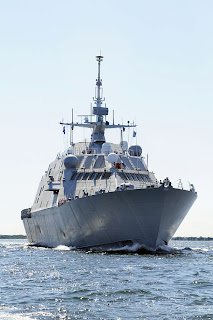 By the eighth year of the program the GAO had identified several serious problems. Developed under the pretense of a lower manned ship, the GOA consistently cited the manpower issue related to the ships operations and maintenance. The performance of the equipment had already led to several changes and cancellations to ships systems, and other issues identified by the GAO included cost, performance, and effectiveness in the ships intended primary mission role.
The GAO also consistently raised serious questions related to the ships survivability, and there were calls from various places for the Navy to review the programs acquisition strategy.
The acquisition strategy that awarded one ship of two different types to two different shipyards raised several questions, and within 5 years the program was already over budget 316%. New offboard systems that were yet to be operational had already informed the Navy that a stern redesign would be required in order for the ship to meet operational requirements, but by then the Navy had 26 ships under contract.
The GAO cited several performance problems. The biggest GAO complaint early on was the choice not to include a towed sonar array despite ASW being a primary mission capability. To compensate for what the GAO called inferior ASW capability, the Navy insisted that a new offboard platform would give the ship a stand off anti-submarine capability at a lower cost. Another problem cited by the GAO was that the ship was badly overweight, which meant the service life growth margins of the ship was 200% lower than normal. The GAO repeatedly voiced concerns that the ship would never reach its full service life due to the lack of growth margin. Because the ship was designed with a significantly smaller crew than previous ships, the GAO had serious concerns about the operation and maintenance of the ship. The ship also included a distinctly different propulsion system than other Navy ships of similar type, and the ship lacked accommodations to support additional personnel. Finally, the GAO had serious concerns about survivability. Survivability concerns ranged from the aluminum construction to the lack of armor to the absence of a shock damage testing plan to the absence of protection from chemical and biological agents. The GAO was extremely concerned about the "cheap kill," which the ship was suspected to be highly vulnerable to. A cheap kill occurs when a damaged system on the ship prevents the ship from completing its mission even though there is little or no physical damage to the ship. Congress raised the issue regarding the ships survivability many times, as did the Commander of the Second Fleet.
While the story might sound somewhat similar, by now some of you have likely figured out this is not a story about the Littoral Combat Ship program, rather it is my notes taken directly from the testimony of Jerome H. Stolarow, Director, Procurement and Systems Acquisition Division before the Subcommittee on Priorities and Economy in Government, Joint Economic Committee January 3, 1979. For those who would like to see the details of this testimony, his testimony is titled The Navy's FFG-7 Class Frigate Shipbuilding Program, and Other Ship Program Issues (PDF).
The early history of the Oliver Hazard Perry program carries with it a positive image that is completely out of step with reality. In the first decade of the program, FFG-7 was a dumpster fire that had serious people questioning whether the Navy would be capable of fielding a single Perry class able to perform the ships primary missions. Sound familiar?
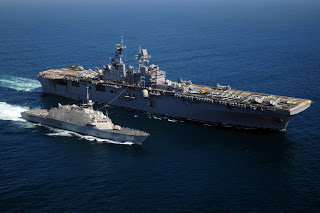 In December of 1978 George Wilson of the Washington Post wrote a story about the Oliver Hazard Perry titled "Destroyer Built on Time, Under Budget" that was picked up in newspapers across the country. In the story, published only 13 months before the details above were discussed in Congressional testimony, Vice Adm. John Bulkeley (who was president of the navy's Board of Inpection and Survey at the time) personally conducted the Sea Trials of the Oliver Hazard Perry (FFG 7) and reportedly was so satisfied with the ship it returned 2 days early from its first trial. He was quoted in the Washington Times article as saying the ship was "magnificent" and "The Best Ship in 20 Years." It is impossible to imagine that Vice Adm. Joseph Bulkeley didn't know full well the problems with the Oliver Hazard Perry class at the time, including the need to redesign the stern of the ships, but in true NAVSEA fashion he said one thing while knowing another. Things haven't changed much...
The Washington Post story, like other newspaper articles about the Oliver Hazard Perry in the late 1970s, was a feel good story about a small shipbuilder in Maine struggling in the 1970s economy that had been able to deliver a quality product to the US Navy, and the shipbuilders reward for a quality product was a series of contracts to build more ships. These ship contracts would save the shipyard and the local economy in Bath. The problems were there, indeed they were very serious problems that directly influenced the ships ability to conduct it's primary mission, but that information never became widely disseminated to the general public because access to information at the time was limited. Despite the existence of problems, the FFG-7 program was built to 51 ships even though half of the ships had a very limited anti-submarine capability (without LAMPS III), all had gaps in radar coverage including the inability of the radar to determine the altitude of aircraft, the primary weapon was a limited range anti-air missile, and despite knowledge the FFG-7 required a stern redesign the Navy knew about as far back as 1976. In the end, half the ships were never capable of supporting the new LAMPS III helicopter. Other postponed or deleted equipment early in the program included a recovery assist securing and traversing (RAST) control station, the SQL-32, Nixie, a MK 36 Super RBOC, and an ASROC launcher - all of which were technologies that contributed to the ships primary mission.
The problems with the Oliver Hazard Perry program during that first decade were serious, as each and every problem directly impacted the primary mission role the ship was designed to perform. As we know in hindsight, the decision to use the reduced capability SQS-56 sonar instead of the new at the time SQS-53 potentially impacted the ship classes ability to detect mines, which could have been very useful to the USS Samuel B. Roberts (FFG-58) in 1988. The cost saving decision to use the AN/SPS-49 2D radar rather than a 3D radar has been cited as a primary contributing factor for the inability of the USS Stark (FFG-31) to detect the maneuvering behavior of the Iraq F-1 Mirage prior to the attack in 1987. In hindsight one might ask why the Navy cut so many corners with the systems that directly contributed to the ships primary role, and how it was that the Navy was ever allowed to develop the Oliver Hazard Perry class when there were so many obvious problems with the ship during the early years of the program. The answer is simple, in a different information environment, the problems weren't as obvious as problems on ships are today.
The Navy, with a ship class that they knew required a redesign as early as 1976, built FFG-7 and fifty more just like it anyway - and to this very day the Oliver Hazard Perry class serves in several Navies worldwide including the US Navy conducting the roles and missions in low intensity environments the ship was originally designed for. Last week on July 29th the Navy retired USS Doyle (FFG 39) after completing over 27 years of service in the US Navy. Despite all of the early, very serious program and cost problems with the Oliver Hazard Perry class and despite the very serious criticism those who knew about the problems heaped onto the program, is anyone today ready to say the Navy made a mistake building the ships of the Oliver Hazard Perry class?
Not me, the early history of a shipbuilding program does not tell the story of a ship class.
Subscribe to:
Posts (Atom)