Showing posts with label Horn of Africa. Show all posts

Saturday, April 26, 2024

5th Fleet Focus: More Incidents You Don't Hear About

We are observing a pattern of press reporting worldwide of incidents that have been absent in the media in the past from the 5th Fleet AOR. We have recognized for a long time that news reporting of events didn't match up with Mariner reports from the region, but chalked the lack of news reporting up to the presence of Admiral Fallon, who was very good at controlling information from the sea in his AOR.

Fallon is gone and the news is getting out. We will attempt to highlight some of the more interesting English language media reporting, and may attempt to translate some of the more interesting foreign reporting as well. The Guardian took its turn today, with stories from the region from the day the Japanese Super Tanker was attacked. The article is written from the perspective of Johan Lillkung and his ship log. John is captain of Dolphin, a 27-metre private yacht in the Red Sea that day. In his captain's log he describes several recent attacks on boats, including his own. This is an excellent article.

It started 20.35 (local time) on 20 April with a Mayday call on the radio. Faisal Mustafa, a small wooden cargo ship, was en route from the Red Sea to India. Their position was only four nautical miles off our starboard side. We saw four dinghy type speedboats quickly approach the ship. The last radio transmission, from the captain, was 'Merciful God, can somebody help us, pirates are boarding. Merciful God, help us please!'

A fantastic job of reporting here, many more incidents you haven't heard and details of those incidents in this story. Read it all. Same story is being covered here as well, including some commentary similar to ours of a shift in media attention, or as we see it, a lack of secrecy at the same level as in the past regarding activity at sea. BTW, sounds like that pirate incident may have generated an environmental problem, the report indicates the Takayama was spilling oil. I had previously read the tanker was empty. Perhaps not?

Tuesday, April 22, 2024

Somalia Pirates Strike Quickly

The pirates operating from Somalia are back in action, with two ships attacked in two days. While there was some hope the French actions last week might deter piracy in the region to some degree, it appears more work will need to be done.

Eagle1 has both stories, the first a Spanish Tune Fishing boat with a crew of 26 which has been hijacked, the other a 150,000 ton empty tanker was hit with all kinds of weapons but was able to escape.

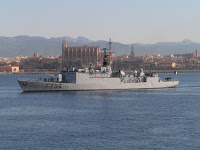
The news today is that Spain has dispatched a frigate to Somalia. The ship is probably the SPS Mendez Nunez (F104) that deployed with the Orion 08 British Task Force. The dispatch of a single ship doesn't imply Spain has any intentions to take action, and France had a much better logistical situation than Spain does in dealing with the problem.

However, it should be noted the Spanish had a major exercise a few weeks ago called Gruflex 08, that involved a rather large Spanish Naval force including SPS Principe de Asturias (R11), SPS Galicia (L51), SPS Pizarro (L42), SPS Victoria (F62), SPS Numancia (F83), SPS Navarra (F85), SPS Patino (A14), SPS Segura (M31), and SPS Tambre (M33). Given a mandate, Spain could wipe out the Somalia pirates involved with that kind of naval power.

It will be interesting what happens, because with only one exception, pirate activity usually ends with ransom money paid. Unless something changes, we fully expect that to be how this incident concludes as well.

Friday, April 4, 2024

5th Fleet Focus: Somalia Piracy Map

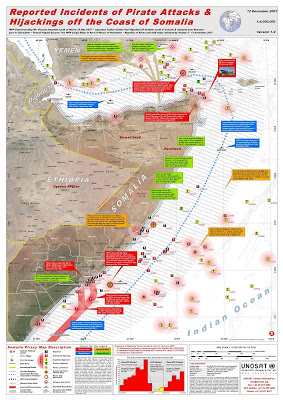
The United Nations has released a new map on Somalia piracy, and we find it very interesting. It is from the fall time frame of last year, and offers an interesting perspective on where pirate attacks are taking place. I'm sure gamers would agree, this as an excellent open source tactical map for building anti-piracy simulations. You can download a PDF copy here.

Click the picture for high resolution, it is a bit larger than half a MB, so be aware. As we noted in our last Order of Battle, there are a lot of European warships in the TF150 AOR right now. In observing, one gets the impression the international community is slowly building up for something. The last few months have seen a rather large increase in naval contributions from both European and Asian nations, and there appears to be even more including a major contribution from Canada coming in the future.

HT Chris Albon

Monday, October 29, 2024

5th Fleet Focus: Addressing the Pirate Menace

I was going to wait until next week before pointing out the increased naval activity off the east coast of Africa in regards to pirates, but events have drawn my attention to the region sooner. On Monday, Eagle1 posted an article about a Japanese Tanker hijacked at sea on Sunday off the coast of Somalia. Later on Monday we learned that the USS Porter (DDG 78) engaged the pirates while they were in international waters, sinking to skiffs ties to the hijacked vessel hull.

It appears that fog of war played into the incident, as it is reported the USS Porter (DDG 78) was unaware of the nature of the cargo on the hijacked Japanese-owned, Panamanian-flagged ship the Golden Mori. I'm not going to bother with much of the details of the incident beyond what Eagle1 is reporting, because the DoD is working to schedule a press conference with the Captain of the USS Porter (DDG 78) on Tuesday, where the fog of war will clear on the incident.

However, new details are being reported that the hijacking took place off the Socotra Islands, and the USS Arleigh Burke (DDG 51) is shadowing the vessel. More interesting is news that the Somalian government has given permission to the USS Arleigh Burke (DDG 51) to enter Somalian waters to pursue the hijacked vessel. As far as I am aware, this is the first time the government of Somalia has given the international coalition permission to hunt pirates.

Last week France dispatched the frigate FS Guépratte to Somalia to escort UN chartered ships supporting the World Food Program in Somalia. The USS Whidbey Island (LSD 41) is also in the region, however I do not believe the LSD has any Marines onboard. However, on October 16th, the 22nd MEU completed 2 weeks of training in Kuwait and reconstituted aboard the Kearsarge Strike Group amphibious ships. This would free up the ships to offer Marines for any operations against the pirates and the hijacked ship. USS Porter (DDG 78) is part of the Kearsarge Strike Group.

Although the Enterprise Strike Group is in the theater, and while the USS Arleigh Burke is part of the Enterprise Strike Group, it is unlikely the USS Enterprise would move away from Iraq to deal with pirates. However, the USS Forrest Sherman, also part of the Enterprise ESG, has been operating off the east coast of Africa in support of AFRICOM and is available.

Finally, the USS Wasp (LHD 1) is in theater as well. The USS Wasp (LHD 1) is also not carrying Marines, but does offer an alternative for moving aircraft around the region in MAG elements that would be supporting either Iraq, or operations off Somalia.

The US Navy has a number of assets available regionally that can support virtually any operation against pirates. I'm not going to go into detail, but there are at least 4 US and allied nuke subs in the region, and they bring a number of SOF options into play. If I was the pirates onboard the Golden Mori, I don't think I would be sleeping well tonight.

Monday, September 10, 2024

5th Fleet Focus: Horn of Africa Getting Hot

The Horn of Africa is starting to boil a bit and could spill into any number of directions. The US and the UN are sounding warnings to both Ethiopia and Eritrea. At the same time, Ethiopia is engaged in skirmishes in Somalia.

Last time the rhetoric and activity both hit a pitch at the same time was in early June when the USS Chafee (DDG 90) ended up firing some cruise missiles into Somalia. It is unclear if or how the US would respond to action this time, however warnings regarding terrorists in Eritrea are probably based on intelligence.

There is one major difference between June and today, there is a MEU in theater not offloaded, something that wasn't the case back in June. It is noteworthy the USS Carter Hall (LSD 50) is set to come home very soon, maybe as early as this week, but with the USS Wasp (LHD 1) delayed for humanitarian support to Honduras in response to Hurricane Felix, they may be on station for another week. Also returning home from the theater shortly will be the USS Normandy (CG 60), which has nearly completed its tour with SNMG1 following the exercises with South Africa. The USS Bainbridge (DDG 96) crossed the Suez last week and will replace the USS Normandy (CG 60) in SNMG1 off the coast of east Africa.

SNMG1 should be somewhere off the eastern African coast this week towards the high piracy areas off Somalia, which may not seem like much, but would free up US forces normally on patrol in that region to other actions closer to the Horn of Africa if necessary. Something to keep an eye on.

Monday, June 11, 2024

5th Fleet Focus: 21st Century Pirate Coast

CDR Salamander has an interesting post up about "Letters of Marque" as a constitutional enabled mechanism the Congress could take to fight Piracy in the 21st Century, even suggesting the US outsource piracy to BlackWater.

I think there is an interesting intellectual discussion in the idea, but at the end of the day, I think
Eagle1 has the right idea, the combination of a Convoy system, small fast boats, and a rapid response force of Helicopters makes more sense.

I would add to
Eagle1's comments that there is both a historical and contemporary model on how to approach this problem. If the US Navy is going to get serious about the piracy problems, I think is time to setup Mobile Offshore Bases off Somalia. With Sea Basing on the horizon, 18 billion in spending in the pipeline on the powerpoint concepts, maybe the Navy should explore Sea Base solutions to a true Maritime problem like piracy.

The roots of the Mobile Offshore Base concept go back to Vietnam, where the Navy set up bases both offshore and on rivers to support Navy swift boat operations in the Vietnam War theater. The idea was revived during the
Tanker Wars in 1987-1988, when the US Navy deployed the Wimbrown VII and the Hercules in Operation Prime Chance to areas around Farsi Island to deal with Iranian small boat activity and monitor the seas for minelaying operations. In both cases the Sea Bases were very effective, because presence cannot be replaced by 'revolutionary' ideas like unmanned reconnaissance.


That tradition continues today with the Command and Control barge
Ocean 6 that guards the Iraqi Oil Terminals ABOT and KAAOT. While Bechtal has some ideas on how large Sea Based platforms can be reliably achieved in the future, to stop piracy now requires easy to impliment ideas on the cheap, or as CDR Salamander calls it, "out of the box" thinking.

Somalia has 3700 kilometres (2300 miles) of unpatrolled coastline. Given that in the past, offshore mobile platform bases (barges) have operated no more than 50 miles apart to cover area, it would seem the barge idea wouldn't work. However, if you look at piracy maps on the ICC website, attacks off Somalia over the last 3 years are concentrated.

3 Barges separated by about 55nms could cover the area from Kismaayo and Mogadishu, while a 4th, larger barge could serve as a CIC platform (
similar to Ocean 6) in the Bari region where US military activity in Somalia has been concentrated lately. These Mobile Offshore Sea Bases provide the solution to the small FAC flotilla logistical problem, and additionally put static presence in an area currently hot with both military operations and criminal activity.

The 3 barges in the south, each manned by a Marine Platoon, SEAL Team, and supported by small Navy boats and USMC Hueys/Navy Seahawks provide excellent platforms for Maritime Domain Awareness, and can be both defended and supported against virtually all known regional threats. The catch is that each barge would meed am excellent radar able to support SeaRAM defense, otherwise it provides opportunity to relive an INS Hanit incident.

The Bali region Barge on the other hand would set up an excellent waypoint for convoys moving around the Horn of Africa, while also offering coalition forces a naval logistical base on the opposite side of the Horn from Djibouti.

While certainly not an ideal solution, and while it is also a manpower intensive operation that consumes at least 1 company of Marines and several hundred sailors for MSO operations on small boats, nevermind the logistical trail, it is an alternative to paying "consultants" like Blackwater to do the job the US Navy has traditionally handled effectively in the past.

Thursday, June 7, 2024

5th Fleet Focus: Horn of Africa

UPDATE: Eagle1 has an update that explains how events occurred, which also points out some of the flaws in the early media reporting I originally based my opinions on. Looks like CDR was right to change his mind, and like him I have to admit my mistake as well. CTF 150 did what it could, and if latest news is to be believed, the French are still on station.


The naval engagements off the coast of Somalia this week have been the topic of various blogs and discussions on the internet. There are many angles, lots of questions, and no doubt the whole story won't be told for a generation. CDR Salamander originally blamed the French, but has since backed off some. Personally, I think he should have trusted his instincts, because the open source information available tells us enough to raise some concern, and begin asking some important questions.

The first question: How is it the USS Carter Hall (LSD 50), which is 4 knots slower and 12 times larger than the French frigate Enseigne de vaisseau Jacoubet (F794) is able to engage a hijacked freighter at relatively short range and sink 3 skiffs, but the French frigate that is carrying the Commander of Task Force 150, was unable to do anything for 3 days and never engaged?

Lets explore the possibilities.
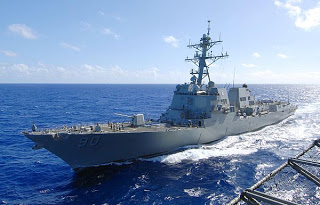
To fully understand what is happening off the coast of Somalia, first we can review the order of battle. The Somalia coast falls under the responsibility of Task Force 150, which as of June 1st was known to consist of the destroyer USS Chafee (DDG 90), the USS Carter Hill (LSD 50), the German frigate FGS Köln (F211), the French frigate Enseigne de vaisseau Jacoubet (F794), the RFA Fort Austin (A386), and potentially others. Rear Admiral Alain Hinden of the French Navy is the current commanding officer of CTF 150.

The action started early on Saturday morning involving the USS Chafee (DDG 90) when she provided some Naval gunfire support for Task Force 88, the Special Operations unit that has been operating inside Somalia since December 2006 when Somali President Abdullahi Yusuf Ahmed has asked Ethiopia for assistance. Since that invasion, the United States has operated special forces in the country attacking al Qaeda targets in the country.

A few points here. First, while the USS Chafee (DDG 90) is an ideal naval platform for striking land targets, but it is hard to imagine the Chafee has any responsibility in logistical support for Task Force 88 assets in the area, nor is it likely the ship was operating alone. It is unclear from news reporting whether the targets were structures in a village, on a mountain, or some sort of retreating boats (all have been speculated), but either way, the problem here is the Navy is engaging in combat operations and the platform most suited for supporting land operations from sea in the area, namely the USS Carter Hall (LSD50), isn't reportedly involved.

I think the USS Carter Hall (LSD 50) was involved, or was at least in route. There are plenty of reasons to assume it was, mostly because from most logistical and operational perspectives it makes sense, but it would also match historical patterns for L class ships operating in the region over the last few years.

OK, so it may have been involved, but there is no evidence it was, nor is there any public evidence the ships configuration would allow it to be of much assistance. The week leading up to the naval actions, the USS Carter Hill (LSD 50), FGS Köln (F211), and RFA Fort Austin (A386) were performing joint Maritime Security Operations in the Arabian Sea around the Horn of Africa. This does match historical trends for L class deployments to the region. The public affairs office of the USS Carter Hall describes the operations L class ships have been conducting the last few years, and the operations of the USS Carter Hall (LSD 50) specifically:

This week the USS Carter Hall and the RFA Fort Austin exchanged several officers to improve the coordination of their joint operations. Embarked onboard the Fort Austin is a detachment of the 857th Royal Naval Air Squadron. Together these units along with the German ship, the FGS Köln, are working to identify and stop suspected pirate and smuggling vessels in the Gulf of Aden off the coast of Oman and Yemen.
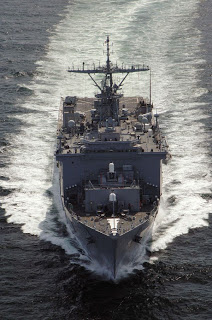
Through cooperation, these units drastically increase their individual capabilities. Flying two ASAC 7 Sea King helicopters, each equipped with the Searchwater 2000 radar the aviators of the 857th RNAS are capable of locating and classifying contacts up to several hundred miles away. The Carter Hall then uses their unmanned aerial vehicle (UAV), Scan Eagle to provide positive visual identification of the subject vessels. Together these air assets allow the coalition partners the ability to cover a much larger area with fewer ships.

“Being onboard a fleet auxiliary ship is a unique situation for us. Traditionally we fly off of Royal Naval Ships; the use of auxiliary ships like the Fort Austin has allowed us to expand our deployment options making the use of our time more effective,” said Lieutenant Commander Smith, the Commanding Officer of the 857th. “The only real drawback to this configuration is that we cannot stop and search suspect vessels, that’s were the American’s come in.”

Once the Sea Kings have narrowed down the possible list of suspect vessels the Carter Hall uses Scan Eagle to further assess their threat. The crew of the Carter Hall asks suspect vessels a set of questions in an attempt to determine if they meet the certain profiles. If necessary the Carter Hall sailors will board and search the vessels.

“The exchange officers have played an important roll in coordinating our efforts with both the British and German ships in the area. The improve communication flow was vital to the successful completion of the operation,” said CDR McGovern.

Throughout this process Carter Hall, the 857th and Fort Austin remained in constant communication with Köeln. This allowed the Köeln to expand her search to other areas without leaving gaps in their collective coverage.
If we believe the time line coming from the media, at about the same time as the USS Chafee (DDG 90) was striking al Qaeda, the Danish cargo ship Danica White was hijacked off Somalia. The details appear strange though. According to reports, the hijacking of the ship took place in view of the French frigate Enseigne de vaisseau Jacoubet (F794).
The Danica White and its crew of five were hijacked early Saturday in view of a French warship that was unable to cross into Somali territorial waters to offer help.

...pirates had already successfully taken the Danica White out of international waters and towards a known pirate camp.
Like I said earlier, Rear Admiral Alain Hinden of the French Navy is the current commanding officer of CTF 150., and unless something has changed (which is possible), he is on the Enseigne de vaisseau Jacoubet (F794). So how is it that pirates operating from a known pirate camp are able to hijack a Danish cargo ship in view of the Commanding Officer of CTF 150, and they are unable to do anything about it?

But the strange tale doesn't end there, it turns out that 3 full days later, on Tuesday, the USS Carter Hall (LSD 50) engages the hijacked ship in international waters, and some how able to do some damage with weapons that have a very short range. The Navy Times has run a similar article to the one above.

The dock landing ship Carter Hall shot flares, fired warning bursts and unleashed a volley that set fire to three skiffs towed behind a hijacked Danish cargo ship off Somalia on Tuesday, but it could not prevent the freighter from slipping out of international waters and toward a known pirate camp, the Navy said.

The Danica White, a Danish-flagged merchant vessel with a crew of five, was hijacked by pirates early Saturday in view of a French warship that could not cross into Somali territorial waters to offer help. The Danica White never radioed for assistance, but the Carter Hall called to ask if it needed help, said Lt. John Gay, a spokesman with Navy Forces Central Command in Bahrain.

So the story being told is that pirates hijacked a Danish ship in front of a French frigate that has the Commander of Task Force 150 on board. 3 days later the USS Carter Hall is able to get close enough to engage the hijacked ship and sinks 3 skiffs in tow.

So I ask the question again, how is it the USS Carter Hall (LSD 50), which is 4 knots slower and 12 times larger than the French frigate Enseigne de vaisseau Jacoubet (F794) is able to engage at relatively short range and sink 3 skiffs, but the French frigate carrying the Commander of Task Force 150, was unable to do anything for 3 days?

The CDR may have changed his opinion because he is aware of information not available to the public, but as for me, I gamed it out a bit tonight and came up with only one possible scenario that could make sense of the incident, and explain some of the questions.

If the hijacking took place in Somalian waters, and the French frigate did view the entire thing, lets assume Eagle1's explanation of the Law of the Sea explains the French frigates behavior, and it was forbidden from offering assistance and was completely unsuccessful for 3 days getting permission from the Somalian government. The hijacking would have had to of taken place in the northern waters, and the French frigate may have shadowed the ship as it traveled south down the coast. The USS Carter Hall (LSD 50) could have been somewhere south of the incident, perhaps operating with the USS Chafee (DDG 90), and some plan was thought up to have the LSD intercept the Danica White at some pre-arranged location in international waters. This at least would give this American hope that what happened was a nearly successful attempt to intercept the ship, although even that optimistic scenario would still leave some questions.

Why were the French forbidden to engage over a 3 day period? Did the French even try to get permission from Somalian authorities to stop the piracy? Did the French frigate shadow the cargo vessel, or simply let it go? CDR let the French off too easy, because even a generic explanation from the Commander of Task Force 150 regarding the action of his nations forces under his command isn't too much to ask.

Why was the USS Carter Hall (LSD 50) the intercepting vessel and not the USS Chafee (DDG 90), or some other coalition vessel like the FGS Köln (F211) or even the French frigate, both of which could have been in position given the three full days to maneuver and all of which have weapons with better range to disable the cargo ship if it entered international waters?

If the USS Carter Hall (LSD 50) is deployed for Maritime Security Operations, why doesn't it appear to have the necessary equipment to handle combat operations at sea that may arise from such operations? The Navy intends to use 3 Harpers Ferry Class ships for anti-terrorism operations in its 9 ESG, 31 L-class ship, MFP(F) concept of the 313-ship plan. While supporting land based anti-terrorism operations from the sea is an important contribution, the Navy can ill afford to utilize these ships in anti-terrorism operations at the expense of supporting sea based anti-terrorism operations like piracy.
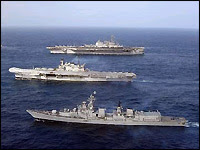
At the end of the day, one thing is clear. The 1000-Ship Navy initiative is not going to substitute for a shrinking US Navy when partners can't take action in plain view of criminal activity at sea. I don't think Admiral Mullen expected inaction when he made a call for "-a proverbial world navy of 1,000 ships -- comprised of all freedom-loving nations, standing watch over the seas."

If the US Navy can't find help from our committed European allies within the existing framework of TF 150 against an age old problem like piracy (off waters best known for piracy in the 21st century no less), including support against piracy against flagged vessels of other NATO allies, the current vision for the Navy in the 21st century that puts so much reliance on other nations is flawed.


UPDATED: Somali officials are now saying the strike was with cruise missiles, not guns. Strategy Page seems to think so too.

Wednesday, June 6, 2024

US Navy Goes "Old-School?"

Old-School? Stars and Stripes may think so, but it is also new school with the DD(X) on the horizon. While labels are actually just a distraction, it is both interesting and noteworthy the US Navy is engaged in the GWOT with weapons other than cruise missiles, and has been off Somalia for years.

The Navy went old-school on Somali militants Friday, using naval gunfire against bad guys for the first time in the region since the Gulf War.

It was first reported over the weekend that a U.S. destroyer had shelled Islamic militants in Somalia, where Ethiopian and Islamic government forces are fighting insurgents from the Islamic Courts Union, which the U.S. government has accused of sheltering al-Qaida terrorists.

A senior Defense official confirmed Tuesday that the USS Chafee, based out of Pearl Harbor, Hawaii, fired more than a dozen rounds from its 5-inch gun during the strike.
The USS Chafee (DDG 90) is one of the most modern warships in the world, and represents an ongoing mission requiring military action in those waters. Last year the USS Winston S. Churchill (DDG 81) seized a pirate vessel in January while the USS Cape St. George (CG 71) and USS Gonzalez (DDG 66) had to blow up another pirate ship in March.

On que, pirates seized a Danish Merchant vessel this week. Apparently among the TF 150 coalition ships that responded to the pirate action was the the French frigate Enseigne de vaisseau Jacoubet (F794) and the USS Carter Hall (LSD 50).

“The USS Carter Hall fired flares and several shots across the bow as well as several disabling shots at the three skiffs in tow,” he said. “They shot at the skiffs and they caught on fire.”

Sailors used the ship’s .50-caliber machine guns, 7.62 mm miniguns and 25 mm Bushmaster cannons in the encounter, Gay said.

“As long as they’re in international waters, they can engage,” he said.

But the hijacked Danica White made it into Somali waters and the Carter Hall had to back off and watch.

“We’re observing them at this point,” Gay said. “It’s ongoing.”


The Navy mission rotation of L class ships without Marines embarked is discussion for another time, but the fact the US has had two engagements this week involving guns raises several questions. Will the 57mm planned for the LCS be enough? Did the Navy make a mistake not putting a larger gun on the LPD-17? Did the USS Chafee make the best case yet for the DD(X) Zumwalt class ship so far in 2007?