
The naval engagements off the coast of Somalia this week have been the topic of various blogs and discussions on the internet. There are many angles, lots of questions, and no doubt the whole story won't be told for a generation. CDR Salamander originally blamed the French, but has since backed off some. Personally, I think he should have trusted his instincts, because the open source information available tells us enough to raise some concern, and begin asking some important questions.
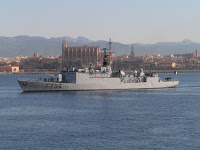
The first question: How is it the USS Carter Hall (LSD 50), which is 4 knots slower and 12 times larger than the French frigate Enseigne de vaisseau Jacoubet (F794) is able to engage a hijacked freighter at relatively short range and sink 3 skiffs, but the French frigate that is carrying the Commander of Task Force 150, was unable to do anything for 3 days and never engaged?
Lets explore the possibilities.
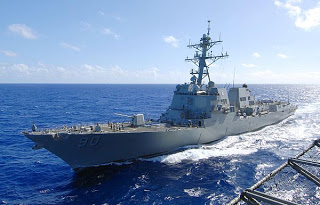 To fully understand what is happening off the coast of Somalia, first we can review the order of battle. The Somalia coast falls under the responsibility of Task Force 150, which as of June 1st was known to consist of the destroyer USS Chafee (DDG 90), the USS Carter Hill (LSD 50), the German frigate FGS Köln (F211), the French frigate Enseigne de vaisseau Jacoubet (F794), the RFA Fort Austin (A386), and potentially others. Rear Admiral Alain Hinden of the French Navy is the current commanding officer of CTF 150.
 The action started early on Saturday morning involving the USS Chafee (DDG 90) when she provided some Naval gunfire support for Task Force 88, the Special Operations unit that has been operating inside Somalia since December 2006 when Somali President Abdullahi Yusuf Ahmed has asked Ethiopia for assistance. Since that invasion, the United States has operated special forces in the country attacking al Qaeda targets in the country.
A few points here. First, while the USS Chafee (DDG 90) is an ideal naval platform for striking land targets, but it is hard to imagine the Chafee has any responsibility in logistical support for Task Force 88 assets in the area, nor is it likely the ship was operating alone. It is unclear from news reporting whether the targets were structures in a village, on a mountain, or some sort of retreating boats (all have been speculated), but either way, the problem here is the Navy is engaging in combat operations and the platform most suited for supporting land operations from sea in the area, namely the USS Carter Hall (LSD50), isn't reportedly involved.
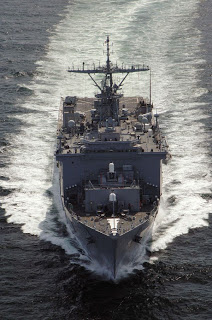
I think the USS Carter Hall (LSD 50) was involved, or was at least in route. There are plenty of reasons to assume it was, mostly because from most logistical and operational perspectives it makes sense, but it would also match historical patterns for L class ships operating in the region over the last few years.
OK, so it may have been involved, but there is no evidence it was, nor is there any public evidence the ships configuration would allow it to be of much assistance. The week leading up to the naval actions, the USS Carter Hill (LSD 50), FGS Köln (F211), and RFA Fort Austin (A386) were performing joint Maritime Security Operations in the Arabian Sea around the Horn of Africa. This does match historical trends for L class deployments to the region. The public affairs office of the USS Carter Hall describes the operations L class ships have been conducting the last few years, and the operations of the USS Carter Hall (LSD 50) specifically:
This week the USS Carter Hall and the RFA Fort Austin exchanged several officers to improve the coordination of their joint operations. Embarked onboard the Fort Austin is a detachment of the 857th Royal Naval Air Squadron. Together these units along with the German ship, the FGS Köln, are working to identify and stop suspected pirate and smuggling vessels in the Gulf of Aden off the coast of Oman and Yemen.If we believe the time line coming from the media, at about the same time as the USS Chafee (DDG 90) was striking al Qaeda, the Danish cargo ship Danica White was hijacked off Somalia. The details appear strange though. According to reports, the hijacking of the ship took place in view of the French frigate Enseigne de vaisseau Jacoubet (F794).
Through cooperation, these units drastically increase their individual capabilities. Flying two ASAC 7 Sea King helicopters, each equipped with the Searchwater 2000 radar the aviators of the 857th RNAS are capable of locating and classifying contacts up to several hundred miles away. The Carter Hall then uses their unmanned aerial vehicle (UAV), Scan Eagle to provide positive visual identification of the subject vessels. Together these air assets allow the coalition partners the ability to cover a much larger area with fewer ships.
“Being onboard a fleet auxiliary ship is a unique situation for us. Traditionally we fly off of Royal Naval Ships; the use of auxiliary ships like the Fort Austin has allowed us to expand our deployment options making the use of our time more effective,” said Lieutenant Commander Smith, the Commanding Officer of the 857th. “The only real drawback to this configuration is that we cannot stop and search suspect vessels, that’s were the American’s come in.”
Once the Sea Kings have narrowed down the possible list of suspect vessels the Carter Hall uses Scan Eagle to further assess their threat. The crew of the Carter Hall asks suspect vessels a set of questions in an attempt to determine if they meet the certain profiles. If necessary the Carter Hall sailors will board and search the vessels.
“The exchange officers have played an important roll in coordinating our efforts with both the British and German ships in the area. The improve communication flow was vital to the successful completion of the operation,” said CDR McGovern.
Throughout this process Carter Hall, the 857th and Fort Austin remained in constant communication with Köeln. This allowed the Köeln to expand her search to other areas without leaving gaps in their collective coverage.
Like I said earlier, Rear Admiral Alain Hinden of the French Navy is the current commanding officer of CTF 150., and unless something has changed (which is possible), he is on the Enseigne de vaisseau Jacoubet (F794). So how is it that pirates operating from a known pirate camp are able to hijack a Danish cargo ship in view of the Commanding Officer of CTF 150, and they are unable to do anything about it?
The Danica White and its crew of five were hijacked early Saturday in view of a French warship that was unable to cross into Somali territorial waters to offer help.
...pirates had already successfully taken the Danica White out of international waters and towards a known pirate camp.
But the strange tale doesn't end there, it turns out that 3 full days later, on Tuesday, the USS Carter Hall (LSD 50) engages the hijacked ship in international waters, and some how able to do some damage with weapons that have a very short range. The Navy Times has run a similar article to the one above.
The dock landing ship Carter Hall shot flares, fired warning bursts and unleashed a volley that set fire to three skiffs towed behind a hijacked Danish cargo ship off Somalia on Tuesday, but it could not prevent the freighter from slipping out of international waters and toward a known pirate camp, the Navy said.
The Danica White, a Danish-flagged merchant vessel with a crew of five, was hijacked by pirates early Saturday in view of a French warship that could not cross into Somali territorial waters to offer help. The Danica White never radioed for assistance, but the Carter Hall called to ask if it needed help, said Lt. John Gay, a spokesman with Navy Forces Central Command in Bahrain.
So the story being told is that pirates hijacked a Danish ship in front of a French frigate that has the Commander of Task Force 150 on board. 3 days later the USS Carter Hall is able to get close enough to engage the hijacked ship and sinks 3 skiffs in tow.
So I ask the question again, how is it the USS Carter Hall (LSD 50), which is 4 knots slower and 12 times larger than the French frigate Enseigne de vaisseau Jacoubet (F794) is able to engage at relatively short range and sink 3 skiffs, but the French frigate carrying the Commander of Task Force 150, was unable to do anything for 3 days?The CDR may have changed his opinion because he is aware of information not available to the public, but as for me, I gamed it out a bit tonight and came up with only one possible scenario that could make sense of the incident, and explain some of the questions.
If the hijacking took place in Somalian waters, and the French frigate did view the entire thing, lets assume Eagle1's explanation of the Law of the Sea explains the French frigates behavior, and it was forbidden from offering assistance and was completely unsuccessful for 3 days getting permission from the Somalian government. The hijacking would have had to of taken place in the northern waters, and the French frigate may have shadowed the ship as it traveled south down the coast. The USS Carter Hall (LSD 50) could have been somewhere south of the incident, perhaps operating with the USS Chafee (DDG 90), and some plan was thought up to have the LSD intercept the Danica White at some pre-arranged location in international waters. This at least would give this American hope that what happened was a nearly successful attempt to intercept the ship, although even that optimistic scenario would still leave some questions.
Why were the French forbidden to engage over a 3 day period? Did the French even try to get permission from Somalian authorities to stop the piracy? Did the French frigate shadow the cargo vessel, or simply let it go? CDR let the French off too easy, because even a generic explanation from the Commander of Task Force 150 regarding the action of his nations forces under his command isn't too much to ask.
Why was the USS Carter Hall (LSD 50) the intercepting vessel and not the USS Chafee (DDG 90), or some other coalition vessel like the FGS Köln (F211) or even the French frigate, both of which could have been in position given the three full days to maneuver and all of which have weapons with better range to disable the cargo ship if it entered international waters?
If the USS Carter Hall (LSD 50) is deployed for Maritime Security Operations, why doesn't it appear to have the necessary equipment to handle combat operations at sea that may arise from such operations? The Navy intends to use 3 Harpers Ferry Class ships for anti-terrorism operations in its 9 ESG, 31 L-class ship, MFP(F) concept of the 313-ship plan. While supporting land based anti-terrorism operations from the sea is an important contribution, the Navy can ill afford to utilize these ships in anti-terrorism operations at the expense of supporting sea based anti-terrorism operations like piracy.
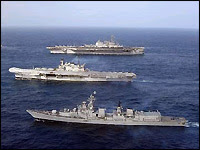 At the end of the day, one thing is clear. The 1000-Ship Navy initiative is not going to substitute for a shrinking US Navy when partners can't take action in plain view of criminal activity at sea. I don't think Admiral Mullen expected inaction when he made a call for "-a proverbial world navy of 1,000 ships -- comprised of all freedom-loving nations, standing watch over the seas."
If the US Navy can't find help from our committed European allies within the existing framework of TF 150 against an age old problem like piracy (off waters best known for piracy in the 21st century no less), including support against piracy against flagged vessels of other NATO allies, the current vision for the Navy in the 21st century that puts so much reliance on other nations is flawed.
UPDATED: Somali officials are now saying the strike was with cruise missiles, not guns. Strategy Page seems to think so too.

No comments:
Post a Comment