Showing posts with label Global Fleet Stations. Show all posts

Tuesday, May 20, 2024

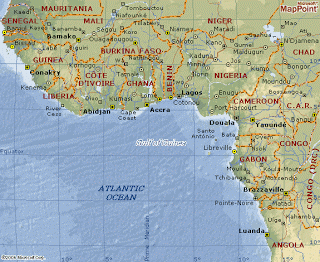
Talking About the African Partnership Station

I just got off the phone with Captain John B. Nowell, Jr. who led the African Partnership Station engagement that completed last month. It was very interesting. The good people who do the bloggers roundtable will have a transcript up later today.

It was a good discussion. Capt. Nowell gave a detailed summery at the beginning of the conversation describing the US involvement in Africa. In talking to many Americans, most people have very little idea what the US Navy is doing in that part of the world, and usually the stereotype of most people is that the US only brings hostility to the region.

Clearly times have changed.

Earlier this month I called the African Partnership Station the most important Navy story so far in 2008. I believe that remains true. Captain Nowell gave a detailed summery of the operation off Liberia, an evolution few outside this blog probably understand, but that evolution uses sea power for a proactive peacetime purpose in a smarter way than any we can think of since the Great White Fleet, and I don't think that is an exaggeration. It isn't like Navies build a port off the coast of a large city with degraded port facilities to donate enormous quantities of materials very often, in fact it had never been done before. There is an interesting synergy discussion there between NGO and the military in that evolution, indeed, the entire APS.

I didn't get the opportunity to ask what the USS Annapolis (SSN 760) role was, but as Molten Eagle often says, submarines are always silent and strange.

More on the APS to come.

Wednesday, April 30, 2024

Global Fleet Stations Forever

When we observe the Navy discussing Global Fleet Stations, the mission objective profile is one of a mission without end. Instead the mission will transition from one phase to another, and the next phase of both the the Caribbean region Global Fleet Station and the African Partnership Station in the Gulf of Guinea region. Admiral Stevenson discussed the next 4th Fleet region Global Fleet Station (PDF) at the last blogger round table discussion.
This year we have a Global Fleet Station. That's a diving platform. That deploys this summer and will go into a majority of the Caribbean countries and do an awful lot of diving, training, port security, harbor protection type of things. And the following year, even later on in the fall, we may get Swift back, before her contract with the Navy ends, to continue some of the things that we started last year.
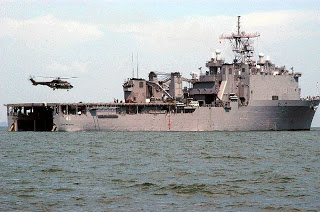
The diving ship being deployed is the USNS Grasp (T-ARS 51), an interesting choice. As a Global Fleet Station ship we observe the ship doesn't bring a lot of berthing, raising the question whether another ship will also be involved (probably via charter). Still, we see the Navy leveraging the MSC in this role as very wise, a way to sustain engagement with regional partners in a way that is clearly relevant to those regional nations.

The next phase in the Gulf Of Guinea will also look different this summer. While I haven't seen confirmation anywhere else yet, back in March Zachary M. Peterson reported for Inside The Navy (subscription only) that plans are already in motion for sustaining the African Partnership Station as well.
A Coast Guard cutter, Dallas, will deploy to the Gulf of Guinea this summer and plans for a French ship to steam in the region with embedded U.S. Navy training teams are also under way, he noted.

“APS doesn’t end when Fort McHenry [and Swift] go home,” Nowell argued. Adm. Mark Fitzgerald, commander of Naval Forces Europe, has said that the Navy is “here to stay” in West African waters, but details of how engagements in the region will fold into the nascent U.S. Africa Command remain to be determined, the captain said.
Zachary Peterson had another article on Tuesday in Inside The Navy that hit on the subject again. It was picked up in the CHINFO Clips.
This fall, the sea service plans to further efforts to build naval and coast guard capacity in coastal Western African countries by deploying a “variety of delivery platforms” ranging from frigates to destroyers and P-3 maritime surveillance aircraft detachments to the region, Capt. John Nowell, commodore of Task Force 365 (focused on West and Central Africa) and Destroyer Squadron Six Zero, said in a telephone interview April 21.

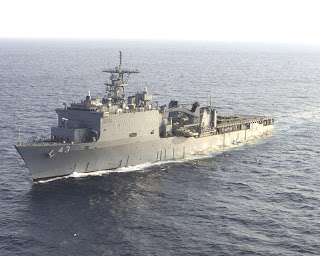
“Next year we expect another amphibious ship, probably the Nashville (LPD-13), to continue to conduct a similar mission to what we did with Fort McHenry (LSD-43),” Nowell said...
Guess that answers the questions regarding the USS Nashville (LPD 13) sale to India. The article goes on to note that blue water naval forces aren't always the best tools for the region though.
The APS effort incorporates a wide variety of projects in the region and is not specifically tied to gray-hull ships, Rear Adm. Anthony Kurta, director of policy, resources and strategy for Naval Forces Europe, said in a telephone interview April 23.

“There will be activity [in West Africa] under the APS banner for the next sixto-eight months,” Kurta noted.

These activities include the deployment of the Coast Guard cutter Dallas (WHEC-716) this summer and ongoing deployments of training teams throughout the region.
Phase 1 is an Amphibious Ship and a HSV. while phase 2 includes a MSC vessel and a Coast Guard Cutter. Admiral Clarke used to talk about using existing platforms and capabilities in new and innovative ways, we observe Global Fleet Stations and the resources being committed fits that description well. While the capabilities utilized for Global Fleet Stations are not new, the approach is innovative, a trend in ideas for the maritime domain that reflects a 4GW world.

Thursday, April 24, 2024

Excellent Article on African Partnership Station

David Axe is to the Navy, Coast Guard, and Air Force what Phillip Carter has become covering the Army and Marines, and since David already lives in Washington, we encourage the Washington Post to offer David a job and complete the circle of military coverage. Between Phillip Carter and David Axe, it would be very difficult for any other news organization to employ two other bloggers who get it strategically and understand it all tactically in regards to all the military services.

David's article today in World Politics Review is an excellent piece on the African Partnership Station, and is the first I've seen outside the military that ties in the strategic vision and the tactical day to day in what the Navy is trying to accomplish with its soft power strategy.

Last week the U.S. Navy amphibious ship Fort McHenry quietly slipped into Naples harbor in Italy, home of the U.S. Sixth Fleet, ending a six-month deployment to the West African coast. The 16,000-ton vessel's mission, though largely unheralded, signaled a sea change in the Navy's strategy.

During its October-to-April cruise, Fort McHenry visited 19 ports in 10 countries, from Liberia to Senegal, supporting scientists, aid workers and military trainers from the U.S. and allied militaries -- and delivering half a million meals to starving families. The Pentagon calls the vessel's mix of training, diplomacy, science and humanitarian assistance the "Africa Partnership Station," and aims to make it a regular affair.

It's all part of Defense Secretary Robert Gates' increasing emphasis on addressing underlying societal ills before they fester into full-blown conflicts. Instead of bombing, shooting and capturing bad guys, "ultimate success or failure will increasingly depend more on shaping the behavior of others -- friends and adversaries, and most importantly, the people in between," Gates said in an April 21 speech in Alabama.

We recommend reading in full. We also note David has the inside information at the end of the article on what to expect for the East African Partnership Station, another unique deployment that you Coast Guard folks might find very interesting.

Sunday, April 13, 2024

6th Fleet Focus: African Partnership Station Ends

The Africa Partnership Station to the Gulf of Guinea concluded this week, according to yesterday's press announcement. It has been a long time since the American people can point to a military supported operation in Africa with a lot of pride, but only someone who hates Africa and the people there could conclude the African Partnership Station is a bad idea.

Most Americans have no doubt heard that there is a need for inter service cooperation and inter agency cooperation that factors in the private sector. If you are looking for that model supported from the sea, the Global Fleet Station is it, and the African Partnership Station was the realization of the successful implementation of that model for Africa.

Today's press announcement summarizes some of the data of the deployment, we like this summery best.

Over the course of seven months, APS has visited 19 ports of call in 10 countries and trained over 1500 maritime professionals in skills ranging from small boat handling, port security, and martial arts to non-commissioned officer leadership, damage control, and maritime law.

“We have been working with our partners in many European countries. The French have been down here with a number of ships and we have been working very closely with them,” said Rear Adm. Anthony M. Kurta, U.S. Naval Forces Europe. “The staff of APS has also been very international in nature; we’ve had representatives from Portugal, France, Germany, and England as well as many staff members from our African partners as well.”

Additionally, APS worked with non-governmental organizations such as Project Handclasp, USAID, and Project Hope to bring relief and aid to many people in need. With the help of APS, Project Hope was able to donate five hundred thousand high nutritional meals, twenty-five pallets of medical, hygiene and educational supplies along with hospital beds and medical equipment valued at over one hundred thousand dollars.

Even those very interested in the US Navy probably had no idea France has been involved the whole time, and while they call their deployment to the Gulf of Guinea something else, the FS Tonnerre (L9014) has been down there almost the entire time supporting a similar mission profile as the USS Fort McHenry (LSD 43) and HSV-2 Swift. That is a pretty big platform for France to commit to a Global Fleet Station mission. In truth though, they've done that mission with similar platforms to that region in the past, the only difference was this year they increased the scale of their operation to match the US commitment.

There were two major events of the African Partnership Station that will require additional study to further the concept. The first was the humanitarian crisis that broke out in Chad, of which few may realize the African Partnership Station got involved. We'll let the press release tell the story.

”As we started lap two, we had the unrest in Chad where a number of refugees came over the Cameroonian border. The U.S. ambassador in Cameroon and the leadership there were familiar with APS,” said Capt. John Nowell, Commander Africa Partnership Station. “They were familiar with some of the items we had onboard including some high nutrition meals. They were familiar with our flexibility and so they asked if we could accelerate getting Swift there. Then we used the relationships we had with organizations like USAID and Catholic Relief Services as well as local organizations to facilitate getting those products off the ship and to the right place for use in the refugee operation.”

Note, the non government agency partnerships the mission had developed allowed for rapid response with the right product. Very nice. NGOs really do know best, their integration into the proactive humanitarian approaches represents an ideal way in our opinion for the Navy to conduct humanitarian operations as offensive tactic in peacetime. In that way the services don't have to recreate the process, rather enhance the one in place with what the military already does best: logistics.

The other operation was the Sea Basing operation we highlighted extensively. That operation barely got any press coverage, sad. Probably one of the most important focused proactive humanitarian operations in our nations history considering how much humanitarian supply materials was moved, not to mention an important test of Sea Basing, and almost no one in the country heard about it. Without question, and I'll debate this with anyone, the Sea Base operation off Liberia is the most important US Navy story so far in 2008, and that includes the satellite shoot down in the Pacific that everyone wanted to talk about.

It is this moment, after a successful deployment to Africa that many Americans don't really understand, where Admiral Ulrich's retirement is evident. This was the moment he was at his best. There should be a blogger roundtable on this topic on Thursday, not to discuss the topic with people like you and me, rather to educate the political bloggers who claim care about Africa and humanitarian missions regarding what the Navy just did.

Wednesday, March 26, 2024

Pictures of the Day: Leveraging the Sea as a Base

As long as the Navy continues to contribute excellent photography and stories regarding events taking place off Liberia, we'll continue to expend the blogger bandwidth highlighting the story.


A few thoughts. Anyone want to speculate a bit on the tugs? How many would be used in an operation like this? Would two be enough? Is that LCU acting as a sentry in the background of the second picture? One more thought, in observing the lighting setup, while it may work for this type of operation, one would imagine that isn't an optimal configuration for a Sea Base in wartime.


I don't know about you, but this story doesn't get old. They say a picture is worth a thousand words. From our POV, the pictures have us craving a thousand words not only on the Sea Basing aspect, but now we are curious about the work this base at sea is supporting.

In observing these photo's, are we right in assuming the pictures are being taken from one of the Ro/Ro's looking out onto the causeway pier? Somewhere I imagine the gods of the sea are smiling down observing this in the fine historical tradition of Hercules, Wimbrown VII, and Ocean 6 among too many others to name from Vietnam. As the gods would tell their servants, we have moved way beyond refitted barges for building bases at sea.

Does anyone else think it is time to come up with a clever name for this little US Navy FOB at Sea off the Liberian coast. I'd be curious to know what those folks in the picture are calling their sea base.

I still want to see a picture from sky view, something to give a context to the size and scope.

Observing the Sea Base Off Liberia

I don't know if the African Partnership Station Public Affairs office is reading the blog, but if you are we appreciate you being responsive to our request for more information, detailed information, and excellent information in covering the Sea Basing operation off Liberia. We credit Mass Communication Specialist 2nd Class (SW/AW) Elizabeth Merriam for this excellent contribution to the Sea Basing discussion.

The INLS is a redesign of a floating dock system originally used during World War II. Composed of smaller component links the system pieces can lock together to create ferries, causeway piers, or roll-on, roll-off discharge facilities to transport cargo and equipment from ship to shore while leaving a minimal footprint tailored to the individual mission.

The construction began aboard container & roll-on/roll-off ship USNS Lance Cpl. Roy M. Wheat (T-AK-3016) when various commands from Naval Beach Group 2 worked together to crane the links off of the ship and combine them into their final structures...

Once the construction on the INLS components was completed the discharge facility was transported to container & roll-on/roll-off ship USNS 2nd Lt. John Bobo (T-AK-3008) where it was loaded with Marine Corps vehicles...

The vehicles were then transported to the staging deck aboard amphibious dock landing ship USS Fort McHenry (LSD 43) where the ship's crew and the members of Assault Craft Unit 2, piloting the roll-on, roll off discharge facility, would attempt to dock an INLS structure in a well deck for the first time...

Once the Sailors secured the discharge facility in the well deck members of the 4th Marine Logistics Group simply drove the vehicles off the platform rolling directly into the staging area.

While Fort McHenry's crew worked with the discharge facility, John Bobo moored next to the INLS causeway. As part of the exercise, Marines reloaded the platform and the discharge facility and departed Fort McHenry to rendezvous with John Bobo, again exhibiting the ability of the INLS to dock with an amphibious vessel to transport cargo from ship to ship. Once the roll-on, roll-off discharge facility and causeway ferries were attached to the causeway, High Speed Vessel 2 Swift moored next to John Bobo, where ready receive Marine vehicles were transported to ship to shore.

This is the first time INLS has been used successfully at sea to transport cargo from ship-to-ship and ship-to-shore. During the rest of WATC the INLS will be used to aid in transporting humanitarian assistance supplies to Monrovia as part of the APS contribution to the area.

I've admittedly butchered an excellent story, so I encourage people to read the story without my cut outs, particularly as I think some of the details offered in the interviews tell the 'rest of the story.' For our purposes though we remain focused on the process for now.

From our perspective, observing the news reports and admiring the photography, it appears the Improved Navy Lighterage System (INLS) has demonstrated an amazing degree of capability for Sea Basing operations. As we previously covered, the West Africa Training Cruise (WATC) 08 will continue until April 5th, which we believe means the Sea Base built with the INLS will remain constructed for another week supporting humanitarian operations before being broken down. As some commenter's have previously noted, the port infrastructure in Monrovia is subpar, at best, and almost certainly not of a condition to support the USNS Lance Cpl. Roy M. Wheat (T-AK-3016) or USNS Lance Cpl. Roy M. Wheat (T-AK-3016).

This demonstration leveraging the INLS has thoroughly impressed us, bringing together the combinations of well decks, large Ro/Ro prepositioning ships, and a high speed vessel shallow draft connector has changed our perspective regarding the possibilities of Sea Basing, not only for peacetime operations but also for warfighter operations. With selective offload in the future, we see the potential to leverage amphibious assault ships for multiple assaults, simply reloading Marine Corp equipment from a secure, remote location at sea.

The interconnecting nature of the ferries, causeway piers, and roll-on, roll-off discharge facilities sparks our imagination in regards to potential. In the excellent coverage to date, we observe the only thing missing is a photo from above to get an idea regarding the size of the INLS causeway pier system constructed.

Sunday, February 10, 2024

Marine Counterinsurgency Strategy Slowly Merges With Seapower

As the Marine Corps maintains a forward deployment posture, not only in new theaters like Iraq and Afghanistan, but also old theaters like the Pacific, there have been questions about what the Marines should be doing to retain their expeditionary character. When we observed the Nassau ESG would be deploying empty, our impression was that the Navy and Marines are wasting an opportunity. Combined with this report from Defense News, we are curious whether in fact this deployment will indeed become a test for a new operational concept. It should.

In recent years, with Marines committed to long-term presence in Iraq and Afghanistan, the Navy’s gator force has at times deployed without Marines on unique missions, such as chasing pirates off Africa or serving as a floating health clinic in Asia.

But that may soon be adjusted under the new operational concept known informally as “The Long War brief,” which was signed sometime in late January or early February by Marine Corps Commandant Gen. James Conway.
In comments to reporters Feb. 1 in Washington, D.C., Conway said long-term commitments ashore have dulled the Corps’ sharp seagoing tradition.

“We now have a generation of men and women who do not have a complete understanding of what ‘expeditionary’ is,” Conway said. “That people now believe that three square meals a day courtesy of KBR and a cot is expeditionary, that is just not true in most of the environments where we would expect to find ourselves in the early going of a contingency.”

It’s back to the blue/green team.

Based on a force of 27 active-duty infantry battalions, the new “operational employment concept” puts nine infantry battalions forward at all times: three with Marine expeditionary units, three forward-deployed on Guam and Okinawa, Japan, and three with newly conceived, region-specific foreign military training missions, known as a “security cooperation Marine air-ground task forces.”

The Defense News article goes on to describe this as a “Maritime Security Group” in the spirit of an article for the May 2007 issue of Marine Corps Gazette titled “Rethinking Naval Forward Presence” by Frank Hoffman. In reviewing the article, we would like to see the proposals worked out, but in general we observe conceptually the ideas are very much in line with many of the Strategic concepts expressed on this blog regarding the adaptation of Amphibious Ships to new roles to provide more soft power through Sea Power. We are very pleased to learn our ideas are in line with other ideas that have been promoted, it is always good to learn who our allies are in the realm of theory.

Defense News also goes on to describe part the new concept as a Marine Corps version of the Global Fleet Station. We will wait to see what the differences are before comment, similar can mean many things, and it could be this has more in common with CARAT than the API. The press can often blur those distinctions, so we will wait and see.

Defense News also goes on to describe the idea conceptually as what has been previously termed a Sea Basing mission off East Africa, and the humanitarian mission by the USS Peleliu (LHA 5) last year.

While the new Marine concept may provide greater definition in similar future scenarios, the recent past has shown creative uses for “green-free” amphibs.

In May, the amphibious assault ship Peleliu steamed from San Diego on Pacific Partnership, a floating four-month humanitarian assistance/civil affairs mission throughout Southeast Asia.

Before being decommissioned in 2007, the amphibious assault ship Saipan deployed with only an embarked Navy helicopter detachment in August 2006 as an “expeditionary action group.”

The emergence of COIN theory within the context of Seapower will be one to closely observe. How to best conduct peacemaker missions and balance warfighter requirements at sea is a major challenge facing the Navy in developing a soft power strategy, so the Marines are helping out here by offering their ships as a resource means to those ends. Very smart.

Amphibious ships are not going away, and remain one of the most versatile ships in the fleet inventory. We like new ideas on how to use these platforms, because we believe they have all the right metrics for increasing the ability of both the Navy and Marines to engage in peacemaker operations that address counterinsurgency strategies from the sea, and we see this as a big early step for promoting joint concepts for developing soft power through sea power.

We have observed that Seapower approaches to soft power over the last few years has included the suggestion the LCS will fill that role. As we have argued, no chance in hell, unmanned platforms are primarily warfighter tools that only offer a scouting contribution to peacemaker operations. The LCS lacks the most important requirement as a peacemaker contribution, humans. That is a major reason why when discussing soft power on this blog, we usually discuss amphibious ships and motherships.

In our early studies and discussions of motherships, dating back to before the blog even, we used to advocate for a full marine rifle company to handle this specific role of a soft power training force as part of our littoral strike group concept. As we developed the mothership concept, we eventually dropped that aspect of our mothership concept, and see this development as a better approach to filling the soft power role we observed as a missing piece of sustained operations in regional theaters.

While we are sure this concept will be a work in progress, and will require multiple deployments to get the process right, we welcome this idea and this line of thought in approaching the Long War with Seapower.

Sunday, February 3, 2024

Expeditionary Warfare, Soft Power, and Naval Strategy

The expeditionary character and versatility of maritime forces provide the U.S. the asymmetric advantage of enlarging or contracting its military footprint in areas where access is denied or limited. Permanent or prolonged basing of our military forces overseas often has unintended economic, social or political repercussions. The sea is a vast maneuver space, where the presence of maritime forces can be adjusted as conditions dictate to enable flexible approaches to escalation, de-escalation and deterrence of conflicts.

The speed, flexibility, agility and scalability of maritime forces provide joint or combined force commanders a range of options for responding to crises. Additionally, integrated maritime operations, either within formal alliance structures (such as the North Atlantic Treaty Organization) or more informal arrangements (such as the Global Maritime Partnership initiative), send powerful messages to would-be aggressors that we will act with others to ensure collective security and prosperity.

United States seapower will be globally postured to secure our homeland and citizens from direct attack and to advance our interests around the world. As our security and prosperity are inextricably linked with those of others, U.S. maritime forces will be deployed to protect and sustain the peaceful global system comprised of interdependent networks of trade, finance, information, law, people and governance.

-- Cooperative Maritime Strategy for the 21st Century

The Cooperative Maritime Strategy for the 21st Century defines the Maritime Strategic Concept to be one of strategic defense in the spirit of Julian S. Corbett. Corbett's writings and perspectives on Maritime Strategy focused primarily on the strategic defensive instead of the decisive battle or strategic offensive, but he emphasizes within the context of his strategic defense concept that one must go on the offensive at the operational level as opportunity allows.

In The Long War, we observe the major surface combatant fleet and underwater service have taken a posture based on a strategic defense. This defensive posture enables potential competitors to build naval forces that can potentially challenge for Command of the Sea in the future, or build a future maritime environment for Uncommand of the Sea in the spirit of Corbett. This is natural in peacetime when there is strong maritime competition among the nations with the worlds largest economies. With the major war forces operating in a strategic defensive posture, we observe Expeditionary Warfare forces being configured as the offensive force at the operational level, and we also observe this is directly in line with the expeditionary spirit of the new Cooperative Maritime Strategy.

In particular, and by name, we observe the new concepts attributed to Sea Basing emerging as the tip of the spear for the offensive at the operational level in The Long War. What we have not observed is an offensive strategy, including an official definition and requirement for these Sea Basing operational concepts that defines the objectives of the offensive at the operational level.

We believe the importance of expeditionary forces has increased with globalization and due to the current environment of dispersed, well funded violent extreamlism, but in the process we observe the prominence of amphibious assault within the context of expeditionary forces has decreased. The reason for the decrease in prominence of amphibious assault has nothing to do with the requirement for assault from the sea, rather is due to the nature of the offensive being developed at the operational level to fight The Long War. In the Cold War, maritime expeditionary forces were tailored and deployed to deliver major war firepower to perspective enemy forces.

In The Long War, maritime expeditionary forces are being tailored and deployed to deliver soft power to prevent or mitigate disruptions and crises. The forces for offense in The Long War are completely different, they include traditional amphibious platforms for Global Fleet Stations and Afloat Staging Bases, but also introduce new platforms in Humanitarian Ships and Logistics ships supported by other non-combatant forces. The combination of traditional and non-traditional maritime forces form the material resources required for the offensive in The Long War at the operational level. The new force structure for the required operational level offensive explains why amphibious assault has lost its prominence in expeditionary warfare, but it requires a new definition set to explain how amphibious assault forces and Global Fleet Stations are equal offensive concepts at the operational level within a defensive strategy. This graph is a work in progress that we are tinkering with to establish the relationship.

We contend this graph represents Expeditionary Warfare's emerging role within the context of 21st century challenges. At the far right of the curve, we observe a soft power requirement for phase 0 operations being met by the Global Fleet Station and other nontraditional naval deployments like the use of Hospital Ships. Global Fleet Stations, what has been defined within the context of Sea Basing in the past, is a presence mission conceived as an affordable ship for "engagement" operations up and down a coast and as a springboard for humanitarian and small scale military operations.

We have also observed an "at-sea" aspect of expeditionary warfare emerging, which has also been described as Sea Basing, which I have termed using the historical based term "Afloat Staging Base". An example is the system of platforms that helped conduct the pirate operations off the coast of Somalia at the end of last year, and represents a presence mission at sea and into the littoral for the Navy similar to the presence operations on land that Global Fleet Stations provides. We predict that as both concepts evolve, the Afloat Staging Base will become the Sea Based logistics and support for the Global Fleet Station in certain theaters.

As is illustrated by the graph, we see both Global Fleet Stations and Afloat Staging Bases as part of the Strategic Defense Strategy of the US Navy today in the spirit of Corbett, however both also represent the offensive at the operational level aspect in the Long War that Corbett discusses. We see these operational level offensive concepts as on par with other offensive concepts like Amphibious Assault and the proposed Transshipment Dock that General Conway believes is Sea Basing. The major difference of coarse is scale of conflict, from Phase 0 all the way up to and including Major War. We also note that as the line on the graph goes higher, the cost for operations goes up.

Cost creates the largest challenge facing the US Navy and Marines today in developing Expeditionary Warfare for the 21st Century. Major War requirements demand both the Navy and Marines plan and fund the highest requirements, particularly in the budget constrained environment of today. This raises the challenge of finding platforms at very low cost for anything on the right side of the graph, and indeed anything that is high cost contributing to missions on the right side of the graph must contribute to its cost level all the way to the top of the left side of the scale.

We note that the challenge is philosophical as well, the question becomes whether the Navy will invest in the low end of expeditionary warfare to create the capability to influence more regional areas simultaneously for peacemaking, or will they choose to spend the bulk of budget funding on the Transshipment Dock to support the highest end requirement of Expeditionary Warfare for the warfighter. Under a constrained budget, the Navy will not be able to afford both, so it will be interesting to see at what level of war, major war vs soft power, the Navy decides to invest their limited material resources.

This is also why we see a naval humanitarian response to disaster, or a hospital ship deployment, as a means of grabbing the initiative and going on the offensive at the operational level within the Strategic Defensive context of the Cooperative Maritime Strategy for the 21st Century. Just as the method and means of war has changed for the Army on the ground in both Iraq and Afghanistan, we observe the method and means of war has changed at sea for the Navy as well.
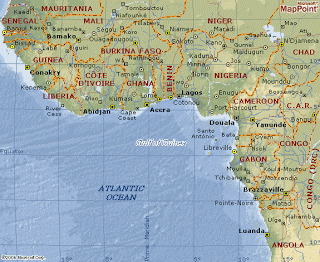
Thursday, January 24, 2024

What Gates and Bono Have In Common

In From the Cold has an interesting post up regarding the recent visit by Bono to the Pentagon, apparently where Bono had a 20 minute meeting with Secretary of Defense Gates. George Smiley (you have to love the spook nicknames) approaches the development with a healthy mix of skepticism and potential, and if it was anyone but Gates I would almost certain dismiss this as a development without a second thought, but our observation of Gates is 'he is one clever bastard' and we consider him one of the most impressive Presidential appointments in decades. Reuters has the story.

U2 lead singer and activist Bono visited the Pentagon to discuss Africa and the fight against global poverty with U.S. Defense Secretary Robert Gates, representatives of the two men said on Wednesday.

Among the topics at the 20-minute meeting on Tuesday afternoon were U.S. plans to set up a new U.S. military command for Africa, Pentagon press secretary Geoff Morrell said.

"I think this was a chance for two people who care about the problems facing the continent of Africa to talk about their shared interest in solving those problems," Morrell said of the meeting that was not publicized in advance.

A spokeswoman for DATA, the group co-founded by Bono to fight poverty and AIDS in Africa, said the singer had been in Washington to meet members of budget committees in Congress.


One could assume that this perhaps has something to do with AFRICOM, and it indeed may, but if Gates had done his homework and we are almost certain he does, he would have recognized that DATA is about AIDS, and when you are talking about AIDS one of the largest areas where AIDS related non governmental organizations have set up shop is in the nations around the Gulf of Guinea. It just so happens, the Navy is in that theater and AIDS is on the agenda. It's called the African Partnership Station, and it is unlikely Bono knows what he should about its purpose.

Consider this, the same week Gates is meeting with Bono about "issues involving poverty in Africa", the same Bono who sponsors one of the largest high profile AIDS organizations in the world (DATA), the USS Fort McHenry (LSD 43) is pulling into Sao Tome and Principe, a nation well known for AIDS issues.

We have discussed the African Partnership Station on this blog many times, but early on we specifically highlighted the desire of an international partnered, joint agency, and non-governmental organization approach, and in our example we specifically cited AIDS in in Sao Tome and Principe. At the time I discussed an observation made by a friend of mine who works in AIDS relief for an NGO in Sao Tome and Principe.

In that area there is a stigma from people regarding others with AIDS, and it leads to people with AIDS not getting treatments because they don't want others to know they have it.

He sees some of the other NGOs demonstrating the same stigma towards the API. While all the NGOs are trying to breakdown the stigma of AIDS, he sees some of the NGOs in hypocrisy because of their stigma over the US military.

The only weakness observed to date with the Global Fleet Station approach, and in particular the African Partnership Initiative is getting the NGOs to get involved. The European NGOs in particular are so skeptical of the US Military based on their perception of credibility issues that they would rather not work with the Americans for no other reason than their personal bias against the military.

If the African Partnership Initiative was able to get DATA involved in the process, and produce positive press regarding the enabling capability the US Navy can offer in their capacity, it could potentially break down the skepticism the Navy is encountering from the European NGOs and truly bridge the gap in creating a joint approach. The Navy desires to be the security enabler for the host nation, but also a logistical enabler for NGO contribution, leveraging civilian rather than military cooperation as a force enabler in connecting to African nations.

Did Gates and Bono discuss the African Partnership Initiative? Of the number of discussions about Africa where Gates and Bono could find common cause, we certainly believe it is one of the more likely topics the two could discuss and both contribute to the 20 minute discussion.

Thursday, January 10, 2024

Pirates Attack 6 Ships in Nigeria

On Sunday we highlighted some disturbing developments coming out of Nigeria. The news today is another warning things are deteriorating quickly.

Unknown gunmen attacked six oil industry ships on the channel leading to Nigeria's largest oil and gas export complex on Bonny Island on Wednesday, oil company security sources said.

Two people were injured, one of them seriously, but none of the vessels was boarded, the sources said. Bonny Island is the export point for about 400,000 barrels per day of crude oil and 18 million tonnes per year of liquefied natural gas.

"Six vessels were attacked within the space of about 20 minutes," one of the sources said, asking not to be named.

There are a number of different aspects to the situation in Nigeria, it is difficult to tell if MEND is involved in this incident, or if this is a criminal element. Reading the article further reveals the Nigerians believe the attackers were most likely pirates, but the article makes the point they actually have no idea who is responsible.

In their annual piracy report, IMB notes an increase in piracy in Nigeria for 2007. The US Navy supposedly has an evolving, slowly emerging strategy for that region with its African Partnership Initiative program, but we are yet to see evidence that program does more than provide local security forces training. In the case of Nigeria, the local security forces are either overwhelmed or overtly corrupt, and the military is engaged against the MEND insurgency, so while the training helps, it won't be enough.

AFRICOM is meeting a great deal of skepticism in Nigeria, if not outright rejection. Given the American track record in that region, that is hardly surprising. With the security problems deteriorating though, it is possible the US will get an opening to contribute to the security situation, and if that call comes I hope both our political leaders and the DoD is ready to respond effectively. They will probably get a shot to make a first impression, although probably at a small, limited level. It will be important to make the right impression when the opening comes.

As for the status of the API, the USS Fort McHenry (LSD 43) arrived in Libreville, Gabon this week. It is still unclear how effective the API is. That might be good news though, there is some speculation that the API can be evaluated as more successful the less we hear about it in the press. Considering how very little we have heard about the pilot Global Fleet Station in the Caribbean Sea in its last 2+ months of its deployment, despite all the early attention that GFS got, it must of been an extraordinary success. Or not.

Sunday, January 6, 2024

The Deutsche Marine Will Join The API In February

When Adm. Ulrich briefed reporters on some of the details of the African Partnership Initiative back in October, he mentioned that "five European nations already have signed on, and “Spain, Italy, France are all very interested,” he said."

France has arrived, with FS Bougainville (L9077) arriving on station last month. We are learning now that one of the unmentioned nations intending to make a stop as part of the African Partnership Initiative is Germany. Kato has the details over at Rear Echelon.

"EAV" is the German Training Cruise Flotilla, setting out yearly to train new officer cadets. This year - leaving Germany on January 15th - the cruise will go a bit further than usual. The EAV for 2008 consists of the Type 124 frigate FGS Hamburg (F 220), Type 122 frigate FGS Köln (F 211), and the Type 702 AOR FGS Berlin (A 1411).

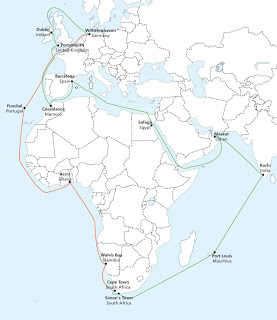
The tour, this year, will first set out for Accra, Ghana to the Gulf of Guinea - where the African Partnership Station Initiative is active - then go on towards South Africa.

Kato outlines the entire EAV training cruise, including stops in South Africa, India, and Oman among other locations. Excellent details. This is an interesting deployment for a number of reasons, but one of the first things that caught my eye was the deployment of FGS Hamburg (F 220), because it was recently pointed out Germany has had a lot of trouble integrating the new Type 124s with allied battlefield information networks.

Since their commissioning, the three Type 124 AAW frigates have been wrought with one little problem - their FCS software is incompatible. This is the result of ordering the ships from three different yards, and splitting FCS installation along with the contract (something that will not be repeated with Type 125). The incompatibility isn't visible at first - each ship funtions perfectly well, as long as it's on its own. However, the three ships are not able to share battlefield information among each other beyond standard Link-11 datalink messaging. Which effectively means that they cannot form a joint AAW battlespace.

The F124s represent an enormous investment of treasure by Germany for the Deutsche Marine, the most expensive warships afloat for Germany. As their primary air defense warship, integration with allies is a critical requirement of the air defense vessel. Has this problem been resolved? It remains unclear, but this EAV deployment represents the first major overseas deployment of the Type 124 and as Kato points out, it will be very interesting to see how the Hamburg integrates with allied forces once it reaches the 5th Fleet AOR during this cruise.

Regardless of the specific technical issues that have effected the new platforms for the Deutsche Marine, involvement by Germany in the African Partnership Initiative is very positive sign. American involvement in Africa will almost certainly hit skepticism at every turn, in fact it has. The broader the cooperation among multiple nations in the US approach to Africa the easier it will be to gain acceptance in the initiatives offered.

Friday, January 4, 2025

Silent Partnership Is the Theme For 2008

Updated: Ask and you shall receive.


Have you read the story about the LPD part of the African Partnership Station Initiative in the Gulf of Guinea? No, not the USS Fort McHenry (LSD 43), but the LPD that deployed back in November to operate in theater. No? We noticed, but we didn't connect the dots without help.

Quietly, without any US media attention, FS Bougainville (L9077) has been operating for several weeks as part of the African Partnership Station Initiative. Throw in the USS Annapolis (SSN 760) and HSV Swift and we are observing some interesting capabilities for the Global Fleet Station concept. It sure would be nice to discuss details, but one of the most interesting observations about these international partnerships is the silence in the media.

It is unclear if this is intended or not. If you recall, Adm. Ulrich was initially excited to discuss API before it began, but apparently peacemaking doesn't make headlines. The article hinted at this development.

From Washington, Ulrich is heading to a sea-power conference featuring naval chiefs from across the globe. There, he said he wants to explain why the next ship that sails into the Gulf of Guinea for the APS effort “isn’t flying an American flag.”

If he ever mentioned FS Bougainville (L9077), the media never covered his discussion. For some reason, and it would be nice to know the real reason, these partnership missions aren't generating any news stories unless it involves some humanitarian work. That is well and good, but the partnership aspect is being ignored.

It is a critical aspect of the mission though, that information represents the partnership justification the Navy will need if it ever intends to walk into Congress and discuss the new Maritime Strategy as opposed to shipbuilding problems. The new Strategy will require the Navy to sell ideas, but right now those ideas are not making it into the public discussion.

Another example of silent partnership is the upcoming Orion 08 deployment. The British are sending HMS Illustrious (R06) on a major deployment next month. This will be another partnership deployment.

Codenamed Orion 08, deployment will include Royal Navy, French, Spanish and US warships - including a submarine - and 20 fixed-wing and rotary aircraft. The force will be under the operational control of the RN and will visit 20 ports in the Mediterranean, in Africa, the Middle East, southern Asia and the Far East.

There hasn't been an official announcement regarding the full force composition, much less which US Navy ships will be attached. If we had a guess, we would say the USS Nicholas (FFG 47) for a few random reasons, but that is just a guess. As for aircraft? No idea, is 1(F) Squadron Royal Air Force deployed to Afghanistan? 800 NAS? Or perhaps as the RN article above implies, it will be Spanish Harriers...

The Orion 08 group is now said to include HMS Edinburgh (D97) and HMS Westminster (F237), but we are also hearing 4 minesweepers (Two Hunt and Two Sandown Class) instead of the 2 originally reported, and three RFA support ships, one of which will be the RFA Cardigan Bay (L3009) already in route to the Gulf. A nuclear submarine (Trafalgar-class) is rumored.

No word on what French or Spanish ships will deploy with the group, which isn't too surprising, as best we can tell when it comes to partnership deployments in 2008, all we hear is the silence of details.

Thursday, January 3, 2025

HSV Swift Deploys To African Partnership Initiative

The Navy is deploying HSV Swift to Africa to take part in the African Partnership Initiative.

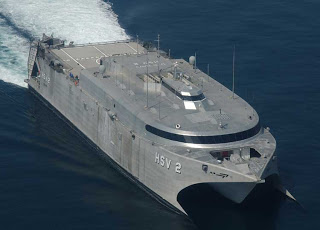
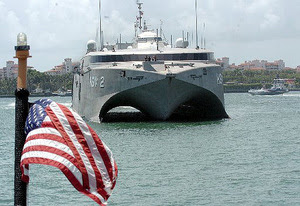
The high speed vessel, HSV Swift, will depart Friday to join USS Fort McHenry (LSD 43) off the west coast of Africa.

Swift will join the Navy's Global Fleet Station (GFS) initiative in an effort to promote maritime security, build relationships with surrounding nations and provide a stronger naval presence.

The ship will deploy from Little Creek Amphibious Base along with the Naval Station Ingleside, Texas-based Blue Crew, who will conduct a turnover with the Little Creek-based Gold Crew Thursday.

We have not seen any good articles on the pilot Global Fleet Station mission to Central America, and continue to look for a good summery. We still find that to be a bit odd, particularly considering the amount of attention that goes into promoting these types of missions before they begin. The hospital ships get the same coverage, a bunch of information up front but very little follow up.

However, we are getting good information on the use of High Speed Vessels. This is a particularly useful list of statistics from the same article.

In October, Swift returned to the United States after a two-year deployment that took the crew on a 100,000 nautical mile trip in which the crew visited over 30 countries and moored in over 100 ports.

HSV Swift is a rental, and the US Navy is getting its moneys worth. This leads to several questions. How cost effective are these high speed platforms compared to conventional platforms? For example, we know it costs more to send a ship like HSV Swift than to send a conventional ship, at least on a per ton basis; however we also would assume the speed is very useful.

For all the attention given HSV Swift, we don't see a lot of attention given in shipbuilding to producing ships like it. The JHSV program is scheduled to begin this year, FY09, but only consists of 8 platforms and it is a joint program with the Army. Given the amount of PR HSV Swift gets, one would think the Navy would want a few dozen of these low cost platforms. Or not.

While we know that these high speed vessels are cheap to produce, I get the impression they must be fairly expensive to operate, because that would explain why the Navy isn't building more of them. In our list of metrics, lift ranks very high, higher than tactical speed, which is why we advocate the CH-53K over the MV-22 as another example. These High Speed Vessels have 'decent' lift, not excellent, but do add speed to that lift capacity which can be important in some situations. It will be interesting to observe the evolution of high speed vessels as they become more numerous within the US Navy's deployment options.

Friday, December 7, 2024

The African Partnership Station Submarine

We heard about the USS Fort McHenry (LSD 43) and the HSV Swift supporting the African Partnership Station off west Africa, but now we are learning that the US Navy also has a submarine assigned to this Global Fleet Station.

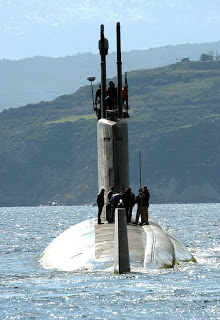
Africa Partnership Station (APS) gave six Ghanaian military officers from Western Naval Command a tour of three Navy vessels Nov. 30 when they embarked Amphibious Dock Landing Ship USS Fort McHenry (LSD 43), and the Los Angeles class submarine USS Annapolis (SSN 760), the submarine accompanying APS. The group also embarked a Landing Craft Unit Utility from Assault Craft Unit TWO.

The visit was organized as part of APS' visit to Takoradi, Ghana. In keeping with the Chief of Naval Operations' Maritime Strategy for building trust and increasing collaboration among partners, Annapolis was participating in an information sharing event, designed to bolster the maritime domain awareness of APS partner countries in the region.

Annapolis' participation in APS marks the first time a U.S. Navy submarine has been used as a 'partnership platform' to conduct personnel and information exchanges, and is another example of how the international community is collaborating in creative ways with African partners to achieve common goals regarding maritime safety and security, and stability.

This is a strange merge of naval theories between Mike Burleson and I, two guys who look to the future of the Navy with different metrics. Mike has advocate for an all submarine Navy in the past, where if I was going to make a major force structure change, I would build VLS or AGS armed LPD/LSD motherships instead of a Sea Base and DDG-1000.

Global Fleet Stations is said to represent the Maritime Strategy for the 21st century about as well as any new concept the Navy has put out so far in the 21st century. Apparently, as if there is any doubt otherwise, the USS Annapolis (SSN 760) is proving there will be plenty of room for submarines to contribute in the 21st century.

Friday, November 16, 2024

6th Fleet Focus: African Partnership Initiative (API) Indirectly Influences

There are some interesting events taking place in Nigeria, what I would call early returns, but would more accurately be described as indirect side effects of the African Partnership Initiative (API). There has been a lot of build up to this, but in the trends I am watching I am seeing a lot of coincidence in the focus of the US in the region and the efforts coming out of Nigeria in aspects of security.

The Nigerian Navy has so far arrested no fewer than 260 ships and barges allegedly involved in illegal bunkering of the nation's crude products.

Chief of Naval Staff, Admiral Ganiyu Adekeye, disclosed this in Abuja yesterday at the Nigerian NEWSWORLD Leadership Forum, stressing that the nation's waters is a very complex one.

The naval chief, however, absolved the navy from alleged sharp practices in the nation's seaports, noting that the navy does not control ships in the ports.

"It is the function of the Nigerian Ports Authority (NPA). The navy has been removed from the port since 1988. What we do is random checks," Admiral Adekeye said.

The big change we are seeing in Nigeria is a fight against government corruption. There are some zero tolerance policies that are starting to have an effect within the security infrastructure, which started in the Army but is now trickling into other aspects of the government. Mostly this leads to arrests, but there have been some 'mysterious' deaths of suspected corrupt high ranking officials as well. This is a change originating from somewhere in the background, empowered by something not seen in the media, and in evaluation I think what we might be seeing is the indirect influence of Nigeria's economic partners on the Nigerian governments priorities. Like I said, indirectly it appears the African Partnership Initiative (API) is paving the way for change.

The CNS also endorsed the presence of the United States marines in the Gulf of Guinea, stressing that the US has interest all over the world.

He said that the US marines' presence in the Gulf of Guinea would help combat global terrorism.

Adekeye also said that the US buys much of the nation's crude oil products and needs to protect their ships.

The CNS said that so many of the nation's ships have been reactivated in the past two years.

He said that the fleet renewal is aimed at making Nigeria a naval power.

Besides the refurbishing of the ships, he also hinted that the first set of new fleet of ships would arrive the country in June, next year.

Naval power, new ships, arrests, engagement, and assistance. Nigeria is in the early stages of something new to them, the western economic interests and governments are there, not only in the form of military, police, and Coast Guard, but in "full spectrum" assistance ranging from government to military to non governmental. This is what was missing in Iraq, this is an excellent approach to insure preventing regional tensions in the future, but most importantly it is a mechanism for building trust and breaking down the stigma's of the United States in a region that it is important to the United States. Watching Nigeria the last several weeks is like watching scenario's unfold straight out Thomas P.M. Barnett's books, as it is becoming very clear economic interests are driving policy and action.

This approach requires a lot of patience though, these early signs in the first weeks are noteworthy, but results will be measured in years.

Thursday, November 8, 2024

6th Fleet Focus: African Partnership Initiative Stigma and Hypocrisy

The African Partnership Initiative (API) has begun in the Gulf of Guinea region, and Eagle1 has an outstanding summery up well worth reading in full. When I read it, I called up a doctor friend of mine who volunteers in Sao Tome & Principe in dealing with HIV/AIDS.

His organization will be working with the API, but he says not every western NGO has stepped up yet.

He made an interesting point. In that area there is a stigma from people regarding others with AIDS, and it leads to people with AIDS not getting treatments because they don't want others to know they have it.

He sees some of the other NGOs demonstrating the same stigma towards the API. While all the NGOs are trying to breakdown the stigma of AIDS, he sees some of the NGOs in hypocrisy because of their stigma over the US military.

For an example of the stigma, the media recently reported on it.

When Maria (not her real name) took the brave step of speaking to the media in Sao Tome about her HIV-positive status, she had no idea what she was letting herself in for.

Although she had her back turned to the cameras, her voice was not disguised and it did not take long for people in her community to identify her. "After that, everyone knew it was me - at least, they thought it was me," she told IRIN/PlusNews.

The stigma attached to being HIV positive in the tiny twin-island state of Sao Tome and Principe is huge. No one living with the virus has so far gone public about his or her status, and health workers say that discrimination presents the biggest challenge to curbing the spread of the epidemic.

"This is our biggest problem at the moment. If we don't start accepting that AIDS is a normal disease like others, we are going to make things even harder," said Dr Alzira do Rosario, coordinator of Sao Tome's national AIDS programme.

That story makes his point clear as day. Westerners think they can preach removing stigma's from AIDS when they are struggling with their own stigma of the military involvement in the African Partnership Initiative. Read Eagle1's summery; he takes those pinheaded hypocritical fools to task, rightfully so. API may be enabled by military power, but ultimately it is a humanitarian and security service that the region is in desperate need of.

The use of soft power enabled by military power is critical in dealing with security and humanitarian issues in troubled regions in the 21st century, but the distaste of too many regarding involvement of the DoD in anything, period, is a major hurdle in leveraging this soft power. Programs like Global Fleet Stations are designed to be a counterweight to disruptive influences in impoverished places like Africa, supplying order and opportunity through safety and security initiatives in places overrun by corruption and lawlessness enabled by violence. Overcoming that western stigma is one of the major hurdle of implementing the "Safety and Security" aspect of the new 21st Century Cooperative Maritime Strategy of the 21st century.

Wednesday, October 17, 2024

6th Fleet Focus: Early Victory for AFRICOM

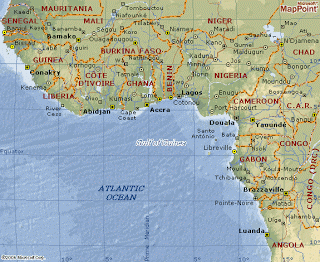
When the USS Fort McHenry (LSD 43) deployed on Tuesday, the nations expecting to participate in the African Partnership Station Initiative included Senegal, Liberia, Ghana, Cameroon, Gabon, and Sao Tome & Principe. Other nations have been invited, but no official interest from other nations had been announced.

There are two African nations specifically that have been critical of the US efforts to stand up AFRICOM, South Africa and Nigeria. Nigeria specifically was a hopeful for the African Partnership Station Initiative to take place in Global Fleet Station initiative in the Gulf of Guinea, but as of yesterday Nigeria hadn't expressed interest. Today, we have news otherwise.

The top U.S. Navy official in the African region says Nigeria, long opposed to the slowly developing increased American military presence on the continent, has accepted an invitation to participate in a new maritime security program.

U.S. officials, as they were planning the “Africa Partnership Station” (APS) effort, extended an invitation to a long list of African nations, including Nigeria and South Africa, which have both signaled opposition to the new U.S. Africa Command (AFRICOM). Both nations’ governments also have raised concern about Washington’s intention to focus more on the long-troubled continent.

South African leaders have not yet responded to an invitation “to at least send observers” for the first APS activities off the continent’s western coastline; Nigerian officials “initially showed no interest,” said Adm. Henry Ulrich, commander of U.S. Naval Forces Europe and the Sixth Fleet.

But the Nigerian leaders recently altered course, the soon-to-retire four-star said during an Oct. 16 Center for Strategic and International Studies-sponsored forum in Washington, indicating the African nation will take part. The “level of that participation,” Ulrich said, has not yet been determined.

This comes off news earlier this month of the USS Doyle (FFG 39), already in the region, conducted exercises with the South African frigate SAS Mendi (F 148) and 4 patrol boats of Ghana. The Navy has found mutual interest with the critics and is bringing them into the fold.

Time to eat crow. I have been especially hard on Ulrich, who I have not been impressed with in affairs of Europe. However, when it comes to Africa, Ulrich continues to produce big. This blogs author, and his staff of support who is wiser than he, extends its apology to the Admiral for our unfair criticism to date. While this blogs position is the good Admiral says things that are quite disagreeable, actions speak louder than words.

All the credit here goes to Admiral Ulrich, and I would forecast that following the good PR following successful SNMG1 tour of Africa from the last few months, South Africa will ultimately be involved in some way. When you look at Ulrich's record of just the last few months, whether it is the SNMG-1 African Cruise, Maritime Domain Awareness initiatives in the Mediterranean Sea, or this African Partnership Station Initiative the US Navy 6th Fleet is doing good work with joint, international cooperation on every level.

But it doesn't end there, the article goes on to cover this tidbit:

From Washington, Ulrich is heading to a sea-power conference featuring naval chiefs from across the globe. There, he said he wants to explain why the next ship that sails into the Gulf of Guinea for the APS effort “isn’t flying an American flag.” To that end, five European nations already have signed on, and “Spain, Italy, France are all very interested,” he said.

U.S. officials have been in early talks with nations along the east African coasts about bringing APS or a very similar initiative to that side of the continent, Ulrich said, adding nothing has yet been nailed down.

It will be interesting to see what types of ships European nations send to the region. Noteworthy though, because there has been some discussion that France is interested in leading the next Global Fleet Station Initiative to East Africa, specifically rumored to be willing to deploy a Mistral class. I thought that was rumor only, but maybe there is some truth to it?

The Global Fleet Station concept is an extension of the Sea Basing concept in Sea Power 21, and in my opinion the best Sea Basing idea to come out yet. What I am impressed by is how the US Navy has already influenced allies with this idea to get them on board. When one considers the potential of international Sea Bases of maneuver in maritime regions with security problems, the 1000-ship Navy vision is realized.

6th Fleet Focus: African Partnership Station Initiative

The USS Fort McHenry (LSD 43) deployed today on the second US Navy Global Fleet Station deployment. Admiral Henry Ulrich has given the GFS a name, the African Partnership Station Initiative. In his press conference on Monday, Adm Ulrich laid out the details describing 4 pillars of training emphasis that will be utilized in the deployment.

  • Maritime Domain Awareness
  • Maritime Professionals
  • Maritime Infrastructure
  • Maritime Enforcement

Stars and Stripes has the summery of the press conference.

The USS Fort McHenry was expected to leave Norfolk, Va., on Tuesday, on a mission to deliver training teams to western Africa next month, said the head of U.S. Naval Forces Europe on Monday.

The Fort McHenry and the High Speed Vessel Swift are expected to begin a seven-month deployment to the Gulf of Guinea in November as part of the Navy’s Global Fleet Station program, according to the Navy.

The mission will allow training teams aboard the Fort McHenry to assist western African nations develop their maritime security capabilities, said Adm. Henry G. Ulrich III.

The training teams will have between 80 and 100 people, and will consist of both civilian and military personnel, Ulrich told reporters Monday.

The teams will include representatives from European and African countries’ militaries, U.S. government agencies and nongovernmental organizations, Ulrich said.

Their missions will include civil engineering, port security, humanitarian assistance, and search and rescue, according to information provided by the Navy.

This is the first major initiative of AFRICOM, and will likely get a lot of attention and create the framework for what the US intends to do with AFRICOM. The details from the first Global Fleet Station deployment have not been publicized, and it is unclear if the press will pay any attention to this deployment either. A few thoughts.

Oil bunkering in this region is currently costing the region around 3 million dollars a day. That is on top of other problems, including illegal fishing, which probably sounds like nothing to a laymen but is actually a billion dollar industry in that region. Additionally there is piracy, insurgency, terrorism, and other security problems that require stronger domestic maritime security forces to deal with. In all, the African Partnership Station Initiative can impact the economics of the Gulf of Guinea region in a number of ways.

I've recently found myself reading Thomas P.M. Barnett, and found a specific blog update the other day very interesting. I haven't done my research well enough to comment extensively, but I did order Blueprint for Action after I read it.

Barnett was commenting on this report out of Reuters.

Wars stripped about $284 billion from Africa's economies between 1990 and 2005, roughly equal to the amount of aid money given to the world's poorest continent, according to a report on Thursday by Oxfam International.

In the study "Africa's Missing Billions," the British aid group said the 23 conflicts engulfing Africa in the period had shrunk economies by an average 15 percent per year at a cost of almost $18 billion a year.

Oxfam based its estimate on a calculation of the various costs of conflicts and violence, including higher military expenditures, loss of development aid, rising inflation and medical expenses of those injured or disabled.

It said, however, that the tally was probably on the low side, when considering the impact of civil wars on the economies of neighbouring countries as well as the long-term effects of higher military spending on individual economies.

Barnett, whose blog has become a daily visit for me, threw me off when he advocated military action as part of the solution to the problems in Africa the other day. His blog entry makes a case in and of itself, but I think I'll reserve extensive comment until after I read his book. One thing I would add though, I included the link to the "Africa's Missing Billions" report, which I tend to agree went low on the costs. Make sure you read it before you criticize Barnett, because the report does tend to support his position, even if it is counter intuitive.

While Global Fleet Stations is a service oriented operation as opposed to a military campaign, it seems to me if you were to engage militarily in Africa, the only way to do it would be with smaller forces on the ground taking on the centers of gravity of other smaller forces on the ground, while also interdicting arms shipments by land and air. All three of those roles fall into the capabilities of the Navy and Marine Corp combined with SOF, and in such an action, a "full spectrum" support team similar to the one used in the GFS concept makes the most sense regarding post action activity. Food for thought.

Thursday, October 4, 2024

Global Fleet Station Pilot Concludes

With virtually no coverage, which actually describes the deployment for the most part, HSV Swift quietly completed the Global Fleet Station (GFS) pilot mission to the Caribbean nations of Belize, Dominican Republic, Guatemala, Honduras, Jamaica, Nicaragua and Panama.

In these countries, they conducted 39,890 hours of exchanging knowledge in such areas as leadership, small boat operations, port security and small unit tactics.

“The past six months have been very successful,” said Capt. Douglas Wied, Commander, Task Group (TG)40.9. “Through our subject matter exchanges we’ve learned just as much from our partner forces as they have from us. Terrorism, narco-trafficking and piracy don’t care what nationality you are, these aren’t problems we can solve alone, but together as a team, we can.”

Aside from the subject matter exchanges and training, TG 40.9 also conducted 15 community relations projects in every country they visited as well as visiting schools and sharing their military experiences and messages of GFS with children in Guatemala, Honduras and Panama.

There was so little press coverage it is very difficult to make any specific comments, although I do have one observation. Can anyone tell me any major difference between Global Fleet Stations and CARAT? Looks the same to me.

That isn't a criticism of the mission, the Navy should be commended for recognizing the excellence of CARAT and exporting it to other regions. I also thought it was innovative to use the HSV hull. However, in relation to the original explanation and descriptions of Global Fleet Stations by the CNO back in September of 2006, let me just say the CNO embellished.

Could the GFS have done more? I have no idea, but I do think events occurred that fit right into the GFS model, example 2 major hurricanes that hit GFS targeted nations, that could be recognized as missed opportunities for the Navy. There was also a fair amount of reported piracy in the region, not to mention the usual drug running, so perhaps the GFS missed some chances to be more than an education medium.

If the Navy sees Global Fleet Stations as a way to establish presence in a region, they are going to need more than 1 ship.

Regardless, given the success of CARAT I have no doubt HSV Swift crew did an excellent job and performed brilliantly in ways that will be rewarding towards our nations interests. It certainly sets the stage for the upcoming GFS deployment of the USS Fort McHenry (LSD 43) to West Africa.

Tuesday, August 21, 2024

Navy Poised for Action in Hurricane Response

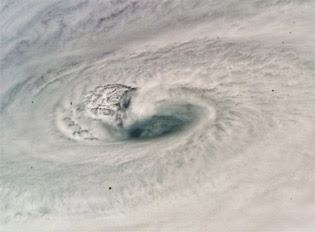
I was pleased to see the Navy is already in position ready to react to the damage Hurricane Dean is likely to leave in its wake. Then I realized it wasn't the US Navy, rather the Royal Navy.

Royal Navy vessels HMS Portland and the Royal Fleet Auxiliary tanker Wave Ruler are following 240km (150 miles) behind the hurricane ready to offer help if needed.
It will be interesting to watch how the US Navy does. We have spent 11 months hearing about how the Global Fleet Station is going to make a significant impact to its Area of Operation, including in humanitarian response, yet on the eve of disaster I remain highly skeptical.

I hope to be proven wrong.