
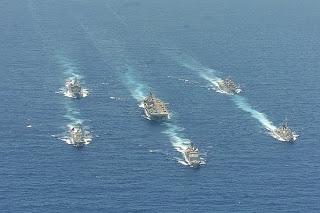
 As the Marine Corps maintains a forward deployment posture, not only in new theaters like Iraq and Afghanistan, but also old theaters like the Pacific, there have been questions about what the Marines should be doing to retain their expeditionary character. When we observed the Nassau ESG would be deploying empty, our impression was that the Navy and Marines are wasting an opportunity. Combined with this report from Defense News, we are curious whether in fact this deployment will indeed become a test for a new operational concept. It should.
In recent years, with Marines committed to long-term presence in Iraq and Afghanistan, the Navy’s gator force has at times deployed without Marines on unique missions, such as chasing pirates off Africa or serving as a floating health clinic in Asia.
But that may soon be adjusted under the new operational concept known informally as “The Long War brief,” which was signed sometime in late January or early February by Marine Corps Commandant Gen. James Conway.
In comments to reporters Feb. 1 in Washington, D.C., Conway said long-term commitments ashore have dulled the Corps’ sharp seagoing tradition.
“We now have a generation of men and women who do not have a complete understanding of what ‘expeditionary’ is,” Conway said. “That people now believe that three square meals a day courtesy of KBR and a cot is expeditionary, that is just not true in most of the environments where we would expect to find ourselves in the early going of a contingency.”
It’s back to the blue/green team.
Based on a force of 27 active-duty infantry battalions, the new “operational employment concept” puts nine infantry battalions forward at all times: three with Marine expeditionary units, three forward-deployed on Guam and Okinawa, Japan, and three with newly conceived, region-specific foreign military training missions, known as a “security cooperation Marine air-ground task forces.”
The Defense News article goes on to describe this as a “Maritime Security Group” in the spirit of an article for the May 2007 issue of Marine Corps Gazette titled “Rethinking Naval Forward Presence” by Frank Hoffman. In reviewing the article, we would like to see the proposals worked out, but in general we observe conceptually the ideas are very much in line with many of the Strategic concepts expressed on this blog regarding the adaptation of Amphibious Ships to new roles to provide more soft power through Sea Power. We are very pleased to learn our ideas are in line with other ideas that have been promoted, it is always good to learn who our allies are in the realm of theory.
Defense News also goes on to describe part the new concept as a Marine Corps version of the Global Fleet Station. We will wait to see what the differences are before comment, similar can mean many things, and it could be this has more in common with CARAT than the API. The press can often blur those distinctions, so we will wait and see.
Defense News also goes on to describe the idea conceptually as what has been previously termed a Sea Basing mission off East Africa, and the humanitarian mission by the USS Peleliu (LHA 5) last year.
While the new Marine concept may provide greater definition in similar future scenarios, the recent past has shown creative uses for “green-free” amphibs.
In May, the amphibious assault ship Peleliu steamed from San Diego on Pacific Partnership, a floating four-month humanitarian assistance/civil affairs mission throughout Southeast Asia.
Before being decommissioned in 2007, the amphibious assault ship Saipan deployed with only an embarked Navy helicopter detachment in August 2006 as an “expeditionary action group.”
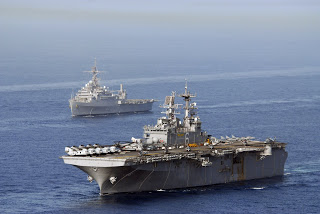 The emergence of COIN theory within the context of Seapower will be one to closely observe. How to best conduct peacemaker missions and balance warfighter requirements at sea is a major challenge facing the Navy in developing a soft power strategy, so the Marines are helping out here by offering their ships as a resource means to those ends. Very smart.
Amphibious ships are not going away, and remain one of the most versatile ships in the fleet inventory. We like new ideas on how to use these platforms, because we believe they have all the right metrics for increasing the ability of both the Navy and Marines to engage in peacemaker operations that address counterinsurgency strategies from the sea, and we see this as a big early step for promoting joint concepts for developing soft power through sea power.
We have observed that Seapower approaches to soft power over the last few years has included the suggestion the LCS will fill that role. As we have argued, no chance in hell, unmanned platforms are primarily warfighter tools that only offer a scouting contribution to peacemaker operations. The LCS lacks the most important requirement as a peacemaker contribution, humans. That is a major reason why when discussing soft power on this blog, we usually discuss amphibious ships and motherships.
In our early studies and discussions of motherships, dating back to before the blog even, we used to advocate for a full marine rifle company to handle this specific role of a soft power training force as part of our littoral strike group concept. As we developed the mothership concept, we eventually dropped that aspect of our mothership concept, and see this development as a better approach to filling the soft power role we observed as a missing piece of sustained operations in regional theaters.
While we are sure this concept will be a work in progress, and will require multiple deployments to get the process right, we welcome this idea and this line of thought in approaching the Long War with Seapower.

No comments:
Post a Comment