
In his post below, Raymond correctly points out the riskiness of the "spread the wealth" approach that the Seapower Subcommittee leaders are advocating for the Navy's UCLASS program. This strategy might work beautifully; however it should be noted that recent history demonstrates that keeping all the contractors happy in a no lose competition doesn't always produce the most capable, affordable platform for the navy. Constantly adjusting or just plain unrealistic key performance parameters - say stealth and ultra endurance - generally result in major cost creep and a design that does no one thing all that well (see for example, LCS).
Over the summer, USNI News leaked some of the details of the U.S. Navy's private UCLASS RFP requirements. USNI notes that the UCLASS requirements were altered to create a platform more suitable for counter-terrorism (CT) missions vice stealth or "day 1" operations in a major theater war. I have argued on this forum and elsewhere for a number of years that the future of CT is sea-based. I stand by this argument. Until we get serious about killing Salafist Jihadis in significant numbers wherever they appear fast enough to diminish their will and capability to fight (a subject for another blog), we will continue to play whack-a-mole generally following one step behind them as they transition from battlefield to battlefield. To wit, the US CT center of focus the past decade has shifted repeatedly (with some concurrent operations) between Afghanistan, Iraq, the FATA, Yemen, the Sahel, and Horn of Africa. And now Syria is the latest unaddressed foreign fighter sponge where jihadis freely train, build combat experience, and plot against western targets while the world focuses on the other side of the conflict. What all this means is simply that al Qaeda is still very alive and well, whether or not the average American understands it or even cares. Constant offensive CT pressure is required to keep larger terror safe havens from forming and another 9/11 type event from happening.
The flexibility ISR/CT orbits flown from the sea provide will be critical to sustaining this fight for the next two decades. An orbit is defined as the ability to indefinitely - that is 24 hours a day, 7 days a week - monitor a point on the ground (or water). Generally, orbits are used to refer to UAVs conducting ISR missions, but the term is also applicable to CAS, airborne interdiction, and other armed missions.
The unspoken issue driving the Congressmen's letter (I surmise) is that it appears unlikely that any of the existing publically known UCLASS designs except for perhaps the General Atomics Sea Avenger will be able to meet the stated range and endurance requirements. So possibly the Navy has already made up its mind and just issued the RFP thusly to meet government competitive requirements, or the competitors have designs capable of meeting the combat radius requirements that have not been-publically revealed. Or maybe it's still up for debate.
Press reports note that the UCLASS will be able to carry two 500 lb bombs, which likely means the GBU-38/54. These payloads are perfectly adequate against mobile targets such as SCUD or ASCM launchers or a terrorist leader in a pick-up. Regardless of the eventual aircraft's stealth, in a major war the UCLASS's ordnance will complement larger munitions dropped by strategic bombers or in the form of sea-launched TLAMs. The accuracy of these precision weapons, especially when delivered by a plane that has been monitoring the target area for hours (or days) makes up for sheer firepower. Therefore, I'd be suspect of anyone who tells you the platform needs to carry larger weapons.
Regardless of which direction the Navy sways on this RFP, UCLASS is going to be an amazing leap forward in CVN capability. Carriers haven't flown aircraft with a 2000 NM single sortie range since the A-6 Intruder retired in the 1990s. And flying between manned aircraft deck cycles (>12 hours endurance) will give CVNs the ability to have aircraft over the battlefield 24 hours a day for unlimited periods of time. Also, once all the infrastructure is in place to support them (much of it is already but needs to be adapted for shipboard use), the overall cost per flying hour and per pound of ordnance on target from ship-board UAVs will fall significantly below that of manned aviation.
Finally, even if the UCLASS competition turns into a winner take all and the initial design turns out not to be exactly what the navy needs for the long term, any CVN-based UAV is better than no CVN-based UAV and the testing and operational experienced gained will quickly identify shortcomings and allow for a continually improved future mix of unmanned (and still manned for the foreseeable future) air wing.
The opinions and views expressed in this post are those of the author alone and are presented in his personal capacity. They do not necessarily represent the views of U.S. Department of Defense or the US Navy.
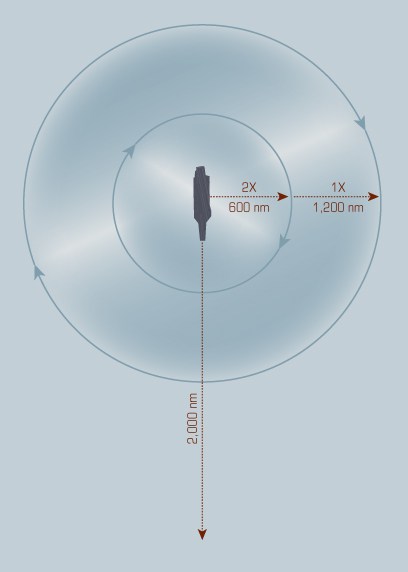 |
| Proposed UCLASS ranges (USNI Graphic) |
The flexibility ISR/CT orbits flown from the sea provide will be critical to sustaining this fight for the next two decades. An orbit is defined as the ability to indefinitely - that is 24 hours a day, 7 days a week - monitor a point on the ground (or water). Generally, orbits are used to refer to UAVs conducting ISR missions, but the term is also applicable to CAS, airborne interdiction, and other armed missions.
The unspoken issue driving the Congressmen's letter (I surmise) is that it appears unlikely that any of the existing publically known UCLASS designs except for perhaps the General Atomics Sea Avenger will be able to meet the stated range and endurance requirements. So possibly the Navy has already made up its mind and just issued the RFP thusly to meet government competitive requirements, or the competitors have designs capable of meeting the combat radius requirements that have not been-publically revealed. Or maybe it's still up for debate.
Press reports note that the UCLASS will be able to carry two 500 lb bombs, which likely means the GBU-38/54. These payloads are perfectly adequate against mobile targets such as SCUD or ASCM launchers or a terrorist leader in a pick-up. Regardless of the eventual aircraft's stealth, in a major war the UCLASS's ordnance will complement larger munitions dropped by strategic bombers or in the form of sea-launched TLAMs. The accuracy of these precision weapons, especially when delivered by a plane that has been monitoring the target area for hours (or days) makes up for sheer firepower. Therefore, I'd be suspect of anyone who tells you the platform needs to carry larger weapons.
Regardless of which direction the Navy sways on this RFP, UCLASS is going to be an amazing leap forward in CVN capability. Carriers haven't flown aircraft with a 2000 NM single sortie range since the A-6 Intruder retired in the 1990s. And flying between manned aircraft deck cycles (>12 hours endurance) will give CVNs the ability to have aircraft over the battlefield 24 hours a day for unlimited periods of time. Also, once all the infrastructure is in place to support them (much of it is already but needs to be adapted for shipboard use), the overall cost per flying hour and per pound of ordnance on target from ship-board UAVs will fall significantly below that of manned aviation.
Finally, even if the UCLASS competition turns into a winner take all and the initial design turns out not to be exactly what the navy needs for the long term, any CVN-based UAV is better than no CVN-based UAV and the testing and operational experienced gained will quickly identify shortcomings and allow for a continually improved future mix of unmanned (and still manned for the foreseeable future) air wing.
The opinions and views expressed in this post are those of the author alone and are presented in his personal capacity. They do not necessarily represent the views of U.S. Department of Defense or the US Navy.

No comments:
Post a Comment