
 |
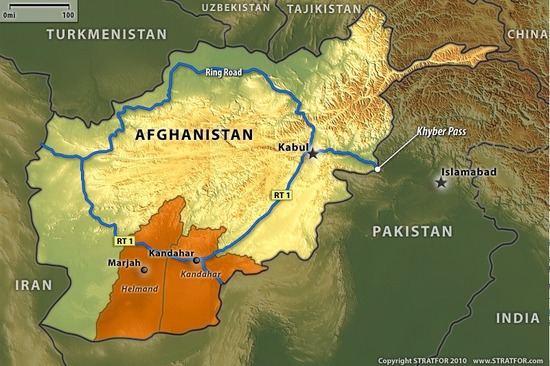
| Afghanistan's "ring road roundabout provides many connections |
This week a number of papers have again trumpeted the headline that the U.S. govt. may yet again speed up its planned military withdrawal from Afghanistan. Continuing Taliban resistance, inability of the Afghans to rise to the challenge of self-governance, and the continuing costs of U.S. and NATO military involvement have all combined to sap the will of Western powers to finish the task of stabilizing the Afghan state. Before we again consign Afghanistan to the backwaters of our collective strategic mind, perhaps we should review some remote and recent Afghan history and consider its enduring strategic importance. Hardly a "graveyard of empires," Afghanistan has been and remains the vital strategic hub of central Asia whose importance will only grow in the 21st century.
Afghanistan's geography has made it a virtual "roundabout" for transportation across the vast Eurasian continent. This unique feature (seen above in blue in the form of the Soviet-era ring road) has allowed overland communication for travelers, conquerers and kings since the time of the ancient Persian empire of the 6th century BC. It provided Alexander the Great access to the Indian subcontinent from the plains of Iran. It allowed travelers such as Marco Polo and Ibn Battuta free movement from the Mediterranean to China. It allowed an upstart Pashtun Afghan leader named Mahmud Khan to invade and depose the tottering Persian Safavid Empire in 1722. It served as a vital buffer state for the British Empire against Imperial Russian and Persian designs on India for nearly a century. In recent times the Afghan ring road started by U.S. builders (the Morrison Knudsen Company) in the 1950s and finished by the Soviets continues as a transportion system. It may yet serve as a maintenance road for an even more important highway of petroleum products in the near future.
Just who controls this vital hub of Central Asia may become very important in the next century as the Central Asian hydrocarbons market seeks new customers and greater profits. The Chinese in the quest to fill their deepening industrial thirst for oil and natural gas have explored possibilities for overland pipelines (for both oil and natural gas) through Pakistan and Afghanistan. Afghanistan's unique geographic position would place it directly athwart a potential pipeline's path. Chinese tankers and liquid natural gas carriers could stop and discharge their cargoes at a port such as Gwadar in Pakistan rather than brave a potentially hostile Indian ocean and Malacca strait guarded by U.S. and other friendly nation seapower. Such a choice might enable China to undertake more aggressive action in its designated "First Island Chain" without regard for a distant maritime blockade. These pipelines could also serve to tie potential U.S. competitors like China to friendly petroleum and natural gas suppliers like Russia and Iran. Such a strong combination would inevitably become a powerful competitor against U.S. economic, financial and military interests. It could also de-stabilize the relationship between India and Pakistan. China is a strong supporter of the Pakistani military while India and China maintain a wary eye on each other over a fortified border on the old Silk road pass of Nathu La. Tensions flared there as late as May of this year over control of a set of bunkers. India takes pride in its place as the guardian of stability in the Indian Ocean littoral. A recent (2010) article in The American Interest by Indian strategist C. Raja Mohan advanced a concept of Indian strategic thinking more in line with early 20th century British Indian Viceroy Lord Curzon rather than Jawaharlal Nehru. Mohan envisions a more muscular India exerting power in Central Asia much as the British Empire once did through Indian Viceroys like Curzon. How is India likely to respond to a China with a new northern overland energy route, out of range of most assets of Indian military power, and buffered by India's main rival Pakistan?
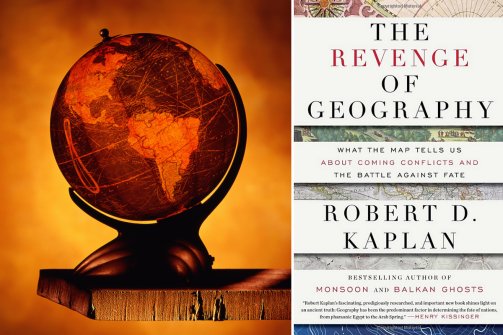
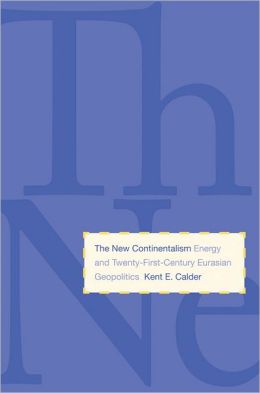 A stable Afghanistan is good for the Afghan people and the world in general, but just who provides this stability really matters. Two recent books directly examine the centrality of Afghanistan to Central Asia and the Eurasian continent. The Revenge of Geography by Robert Kaplan and The New Continentalism, Energy and Twenty First Century Eurasian Geopolitics by Kent Calder both address this issue as does Kaplan's earlier book Monsoon, The Indian Ocean and the Future of American Power. While Afghanistan may still seem to some as a useless backwater unworthy on continued Western stabilization efforts, it is actually a vital strategic hub on which many potential conflicts of this century may yet hang. Previous powers such as the Persian and British empires were able to successfully exercise significant influence in Afghanistan over long periods. While their use of financial support and occasional military action in favor of friendly Afghan rulers may seem corrupt or antiquarian to current western leaders, these methods remain the currency of choice in a divided and unstable Afghanistan. Western powers, most notably the United States must not precipitously withdraw military forces from Afghanistan without ensuring a peaceful pro-Westerm regime remains in control of the country. Any other result could later be disastrous to both Western economies and peace and stability in the region.
No comments:
Post a Comment