
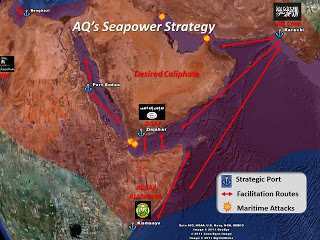
 Last week CDR Chris Rawley published a journal article with the Small Wars Journal titled Al Qaeda's Seapower Strategy. Small Wars Journal has been going through a software upgrade so I decided to wait a bit to let them work out the bugs before linking, but with those bugs worked out I want to highlight this article and a specific aspect covered within.
 For hundreds of years, Arab traders in sailing dhows followed the seasonal monsoons in the Indian Ocean to move spices and other goods from the Orient to European markets. Today, diesel powered dhows with very similar designs move cargo - both legitimate and illicit - along many of the same routes. Criminal networks, insurgent groups and transnational terrorists utilize these routes to ship fighters, weapons, and other commodities across the sea. AQ can easily outsource its facilitation to human smugglers and drug runners who own these rat lines.CDR Rawley goes on to note several aspects of how Al Qaeda is leveraging the sea for income. For example, he notes Kismaayo now provides what is likely al Shabaab’s primary source of revenue, via taxes on imports and exports, but also notes the smuggling routes and sea lines of communication out of Karachi, Zinjibar, Port Sudan, and Benghazi. With increased activity from AQIM, it is logical to presume Al Qaeda is leveraging a port in Western Africa as well.
AQ has also moved key leaders across these routes as the indictment unsealed in July 2011 against Ahmed Abdulkadir Warsame revealed. Warsame was an al Shabaab facilitator who had traveled to Yemen to coordinate logistics and operations with Al Qaeda in the Arabian Peninsula (AQAP) and was captured by U.S. forces at sea while attempting to return to Somalia.2 The same route across the Gulf of Aden is utilized by human smugglers who annually transport thousands of refugees paying anywhere from $30 to $120 per person to make the perilous 30 hour journey from Somalia to Yemen in less-than-seaworthy vessels. Al Qaeda’s affiliates, whether by conscious decision or happenstance, have secured access to a number of important ports along these shipping lanes.
The western preference to leverage economic sanctions on Iran and North Korea quickly forced both countries to leverage the sea as a shadow zone for economy, and I think it is logical to presume Al Qaeda is doing the same. We know that the sea is heavily leveraged by narcotics smugglers globally, but it is still relatively unknown to what extent Al Qaeda leverages the sea as a source for income. As pressure tightens on land, leveraging the sea for income would in theory become a better option for Al Qaeda, as there is more freedom of maneuver and action at sea than there is on land.
When thinking about how Al Qaeda relates to the sea, it is easy to get caught up focusing on the potential for Al Qaeda to strike targets at sea, but the hard work is denying Al Qaeda the ability to leverage the sea for economic benefit. Denying Al Qaeda sea lines of communication is unsexy work by naval forces designed with superior combat power against other maritime opponents, but it is vital to strangling Al Qaeda's ability to expand and connect their influence throughout the Middle East and Africa.
One of the recommendations by CDR Rawley towards denying Al Qaeda the sea is to recapture ports. He describes it as a whole of government the effort would enable partner nations with training, intelligence sharing, and when necessary, fire power and direct combat support - to take back this key terrain from al Qaeda. I think the US needs to think about this one step further, indeed I think one of our problems as a nation is that we seem very willing to take a whole of government approach to fighting wars, but are very unwilling to take a whole of defense approach without thinking about a whole of defense approach as a full scale occupation.
In my opinion the US government needs to rethink our concepts of reliance on air power to fight wars across the globe and start incorporating more tactical capacity for limited ground power when and where it can be very effective in delivering blows to the enemy. For some reason, our political leaders seems to think of air power with drones as very low level of warfare, the next step up being war with the full spectrum of air power, and then we skip our ability to escalate warfare all the way to massive Army Corps buildup as the only option for leveraging land power. What is lost in that vast middle are options like the amphibious raid, which can be conducted successfully to move in, insure destruction of enemy capabilities and the collection of important intelligence on the ground, and the most important step of withdrawing without leaving a shore based footprint.
Amphibious raids are not the deployment of occupation forces, and I believe in both Somalia and Libya amphibious raids could have been used under existing UNSCRs to significantly damage the ability of the enemy to operate effectively. This option has likely been passed up due to perceptions of risk, but the idea of committing any combat power to war - even if it is all up in the air with drones - and believing one isn't taking a major risk is the height of human folly.

No comments:
Post a Comment