
 Kurt Albaugh has an article discussing naval power over at the Small Wars Journal. The article takes on the LCS and Aircraft Carrier as potential bad matches for the future Navy. The article has many aspects we could discuss, but I want to focus on this question.
Adopting an acquisition strategy informed by the early US Navy would favor neither the aircraft carrier nor the LCS. It would favor a generous number of highly capable, adaptable, affordable platforms. During the Barbary Wars, the American heavy frigate met those goals; what might the modern equivalent look like?I'm a big fan of Ian Toll's book Six Frigates, and appreciate whenever someone discusses that book in a way that seeks answers to modern questions. However, in the case of this article I can't say I agree with Kurt Albaugh's most important point.
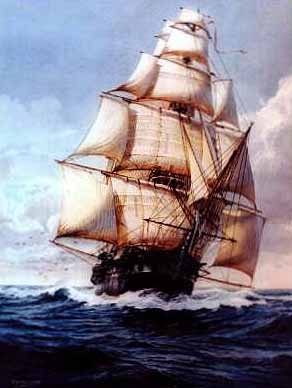
The United States has a class of ship today nearly equivalent to the Constitution and her sister ships: the Arleigh Burke-class destroyer. Smaller than a modern capital ship, the class nonetheless contains an incredible amount of combat capability: the Aegis combat system, Tomahawk cruise missiles, surface and undersea weapons, and in many cases, ballistic missile defense capability. Operating independently, they can conduct a variety of missions in high-threat environments where carriers need many escorts and where the LCS is vulnerable. Moreover, their mature design allows more ships to be purchased at a comparatively lower cost, ensuring that potent capability can be distributed on a global scale.I think there is a fair case that can be made that the original six frigates would favor neither the aircraft carrier nor the LCS, but to suggest the original six frigates is like the Arleigh Burke-class destroyer is also incorrect.
Folks, the Arleigh Burke-class is the most powerful surface combatant in history, and the most important battleship class in history, and it isn't even close. This is a class the United States Navy fully expects to serve as a front line warship for almost 7 decades (1991 - at least 2057). Yeah, we call the Arleigh Burke-class a "destroyer", but primarily for political reasons, not for reasons of historical naval science.
Battleships in the age of sail did not displace over 2000 tons, and yet battleships in the gun era could displaced over 70,000 tons. Guess what - the displacement and armament of those ships determined they were battleships specifically because of how they compared relative to other ships in the same era. In the missile era, the Arleigh Burke-class is at minimum a modern second-rate battleship.
That is why I do not see how the original six frigates can be compared to the Arleigh Burke-class. The USS Constitution was a high end frigate of her era while the Arleigh Burke-class is a high end battleship of her era, and if the case the author is trying to make is that we need a lot of flexible high end frigates, advocating the Arleigh Burke-class seems odd to me. When the answer is always the big deck nuclear aircraft carrier or Arleigh Burke-class, I have serious concerns whether we are asking the right questions.
When I look around the world, I see two nations building ships that seem more appropriate in following the tradition of the original US six frigates in the modern era: Spain and Australia.
The Spanish F100 Alvaro de Bazan class multirole frigate and the slightly larger Australian Hobart class of destroyers seem to squeeze into a middle space below the Royal Navy Type 45 and the Japanese, South Korean, and US AEGIS warships but slightly more capable (better armed) than European warships of similar displacement/configuration.
Whether one looks at the Alvaro de Bazan class and Hobart class as heavy frigates or light destroyers, in the modern era they are more similar to the USS Constitution of the age of sail, or even the Heavy Cruisers of the gun era. They come heavily armed relative to other ships of similar displacement, but are clearly a step below the larger missile warships of this era that represent the 'ship of the battle line' classes.
So if these mini-Burkes are the modern equivalent of the USS Constitution, is that what the US Navy needs today? I would argue no. We have the real deal in the Arleigh Burke-class and plenty of them, and I don't see a need for 'half the payloads' today. In many ways the flaw I see in the analysis is that Kurt Albaugh does what many do with the Littoral Combat Ship - attempt to frame the vessel in the context of a frigate. To me, that is like attempting to put the nuclear powered attack submarine or aircraft carrier into the context of a rated ship of the line, when I am not sure such a thing works in the modern era.
The LCS is a mothership, not a frigate. The LCS is a platform for deploying manned and unmanned systems of a variety of types, just as the aircraft carrier is a platform for deploying manned and unmanned aviation systems. I am the first to agree the LCS is an imperfect solution for that purpose, but I also believe the LCS is an important solution towards developing that purpose. Deploying multiple systems above, on, and below the sea and sustaining the operations of those systems is going to be difficult, and there is going to be a learning curve. The LCS has ultimately become an inexpensive means towards those ends, and for that I am pleased the US Navy continues to move forward.
I would also point out that it is entirely possible to suggest the LCS is more similar to the approach of the USS Constitution than the Arleigh Burke-class is as the author suggests. The original six frigates were a product of out of the box thinking, and there is no question the LCS fits that criteria. A lot of people are naive enough to believe the LCS is similar to the STANFLEX designs in Europe, or even the FREMM concept. Not so, the engineering, integration, and modularity differences are enormous, and modularity is a lot more than simply rolling on and off different disconnected systems - indeed it is the integrated engineering of the interchangable systems that makes LCS very different than anything else in the world. That same interchangable engineering is also what makes the LCS a great deal more complex.
So one could argue that if Kurt Albaugh is looking for the US Navy to be innovative and develop a future combatant platform that doesn't follow the mold of what everyone else is doing, just as the United States did when the nation built the first six frigates, then the Littoral Combat Ship is very similar to the USS Constitution.
It is very much unclear if the first 24 Littoral Combat Ships will be as valuable to the nations Navy as the first six frigates were. Given the answer will be determined by the systems deployed rather than the platforms as designed, what is clear is that it too early to say the LCS couldn't have the same type of impact.

No comments:
Post a Comment